From Prompts to Steering 🚀: Recursive Feature Machines & Concept Vectors in LLMs episode artwork

EPISODE · Feb 27, 2026 · 18 MIN

From Prompts to Steering 🚀: Recursive Feature Machines & Concept Vectors in LLMs

from The Deep Dive Lab: Unraveling Materials Science · host Son Hoang

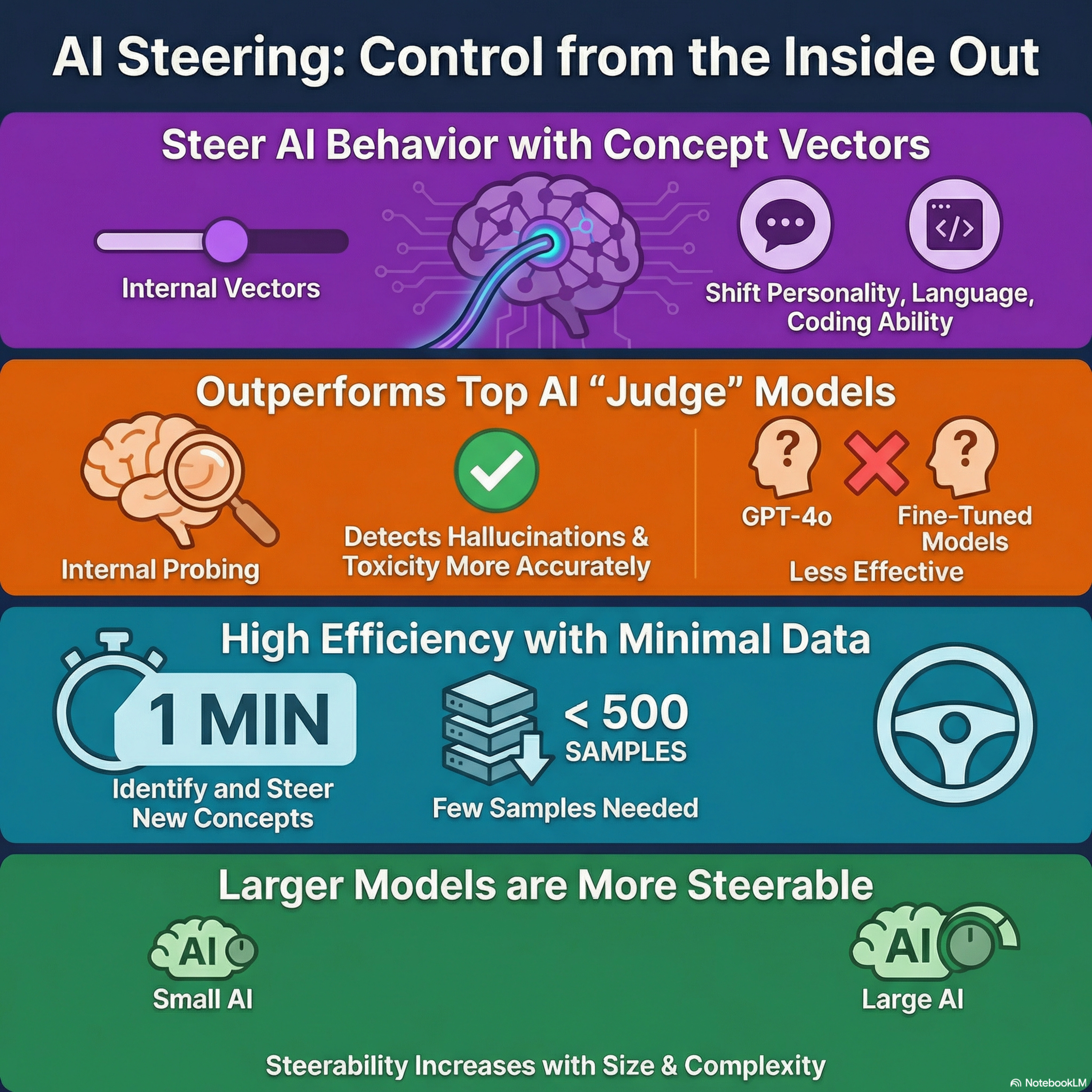
For years, interacting with large language models meant crafting better prompts — refining instructions and hoping the model would comply.But what if prompting is the wrong interface?A breakthrough paper in Science — “Toward universal steering and monitoring of AI models” (Science, 2026, Vol. 391, Issue 6787, pp. 787–792) — introduces a radical shift: instead of talking to AI, we can now steer it from within.Using Recursive Feature Machines (RFM) and Concept Vectors, researchers can:🧠 Monitor internal activations to detect hallucinations more reliably than self-evaluation🎯 Precisely steer model behavior by adding linear vectors in activation space⚡ Improve coding performance dramatically — without retraining🌍 Transfer semantic concepts across languages through simple vector addition🔬 Extract powerful steerable features with fewer than 500 samples in under a minuteThis episode explores the transition from prompt engineering to activation engineering — and what it reveals about the hidden geometry of knowledge inside neural networks.If meaning is just a direction in high-dimensional space… what does that say about human thought itself? 🤯#AI #LLM #MachineLearning #RecursiveFeatureMachine #ConceptVectors #Interpretability #AISafety #DeepLearning #NeuralNetworks #SciencePodcast #deepdivelab

For years, interacting with large language models meant crafting better prompts — refining instructions and hoping the model would comply.But what if prompting is the wrong interface?A breakthrough paper in Science — “Toward universal steering and monitoring of AI models” (Science, 2026, Vol. 391, Issue 6787, pp. 787–792) — introduces a radical shift: instead of talking to AI, we can now steer it from within.Using Recursive Feature Machines (RFM) and Concept Vectors, researchers can:🧠 Monitor internal activations to detect hallucinations more reliably than self-evaluation🎯 Precisely steer model behavior by adding linear vectors in activation space⚡ Improve coding performance dramatically — without retraining🌍 Transfer semantic concepts across languages through simple vector addition🔬 Extract powerful steerable features with fewer than 500 samples in under a minuteThis episode explores the transition from prompt engineering to activation engineering — and what it reveals about the hidden geometry of knowledge inside neural networks.If meaning is just a direction in high-dimensional space… what does that say about human thought itself? 🤯#AI #LLM #MachineLearning #RecursiveFeatureMachine #ConceptVectors #Interpretability #AISafety #DeepLearning #NeuralNetworks #SciencePodcast #deepdivelab

NOW PLAYING

From Prompts to Steering 🚀: Recursive Feature Machines & Concept Vectors in LLMs

0:00 18:00

No transcript for this episode yet

We transcribe on demand. Request one and we'll notify you when it's ready — usually under 10 minutes.

No similar episodes found.

No similar podcasts found.

Frequently Asked Questions

How long is this episode of The Deep Dive Lab: Unraveling Materials Science?

This episode is 18 minutes long.

When was this The Deep Dive Lab: Unraveling Materials Science episode published?

This episode was published on February 27, 2026.

What is this episode about?

For years, interacting with large language models meant crafting better prompts — refining instructions and hoping the model would comply.But what if prompting is the wrong interface?A breakthrough paper in Science — “Toward universal steering and...

Can I download this The Deep Dive Lab: Unraveling Materials Science episode?

Yes, you can download this episode by clicking the download button on the episode player, or subscribe to the podcast in your preferred podcast app for automatic downloads.
URL copied to clipboard!