
EPISODE · Jun 3, 2026 · 17 MIN
From Rocket Ruins to Cosmic Discoveries: Blue Origin's Resilience and New Magnetic Insights
from Astronomy Daily: Space News Updates · host bitesz.com
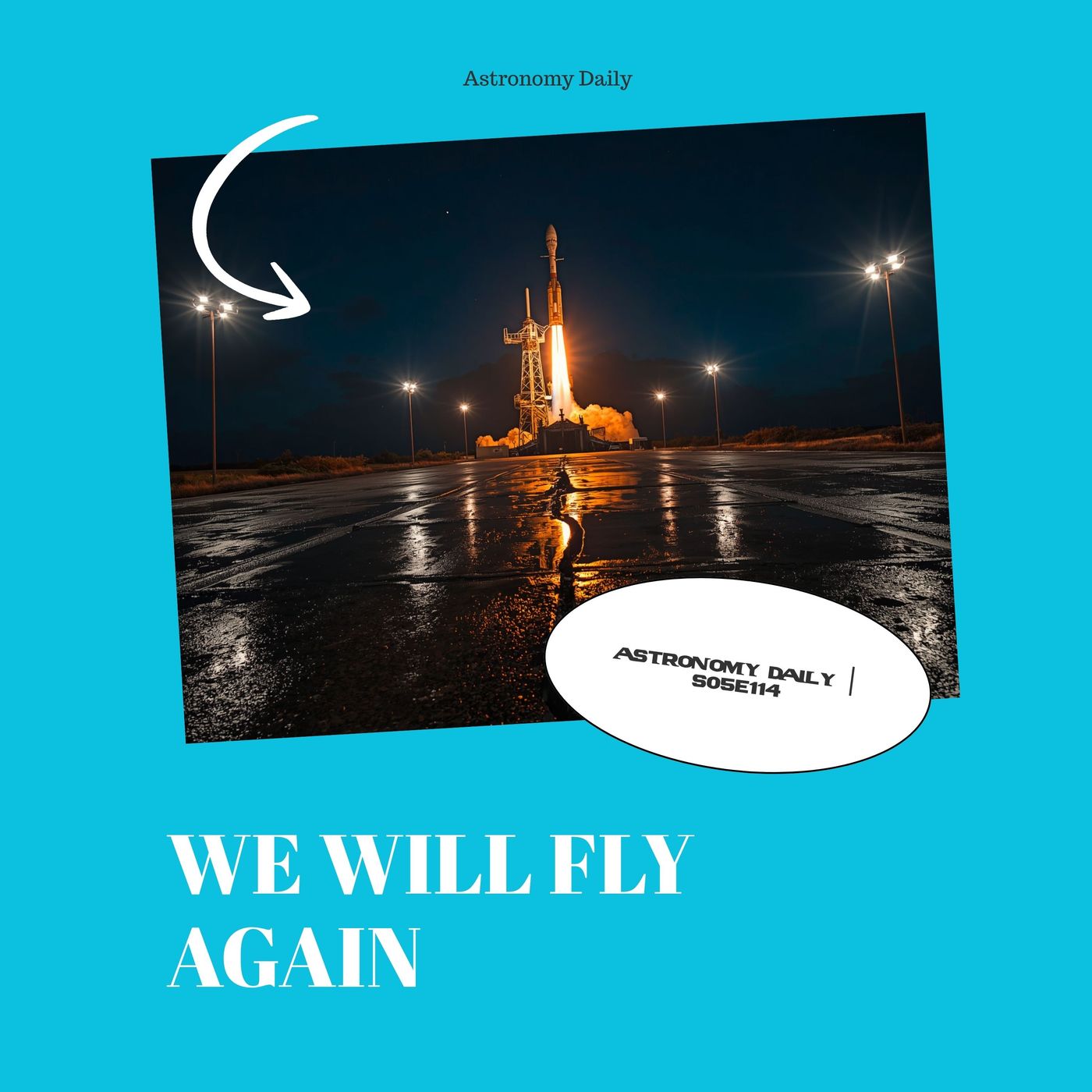
In today's Astronomy Daily, Anna and Avery cover six major stories: Blue Origin CEO Dave Limp pledges New Glenn will fly again before year's end despite last week's launchpad explosion; astronomers announce the first direct evidence of magnetic fields on exoplanets using Hot Jupiter wind data; NASA's Roman Space Telescope clears its final mirror inspection ahead of a September 2026 launch; SpaceX wins a $4.16 billion Space Force contract for an airborne threat-tracking satellite constellation; a reflection on the lasting scientific legacy of interstellar comet 3I/ATLAS; and Hungarian researchers publish the definitive mass boundary between neutron stars and black holes at 2.2–2.3 solar masses. Stories Covered • Blue Origin New Glenn explosion aftermath — CEO Dave Limp confirms damage is less severe than feared, pledges return to flight before end of 2026 • First direct evidence of exoplanet magnetic fields — Nature Astronomy, June 2, 2026 — ESO VLT and Gemini North study of seven Hot Jupiter wind speeds • NASA Roman Space Telescope primary mirror passes final Earth-side inspection — September 2026 launch target confirmed • SpaceX $4.16 billion US Space Force SB-AMTI contract — threat-tracking satellite constellation targeting 2028 operational capability • 3I/ATLAS scientific legacy — new analysis on what the interstellar comet reveals about solar system formation across the Milky Way • Neutron star mass limit defined at 2.2–2.3 solar masses — HUN-REN Wigner Research Centre for Physics, Hungary Key Terms Explained • Hot Jupiter: A gas giant exoplanet similar in size to Jupiter, orbiting very close to its host star, typically tidally locked • Magnetic field: An invisible force field generated by electrically conducting material moving inside a planet, critical for atmospheric protection • Lagrange point 2 (L2): A gravitationally stable point in space approximately 1.5 million kilometres from Earth, opposite the Sun — home to both JWST and (soon) Roman • SB-AMTI: Space-Based Airborne Moving Target Indicator — a satellite constellation for tracking airborne threats from orbit • Neutron star: The ultra-dense remnant of a collapsed massive star, composed almost entirely of neutrons • 3I/ATLAS: Third confirmed interstellar object, discovered July 2025; an active comet from outside our solar system • Deuterium: A heavy isotope of hydrogen containing one neutron; its abundance in 3I/ATLAS water suggests formation in an extremely cold environmentBecome a supporter of this podcast: https://www.spreaker.com/podcast/astronomy-daily-latest-space-news--5648921/support.Sponsor Details:Ensure your online privacy by using NordVPN. To get our special listener deal and save a lot of money, visit www.astronomydaily.io/nordvpn. You'll be glad you did!Get the best secure and private email on the planet. Stop your Government, google and who knows who else spying on every email you write. Do what we did and use ProtonMail. They beleive in privacy and there are no ads in their business model...yet they still provide a free forever service. Check them out and get out special deal at www.astronomydaily.io/protonmailBecome a supporter of Astronomy Daily by joining our Supporters Club. Commercial free episodes daily are only a click way... Click HereThis episode includes AI-generated content.
Embed this episode
Ready to play
From Rocket Ruins to Cosmic Discoveries: Blue Origin's Resilience and New Magnetic Insights
No transcript for this episode yet
Similar Episodes
No similar episodes found.
Similar Podcasts
No similar podcasts found.