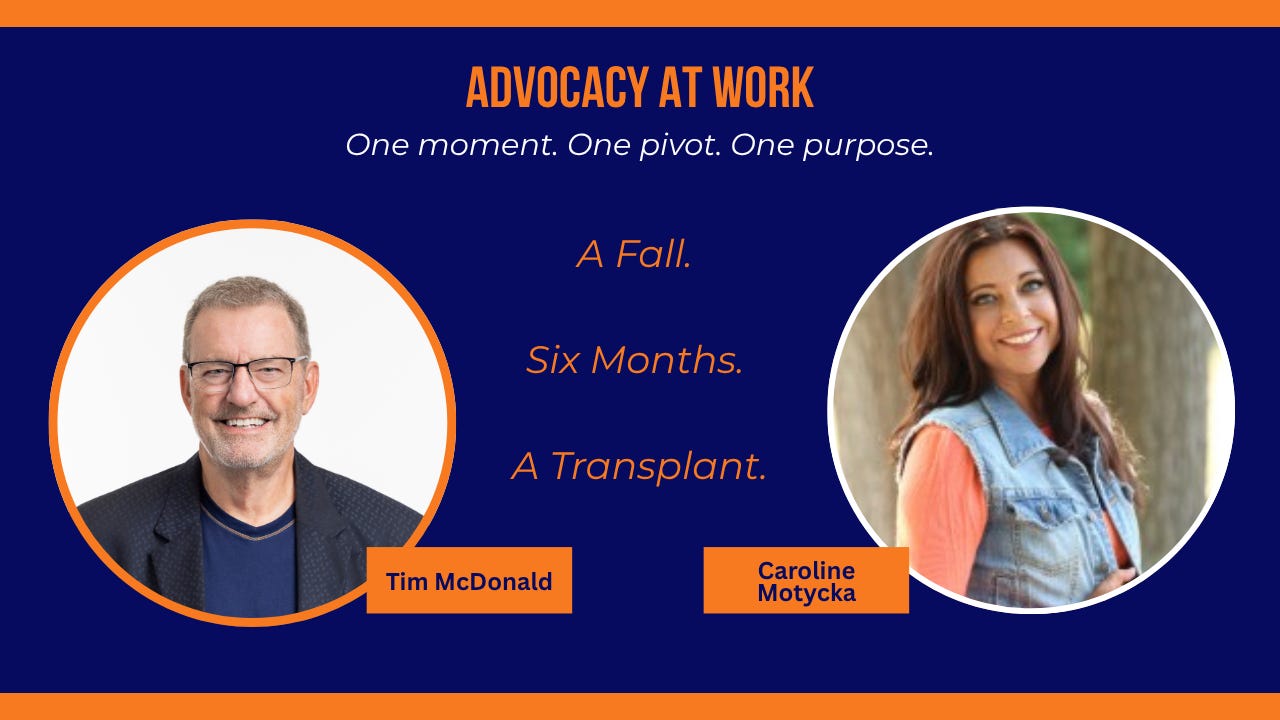
From Six Months to Ten Years
from Advocacy at Work Hosted by Tim McDonald
A suburban mom’s fall on a hiking trail led to a metastatic cancer diagnosis, and an unexpected path through clinical trials, liver transplant, and discovering that advocacy is just as healing as it is transformative Carole Motycka was living the dream. She was a suburban mom with four kids, watching them grow into cool, independent humans. She was transitioning from the exhausting role of hands-on parenting into what she calls the “sidecar”—letting them drive while she got to do more of her own things. She was an active runner in the best shape of her life. She and her family were hiking. Then she fell on a trail and thought she had a sore shoulder. She went to the emergency room. And from a simple diagnosis of shoulder pain came a cascade of medical terminology that would reshape her entire existence: metastatic colorectal cancer, stage 4, prognosis of six months to live. “My world that was seemingly normal gosh turned upside down in a hot second,” Caroline says. “And it really spiraled into honestly panic in some senses, grief, pain. There were so many sad things that I experienced right away.” But what hit her hardest wasn’t just the diagnosis. It was the realization that she didn’t speak the language of oncology. She didn’t understand the words doctors were using. She had no framework for what was happening. “I was crippled with how do I figure out what my steps are because I don’t know any of this,” she recalls. That helplessness—that moment of standing at the bottom of a mountain you didn’t know you had to climb—became the catalyst for everything that followed. The Language of Cancer: When Education Becomes Survival Carole’s early response to her diagnosis was methodical and deeply Type A: she decided to learn. She bought little pocket guides on how to advocate for herself. She googled obsessively. She did homework. She asked her oncologist endless questions. She tried to be 10 steps ahead of the disease, to control what was happening. “I’m a type A person, so I wanted to be 10 steps ahead. And I quickly realized that that wasn’t the case, that it was a day-by-day process,” she admits. But there was a problem with her solo approach: her brain was starving for something that facts and figures couldn’t provide. She needed to know that other people were surviving this. She needed to hear stories of hope. She needed witnesses to the possibility that life could continue after cancer. That’s when she found Colon Talks, a community space within the Colon Club. She dove into the chats. She read other people’s stories. She learned that what she was experiencing was real, shared, and survivable. “I learned so much from community,” she says. “And I think that really uplifted me and empowered me.” That education took years. It wasn’t a two-week process. It was slow, sustained engagement with people who understood at a cellular level what she was going through. “I needed both of those things,” she explains. “The medical side that I was digging into so much, trying to get myself so far ahead and have plans. And I really needed that balance of the community to help me understand that it could also pivot and things were okay.” The Six-Month Sentence and the Pivot Nobody Expected Twelve rounds of chemotherapy. A clinical trial with fifteen patients testing a new treatment called FUDR administered through a HAI pump inserted directly into her liver. And then: acute liver failure. The treatment that was supposed to save her life nearly killed her instead. She overdosed her liver. She developed an aneurysm in the Cleveland Clinic parking lot. There’s a gap in her memory from this period, she calls it “very gray”, because the trauma of it blurred the edges of what should have been distinct moments. But she remembers two specific things. The first is the image of her surgeon sitting on her hospital bed. He was a man who had always had “something in his back pocket” as an attempt to save her. A plan. A solution. A next step. “And he said, ‘I’m out of things in my pocket,’” Caroline recalls. “He said, ‘I can’t give you chemo for your liver. I can’t save you at this point.’” That admission, the moment when the thing supposed to save you admits defeat, would break most people. Caroline felt the weight of it. But her surgeon wasn’t finished. He had one more thing. One last card he hadn’t played yet. “He said, ‘I have an opportunity,’” Caroline remembers. He went through a process she didn’t understand. Translational research. Something from Norway. Details that meant nothing to her because she was drowning in the moment. But he said she had a chance at life. “I have four boys and I said immediately, I’m in,” she says. “It didn’t matter to me what it meant, what the details were. I knew that I wasn’t going to let my kids think I ever gave up on them.” That day on the hospital bed was the day everything changed. She had no idea what was going to happen. She was agreeing to something she didn’t understand, with outcomes she couldn’t predict. But she was all in. One of the First: Finding a Liver Through Faith and Congregation Carole was one of the first people in North America to receive a liver transplant after being diagnosed with metastatic colorectal cancer. There was no list to consult. There were no guidelines. There was essentially one option: find a donor yourself. “Here I am dying and now I have to find a liver too. I mean, this is a lot of work for me,” she says, with the dark humor of someone who’s survived the unsurvivable. But her Type A personality that had worked against her in the early days of trying to “out-research” cancer became an asset in a completely different way. She had to take action. She had to find someone willing to give her part of their liver. She worked at her church in Ohio as the youth director. She had raised her children there. She was part of that community’s fabric. Her pastor offered a radical solution: put a note in the church bulletin asking if anyone would donate a liver to Caroline. “I said to him, ‘I don’t think that’s the thing that you do with the bulletin,’” Caroline laughs. “And he said, ‘No, it’s fine.’” It was fine. It was more than fine. It worked. Her community rallied. The bulletin went out. And Caroline’s donor—Jason—saw the note and knew immediately that he was the person. He knew it the moment he read those words. The medical team evaluated him as one of fifty potential donors. He was the sixth person they looked at closely. He was frustrated by the process because he already knew. “He was right. He was the perfect match,” Caroline says. She found her liver through faith. Through a congregation that showed up. Through a stranger who became family through an act of unselfishness. Jason saved her life. The Hardest Part: Surrendering Control in the Process Being Type A through a liver transplant evaluation process is its own unique torture. You want to know things. You want to understand the details. You want to be in control of which donor gets selected, when the surgery happens, what the timeline is. But HIPAA restrictions mean you know almost nothing. Other people make the decisions. You have to trust their judgment. You have to surrender. “On top of all the trauma that my family were going through, we had to really just lean into trust and lean into hope and lean into just knowing that this was going to be okay no matter what happened,” Carole says. “And I say that without... I say that really, I guess sort of flippantly. I don’t want people to think that wasn’t a hard job because that is extremely hard work.” Especially when you’re someone who was trained to be 10 steps ahead. “I had to advocate for myself in that space and say, ‘Okay, Caroline can do this much. I can control these things and everything else I’m going to have to allow other people to trust and count on their knowledge,’” she explains. “And that’s extremely hard and it takes a lot of work.” After Transplant: The Unexpected Gift of Advocacy Carole spent a year in acute care after her transplant. When s… This is a public episode. If you would like to discuss this with other subscribers or get access to bonus episodes, visit www.advocacyatwork.com
Embed this episode
No transcript yet.