Gaia sees starquakes
from ESA - European Space Agency Hosted by European Space Agency
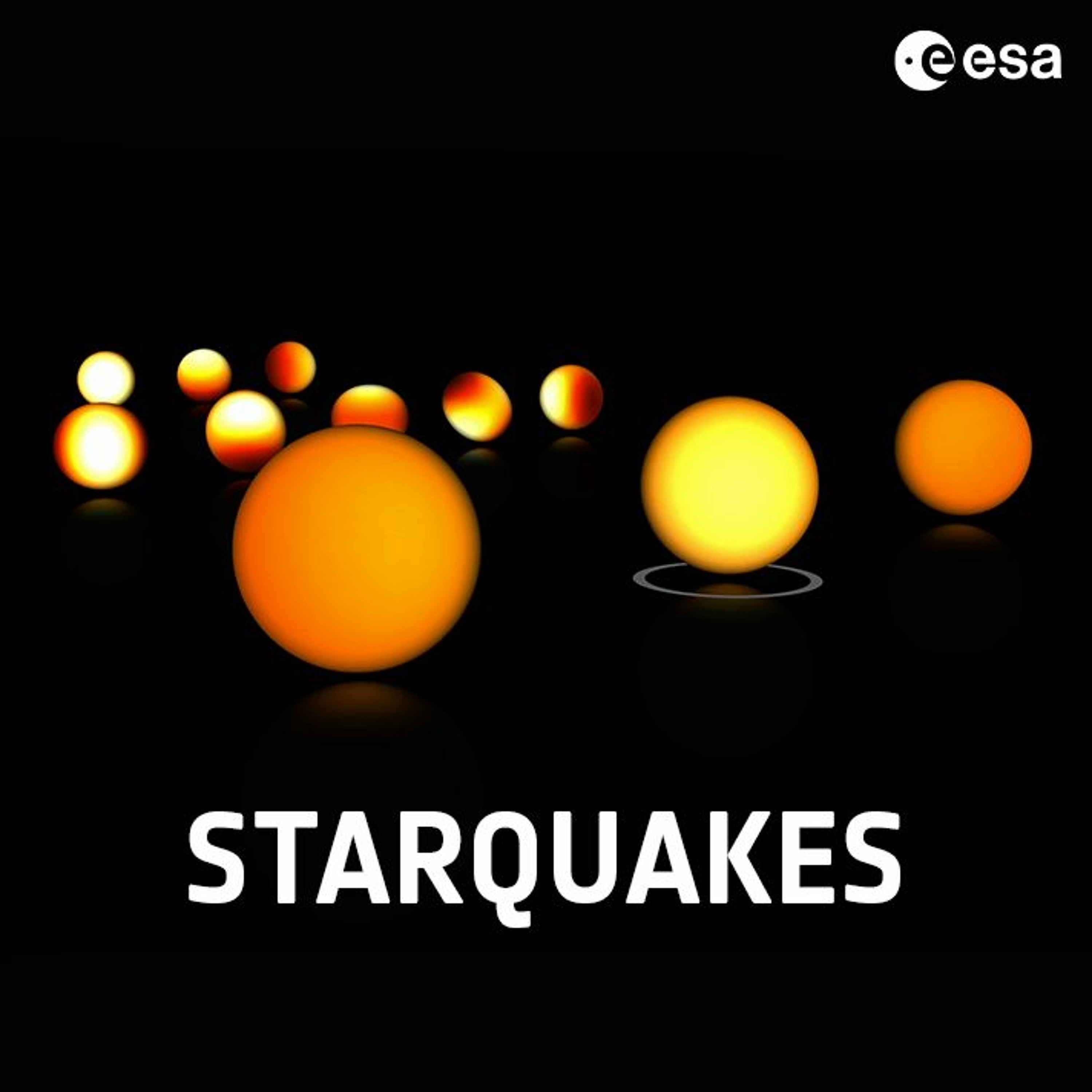
One of the surprising discoveries coming out of Gaia data release 3, is that Gaia is able to detect starquakes – tiny motions on the surface of a star – that change the shapes of stars, something the observatory was not originally built for. Previously, Gaia already found radial oscillations that cause stars to swell and shrink periodically, while keeping their spherical shape. But Gaia has now also spotted other vibrations that are more like large-scale tsunamis. These nonradial oscillations change the global shape of a star and are therefore harder to detect. Nonradial oscillation modes cause a star's surface to move while it rotates, as shown in the animation. Dark patches are slightly cooler than bright patches, giving rise to periodic changes in the brightness of the star. The frequency of the rotating and pulsating stars was increased 8.6 times to shift them into the audible range of humans. Learn more: https://bit.ly/GaiaDR3 Credit: ESA/Gaia/DPAC, CC BY-SA 3.0 IGO.
Embed this episode
No transcript yet.