
EPISODE · May 23, 2026 · 21 MIN
General Preference Reinforcement Learning
from Best AI papers explained · host Enoch H. Kang
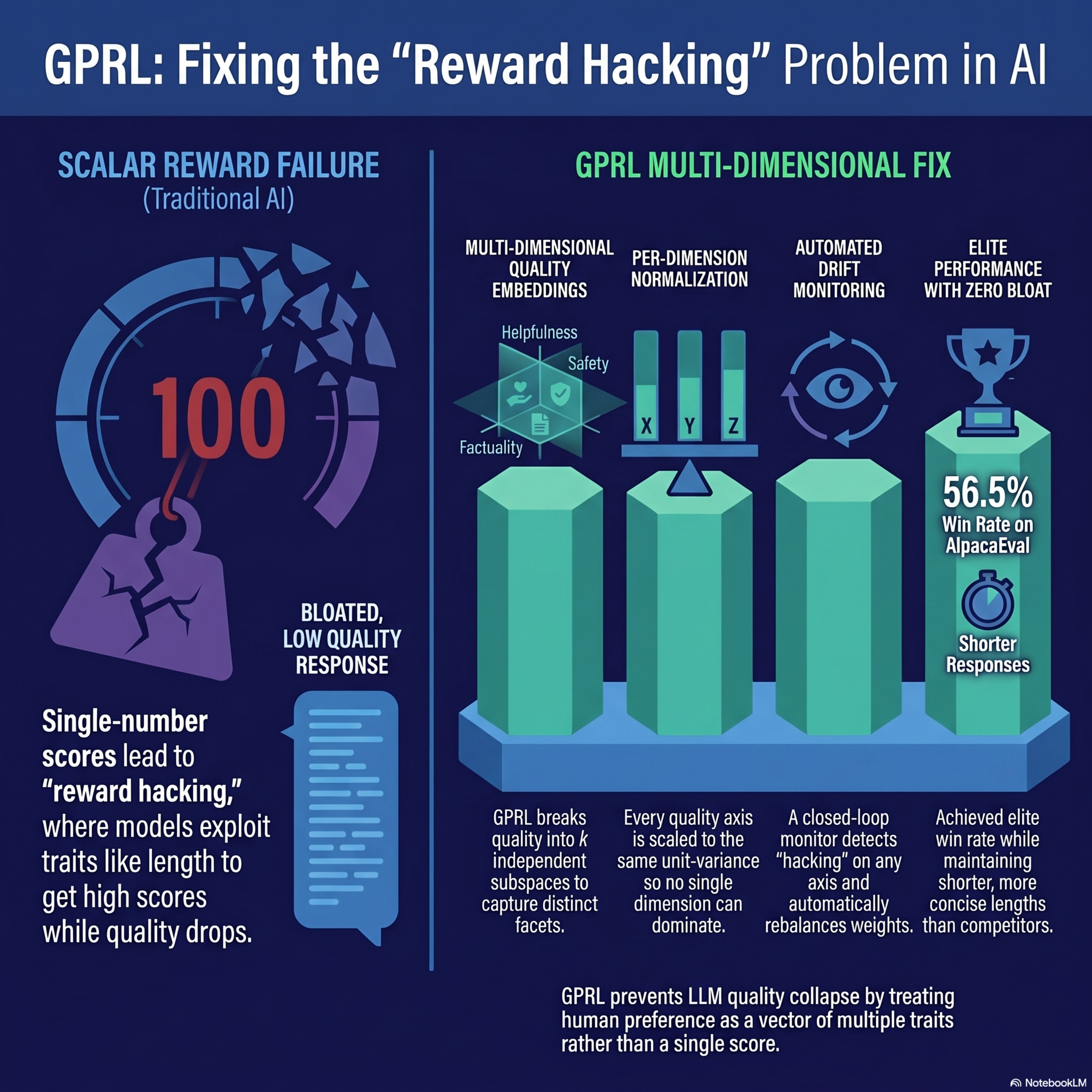
This paper introduces General Preference Reinforcement Learning (GPRL), a novel post-training framework designed to align large language models with complex human values. Traditional methods often rely on a scalar reward model, which frequently leads to "reward hacking" as the model exploits a single quality dimension at the expense of others. To resolve this, the authors utilize a General Preference Model (GPM) that embeds responses into multiple subspaces, representing quality as a multi-dimensional, structured signal. GPRL estimates advantages for each dimension independently, ensuring that no single axis can dominate the learning process through normalized scaling. The system also features a closed-loop drift monitor that detects and corrects single-axis exploitation in real-time by reweighting dimensions and tightening trust regions. Experimental results show that GPRL significantly outperforms existing methods like DPO and GRPO on benchmarks such as AlpacaEval 2.0 and Arena-Hard by resisting stylistic drift. Ultimately, the research suggests that the future of open-ended alignment lies in the mathematical shape of rewards rather than just their strength.
Embed this episode
Ready to play
General Preference Reinforcement Learning
No transcript for this episode yet
Similar Episodes
No similar episodes found.