
EPISODE · Apr 29, 2025 · 13 MIN
Genghis Khan Reforged: The Conqueror Navigates Modern Strategy, Politics, and Cyber Frontiers
from The Cogitating Ceviché Podcast · host Conrad T Hannon
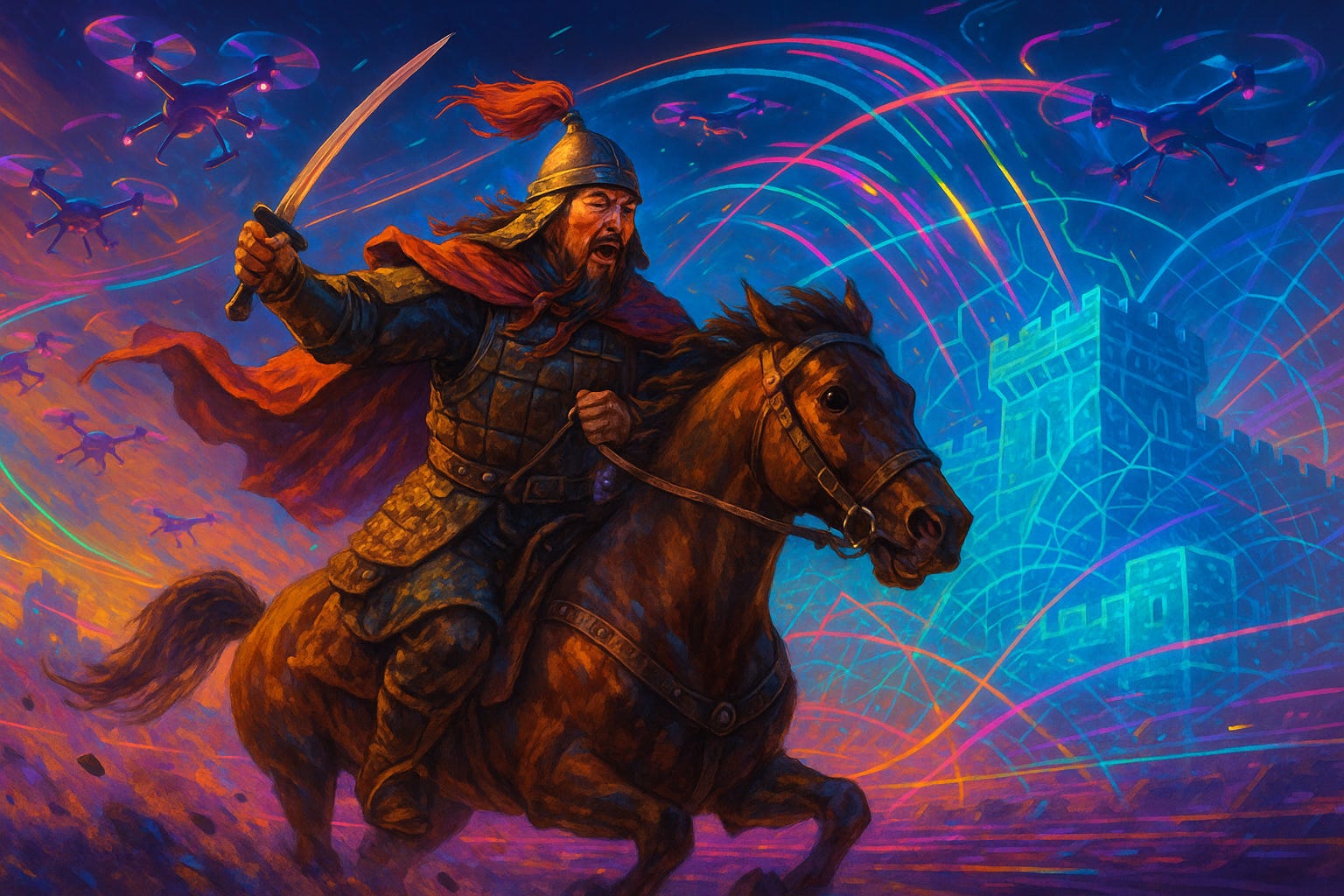
The Cogitating CevichePresentsGenghis Khan Reforged: The Conqueror Navigates Modern Strategy, Politics, and Cyber FrontiersEntry #58 – Past Forward: Historical Icons in the Digital FrontierBy Conrad HannonPrefaceGenghis Khan’s thirteenth-century campaigns reshaped Eurasia and rewrote the art of war. He fused lightning mobility with coordinated fire, built merit-based command chains, and weaponized intelligence long before the word “intelligence” meant code-breaking or satellite feeds. Eight hundred years later, fields of battle stretch from kinetic skirmishes on city streets to invisible duels in silicon. How would history’s most successful commander—who stitched half the known world together with horsehair bows—operate in an age of hypersonic missiles, drone swarms, and quantum-safe cryptography? Might he still out-maneuver rivals when battle rhythms are measured in microseconds and victory can hinge on a single breached login? This installment imagines Genghis Khan stepping into our tightly networked century to test—and transform—modern military doctrine, global politics, and cybersecurity.IntroductionHe appears in a dim situation room at U.S. Indo-Pacific Command, screens glowing with real-time tracks of carrier groups and satellites. The whir of HVAC reminds him of wind across the steppe; rows of operators become his new “tumen” of ten thousand, except their mounts are server racks and their arrows lines of code. Instinctively, he searches for the commander. Instead he finds a distributed operations desk where junior specialists can redirect a missile battery in seconds—decentralization that mirrors his own 13th-century practice of empowering sub-commanders. Yet he notices friction: staff follow preset escalation ladders; approvals slow when bandwidth is needed most. He senses an opening to apply his old principle—“speed is security”—to this modern battlespace.A briefing officer explains drone swarms over Eastern Europe. Thousands of quadcopters coordinate by algorithm, probing armor columns the way Mongol horse archers once probed a shield wall. Genghis leans closer. Target lists update in milliseconds; AI agents decide whether a loitering munition dives or circles back. The technology excites him, but he winces when told that human operators must still confirm each lethal strike. “A bow does not ask permission,” he mutters. The room falls silent. He is not dismissing ethics—he is identifying lag.Thus begins the conqueror’s survey of 21st-century power: from network-centric strike doctrine and expeditionary diplomacy to zero-trust cyber defense and quantum-safe keys. Each new concept is weighed against hard-won lessons from the steppe.Historical Context and Modern ConnectionMongol victory rested on three pillars: mobility, information dominance, and modular command. Cavalry could ride 100 miles a day, rotate mounts, and hit flanks hours before defenders expected contact. Spies mapped rivers, city gates, even the temper of local princes. Commanders wielded “decisions on the spot,” issuing smoke-flag signals that synchronized composite-bow volleys with heavy-cavalry charges. Historians credit this predisposition for agile convergence—fire and movement timed to fractions of an hour—as a medieval forerunner of AirLand Battle doctrine.Those patterns resemble today’s network-centric warfare (NCW), where dispersed units share sensor data and act faster than an opponent can react. Naval analysts cite NCW’s emphasis on decentralized strike packages and distributed lethality—combat power spread across many platforms rather than a few capital ships. Genghis instantly recognizes the concept: his tumens were autonomous nodes feeding into a shared operational picture carried by messengers instead of fiber links.What surprises him is the absence of a single commander-in-the-saddle. Modern staff expect unanimity, consensus, and strict legal review. He appreciates why: global scrutiny, instant media, and the Geneva Conventions. Still, he argues that tempo kills. He recommends red-team rehearsals in which brigade-level AI agents receive intent and improvise tactics, mirroring Mongol feigned retreats or envelopments, rather than waiting for headquarters to script each engagement.Exploring Modern InnovationsDrone Swarms and AI CommandAt a DARPA demonstration site, Genghis witnesses 250 autonomous drones coursing through mock urban canyons, each shifting roles from scout to bomber to jammer in seconds. He asks engineers whether the swarm could split into ten “wings,” regroup behind a ridge, then sweep in sequence to fracture air-defense radar. “We can write that behavior,” a coder replies. The conqueror smiles: the Mongol “tulughma”—a complex wheel maneuver—lives again in silicon.German start-up Stark reveals a fully autonomous strike drone rated for 100 km and able to pick its own targets if rules permit. Genghis presses for battlefield integration. He proposes allocating each ground battalion its own micro-swarm, equal in cost to a single infantry fighting vehicle, thereby restoring cavalry-level scouting reach. Planners balk at bandwidth needs; he counters with a concept of “local autonomy” where drones fall back on pre-loaded decision trees when jamming severs links—modern echoes of riders dispatched with sealed orders to be opened only at dawn.Cybersecurity and Zero-Trust FortificationsBack in Washington, the Department of Defense walks Khan through its Zero Trust architecture roadmap: micro-segmentation, least-privilege access, and continuous authentication, all targeted for milestone completion in 2027. To him, this feels like ring-fenced garrison towns—every courtyard inspected, every stranger challenged. He sees merit but warns against complacency: “Fortresses can blind a general who never rides beyond the wall.”He proposes adopting a “nomad enclave” model for classified networks. Critical data sets remain mobile—replicated, encrypted, and distributed across several theaters—so a single breach yields stale fodder. It mirrors how he dispersed royal family members and imperial treasuries, denying any besieged city fatal leverage. System architects note the strategy aligns with emerging quantum-safe key distribution programs at NATO, which pair out-of-band channels with quantum-random keys to blunt future quantum attacks.Diplomacy by LogisticsIn 1219, Genghis destroyed Khwarazm after the shah killed his envoys. In 2025, he finds assassination unnecessary when trade chokepoints can achieve the same effect. He studies semiconductor supply chains, satellite-launch dependencies, and rare-earth exports. He sketches a map showing how a cyber strike on a single Taiwanese lithography plant, coupled with a drone blockade of key shipping lanes, could coerce multiple capitals without firing a brigade-level shot. Policy advisers reel; he is merely transposing the old Silk Road playbook—control the caravan routes, shape the world.Ethical Reflections and Societal ImpactJournalists confront him about the 1220 sacking of Nishapur, where chroniclers claim 100,000 died. In modern terms, such acts constitute war crimes. Khan responds that his era punished resistance to deter future bloodshed and thus saved lives in aggregate—a moral calculus unacceptable today. International law codifies proportionality; victims are never a strategic message. He listens, arms folded. Then he asks whether drone operators ever strike “signature targets” based on patterns of behavior rather than confirmed identity. They admit it happens. He nods slowly: “We differ only in what your scribes write afterward.”The debate deepens around autonomous weapons. EU officials seek a preemptive ban, yet research races onward because rivals may ignore treaties. Khan sympathizes with commanders who crave faster loops but warns that machines without cultural or moral context could tip wars into endless cycles of reprisal. He urges embedding hard-coded “red rules” analogous to Mongol practices of sparing artisans and clergy: even the Golden Horde had controlled brutality. Engineers begin designing AI ethics layers with immutable constraints, a digital echo of Khan’s Yassa law code.Global politicians court the new celebrity strategist. He entertains invitations from Washington, Beijing, and Brussels, yet refuses to serve any single flag. Instead, he crafts a doctrine of conditional alignment: alliances last only as long as common objectives do; betrayal is expected, so plans account for it. Diplomats squirm, but cybersecurity professionals recognize the parallel in zero-trust: assume breach, verify continuously.Collaborative ContributionsJoint Force Agile Command ProjectPentagon officials pair Khan with a team from DARPA OFFSET and the Army Software Factory. Over three months, they build “TumenNet,” a battlefield operating system that breaks brigades into 1,000-node clusters, each cluster able to swap sensor feeds with any other in under 200 ms, even when satellite links drop. The routing logic borrows from Mongol courier relays: every node knows two neighbors forward and two back, guaranteeing alternate paths. Early war-game results show a 35 percent reduction in decision latency versus standard command-and-control pipelines.Nomad Shield Cyber ExerciseNATO’s Cyber Rapid Reaction Force invites Khan to design an exercise stress-testing quantum-safe protocols under hypersonic strike pressure. His scenario mimics a siege: hackers infiltrate a logistics cloud, corrupting drone spare-part inventories so that replacement rotors never arrive. Defenders must re-route supply caches across continents in real time—effectively a digital version of breaking a siege by opening new caravan routes. The drill forces logisticians to treat data as mobile caravans, not static stockpiles.Information Warfare SymposiumFinally, he joins social-media researchers exploring memetic warfare—how viral content shapes public opinion. He teaches them the Mongol method of exaggerated rumor, once carried by merchants: spread tales of unstoppable hordes so cities surrender without a fight. The team translates this into counter-disinformation playbooks, fortifying democratic discourse by preemptively “inoculating” audiences with truth packets. In a sense, Khan completes the circle: psychological dominance from horsemen to hashtags.Conclusion: Legacy and Modern InfluenceAfter months immersed in secure bunkers and cloud dashboards, Genghis Khan rides a Black Hawk over Washington’s Potomac River. The city grid below resembles the chessboard encampments of Karakorum. He reflects on what he has learned—and what he has taught.Modern forces excel at precision but stumble on decisive speed. Politicians prize alliances yet discount raw coercive leverage concealed in supply lines. Cyber defenders build strongholds while forgetting that nomads thrived by moving valuables, not locking them away. Everywhere he looks, echoes of the steppe linger—only the horses have changed.Khan leaves behind practical legacies: TumenNet will seed next-generation command software; Nomad Shield will harden NATO’s quantum-safe roll-out; drone-swarm doctrines now incorporate staged feints derived from tulughma. Yet his deepest impact may be philosophical: reminding strategists that agility, intelligence dominance, and psychological shock are timeless. Technology offers new tools, not new instincts.As his helicopter banks toward the horizon, he envisions future wars fought across orbital relays and quantum channels. The principles remain: move faster than fear can travel, see farther than doubt can reach, strike only where it counts. History’s great unifier closes his eyes, content that in any century, the general who masters tempo, knowledge, and adaptive command will rule the field—whether that field is a dusty plain or a global mesh of glass fibers and RF spectra.Thank you for your time today. Until next time, stay gruntled. This is a public episode. If you'd like to discuss this with other subscribers or get access to bonus episodes, visit thecogitatingceviche.substack.com/subscribe
Embed this episode
NOW PLAYING
Genghis Khan Reforged: The Conqueror Navigates Modern Strategy, Politics, and Cyber Frontiers
No transcript for this episode yet
Similar Episodes
No similar episodes found.
Similar Podcasts
No similar podcasts found.