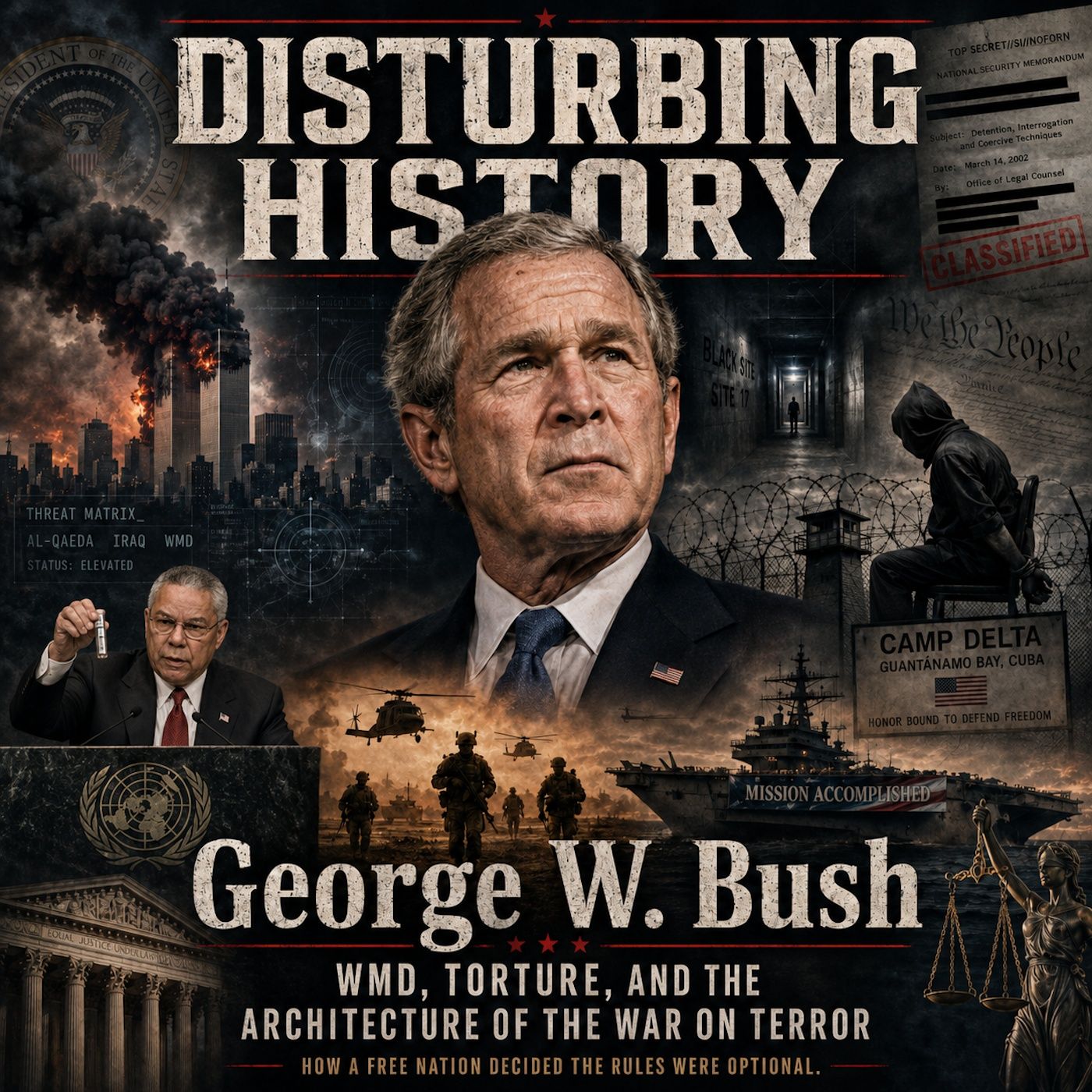
George W. Bush: The War On Terror episode artwork

EPISODE · Jun 5, 2026 · 1H 14M

George W. Bush: The War On Terror

from Disturbing History · host Disturbing History-True Stories

In this episode of the Disturbing History presidential series, we cross out of settled history and into living memory to examine the presidency of George W. Bush through the architecture of the War on Terror.Beginning with the attacks of September 11, 2001, and the fear that reshaped American government overnight, we trace how that fear was translated into law, policy, and ultimately a global apparatus of detention, interrogation, surveillance, and war.We walk through the legal scaffolding built inside the Justice Department's Office of Legal Counsel, where attorneys John Yoo and Jay Bybee drafted the August 1, 2002 "torture memos" that redefined torture so narrowly that only pain equivalent to organ failure or death would qualify, and that advanced the unitary executive theory placing the president's wartime authority beyond the reach of Congress and the courts.We examine the opening of the Guantánamo Bay detention camp on January 11, 2002, deliberately sited beyond the expected reach of American courts, and the roughly 780 men held there, the overwhelming majority eventually released without charge.We follow the CIA's enhanced interrogation program from its first subject, Abu Zubaydah, through the network of secret black sites in Thailand, Poland, Romania, Lithuania, and Afghanistan, including the death of Gul Rahman from hypothermia at the site known as COBALT or the Salt Pit in November 2002. We cover the extraordinary rendition of innocent men, among them Canadian engineer Maher Arar, German citizen Khaled el-Masri, and the Milan cleric Abu Omar, whose abduction led to the in-absentia conviction of more than twenty CIA operatives in Italian courts.The episode then turns to the case for the Iraq War: the aluminum tubes claim disputed by the Department of Energy and the State Department, the mobile biological weapons labs invented by the fabricator code-named Curveball (Rafid Ahmed Alwan al-Janabi), and the "sixteen words" about Niger uranium built on forged documents, along with the leak that exposed CIA officer Valerie Plame.We revisit Secretary of State Colin Powell's February 5, 2003 presentation to the United Nations, which he later called a "blot" on his record, and the invasion of March 19, 2003, followed by the "Mission Accomplished" banner of May 1, 2003.We document the conclusion of weapons inspectors David Kay and Charles Duelfer that no stockpiles ever existed.We confront the Abu Ghraib photographs that surfaced in April 2004, the death of detainee Manadel al-Jamadi, and the line connecting low-ranking soldiers to the policies authorized at the top. We cover the warrantless surveillance program Stellar Wind, the 2004 hospital-room confrontation over its reauthorization, and its eventual legalization. We trace the Supreme Court's slow pushback through Rasul v. Bush, Hamdi v. Rumsfeld, Hamdan v. Rumsfeld, and Boumediene v. Bush. And we close with the December 9, 2014 Senate Intelligence Committee report, its findings that the program was ineffective and far more brutal than disclosed, that at least 26 of 119 detainees were wrongfully held, and that no senior official was ever prosecuted.Throughout, we ask the question that outlives the administration: how a free nation decided the rules were optional, and why the machinery it built has never been turned off.This episode draws on the public record, including the Senate Select Committee on Intelligence report on the CIA's Detention and Interrogation Program, the Iraq Survey Group's Duelfer Report, the Senate's prewar intelligence assessment, declassified Office of Legal Counsel memoranda, and Supreme Court opinions. Where the historical record remains genuinely contested, such as the question of intent versus error in the WMD case and the British Butler Report's defense of the uranium claim, both sides are presented.  This episode discusses torture, death in custody, and wartime atrocity. Listener discretion is advised.Have a forgotten historical mystery, disturbing event, unsolved crime, or hidden conspiracy you think deserves investigation?Send your suggestions to [email protected] History is a dark history podcast exploring unsolved mysteries, secret societies, historical conspiracies, lost civilizations, and the shadowy stories buried beneath the surface of the past.Follow the show and enable automatic downloads so you never miss a deep dive into history’s most unsettling secrets.Because sometimes the truth is darker than fiction.

In this episode of the Disturbing History presidential series, we cross out of settled history and into living memory to examine the presidency of George W. Bush through the architecture of the War on Terror.Beginning with the attacks of September 11, 2001, and the fear that reshaped American government overnight, we trace how that fear was translated into law, policy, and ultimately a global apparatus of detention, interrogation, surveillance, and war.We walk through the legal scaffolding built inside the Justice Department's Office of Legal Counsel, where attorneys John Yoo and Jay Bybee drafted the August 1, 2002 "torture memos" that redefined torture so narrowly that only pain equivalent to organ failure or death would qualify, and that advanced the unitary executive theory placing the president's wartime authority beyond the reach of Congress and the courts.We examine the opening of the Guantánamo Bay detention camp on January 11, 2002, deliberately sited beyond the expected reach of American courts, and the roughly 780 men held there, the overwhelming majority eventually released without charge.We follow the CIA's enhanced interrogation program from its first subject, Abu Zubaydah, through the network of secret black sites in Thailand, Poland, Romania, Lithuania, and Afghanistan, including the death of Gul Rahman from hypothermia at the site known as COBALT or the Salt Pit in November 2002. We cover the extraordinary rendition of innocent men, among them Canadian engineer Maher Arar, German citizen Khaled el-Masri, and the Milan cleric Abu Omar, whose abduction led to the in-absentia conviction of more than twenty CIA operatives in Italian courts.The episode then turns to the case for the Iraq War: the aluminum tubes claim disputed by the Department of Energy and the State Department, the mobile biological weapons labs invented by the fabricator code-named Curveball (Rafid Ahmed Alwan al-Janabi), and the "sixteen words" about Niger uranium built on forged documents, along with the leak that exposed CIA officer Valerie Plame.We revisit Secretary of State Colin Powell's February 5, 2003 presentation to the United Nations, which he later called a "blot" on his record, and the invasion of March 19, 2003, followed by the "Mission Accomplished" banner of May 1, 2003.We document the conclusion of weapons inspectors David Kay and Charles Duelfer that no stockpiles ever existed.We confront the Abu Ghraib photographs that surfaced in April 2004, the death of detainee Manadel al-Jamadi, and the line connecting low-ranking soldiers to the policies authorized at the top. We cover the warrantless surveillance program Stellar Wind, the 2004 hospital-room confrontation over its reauthorization, and its eventual legalization. We trace the Supreme Court's slow pushback through Rasul v. Bush, Hamdi v. Rumsfeld, Hamdan v. Rumsfeld, and Boumediene v. Bush. And we close with the December 9, 2014 Senate Intelligence Committee report, its findings that the program was ineffective and far more brutal than disclosed, that at least 26 of 119 detainees were wrongfully held, and that no senior official was ever prosecuted.Throughout, we ask the question that outlives the administration: how a free nation decided the rules were optional, and why the machinery it built has never been turned off.This episode draws on the public record, including the Senate Select Committee on Intelligence report on the CIA's Detention and Interrogation Program, the Iraq Survey Group's Duelfer Report, the Senate's prewar intelligence assessment, declassified Office of Legal Counsel memoranda, and Supreme Court opinions. Where the historical record remains genuinely contested, such as the question of intent versus error in the WMD case and the British Butler Report's defense of the uranium claim, both sides are presented.  This episode...

NOW PLAYING

George W. Bush: The War On Terror

0:00 1:14:36

No transcript for this episode yet

We transcribe on demand. Request one and we'll notify you when it's ready — usually under 10 minutes.

Bitcoin Gateway Lea meakin Welcome to Bitcoin Gateway, the podcast where we dive deep into the world of Bitcoin, hosted by Lea Meakin. This show is for anyone who’s ever felt overwhelmed by the complex world of cryptocurrencies and wants a simple, straightforward explanation. Each episode, we’ll break down the basics of Bitcoin, explore its history, and discuss its potential impact on the future of finance. Whether you’re a complete beginner or just looking to expand your knowledge, Bitcoin Gateway is here to help you understand Bitcoin, one episode at a time. Explicit WTF Conspiracy ? Operation: Disclosure Jolly West Welcome to Conspiracy Theory Or Not?, your deep dive into the world of secrets, shadows, and speculation. This podcast is dedicated to unraveling history's most controversial and mind-bending conspiracy theories, asking tough questions and exploring hidden truths. Whether you're a skeptic or a believer, we take you on a journey through some of the most mysterious events and covert operations ever revealed.In this episode, we explore the dark and mysterious world of MK-Ultra—a top-secret CIA program that ran from the 1950s to the early 1970s. The program's purpose? To develop mind control techniques for use in espionage. But as we will uncover, the methods employed often crossed ethical boundaries, involving everything from drugs to hypnosis and, in many cases, torturous experimentation.We’ll investigate the history and controversial practices behind MK-Ultra, shining a light on its disturbing experiments, key figures, and pivotal events. Drawing from two essential books, "The Sea Explicit Vampires of White Chapel Transmissions From Atlantis Entertainment Vampires of White Chapel follows the story of FBI Agent Arianna Grayson as she hunts the serial killer, Allister the Annihilator but gets more than she bargains for. She discovers he’s a vampire, sired by the notorious murderer Jack The Ripper. Grayson is pulled into the world of the vampires and the show follows her story as an unwilling fledgling, Allister’s fall to monstrosity and the real history of Jack and his vampire origins. (Fiction Podcast/Horror) Explicit The Midnight Cinema Screening Unkn  Welcome to The Midnight Cinema Screening.This is basically the place where we hang out after midnight and talk about movies and TV shows that stuck with us… the good, the bad, the weird, and the ones that probably shouldn’t exist but somehow do. I also talk about true crime. If you love horror, cult classics, creepy shows, and the occasional random deep dive into something strange, you’re in the right place. Nothing here is super scripted or overly serious. It’s more like sitting around with friends after a late-night movie, breaking down what worked, what didn’t, and the moments that made you pause the screen and go, “Wait… what just happened?”Some episodes we’ll be reviewing movies.Some we’ll be talking about TV episodes.And sometimes we’ll just go down a rabbit hole about the weird history behind something we watched.So if you like late-night movie talk, dark stories, and conversations that feel a little unfiltered Explicit

Frequently Asked Questions

How long is this episode of Disturbing History?

This episode is 1 hour and 14 minutes long.

When was this Disturbing History episode published?

This episode was published on June 5, 2026.

What is this episode about?

In this episode of the Disturbing History presidential series, we cross out of settled history and into living memory to examine the presidency of George W. Bush through the architecture of the War on Terror.Beginning with the attacks of September...

Can I download this Disturbing History episode?

Yes, you can download this episode by clicking the download button on the episode player, or subscribe to the podcast in your preferred podcast app for automatic downloads.
URL copied to clipboard!