Your organization has a story to tell. KPBS Corporate Underwriting provides an opportunity to introduce your business to an audience that turns to public media for news, information, and entertainment. Explore how underwriting can support your organization's communications goals while helping sustain quality public media. Email corporatesupport at kpbs.org. Kevin Grievous has a voice that's unforgettable. Ah, nothing like a warm plasma bath to calm the nerves. It purrs with a bassy rumble that could register on the Richter scale. Funny, I was about to say the same thing. Welcome back to listener-supported KPBS Cinema Junkie. I'm Beth Accomando.
Kevin Grievous has a voice perfectly tuned to villainy, or anything that requires a sense of gravitas. But vocal villainy is not his main gig. He's a multi-hyphenated talent, with credits as an actor, screenwriter, director, publisher, and comic book writer. For the final episode of Cinema Junkie's three-part series, focus on the talented trio of Black Comics Day's Get Shooked, new Masters of Horror panel. I speak with Grievous about his latest projects, owning your own IPs, and monsters.
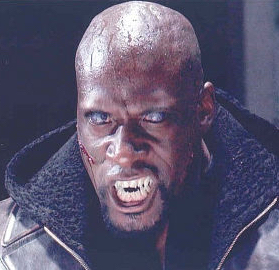
Kevin Grievous not only played a badass Lycan in the Underworld film series, but he co-created the franchise with Len Wiseman. Grievous has an impressive and imposing physical presence on screen, and a voice that seems to pull octaves from a depth that mere mortals can never reach. He fell in love with horror at a young age and immediately developed an empathy for the monsters. For the Black Comics Day panel, he'll be focusing on his work in the upcoming crowdfunded project, Shook, a black horror anthology. He'll be contributing a pair of stories, including one called Ezra the Hunter. We'll discuss the story, as well as the allure of horror, and why he likes to write comic books. I need to take one quick break, so just sit back, relax, and get ready to enjoy my conversation with Kevin Grievous. Listen! You're totally outnumbered! Open those doors now, and we'll go easy on you! You will go easy on me.
Midlife brings a lot of changes. Your Turn with Alison Aubrey is a new podcast to help you navigate the twists and turns. From health and relationships to creativity and purpose, we can help steer your next chapter with Your Turn with Alison Aubrey. Find it on the NPR app or wherever you get your podcasts. Welcome back to Cinema Junkie. As with Rodney Barnes and John Jennings, my previous guests from the Black Comics Day panel, Grievous is a multi-hyphenate creator. All three will be appearing on a panel called Get Shooked, New Masters of Horror, and all three will have stories in the anthology. I asked him about how he got involved with the project, which represents a collaboration between Bradley Golden and Marcus H. Roberts of Second Sight Publishing and Professor John Jennings of John Jennings Studio. Oh, yes, I met Bradley and Marcus at a convention about a year or two ago, and they broached me with the subject. And, you know, I thought it was a good idea.
And so I decided to donate a story or two. That's how we began. And so what were the stories that you decided to write? One is called Ezra the Hunter. And another one is going to be Bass Reeves Monster Hunter. And so I kind of reimagined the character of Bass Reeves as a monster hunter of the supernatural in the Old West. I thought that was a good idea. And what was the appeal to you of participating in this? I've always loved horror. Ever since I was like six years old, it's always been another fascination for me. And so...
And what do you think it is about horror that attracts you? Maybe it's the design level of some of the creatures. You know, that might be it. There's nothing as substantial about it. You know, they're fun. I mean, I think my first introduction to horror was probably, well, I should say my first introduction to monsters were probably dinosaurs, you know, because they were real monsters. And that always held some fascination for me.
And then you start to look at, you know, some of the cartoons that existed at the time I was a kid, like Scooby-Doo. Things like that. And then, you know, one of those individuals who's old enough to remember Dark Shadows came on television. My name is Victoria Winters. My journey is beginning. A journey that I hope will open the doors of life to me and link my past with my future. A journey that will bring me to a strange and dark place. To the edge of the sea, high atop Widow's Hill. A house called Collinwood.
A world I've never known, with people I've never met. People who tonight are still only shadows in my mind, but who will soon fill the days and nights of my tomorrows. And so I was, you know, as avid a watcher of that as I could be at a young age. But that was cool, too. So and then the monsters. Well, it's nice to know as we go through life, we can bring a little happiness to others. And you've worked in film and in multiple mediums. So what is it in particular about comics that appeals to you in terms of either the kinds of stories you can tell or the way that you can tell them? I think comics represent the ultimate form of storytelling because they're both visual and, you know, they're prose oriented as well. You know, kind of mixture of, you know, writing and visuals.
And I think that, you know, since your budget isn't as high, you know, as if, you know, as in televisions or movies, you can really tell any story without, with an unlimited budget. And I think that at least in the beginning, comic book writers were given a lot of latitude creatively. And so the sky was the limit in terms of creativity. And that's what I liked about it. And Shook is kind of riffing off of or inspired by the old EC comics. And was that something that you were reading at some point and inspired you in any way? My interest in the comic books wasn't all through my childhood. I think like most boys back then, by the time I was 10, I had some comics. You know what I'm saying? You know, maybe I could think of 10 stories, you know, that I had or 10 books or something like that. But I really didn't get into comic books until I was.
12. And a buddy of mine, and we're still friends to this day, when we first moved into the neighborhood as a gesture of friendship, he lent me an old EC reprint, you know. And so when Bradley and Marcus started promoting Shook, I saw the trade dress and I said, okay, well, that's kind of an homage to UC Comics, which is pretty cool. And you have also started your own imprints, Astounding Studios and Dark Storm. Yes. What prompted you to do that and why do you feel that's important? Nowadays, it's all about creating IPs and owning IPs and creating them under your own creative umbrella.
And so after my experiences with Underworld, my thing was, you know, you need to have some ownership of these IPs so you can do different things or various things with them. When I did my next film, I Frankenstein. I was given life 200 years ago. I am like none other. You have strength and speed and stamina. You could use those gifts.
My thing was to base it off of a comic book that I did. And that way you maintain more ownership, the monies are better. You know, I wrongly thought you would have more creative control, and that's not necessarily the case, but it did afford me that much more respect and establish myself as that much more of a creator in a different medium. And, you know, it just allows you to expand the breadth of your creativity, your creative palette, you know, your creative influence and footprint in the industry. Since then, it's like...
Film, television, comic books, animation, video games. You know, I've kind of done it all. And that's the key. I think this is, you know, success. So definitely creating your own IP. Our own IPs is a step towards that kind of, you know, freedom and gratitude. Well, you brought up Underworld, which seems to tap into exactly what you were talking about as a kid with this fascination with monsters. You got vampires and werewolves. So tell me a little bit about kind of what led you to that. You know, one of my philosophies when it comes to creating is, you know, what hasn't been done before?
and or what hasn't been done well. And there had never been really a vampire versus werewolf movie. Who are your people? You're in the middle of a war that's been raging for the better part of a thousand years. A blood feud between vampires and lichens. Werewolves. My biggest influence was, most likely, the House of Frankenstein and the House of Dracula. And Frankenstein meets the Wolfman when all the monsters were fighting. Universal monsters. So my thing was, well, how can I translate that to a cool film? Basically use it as a metaphor for race relations, interracial dating, things like that. You know, so that's how that came about. You know, it worked out well. Well, and you even got a little Shakespeare in there too, right?
Yes. And you've also worked with Marvel. And what is that experience like in terms of, you know, you have your own imprint and you've worked with comics there, but working with a massive comic books publisher like Marvel, what was that experience like? I mean, it is what it is. You know, I think everyone gets there 15 minutes with Marvel and you, you know, you go there, you try to put your best foot forward within the parameters that they set before you. And it was fun. You know, it was a bucket list item, you know, that was able to cross off, which was good. But now it's time to move on to Wiener Pastures.
And although I haven't heard it yet, I understand you voiced The Vault Keeper for an audiobook. You seem especially well-suited to that. Yeah, that's what they tell me. Yeah, that was Vault of Horror. I did that probably, what, two or three years, you know, pre-pandemic.
And that was very fun, you know. Were they able to come up with a voice that they liked? Were they able to do that? Yeah. And, you know, it seemed to have gotten a lot of decent responses. You know, I like that. And is voice work something that you enjoy doing? Oh, yes, most definitely. You know, it's not as easy to get as people think. You know, they think because you have a unique voice or what have you that works just going to be thrown at you. But that's not necessarily the case. You know, like a lot of these creative industries or mediums, they're very incestuous. Very incestuous.
So it can be difficult to get jobs even if you have the tools. And you're going to be at Black Comics Day. What is the importance to you about having a convention that focuses on black comics? You know, I think it's important to show the wide range of talents that we as a people have. You know, it's not relegated to just sports or music. You know, there are also other things as well.
in which we have made great strides, I think this show highlights that, you know, which is always important. And your panel is, in addition to be specifically on Shook, it really is looking to horror. And I'm just wondering, do you feel there's something about horror that lends itself especially to dealing with maybe some of the real world issues that... Well, I think that, you know, good horror, like good science fiction, can always be used as a metaphor for something else, something larger. I think, as you know, Godzilla, for instance.
It's a metaphor for the horrors that the Japanese had to deal with when it came to the dropping of the atomic bombs. So horror can be that as well, but it does not always have to be that way. You know what I'm saying? You know, sometimes you want to look at it as just an escape, a fun escape from reality. You know, it doesn't have to delve into the English people feel on a macrocosmic level or whatever. You know, sometimes it's just hate.
It's just fun, you know, and that's what I like about it. To be honest, you know, when I was a kid, I always wanted the monster to live at the end. I would get upset when, you know, he was killed. You know, why can't he live, you know, live some more? Why can't he survive? You know, get rid of all these humans or whatever. You know, I always thought that was fun. But yeah, you know, as you grow old, you understand how people relate to horror. It's just that I wanted to use horror characters like in Underworld and I Frankenstein as the hero, you know, and kind of shift from what they had traditionally been to something new and different, you know.
Yeah, I always cried when the monsters died. Not when humans did. Well, and also I think the appeal about horror, even if it's not something that has an overt social message, is, you know, horror, at least for me when I was growing up, you know, always seemed to be something that was a little transgressive and a little forbidden. And in terms of being rebellious and stuff, I mean, it seemed like it was always something that was special to escape to. Yeah, that's true. Very true. And do you have any other upcoming projects that you wanted to talk about?
You know, I have a lot of things, most of which I can't talk about. One of the things that has been announced, you know, I directed my first film this past year. Well, last year. It's about to be released sometime in the spring. We are, in addition, we're also doing a TV show based on the property. So that would be another fun thing. And, you know, I sold the screenplay to 50 Cent's company. And so me and my partner, Dallas Jackson, are in the middle of writing that. And we will probably shoot that sometime.
later this year or early next year. So there are a lot of cool things on the horizon. When you write a comic, what is the process of you working with whoever illustrates it? You know, it's pretty straightforward. I'll ask for specific character designs of the characters, getting my little notes or whatever, and I write full scripts. You know, I've learned over the years to, you know, you're hiring artists into specific things. So you let them do what they do. You know, so after I hand them the script and give them all of my concomitant notes, I essentially let them go. And unless something is glaring, I live with what I get.
And what I get is usually pretty good and not excellent. I try to make it as painless as possible. All right. Well, I want to thank you very much for talking about your work. Oh, thank you. Thank you for having me. That was Kevin Grievous. His stories in Shook, a black horror anthology, will be out later this year.
Also coming later this year, Grievous will make his feature film directing debut with King of Killers. He will appear at Black Comics Day Sunday, February 12th for Get Shooked, New Masters of Horror. If you have not listened to the previous episodes with Grievous' co-panelists, I urge you to do so, because Rodney Barnes and John Jennings are brilliant Black creators as well. That wraps up another edition of KPBS listener-supported Cinema Junkie. Remember to check out Cinema Junkie's archives, including a collection of podcasts highlighting Black films and filmmakers over the past century. You can find videos and more podcasts at kpbs.org slash cinema junkie.
If you enjoy the podcast, then please share it with a friend, because your recommendation is the best way to build an addicted audience. You can also help by leaving a review. Till our next Film Fix, I'm Beth Accomando, your resident cinema junkie. The KPBS Investigations team digs deep into the issues affecting our region, and tips from the public can help point the way. If you have information to share, email investigations at kpbs.org or contact us on Signal at 619-594-8177.