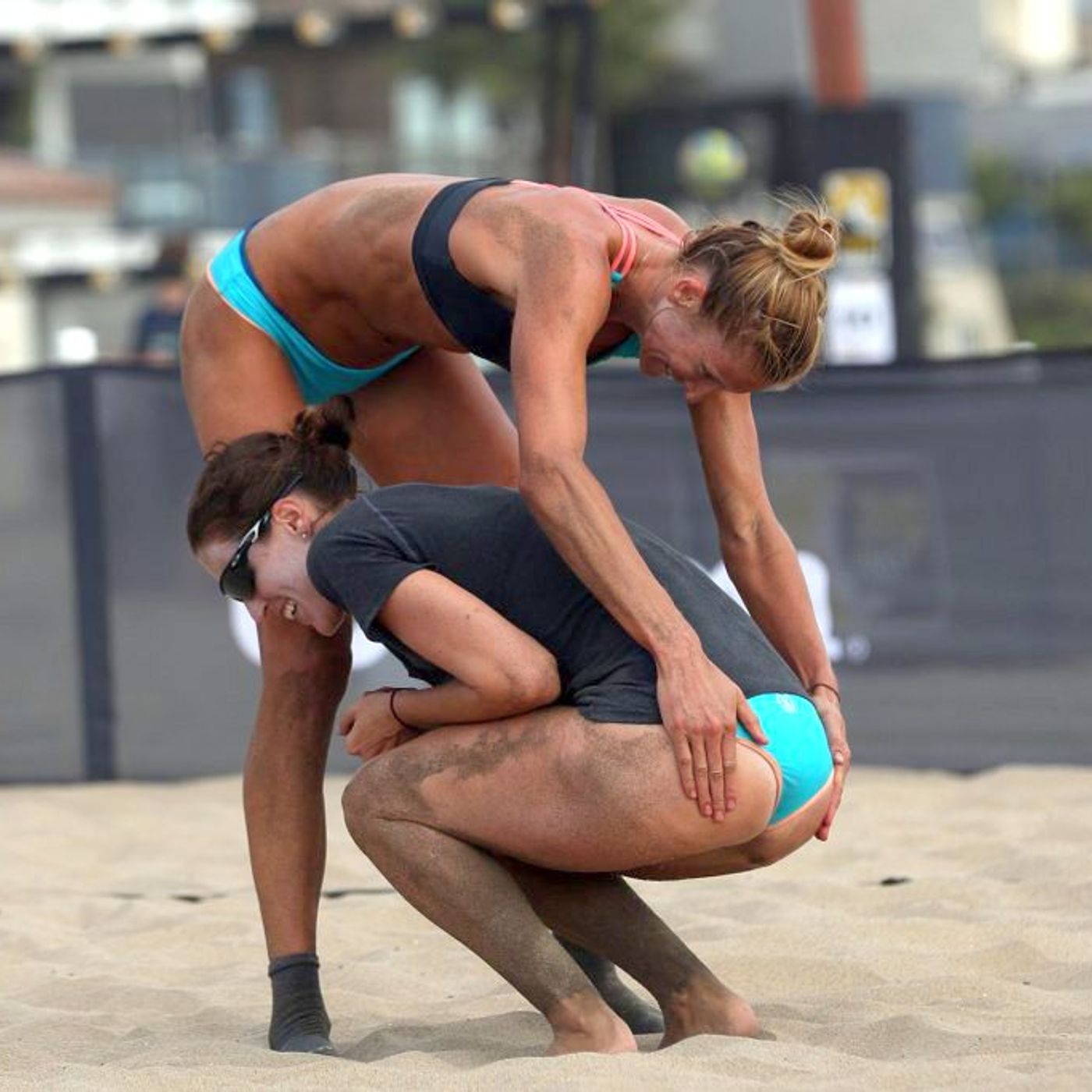
Getting two points better, with Kim Hildreth and Sarah Schermerhorn episode artwork

EPISODE · Mar 4, 2020 · 51 MIN

Getting two points better, with Kim Hildreth and Sarah Schermerhorn

from SANDCAST: Beach Volleyball with Tri Bourne and Travis Mewhirter · host Travis Mewhirter

Kim Hildreth and Sarah Schermerhorn have been to California. They’ve seen the dozens of AVP main draw-level teams practicing up and down the Hermosa Beach strand. They are not unaware of the talent level in Hermosa Beach, in Huntington Beach, in Manhattan Beach. Which makes them quite familiar with the question they, and other top-level players living out of state, get year after year: When are you moving to California? “Well,” Hildreth said on SANDCAST: Beach volleyball with Tri Bourne and Travis Mewhirter, “we just bought a house, so…” So they’re not coming. They’re happy in Florida. More than happy. They’re thriving in St. Petersburg. “I’d say we’re ok out here,” said Schermerhorn, who won the AVP Rookie of the Year in 2019. In saying that, they are flipping every piece of conventional beach volleyball wisdom on its head. It is almost unanimously viewed as a requirement to live in Southern California to excel on the AVP Tour. If you’re to take this sport seriously, you have to pack your bags, stuff them in your Corolla or Camry or Civic or RV or plane, train, or automobile, and make the trek. Doesn’t matter if the inflated cost of living makes you broke, and you have to work three jobs, skip sleep, and live off of canned tuna and pasta. It’s a rite of passage. Hildreth looks at all of that and wonders the exact opposite of what people often wonder of her. She is often asked how she makes it as a professional beach volleyball player in Florida. She’s curious how in the world people do it in California.   “I wouldn’t call it a disadvantage,” she said of living on the opposite side of the country from the beach volleyball capital of the country. “Seeing how the training and stuff here goes, I feel like unless you’re at where [Tri] is at, where you get to pick whoever you want to train with and you’ve got you’re full-time coach, but the girls where we’re at -- we’re main draw, qualifier range -- they’re maybe getting coached twice a week. I don’t know how you’re able to afford it with the cost of living out here. In Florida, we have a full-time coach, five days a week. It’s consistent. It’s five days a week. We know who’s going to show up to practice. It’s progressive.” Hildreth goes as far as to call it an advantage to live in Florida, and it’s fair to wonder: Is she wrong? In the AVP’s halcyon days, Clearwater was every bit as popular of a stop as any Southern California tournament not named the Manhattan Beach Open. Fort Lauderdale was the site of one of the world’s best tournament as the opening event of the Major Series. Its beaches are lined with beach volleyball courts, and there is a rich culture in every corner of the state, be it Orlando, where Phil Dalhausser and Nick Lucena train, or St. Petersburg, or Clearwater down to Miami and the cluster of beaches in the south. Dalhausser recently moved back to Florida, where he and Lucena first learned the game, for similar reasons that Hildreth and Schermerhorn are staying put: The cost of living, astronomical in Southern California, is maybe a quarter of what it is on the West Coast; the weather is excellent year-round; the talent level is high enough to produce bona fide AVP Sunday talents. Last season, two Floridian teams – Hildreth and Schermerhorn, Katie Hogan and Megan Rice – made AVP finals, in Austin and Hermosa Beach, respectively. Hildreth, a defender who played indoor at Eastern Michigan and a season of beach for North Florida, and Schermerhorn enjoyed the best seasons of their career, their prize money ballooning from $1,500 in 2018 to $17,000 in 2019. “We’re making it work,” said Schermerhorn, a 6-foot-1 blocker who played at Elon before a professional indoor career in Denmark and south France. “It’s not too hard to get out [to California, where there are three AVP stops per year, plus another in Seattle]. Our goal is to spend more time out here during season, playing with different people, training a little bit. But for the most part, it’s doable, and you got a decent amount of teams coming out of Florida that are making it happen.” This year, for the first time, they’re branching out of the domestic game and into the international. In February, they traveled to Siem Reap, Cambodia for a two-star and qualified. Currently, they are in Guam for a one-star, seeded fourth in the qualifier.   “We’re ready to make those steps and if we need to jump into competition a little bit earlier then that’s what we’ll do,” Schermerhorn said. “We definitely shifted our training and what we were doing to prepare for match play earlier. It’s good to get one under our belt and we’re ready to get some more.” Hosted by Simplecast, an AdsWizz company. See pcm.adswizz.com for information about our collection and use of personal data for advertising.

Kim Hildreth and Sarah Schermerhorn have been to California. They’ve seen the dozens of AVP main draw-level teams practicing up and down the Hermosa Beach strand. They are not unaware of the talent level in Hermosa Beach, in Huntington Beach, in Manhattan Beach. Which makes them quite familiar with the question they, and other top-level players living out of state, get year after year: When are you moving to California? “Well,” Hildreth said on SANDCAST: Beach volleyball with Tri Bourne and Travis Mewhirter, “we just bought a house, so…” So they’re not coming. They’re happy in Florida. More than happy. They’re thriving in St. Petersburg. “I’d say we’re ok out here,” said Schermerhorn, who won the AVP Rookie of the Year in 2019. In saying that, they are flipping every piece of conventional beach volleyball wisdom on its head. It is almost unanimously viewed as a requirement to live in Southern California to excel on the AVP Tour. If you’re to take this sport seriously, you have to pack your bags, stuff them in your Corolla or Camry or Civic or RV or plane, train, or automobile, and make the trek. Doesn’t matter if the inflated cost of living makes you broke, and you have to work three jobs, skip sleep, and live off of canned tuna and pasta. It’s a rite of passage. Hildreth looks at all of that and wonders the exact opposite of what people often wonder of her. She is often asked how she makes it as a professional beach volleyball player in Florida. She’s curious how in the world people do it in California.   “I wouldn’t call it a disadvantage,” she said of living on the opposite side of the country from the beach volleyball capital of the country. “Seeing how the training and stuff here goes, I feel like unless you’re at where [Tri] is at, where you get to pick whoever you want to train with and you’ve got you’re full-time coach, but the girls where we’re at -- we’re main draw, qualifier range -- they’re maybe getting coached twice a week. I don’t know how you’re able to afford it with the cost of living out here. In Florida, we have a full-time coach, five days a week. It’s consistent. It’s five days a week. We know who’s going to show up to practice. It’s progressive.” Hildreth goes as far as to call it an advantage to live in Florida, and it’s fair to wonder: Is she wrong? In the AVP’s halcyon days, Clearwater was every bit as popular of a stop as any Southern California tournament not named the Manhattan Beach Open. Fort Lauderdale was the site of one of the world’s best tournament as the opening event of the Major Series. Its beaches are lined with beach volleyball courts, and there is a rich culture in every corner of the state, be it Orlando, where Phil Dalhausser and Nick Lucena train, or St. Petersburg, or Clearwater down to Miami and the cluster of beaches in the south. Dalhausser recently moved back to Florida, where he and Lucena first learned the game, for similar reasons that Hildreth and Schermerhorn are staying put: The cost of living, astronomical in Southern California, is maybe a quarter of what it is on the West Coast; the weather is excellent year-round; the talent level is high enough to produce bona fide AVP Sunday talents. Last season, two Floridian teams – Hildreth and Schermerhorn, Katie Hogan and Megan Rice – made AVP finals, in Austin and Hermosa Beach, respectively. Hildreth, a defender who played indoor at Eastern Michigan and a season of beach for North Florida, and Schermerhorn enjoyed the best seasons of their career, their prize money ballooning from $1,500 in 2018 to $17,000 in 2019. “We’re making it work,” said Schermerhorn, a 6-foot-1 blocker who played at Elon before a professional indoor career in Denmark and south France. “It’s not too hard to get out [to California, where there are three AVP stops per year, plus another in Seattle]. Our goal is to spend more time out here during season, playing with different people, training a little bit. But for the most part, it’s doable, a

NOW PLAYING

Getting two points better, with Kim Hildreth and Sarah Schermerhorn

0:00 51:51

No transcript for this episode yet

We transcribe on demand. Request one and we'll notify you when it's ready — usually under 10 minutes.

MG Show MG Show The MG Show, hosted by Jeffrey Pedersen and Shannon Townsend, is a leading alternative media platform dedicated to uncovering the truth behind today’s most pressing political issues. Launched in 2019, the show has grown exponentially, offering unfiltered insights, comprehensive research, and real-time analysis. With a commitment to independent journalism and factual integrity, the MG Show empowers its audience with knowledge and encourages active participation in the political discourse. Breaking News Show | eTurboNews Juergen Thomas Steinmetz News is relevant to the global travel and tourism industry, human rights and global issues.Breaking news when it happens and only from the source. Eat to Live Jenna Fuhrman, Dr. Fuhrman Our health is our most precious gift and smart nutrition can change your life. Each month, join Dr. Fuhrman and his daughter, Jenna Fuhrman as they discuss important topics in the world of nutrition. Eat to Live will change the way you eat and think about food. French Your Way Jessica: Native French teacher founder of French Your Way Boost your French listening skills and test your comprehension with this one of a kind series of podcasts. Get the chance to listen to a real conversation between native speakers talking at normal speed AND customise your learning experience through carefully designed sets of questions (2 levels of difficulty) available for download at www.frenchvoicespodcast.com. All interviews also come with the transcript. French teacher Jessica interviews native speakers of French from around the world who share a bit of their life and passion. Where else would you meet in one same place a French yoga teacher based in Melbourne, a soap manufacturer from Provence, or a couple cycling around the world?

Frequently Asked Questions

How long is this episode of SANDCAST: Beach Volleyball with Tri Bourne and Travis Mewhirter?

This episode is 51 minutes long.

When was this SANDCAST: Beach Volleyball with Tri Bourne and Travis Mewhirter episode published?

This episode was published on March 4, 2020.

What is this episode about?

Kim Hildreth and Sarah Schermerhorn have been to California. They’ve seen the dozens of AVP main draw-level teams practicing up and down the Hermosa Beach strand. They are not unaware of the talent level in Hermosa Beach, in Huntington Beach, in...

Can I download this SANDCAST: Beach Volleyball with Tri Bourne and Travis Mewhirter episode?

Yes, you can download this episode by clicking the download button on the episode player, or subscribe to the podcast in your preferred podcast app for automatic downloads.
URL copied to clipboard!