
EPISODE · Aug 6, 2025 · 59 MIN
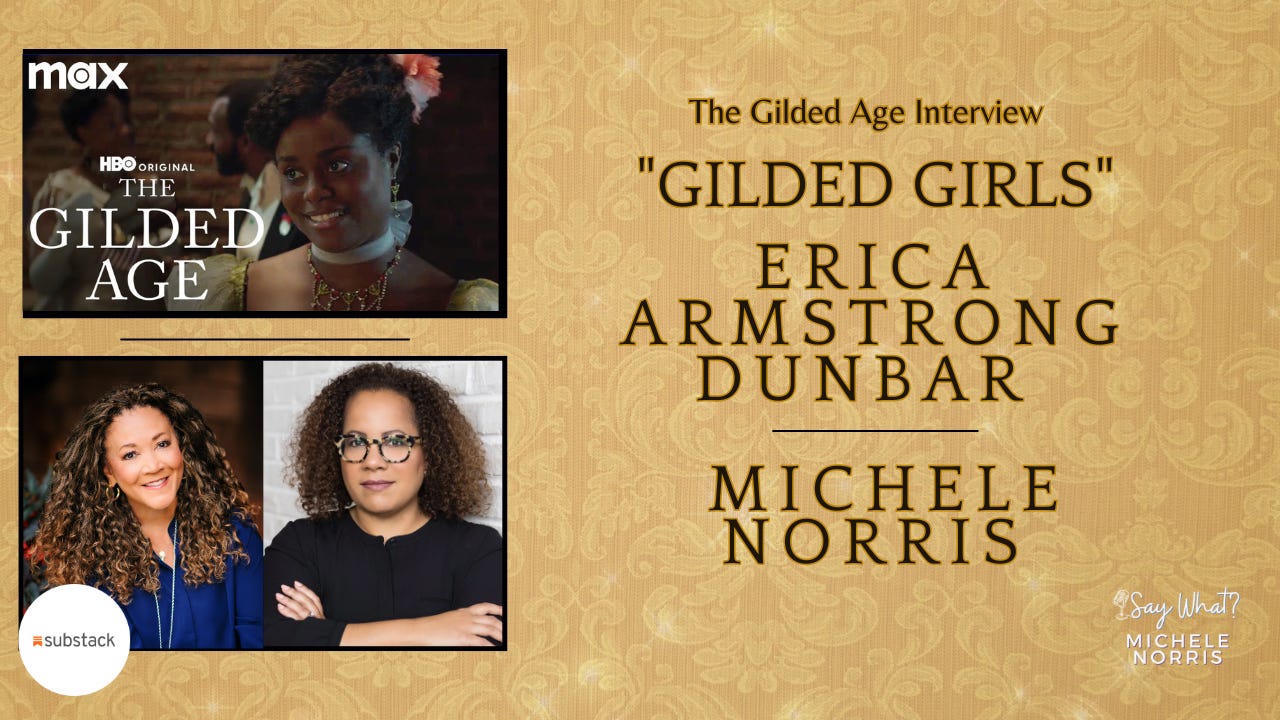
"Gilded Girls" Michele Norris interviews The Gilded Age Co-Executive Producer, Erica Armstrong Dunbar
from Say What? with Michele Norris · host Say What? with Michele Norris
This Substack is reader-supported. To receive new posts and support my work, consider becoming a free or paid subscriber.ABOUT ERICA ARMSTRONG DUNBAR:Erica Armstrong Dunbar received her B.A. in History and Africana Studies from the University of Pennsylvania and her Ph.D. in History from Columbia University. Her area of expertise centers the lives of eighteenth and nineteenth century Black women who lived in what would become the United States of America. Her work focuses on the history of slavery and freedom, social history, urban history, and women’s history. While Dunbar is committed to the production of scholarly literature, she is deeply invested in more public facing work—scholarship that reaches large general audiences through television, film, radio, and podcasts. Dunbar’s first book, A Fragile Freedom: African American Women and Emancipation in the Antebellum City was published by Yale University in 2008. Her second book, Never Caught: The Washingtons’ Relentless Pursuit of Their Runaway Slave, Ona Judge (Simon & Schuster) was a finalist for the National Book Award in nonfiction and a co-winner of the 2018 Frederick Douglass Book Prize. The young readers version of Never Caught (Aladdin/Simon and Schuster) was published in January 2019. In the fall of 2019, Dunbar published She Came To Slay: The Life and Times of Harriet Tubman, an accessible biography of one of the most remarkable social activists of the 19th century. Dunbar’s op-eds and essays in outlets such as the New York Times, The Nation, TIME, Essence, and the New York Review of Books, her commentary in media outlets such as CNN and the LA Times, and her appearances in documentaries such as “The Abolitionists” an American Experience production on PBS, the History Channel’s biopic of George Washington, Kareem Abdul Jabbar’s Black Patriots, and Ken Burns’ Benjamin Franklin, place her at the center of America’s public history. More recently, Dunbar has expanded her audience by serving as Co-Executive Producer on HBO’s hit television series, “The Gilded Age.” From 2019-2022, Dunbar served as the National Director of the Association of Black Women Historians–the only professional organization focused on Black women’s history. From 2011-2018, she served as the inaugural Director of the Program in African American History at the Library Company of Philadelphia.TRANSCRIPT WITH LINKS TO RESOURCESMichele Norris (00:08)I hope you have a strong sense of how much people love this show.I mean, they just have gone in deep and hard. And on Sunday nights, I just imagine that people are sitting with their own little cups of tea, talking to the TV, and then everyone spends the entire week talking about it afterwards. So thank you so much for all that you have brought to the show in terms of depth and purpose, and of course, historic accuracy. I mean, the show really does reflect your work and your spirit.Erica Dunbar (00:43)Sunday nights, after about 9.55 PM, my phone goes bananas, like every, every Sunday. You know, I always say the same thing. I know, keep watching. You know, I can't, of course, reveal anything, but it's really, I don't know. It's, this season in particular has struck a chord.with so many viewers. And I think what tickles me the most is that our viewership is growing across demographics, ⁓ interests. People who you think wouldn't necessarily watch the show are totally watching the show.This Substack is reader-supported. To receive new posts and support my work, consider becoming a free or paid subscriber.Michele Norris (01:31)Yeah, they're totally watching it.So we are talking to Erica Armstrong Dunbar at a really interesting point in the run of this latest season. If you watched Sunday night show, you know that it ended quite literally with a bang. There is only one more episode left in the season. Is that correct?So we're coming up on the season finale and Erica has brought so much to the show, depth, spirit, historic accuracy. And we're gonna talk to her about all of that. First of all, Erica, how did you get involved in this? Julian Fellows, who writes the show, also wrote Downton Abbey. ⁓ Did you knock on his door? Did he knock on your door? How did this happen?Erica Dunbar (02:14)No, no, I did not knock on Lord fellow's door. I wish that ⁓ I had, you know, had those kinds of connections, but no, ⁓ back in 2019, ⁓ when the show was sort of still in development. And I can talk a little bit about sort of the show originating really with NBC Universal. And then they're becoming a sort ofMichele Norris (02:41)YouErica Dunbar (02:43)partnership with HBO, ⁓ one of the executive producers, David Crockett, had reached out to me. And he said, listen, you know, I'm working on a show. It was very sort of not quite cloak and dagger-y, but I didn't know the specifics of the show. ⁓ And he said, ⁓I understand you're an expert in African-American women's history in the 19th century. And we have a storyline in our show that centers a black woman in the 19th century. And I'm wondering if you'd be willing to take a look at some scripts and to weigh in on historical accuracy and to just sort of give us your thoughts. And I was like,Okay, sure. I had no idea what the show was. I didn't know the title of the show, nor did I know the writer. you know, I signed a million NDAs and then they sent me, I think it was two scripts at first. And, you know, I did what historian professors do, like I marked it up. You know, I just read it and wrote,Erica Dunbar (04:05)sort of notes on the side and did a sort of ⁓ light redlining, red line marks on the scripts. And I returned them. And ⁓ that was that. I sent them to the producer. And shortly afterwards, I don't remember how much time passed, not much, ⁓ I got a call from the producer and he said, hey, listen, we really appreciated your comments.⁓ and corrections and, the creator of the show would like to meet you. And I said, okay. And he said, Julian fellows is the creator of the show. I was like, wait, freeze. Like Julian fellows as in Downton, like the show that I watch all of the time. And he said, yes, he's the creator of the show. told me.Michele Norris (04:54)Yes.Erica Dunbar (05:03)the title and he said, um, Julian will be up in Newport. We're scouting locations and can we fly you up to meet him? Um, uh, from, was in Philadelphia and, uh, I said, okay, be happy to. And so, you know, it was a quick visit and I showed up and you know, that moment when you think you're just having a meeting.But then you walk into the room and you realize it's a job interview. It was sort of like that ⁓ Julian, as well as several of the other ⁓ creatives, producers, were sitting at this table. It was very kind of like heavily wood paneled in Newport, Rhode Island. And we just started kind of talking about his vision behind the show and his vision in particular.Erica Dunbar (05:58)for ⁓ Peggy Scott and the decision to have to focus on a black family. And he asked me, said, you know, I've read this book called Black Gotham ⁓ that ⁓ follows the life ⁓ of, I said, I know, Philip White. And he said,you know the book? said, yeah. Well, my friend Carla Peterson wrote that book. And he was like, ⁓ OK, so you understand? I said, yes. It really sort of it's a family history that talks about ⁓ kind of Black New York, more specifically Black Brooklyn at that time period. And so we talked, talked. And the next thing I know, ⁓ Julian said, well, we would love to have you join the team. And I said, sure.And I literally walked out and I called my husband. said, I think I just got a job. I don't really know what I'm doing, but I'm assuming I'll be like doing history stuff. And so of course, later on, you know, I came on originally as a historical consultant for, and someone who was, I would argue, doing kind of sensitivity reads for, for now.Michele Norris (06:56)Hahaha! So we should say that every week we see your name prominently as co-executive producer. And every time I see it, I just yelp a little bit. I am so proud of you.Erica Dunbar (07:28)Thank you. I sort of feel a little bit like ⁓ Jack the clockmaker in that I kind of got the promotion where I came in as a consultant, just kind of weighing in on historical accuracy. And then over time, you know, I was kind of working more with the creatives on the show and I was promoted to a consulting producer.And then ⁓ over time, again, I was ⁓ promoted to a co-executive producer. And for anyone who is a historian and academic like me, this is stuff that, just doesn't happen to us at all.Michele Norris (08:14)Well, can I get an interruption for…anybody, even in Hollywood, to make that leap. I executive producer titles, co, full, whatever it is, they are not handed out like candy. It is a rare thing. And so it says so much about the importance of your contributions and your centrality in the show. So when you met Julian Fellows, he had imagined Peggy Scott already. How did you help him?Erica Dunbar (08:32)Thank you.Michele Norris (08:41)fill out her storyline and her family. Where do we see your contributions in her story?Erica Dunbar (08:49)Yeah, I feel comfortable talking about this now in part because Denee Benton, who plays Peggy Scott, has been very vocal and transparent about the changes in Peggy's storyline. And what I'll say and what I said to the creative team back in 2019, 2020 is that it's my job and my mission and my goal to represent black people in ways that are authentic and truthful. ⁓ And to be very honest, it was, I saw this as an opportunity to do television around black people at a certain moment in time with a different kind of storyline that we haven't seen on television. And as someone who focuses on the 19th century, and in particular,the ⁓ sort of stories of slavery and the afterlife of slavery. This just seemed ripe with potential. And Dene Benton, you know, I met fairly early on ⁓ and, ⁓ you know, we talked a bit and she was also very vocal in helping ⁓ reshape the sort of, the character arc of not just Peggy, but her family. so ⁓ originally, ⁓ Peggy was slotted to be a domestic. And while this was a very, you know, as a historian, I understood this to be, you know, this was very realistic that the majority of black women who are working outside of the home in New York, were domestics and there were especially in other places across the nation because there were very very little opportunity anywhere else. But thinking back on Carla Peterson's book Black Gotham which Julian had read and liked, ⁓ we were able to help suggest that perhaps a domestic wasn't ⁓ the best way to introduce a Black woman in the 19th century with this specific family. Now, there were also very real intricacies in the story that had to tie to Peggy's ⁓ involvement and interest and engagement on 61st Street. Like, okay, what's a black woman doing in 61st Street, ⁓ eventually living with the Van Ryn family. And ⁓ it really became ⁓ clear that we could do it leaning on real historical characters and writers in particular. ⁓ And so it became clear that Peggy could inhabit a space on 61st Street, not as a domestic, but to come in as a secretary, which was still a staff position, but a respected one that implied literacy that ⁓ also would give us and Julian a way in to write a story about a woman who was aspiring to be a writer and a novelist and journalist. so Denee and I really, you we had conversations ⁓ with Julian, with the other creatives, with the network, and they all agreed that it was a great opportunity to do something that we had never seen...on television before and to be very honest, one that ⁓ I felt like black folks would watch. ⁓Michele Norris (12:47)Yeah, was this in the wake of George Floyd? Was there a strange, I don't want to use the word dividend because that would be so wrong, but you know, an awareness about widening the aperture in black life and perhaps a curiosity that didn't exist because we do know that there was just an appetite for black stories, black books, black films. Did that play a role in this at all?Erica Dunbar (13:10)Yes and no. We had already kind of made the decision that ⁓ we would change ⁓ Peggy's story arc and Julian was writing that. ⁓ And this happened. were sitting at our ⁓ first table read. March, March 10th or something around then, 2020. We were slotted to begin production very soon.Michele Norris (13:13)Okay.Erica Dunbar (13:40)Which of course did not happen because of the pandemic. So there was a pause kind of that was horrendous for the world, fortuitous for the show, and that it gave us more time ⁓ to rework, reimagine. And I think that the murder of George Floyd ⁓ just drove home.Michele Norris (13:42)Right.Erica Dunbar (14:08)The importance of ⁓ the need for these kinds of stories. So it ⁓ did not reshape it, but I think it just kind of put an exclamation point on what we already sort of knew. ⁓ once again, the pandemic gave us time, gave Julian time ⁓ to write. We brought on another writer as well, ⁓ Sonia Warfield is a black woman. ⁓ who joined the team. And so that by the time we started shooting, which was October of 2020, which to be very honest was still pretty scary because there were no vaccines yet. And what I will say to HBO's credit is that not one person got sick. We were so fastidious about testing, preventative that they were digging in my brain every time you went on set, while you were on set, when you were after set. So.Michele Norris (15:14)⁓ You mean with those, you remember when they used to do the tests with those Q-tips that were like two feet long?Erica Dunbar (15:19)That went to your brain. You were like, did I just see that Q-tip?⁓ That was the only way we could ensure the safety of our actors who could not be masked during their scenes. So we shot all of, pretty much all of season one or much of it during COVID. And when the show premiered, we actually, couldn't have a premiere party because it was Omicron. Omicron came back and messed everything up. so ⁓ when we got a season two, there was an actor and writer strike and so we didn't have a premiere then. And so it really wasn't.Michele Norris (15:58)Yeah, so this is amazing that what you've had to plow through to get this on. I want to ask you about ⁓ the building the characters. And it's interesting because they're leading parallel lives. I Peggy comes from people of means. that's you see that in her carriage. You see that in the way she break from the beginning, you know, when when the two of them meet at the train station and develop a friendship. ⁓ But there there's this interesting thing that's going on is there their homes are similar but very different. They dress similarly, but very different. The color palette is different. Part of that is because the Van Ryn sisters are older and a little bit fusty, if I can use that word. You they wear lot of lace and you kind of have a, you know, arsenic and old lace kind of feeling in that. The rooms are always really dark. Even then there was the... 18th century version of, excuse me, the 19th century version of bling, ⁓ the black characters, they just, know, in a recent episode, Peggy came out in this like asymmetrical gown that looked like, is that, is that like, I see hints of Wakanda in that or something. So, you can you just talk a little bit about how you helped them and props to the fashion designer—on this who's done such amazing work. But can you talk a little bit about what you brought to historic accuracy and not just who the characters were, but how they present in the world, their clothing, their homes, their speech?Erica Dunbar (17:21)Yeah, Tasha. Yeah, Tasha.Yeah, and it's so yeah shout out to the costume department because and Kasha who runs ⁓ Who's the lead costumer? She's done a magnificent job with everyone and in particular understanding the subtleties ⁓ of fashion and representation for black women in the 19th century and as you've suggested, you know.We see Agnes Van Ryn and Ada presented in a kind of older, perhaps more conservative ⁓ dress and appeal and adornment, we'll say, right? Their home is birth. And birth is like, hey, I'm new, I'm here. Like, let's go, right? ⁓ I'm not about that life. I'm about this life. And ⁓ yes, good luck. ⁓Michele Norris (18:15)And Bertha is like, whoo. And hope you can keep up, you know.Erica Dunbar (18:32)And what I think is great is that ⁓ we've been able to, just through presentation of adornment, show where these families are coming from, what they're attempting to be, what they're attempting to present, right? And so for the Scott family, which is still going to be very trapped in what we would maybe call the politics of respectability in the late 19th century. ⁓ Arthur Scott had been enslaved himself ⁓ and his wife had not. But they have climbed their way up to what we would call the Black elite in the late 19th century. And so some of the colors and daring fabrics that we see a birth aware aside from the fact that she's super loaded, like she's got money, money, right? That's not necessarily something that ⁓ black women in 19th century New York would feel comfortable wearing in part because of the history attached to black women, their bodies and being seen, right? So especially in respectable circles. So the understanding thatOne needed to be adorned appropriately with colors that weren't too loud, that would not draw too much attention. And we have to think also about how that was ⁓ a nod to the need for protection of Black women's bodies, right? ⁓Michele Norris (20:15)Yeah. Yeah. And we should say that at that time, there were a lot of immigrants coming to America who would have been very jealous of the Scott family and all that they had acquired.Erica Dunbar (20:22)Of course, all that they had acquired and whether it was sort of new immigrants or ⁓ white Americans who'd been in this country for a long time, that would be adding fuel to the fire of ⁓ jealousy, of anger, of misplaced jealousy and anger.And so the kind of more subtle, refined nature. Now, it doesn't mean that black women couldn't step out and couldn't ⁓ show themselves in ways that were just gorgeous. And one of the things that costuming does is they have storyboards that come in and I look at them ⁓ and they're photos from the Schomburg and fabrics and everything attached that sort of ⁓ narrates what Peggy or Dorothyand now Elizabeth Kirkland's ⁓ wardrobe will look like over the seasons. And I say, that's a story in itself, right? So if you think about...Michele Norris (21:20)You were relying on pictures and photos from the Beinecke and from the Schomburg and...Erica Dunbar (21:30)Yes, most certainly everything from ⁓ style, bustle size ⁓ to... Now, of course, there's some ⁓ liberty taken because it's Hollywood and because we can and because people want to see a pretty dress. ⁓ But I will say, if you look at Peggy's attire in season one versus where she is in season three, it's very different.Season one, we meet a woman who is attempting to put her life back together. She has a secret. We don't know what that secret is. She has been off on her own in Philadelphia. Shout out to Philly. ⁓ And on her way back to New York in an uncomfortable position with her family, estranged from her father. And...a little less bling, a little, you know, she's much more understated because she'd been kind of doing things on her own. And it isn't really until we move into a season two, when she's established in back in New York, she's ⁓ living with Agnes and Ada, but of course she's back home, back and forth to Brooklyn. And you kind of see, you know, Peggy's wardrobe tick up a notch or two. So by the time we hit season three,Michele Norris (22:31)Hmm?Erica Dunbar (23:00)And she's actually being courted by season three. There's a splendor that I think we've all been waiting to see. And it kind of is telling the story, I think, of a butterfly who is waiting or about to come out ofMichele Norris (23:03)So you mentioned ⁓ she's being courted ⁓ by someone who's based on an actual character. Mr. Fortune was based on someone who was real. So how much liberty did you take in creating characters that were totally fictional? we meet real characters that are coming through, particularly in the woman suffrage movement and in the temperance movement. How much liberty did you have to draw upon actual history? And where did you actually do that?Erica Dunbar (23:53)Well, beginning with ⁓ T. Thomas Fortune, you know, I think once again, there's a real responsibility that I feel ⁓ as a historian to ⁓ present our characters, those that are fictional, but especially those that are non-fictional, right? In ways that are as close to accurate as possible. Now, with all of our characters on the show, we take a little bit of license, right?And with T. Thomas Fortune, know, I'll, you know, I will take a little bit of credit for saying, suggesting that, that we needed him as a character in our show. In part because we have, we know that our, many of our white characters are like kind of composite characters, the, ⁓ the Russells or that, but we have, of course, the Astors and ⁓ this season, JP Morgan and, know, people who, those are recognizable names.People who were living. And originally we did not have that for our black cast. We had composite characters. And T. Thomas Fortune was a way to tether the story to a real person and to a person who was extremely important in the 19th century. He was these kind of journalist daddy of in New York and really nationally.At that moment. so given the desire to have Peggy want to be a writer, it made total sense to bring him in. Now with that said, it's not a documentary, it's a drama. And so we are going to take license in some places, ⁓ but we are mindful of ⁓ reputations, of status, ⁓ and we didn't necessarily, we don't want to, malign someone's characters if they are like were a real person. ⁓ And so much of the storyline around Fortune and who he was and what he did, all of that is accurate, even down to like the kind of printing press that we had to bring ⁓ to location, which weighed like, I don't know how many tons. we literally had the crew had to go in and re-support the floor with more beam.Michele Norris (26:17)My goodness, it was that heavy.Erica Dunbar (26:19)Yes, in order to support the printing press, which you see in season one when Peggy walks in to meet him. So those things are accurate. But once again, Peggy is a fictional character. So...Michele Norris (26:24)Yeah.She's in, she's, because that was my next question, is she a totally fictional character or were you pulling a little bit of this and a little bit of that to create that character?Erica Dunbar (26:40)She's a fictional character based on ⁓ some of our kind of trailblazing ⁓ black women writers ⁓ at the time, like Frances Ellen Watkins Harper, we see in season three, little Ida B. Wells. So in some ways she's that, but no, she is a fictional character, ⁓ but we'll call her kind of composite.Michele Norris (26:51)And what about her parents, Arthur and Dorothy? Are they composite also? Was there a black pharmacist in Brooklyn who Arthur Scott could be based on?Erica Dunbar (27:12)Her parents are...Yes, his name was Philip White. And he was actually, I believe it's the great grandfather, forgive me Carla, ⁓ in Carla Peterson's book, it's her ancestor. And while it's not exactly the same story, it's loosely kind of based on the fact that yes, he was there. He went to ⁓ pharmacy school. He had multiple locations and he was a prominent businessman. And so...Yes, all of that, all of it is grounded in the research that I do to kind of help inform these characters in the show. so with Fortune, to be honest, in season two, when Peggy and ⁓ T. Thomas Fortune go down to Alabama and they are confronted with racial violence, there's this moment in a barn where they kiss. And it's the only kind of inappropriate moment between the two. there was a lot of talk about, you know, okay, how do we do this without crossing the line, without ⁓ damaging his reputation? And, you know, once again, it's fictional, but also look, in...terrifying moments of danger. People do things that they don't necessarily imagine or wouldn't have done when they are not confronted with maybe this is it, like this could be it. And T. Thomas Forgen had kind of shot off his mouth in the restaurant and they had to like get out of Dodge quickly and he did have a kind of a bravado about him.—And a righteous indignation where he would, he sued a hotel that refused to serve him, right? He was the actual T. Thomas Fortune, yes. So this is all informed by our T. Thomas Fortune played by Sullivan Jones that was, you know, that's kind of who he was. And then they're in this situation where, you know, they're being hunted.Michele Norris (29:22)So you're actually talking about the actual T. Thomas Fortune, actual.Erica Dunbar (29:43)And they're not in New York and they're in a barn in Alabama and ⁓ things happen, right? And so we, for dramatic purpose, we needed that to happen. was a kind of, you saw from the beginning, there was a chemistry between the two of them. And then though it was important, I think that that was dialed back, ⁓ you know, like a recognition once that danger was over. You know, okay, how do we have these two in close proximity? How do we have Peggy who by then, you know, America loved and, ⁓ you know, to, with the kind of reminder of her mother, it was like, you know, I raised you better than that, ⁓ to set things straight. so back to the original question, which was, you know, the representation of are real characters and ⁓ those that are composite or fictitious. I think it's important one way or another ⁓ in terms of their presentation, but we can't get trapped in this idea that these black people wore capes and they were perfect and they didn't mess up and they didn't have inappropriate thoughts and even though they're the black elite, that they always moved and lived and ⁓ functioned according to the rules, that too is inauthentic and inaccurate, right? And so we're walking that line of trying to present a different image that we haven't seen on television before in a way that shows the failings of human beings, but also the strength and also, you know, I think this season in particular, there's a different tone to the Scott storyline.Michele Norris (31:42)You mentioned the Black Elite. I'm gonna come back to that in a minute. But it must be wonderful to be able to give someone like Sullivan Jones a dossier, basically saying this is the character you're portraying and this is how he walked in the earth and this is what he did and this is what he looked like and this is what he wore and what a wonderful gift to the actors. In terms of the Black Elite, one of the things that was a little bit...revealing and also kind of heartbreaking as a viewer was to see ⁓ in Arthur Scott's character, a man who had risen from slavery to prominence, wonderful, but the way that he was looked down upon by other black people because he once was enslaved. That instead of, know, they didn't necessarily see all that he had done, they saw all that he was and stopped there. And that folks were already dividing themselves, based on that, based on skin color, which is a huge storyline in season three, is heartbreaking. In a moment where we're stepping into freedom as a people for the first time.Erica Dunbar (32:55)Yeah, it is.Michele Norris (32:57)heartbreaking, I assume very accurate.Erica Dunbar (33:00)It is. I think, you know, once again, we wanted, when we made the decision this season, to do more of an intra, a story that focused on the kind of intra politics or intra relations between black folks. Which we could only really do by expanding the cast, which we did ⁓ in a way that's just been absolutely grand. ⁓ And I think gives real teeth.Michele Norris (33:39)And it just keeps going. mean, Leslie Uggams, suddenly I was like, is that, is that? Yes, it is.Erica Dunbar (33:44)Yes. I mean, and just, you know, I, for those who haven't seen yet, just her, you know, and she's worked with Ms. Rashad before, so they've, you know, they have a relationship and, you know, let me just, let me stop and say, you know, being on set with Felicia Rashad and Leslie Uggums and Audra McDonald, and Denée Benton and, you know, Brian Stokes Mitchell. It is...It is a little bit oh, I'm gonna talk about the skies. I'm not even talking about everybody else, right? Which then just makes you feel like you're on Mars. But it is otherworldly. as a middle-aged historian who spent her life reading, writing, teaching Black history,Michele Norris (34:15)and Christine Baranski and you know.Erica Dunbar (34:43)To suddenly kind of be in this position when you're on set and working with ⁓ the fantastic Sally Richardson-Witfield, who's directing and producing, and she'll say, Erica, come here, tell me, da, da, da, is this that? Where should she sit? How should he stand? Those are things that most academics ⁓ don't imagine will come into our.Our wheelhouse at any moment, and nor did I. But what I will say is this.As a historian, I write and I teach, people are gonna read my books, people are gonna sit in my classes, but I will never have four million people a week or five million people or seven million, however many it is, who are tuning into a show. I won't be able to touch that many people ever. And even if I can do it in the smallest of ways and say, okay, creative team,We need Frances Ellen Watkins Harper in this. If we're gonna talk about suffrage, this can't just be about white women and suffrage, but there's a way to integrate someone who, as a writer, was fantastic, who, as an activist, was fantastic. If I can do, if people hear that name, if they hear T. Thomas Fortune, if they see...Booker T. Washington played, you know, before he was Booker T. Washington, right? Then I feel like I've done something that I've, I have introduced these characters and this history into the mainstream, the most mainstream way of the kind of American cultural landscape. And some people will like it and some people won't, but I feel like, you know, it's...Like when your mother used to give you medicine with a little sugar sprinkled on top, I feel like that's sort of what we get to do with the Gilded Age.Michele Norris (36:51)Yeah, well, it doesn't feel like medicine. feels like protein.It feels really, really, really wonderful. An observation. The Van Rynes we learned very early on ⁓ had been supporting black classes in Pennsylvania. They had been supporting the free school. And this is a show that really is all about the tensions between old money and new money. And I'm wondering if...you're making a statement there also in that the people who were part of the old money, you know, she notes that they'd been there since the 16, you know, since 16s, whatever, whatever, when they arrived. But new money people were so worried about being accepted that they perhaps were less willing to support some of those causes. And I'm wondering if that was a moment ⁓ where money didn't flow in that direction, support didn't flow in that direction. That there was less energy that moved in that direction because the new money crowd was so worried about establishing themselves that they didn't actually support some of the causes that the old money generations were willing to support, particularly when it came to people of color and maybe new immigrants, maybe even the movements movement.Erica Dunbar (38:07)Yeah, think I'm glad you make that point because it's exactly what we're trying to do, which is because Agnes and Ada are older and we can tie them ⁓ season one, they make it very clear that their father was a patron ⁓ of the Institute for Colored Youth, which later on became Cheney University, ⁓ that we're making these kind of early connections, we could call them abolitionist, you know, collect connections in the 1830s, 40s, 50s, before way before the show. And that there were New Yorkers and Pennsylvanians and people from throughout the North who were invested in notions of reform, whether it was abolition, whether it was the right for black men to vote, whether it was suffrage. And so there's a way that we kind of tether Agnes, who doesn't necessarily seem like she would be someone, you know, interested in that camp, but we get to be sort of surprised by her over and over again. Even her relationship with Peggy is somewhat surprising. There is a respect that, and a respect for the grit that she sees in Peggy, that it's the only way this relationship can work. It's the only way that a Black woman in 1883, or, you know, can live on 61st Street. she's, if you notice, there are no Black servants in the Russell household.Michele Norris (39:50)I noticed. I noticed. And I asked that question with Bertha in mind, would she ever invite a Peggy into her world? Or would she be concerned about what Lady Astor would say?Erica Dunbar (40:07)More than likely, she would be worried. But remember, we haven't done a deep dive yet on Bertha's background. We've done a little bit. We've met her sister in season three. And so I think when we know about a person's roots, then we can make ⁓ kind of better assumptions about them. But at first glance, we see there's no one Black ⁓ working in the Russell household.And that wouldn't be unusual at all. That would not be unusual for the wealthiest of the wealthy, right? And there's a difference in scale when we look at the home that Bertha and George are living in versus what Agnes and Ada have. There's wealth and then there's wealth, new wealth too, right? And so we get to see ⁓ the only way that it makes...any kind of sense and even still a little bit ⁓ of a stretch to have ⁓ Peggy living with ⁓ Agnes and Ada, we had to make it some a way that it was somewhat believable. And even still sometimes their moments were like, really? Okay, but we do our best. We do our best.Michele Norris (41:26)Well, they said yes pretty quickly. I know the weather was bad and she couldn't get to, the fairies weren't running, but it still is hard to imagine that the Van Ryn sisters would get to yes that quickly. I love the way that you have teased out Bertha. I think you're gonna have to come back and talk to us again. Maybe after the season finale, we'll have another conversation about this. Because we know that Bertha, we intuit that Bertha has probably been to sorrow’s kitchen and licked all the pots…and she is never going back there again. You know, she is pure ambition, not just driven by what's in front of her, but what's behind her. She's not going back there again. And I look forward to knowing, you know, what she left behind. And Mr. Russell has a little bit of that in him too. And we're seeing that little bit of that street fighter in him in season three. ⁓ One of the surprising things also is, the presence of blacks in Newport.Erica Dunbar (42:26)Yeah. Yeah.Michele Norris (42:27)And that's not just a contrivance for the show. That actually is historically accurate as well.Erica Dunbar (42:35)It is, I mean, we did, ⁓ we spent a lot of time, when we made the decision that season three was going to incorporate more ⁓ black joy. ⁓ You know, season one was very heavy when we find out Peggy's secret. Season two starts off super heavy because we're basically going to meet ⁓ the grave site of her child.who had been given up for adoption against her knowledge. ⁓ And we kind of, and then there's, you know, Alabama and the reminder and Tuskegee was important because it's like, all right, we have this show about what's happening in New York and this small group of black folks who've, you know, accumulated some kind of wealth, but the rest of the country is kind of living more like this. It was important for us for that to register for authenticity sake. And by the time we hit season three, it's like, okay, ⁓ a reminder that it doesn't have to be dark all the time. It's a reminder that, look, even in the midst of oppression and ⁓ the rollback of rights that had come out of reconstruction, which is happening right at that sort of moment, that black people didn't walk around every day, all day saying, whoa, it's me. And, you know, I can only think about this. No, people lived and they loved and they went to church and they danced and they had great meals. And yes, they, their lives were touched frequently by the indignities of racism, of violence.But that we needn't show that all of the time. And to be honest, what I hear from viewers ⁓ is that they're like relieved. Like they want to see that. It's not a negation of what also was happening, but it's an attempt to allow us to think about the storylines that our white characters, you know, focus on. We look at, you know, Elizabeth Kirkland.And how is she different from Bertha, from someone who is trying to manage their children's future, right? And Newport, when I was reading the actual Globe, so part of what I do is I'll read through the 1883, 1884 articles in the Globe.And one of the things I saw over and over again was that, you know, it would announce when Mrs. Jones goes to Newport or Mr. Williams returns from Newport, right? And so it was a sort of trigger like, you know what, we're in Newport with our other storylines. Why can't we be in Newport with the Scots? You know, it would make sense. And so...there's a significant amount of research on the sort of small yet ⁓ important community of Black folks who lived and worked and some summered ⁓ in Newport and that there was a growing entrepreneurial class there ⁓ that in part because it became a sort of resort location, we know that opportunity in terms of labor always opens up with that.So, but it was also a place in which discrimination of course existed, but it didn't feel as, as oppressive as much of the thumb on the scale by the 1880s, the schools were desegregated that, you know, begrudgingly, but they were. And so there was a way I think for us to step into leisure culture this season for black people.And we did that not just through Newport, but also through the baseball game, know, sort of reminding folks that, yeah, people went to see baseball games and this is the precursor to the Negro league. So, and there was of course, and all of this is, you know, factual. There were ⁓ black baseball teams that played one another across the nation. And, it was a way once again to remind our viewers, like this too is everyday life for black people. It isn't just being ⁓ followed in Bloomingdale's like we see in season one or being told to leave, right? But that.Michele Norris (47:29)Yeah, yeah, right. There was that too, but you balance it, and you balance it beautifully. I went on social media and asked some of your fans of the show to send in questions, and I gotta let you go, but can we do a speed round where I just present you? Quick question, quick answer. So, ⁓ I don't know if you know.Erica Dunbar (47:45)Yes, ma'am.Questions from ThreadsWas there any pushback to include the story line in Black Elite (@mspackyetti)? Sounds like no, because you've answered that. Fellows actually wanted to do this ⁓ from the beginning. Q: What are the messages or lessons that ⁓ the Scott and Kirkland family storylines can teach Hollywood and even the whole country about including Black perspective throughout a production and not just on camera, but behind the camera and on several levels within the story? Quick answer.Erica Dunbar (48:28)I think that's a fantastic ⁓ question. And what I'll say is HBO got it right. And they understood that it can't come from one black writer in a writer's room, that it has to happen systemically. So there have to be historians, writers, producers, directors who are coming from, who have a back, not just that they're black, right? That's important. But that they have a...a portfolio and they're coming from a place that allows for a compelling story that's accurate and that is kind of beautifully woven into an American tapestry. And I think this should be the model going forward.Michele Norris (49:39)Love that. She also wanted to know, are Mrs. Van Ryan and Mrs. Kirkland ever going to interact (@mspackyetti)?Or can you say? You can't say. Okay. All right. Moving. Someone who I don't know the name, but they're @the.book.lush wanted to know if you have book recommendations about black society in that area. You already mentioned Black Gotham. You mentioned some of the books you use for research. Is there a curriculum or is there a place where you might post some of that (@mspackyetti)? Is that something you want to share with us and we can post and give people a syllabus if you want to learn more about that? Erica Dunbar (50:16)You know, that's a great question. No one has actually, not from the network at least, talked about a syllabus. Usually we do that as writers with our books and what have you. ⁓ So I haven't, I've been reading scripts, not thought about the syllabus.Michele Norris (50:32)Okay, well, we'll come back to you on that because we might, you know, might be able to just post something here and say what and if people want to find it, they can find it. Was there was the criticism that Downton Abbey was perhaps too white, a reason that Julian Fellows wanted to incorporate a black storyline? Was this an answer to some of the critique that he received on Downton Abbey (@michelinemaynard)?Erica Dunbar (50:56)To my understanding, no. I think that he understood this is an American show. And to do a story, and I've said this in a couple of other interviews, that to do a story about New York in 19th century America and not have black people would just be like, false. So I think from the very...Michele Norris (51:01)Mm-hmm. But people have done it. It doesn't mean it hasn't been done.Erica Dunbar (51:23)Yeah, it would and and that is problematic and I think that ⁓ you know knowing that he wanted it to be something that ⁓ incorporated a black elite that existed. He also knew that you know he got support from people like me like Sonia Warfield who's writing with him and and Sally Richardson Whitfield. So I don't necessarily know, or at least I wasn't told that this was a response to critique. was presented to me as this is an American show and we want it to be authentic. And HBO is pretty good about when possible being as authentic as can be.Michele Norris (52:19)Okay, so a couple other quick round of questions. With so many Broadway stars all over this cast, is there any talk of a fever dream episode with music (@fishermommy)? Erica Dunbar (52:30)Everybody wants that is what I'll say. Meaning all of the viewers want that. I think ⁓ I love the format we have now. If Julian was to decide to do something different, we'll see. But ⁓ I don't know. I kind of feel like everybody's sort of loving. It does, like everybody there can sing. Everybody, like, I don't even hum when I'm on set because.Michele Norris (52:33)Okay. Do they sing off set? Because we saw the wonderful video of people doing the line dance in costume, which was just so delicious. It made my day. But do people just break into song when the characters break? Yeah. We'd love to see. There should be some back content. I think that folks would really love to see that. Would Peggy and her friends really have been invited to the Van Rijn house (@mich-haff)?Erica Dunbar (53:09)At the suffrage meeting. Okay. ⁓ Yes, the answer is yes. And we can trace that all the way back to, when we think about people like Harriet Tubman, who following the Civil War was very invested in things like suffrage, like ⁓ assisting the poor. And she frequently went, to white people's homes, white women's homes, and spoke or participated in talks to either raise awareness and sometimes money. So because of the relationship that Peggy has with Agnes, and once again, this is one of those moments where it's like people are like, well, they're really gonna have her up. And the answer is yes.Would it be with frequency? You know, probably not. But it is not beyond the pale of ⁓ believability that that would happen, because it did.Michele Norris (54:31)Would the Kirklands likely have had staff and will we ever hear about them (@kimcutt)? Erica Dunbar (54:48)Well, see ⁓ we see two I think staff members well we see ⁓ their governess who ⁓ gets a chiding by ⁓ Elizabeth for allowing the children to be outside without an umbrella, right? And I believe we see a butler type. We don't have much interaction with him the way that we get to interact with Ellen, the ⁓ Scots ⁓ maid. But yes, most certainly they would have had staff. They did have staff. We tried to.Michele Norris (55:22)Mm-hmm. Will this storyline there that would might deepen in season four because I'm assuming there will be a season four?Erica Dunbar (55:36)Yes, we were renewed for season four. We were renewed!Michele Norris (55:38)Okay, another quick question. This from Tress409, I love people's names on the socials. Is there a lighting issue or intentional darkening of Audra's character to give distinction between the families (@tressa409)?Erica Dunbar (55:48)No, I don't think there's a, I mean, here's the thing. ⁓ Lighting in the 19th century, remember this is right at the moment when electricity has sort of, not been invented, but there's a small commercial use for it, but very few people have electricity in their homes, right? So we're in rooms that are lit solely by. Candles or lanterns, gas lanterns, right? And so, you know, it is somewhat jarring that it appears like there's a darkness. But that was kind of specific to the time. There's a darkness in Agnes's house all the time, right? There's a darkness in ⁓ this house. They're old, I mean, because that's what you did, right?Michele Norris (56:45)Mm-hmm. And they're always coming to collect the lamps at the end of the day. is...Erica Dunbar (56:53)And I, but I will say this, think in, ⁓ we see Dorothy outside or in different ⁓ venues, there's more clarity, but there, no, there is no darkening of anybody. ⁓ It has everything to do with period lighting.Michele Norris (57:10)Okay, last question, and then you have to promise to come back because we didn't get through all the questions. And I'm certain that after next week's episode, people will have even more. So last question for now. Did Americans wear tiaras (@eapaquelet)?Erica Dunbar (57:27)Yeah, they were tiaras.Yes, I mean the fancy ones?? The fancy ladies at ⁓ the balls and the galas, but, and I'm not sure the exact year that that sort of falls out of favor, but even until the 20th century, you could catch somebody with a tiara, know, at a gala or at, ⁓ you know, at sort of important event. And so, ⁓ you know, what's interesting is kind of the difference between what American culture versus British culture. we see more of that because of Gladys's move, right, to England. ⁓ so there'll be more of, of that back and forth.Michele Norris (58:08)Yeah. Yeah. \Where the rooms are also dark and big and they seem drafty to me even though I'm not even in them. Yes. Yes.Erica Dunbar (58:16)And coal and they got mice. And what I will say is Julian knows this better than anybody else, right? As someone who, ⁓ you know, is familiar with ⁓ British history.Michele Norris (58:26)Yeah. ⁓ Well, hats off to him. ⁓ And thank you so much for joining us. I have so many other questions, so we'll do this again because it was so much fun. I can't wait for the season finale. And I'm so glad, you know, I say this over and over and over again. I believe that history has an energy and it finds the right conservators. It finds the right people who will take care of it and push it forward and make sure that we can examine it and interrogate it. ⁓And understand it. And in this case, history found the right conservator in you. So thank you very much for all that you've shared with us and with the show. And we'll talk to you again. And for now, it's not goodbye. It's just so long. Until next time.Erica Dunbar (59:15)Thank you. Thank you so much.Michele Norris (59:18)Thank you.This Substack is reader-supported. To receive new posts and support my work, consider becoming a free or paid subscriber.Thanks for reading! This post is public so feel free to share it. Get full access to Say What? with Michele Norris at michelenorris.substack.com/subscribe
Embed this episode
NOW PLAYING
"Gilded Girls" Michele Norris interviews The Gilded Age Co-Executive Producer, Erica Armstrong Dunbar
No transcript for this episode yet
Similar Episodes
No similar episodes found.
Similar Podcasts
No similar podcasts found.