
EPISODE · Aug 16, 2025 · 23 MIN
Global Economic Outlook 2025: IMF Report Explained | Economic Growth, Inflation Rate, Monetary-Fiscal Policy, US Market Impact, Stock Market Risks Global Trade Recession Signals | IFR ISLAMIC FINANCE
from ISLAMIC FINANCE RESEARCH · host Zayd Haji
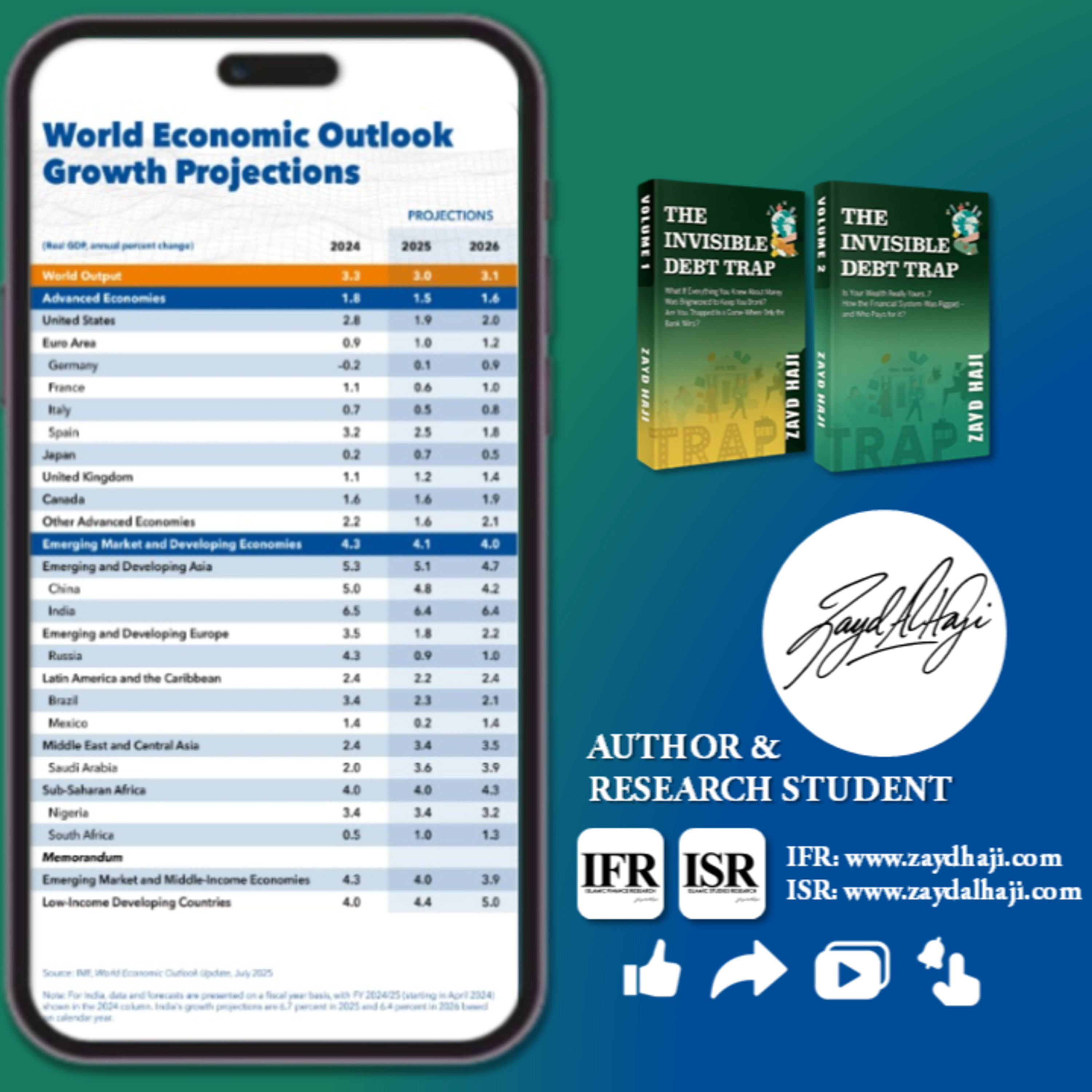
Global Economic Outlook 2025: IMF Report Explained | Economic Growth, Inflation Rate, Monetary-Fiscal Policy, US Market Impact, Stock Market Risks Global Trade Recession Signals | IFR ISLAMIC FINANCE The global market is entering a critical phase where indicators across the nifty 50, sensex today, and the S&P 500 are signalling increased volatility, forcing investors to reassess the foundations of modern monetary theory and its impact on monetary policy, fiscal policy and long-term economic growth. As the US market faces rising home loan interest rates and the broader stock market & share market react to shifting conditions in global trade, traders are closely watching the foreign exchange market, forex factory updates, and adapting their forex trading strategies to account for downturns in economic activity, a rising inflation rate, and growing risks of economic recession and regional recessions. In this episode, Zayd Haji breaks down the IMF World Economic Outlook (July 2025) in simple, practical language and connects it directly to the global market, your household expenses, & the wider economic activity that affects jobs, trade, and everyday prices. The Invisible Debt Trap series by Zayd Iqbal Haji reveals how interest-based systems enslave nations, destroy families, and erode your wealth. Volume 01 : How Interest-Based Systems Enslave Nations, Destroy Families, and Defy God: Exposing Riba, Reviving Justice https://play.google.com/store/books/details/Zayd_Haji_The_Invisible_Debt_Trap_Volume_01_How_In?id=jcFqEQAAQBAJ Volume 02 : Is Your Wealth Really Yours — Are You Financing Your Own Destruction?: How Riba, Debt, and Modern Banking Are Destroying Your Wealth — Are You In It Too? https://play.google.com/store/books/details/Zayd_Haji_The_Invisible_Debt_Trap_Volume_02_Is_You?id=FsVqEQAAQBAJ The report shows that while the global market is still moving forward, the momentum is slowing. Economic growth is projected at 3.0% in 2025 and 3.1% in 2026, which is lower than pre-pandemic levels and below the 2024 numbers. Advanced economies like the US market, Euro Area, Japan, and Canada are losing steam. Their economic growth is falling toward 1–2% levels, driven not by healthy demand, but by temporary front-loaded spending designed to beat future tariff increases. Why does this matter to ordinary people and small businesses? Because slow economic activity in the US market and global trade environment leads to falling demand in other countries. That can pull down stock market performance, push inflation upward, and force governments to adopt tighter monetary policy and fiscal policy. The impact hits directly: Higher inflation rates → higher cost of food, fuel, and basic goods Tight monetary policy → higher home loan interest rates Fragile stock market and foreign exchange market → lower investment returns and increased volatility Declining global trade → fewer export opportunities and rising risk of economic recession The IMF warns that much of today’s economic activity is being supported by early buying and emergency stimulus — essentially using tomorrow’s resources to stabilise today’s global market. That means the risk of recessions in the next cycle is real. From a faith perspective, this raises a deeper point: temporary comfort can create long-term instability if the underlying system is unjust. The global system is running on borrowed strength. If nations continue to avoid real reform and ignore the principles of fairness, balance and cooperation, then inflation, market volatility and potential economic recession will become unavoidable. This discussion links the IMF’s technical data to the stock market, foreign exchange market, global trade, and every individual’s economic reality. Whether you follow the nifty 50, the sensex, the S&P 500, or simply worry about your next grocery trip, this episode shows why economic growth, monetary policy, fiscal policy, and global trade are no longer distant topics — they shape your life.
Embed this episode
Ready to play
Global Economic Outlook 2025: IMF Report Explained | Economic Growth, Inflation Rate, Monetary-Fiscal Policy, US Market Impact, Stock Market Risks Global Trade Recession Signals | IFR ISLAMIC FINANCE
No transcript for this episode yet
Similar Episodes
No similar episodes found.
Similar Podcasts
No similar podcasts found.