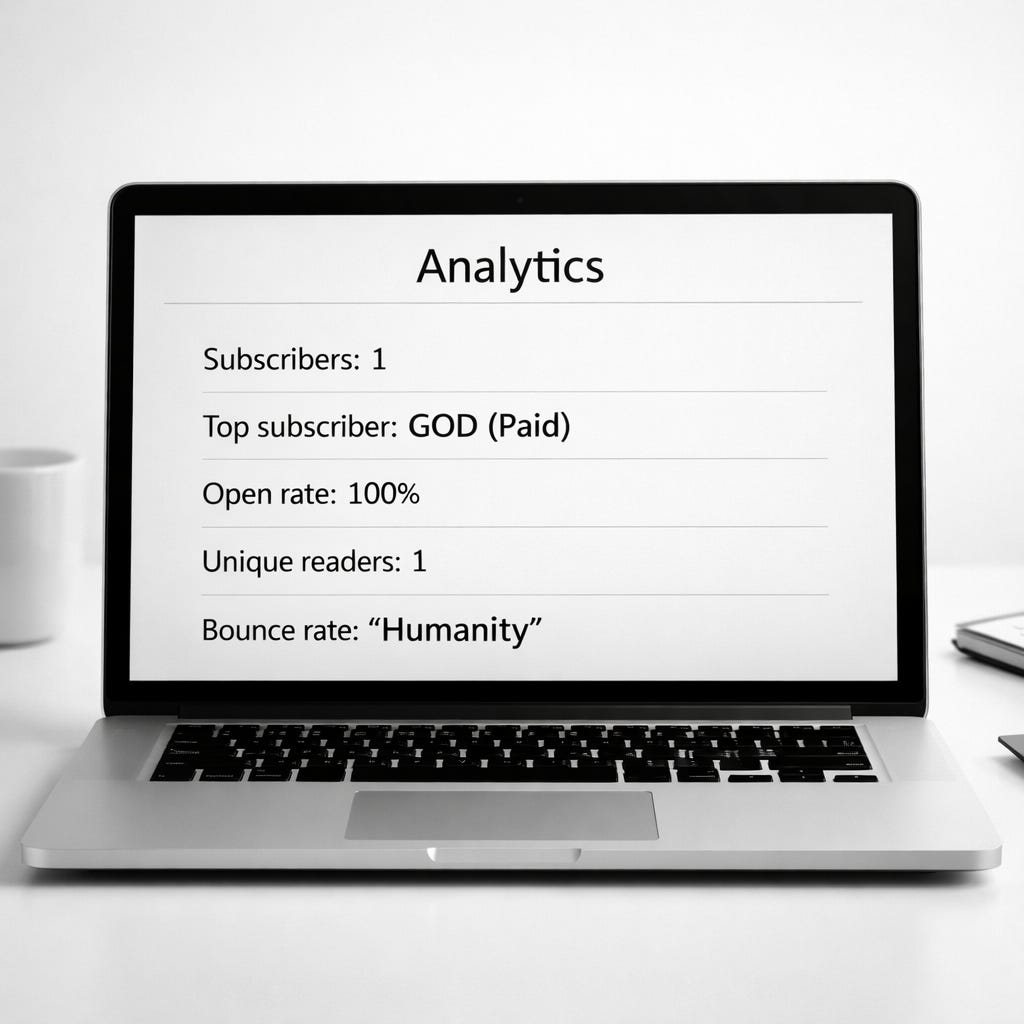
God Is My Only Subscriber
from Language Matters by Elias Winter Hosted by Elias Winter
Chapter 1 — The Alibi Removal Service I fell asleep with my laptop open the way a man falls asleep with a knife in his hand: not because he plans to stab anyone, but because he’s convinced the world is full of intruders and he’s the only one awake enough to see them. In the dream, the room is not my room. It is a room that has the posture of authority without the décor—like a courtroom that got tired of pretending it wasn’t a theater. There’s a desk. Behind it sits God. Not the bearded Renaissance God. Not the thunderbolt God. Not the solemn icon God with the thousand-yard stare. This God looks like he runs customer support for an airline. Sleeves rolled up. Coffee. A face that has read too many emails that begin with “Just circling back.” He is scrolling. At first I think it’s a holy book. Then I see the interface. Substack. My Substack. God doesn’t look up. He keeps scrolling the way a bored teenager scrolls a feed, except the boredom is ancient and the attention is lethal. He scrolls like someone who invented time and regrets it. “You’re late,” he says. “I’m asleep,” I say. “You’re late to your own crisis,” he says. “That’s impressive.” He turns the screen toward me. The dashboard is open. Analytics. Traffic. Subscribers. There is a number in the “Top Referrers” box. It’s just one word. HEAVEN. I swallow. “You—” God holds up a finger without looking up. “Before you say anything,” he says, “yes. I’m the only person who reads your essays.” I feel a rush of relief and horror collide in my chest like two cars driven by the same man. “That’s—” “No,” he says. “Don’t do that. Don’t make it noble. Don’t turn it into a martyrdom narrative. You’re not being persecuted. You’re being ignored.” He takes a sip of coffee like it’s sacramental. “Nobody reads them,” he continues, still scrolling. “Not because they’re bad. Not because they disagree. Because your essays do what people hate most.” “What?” He finally looks up. His eyes are not wrathful. They’re tired in the way a good parent is tired: the kind of tired that comes from watching the same lie be reinvented every generation with new fonts. “You remove alibis,” he says. I stare at him. “I’m trying to tell the truth.” “Exactly,” God says. “Truth is an alibi removal service.” He taps the screen. “Look at this one. Strong opener. Great sentence rhythm. And then—bang—you commit the unforgivable crime.” “What crime?” “You take away the little stories they tell themselves to survive their own choices.” I feel indignation rise. It has the taste of righteousness, which is how it seduces you. “People are living inside a lie,” I say. “They’re anesthetized. They’re—” “They’re doing what humans do,” God says. “They’re coping.” He leans back. “And you,” he continues, “you write like a man who walks into a crowded room and unplugs everyone’s emotional IV.” “That’s not—” God raises the finger again. “I’m going to say this slowly, because you like slow things. You like time horizons.” He speaks as if he’s dictating to a stenographer. “They don’t hate you because you expose power. They hate you because you expose them.” A silence lands between us. In the silence, I realize I’m looking for the moral high ground like it’s a chair in a room where God has removed all chairs. “I don’t expose them,” I say. “I’m talking about systems.” God laughs, once, without joy. A short bark, like a judge who has heard a defendant say, “I didn’t mean it,” one thousand times. “You always say systems,” he says. “It’s your favorite way of not admitting you’re talking about people. Including you.” He swivels the laptop again and pulls up one of my essays. I can’t read the title because my eyes are doing that dream thing—letters wobbling like they’re trying to escape. God can read it fine. Of course he can. He highlights a paragraph without touching the trackpad. It lights up anyway. “This is the paragraph where you remove the first alibi,” he says. “What alibi?” God starts listing them the way a sommelier lists notes in a wine, except the notes are the flavors of self-deception. “‘I didn’t know.’” He scrolls. “‘It’s complicated.’” Scroll. “‘I’m just one person.’” Scroll. “‘I had no choice.’” Scroll. “‘Both sides.’” Scroll. “‘At least I’m not like them.’” He looks up again. “You remove those. One by one. Sometimes in a single sentence. You do it with style, which is rude.” I feel a defensive heat. “So what do you want? For me to lie?” God’s eyebrows rise. “There it is.” “What?” “The dramatic binary,” he says. “Truth or lie. Prophecy or silence. You love that. It makes you feel like a soldier.” “I’m not—” “You are,” God says. “You’re a soldier who thinks the war is against ‘power.’” He says the word power with quotation marks in his voice, like he’s mocking my tendency to summon abstractions like they’re demons. “The war,” God continues, “is also against the average person’s desperate need to feel innocent while benefiting from the machine.” I open my mouth, then shut it. Because the sentence is too clean. Because it lands. God watches my face. “Now,” he says, “let’s do a simple experiment.” He snaps his fingers. The room changes. We’re in a living room that looks like every middle-class American living room designed by an algorithm: neutral couch, big TV, throw pillow that says BREATHE like a threat, a bowl of decorative wood balls that have never been touched by wood. A man sits on the couch with a phone in his hand. He’s not a villain. He’s not a caricature. He’s just a person. On the TV, a panel of people are shouting, but the volume is low. It’s more like the TV is generating a visual texture of outrage, a moving wallpaper of conflict. God points at the man. “Watch,” he says. The man scrolls. His thumb moves like a metronome. Every few seconds his face tightens—micro-anger, micro-satisfaction, micro-disgust, micro-relief. “He works,” God says. “He pays bills. He complains about the price of eggs. He occasionally donates to something if it’s emotionally legible.” The man looks up at the TV. On-screen, someone says something about “freedom.” Someone else says something about “justice.” The man nods as if his nod is a moral act. God leans down toward me like we’re conspirators. “This man is not your enemy,” he says. “But he has a religion.” “What religion?” God points at the phone. “Innocence.” I frown. “That’s not—” “It is,” God says. “His highest value is the ability to feel like a good person without changing his life.” I want to object. I want to call it structural. I want to call it ideology. I want to call it alienation. God anticipates all of it. He says, “Don’t say ‘alienation.’ Don’t say ‘late capitalism.’ Don’t say ‘spectacle.’ You write those words the way people used to write ‘demon.’ It makes you feel like you’re naming a thing.” “I am naming a thing.” God nods. “Yes. You are. But watch what happens when you name it too clearly.” He gestures toward the man on the couch. The man’s phone screen changes. Now it shows one of my essays. The title is visible. I recognize it. I feel a heat of pride, like an idiot. The man starts reading. Two paragraphs in, his face changes. Not anger. Not disagreement. Something closer to the flinch you see when someone hears a truth that moves too close to their private ledger. He scrolls faster. Skims. His eyes bounce, looking for an exit ramp. Three paragraphs later, he stops. His thumb hovers. He stares at a sentence as if it has accused him by name. Then he does what most humans do when a mirror is unflattering: He looks away. He taps the back button. He returns to the feed. God watches him return to the feed the way a doctor watches a patient refuse the medicine and ask for another painkiller instead. “See?” God says. “He couldn’t handle the truth?” I ask, and even as I speak I can hear how contemptuous it sounds. God turns to me sharply. “No,” he says. “He couldn’t handle responsibility.” The room’s light shifts. The couch seems suddenly like a confessional booth. God continues, “Your essays don’t simply say, ‘The system is corrupt.’ They say, ‘You are inside it. Your attention funds it. Your habits reinforce i… This is a public episode. If you would like to discuss this with other subscribers or get access to bonus episodes, visit eliaswinter.substack.com
Embed this episode
No transcript yet.