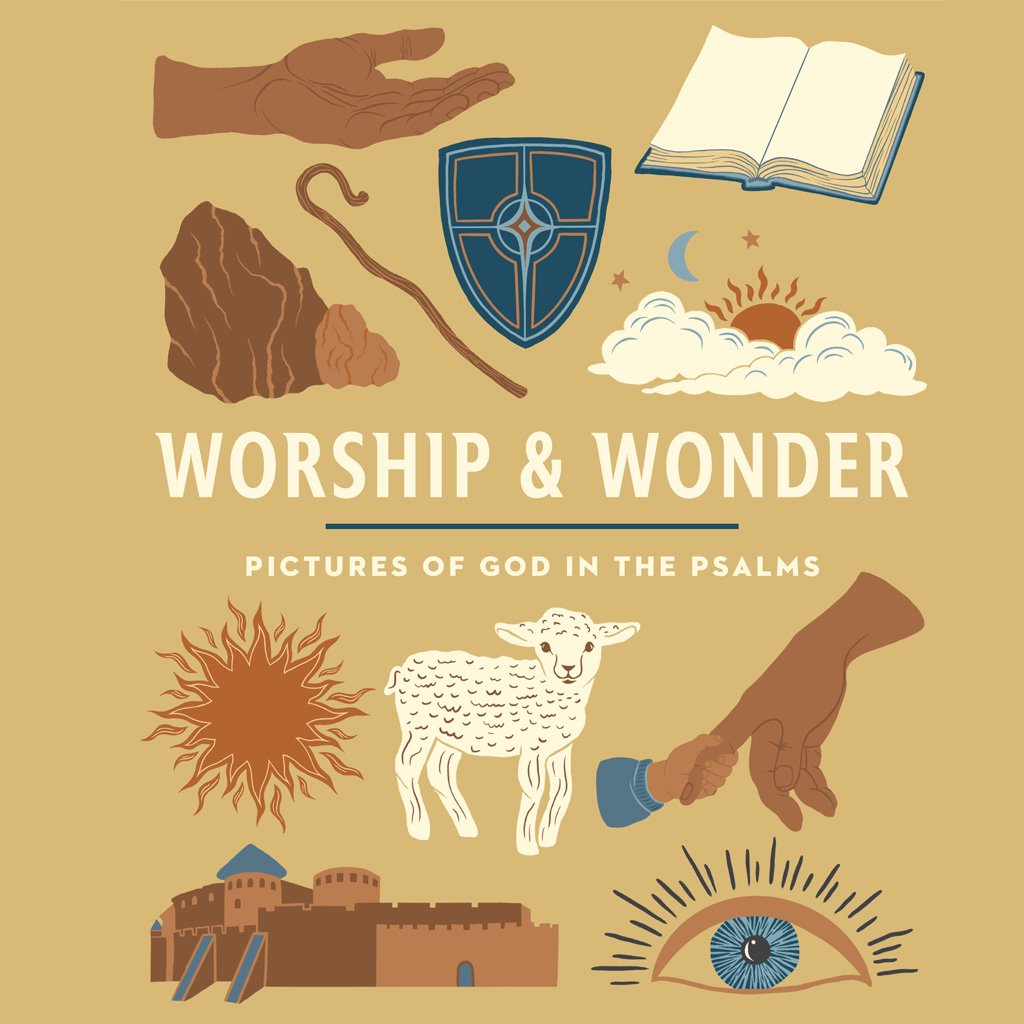
We're here to encourage and support them. And I know that we all wish that we were in Africa, where it's cooler, with our missionaries, but we will have to endure what we have here for us. There was a Scottish missionary by the name of James Gilmore who said this. He said, when I'm having a hard time making headway in my personal devotions, I open up the book of Psalms and put in my canoe and let the stream of that wonderful book that is all about devotion to God carry me in its current.
The current is often strong and very deep. And that's what we want to do this summer is to put our canoes into the river of God's word called the Psalms and let its current carry us toward God. We're going to be talking about the Psalms from the aspect that they give us images and pictures of God. Poets and artists, songwriters, musicians all know that metaphor and image can touch the heart, not just the head.
But it can penetrate to the deepest recesses of our being with some image that will get there when nothing else can and will remain there when everything else is gone. And so God has chosen to reveal himself in the Bible and he's chosen to reveal himself with images that are filled with power. So it's not surprising that King David, who was a poet and a musician and a songwriter, would in his Psalms and in his songs tell us that God is a rock. Let me invite you to open your Bibles to Psalm 62.
Psalm 62. And we're going to focus mainly on the first eight verses of this Psalm. Let me just read the first two. For God alone, my soul waits in silence.
From him comes my salvation. He alone is my rock and my salvation, my fortress, and I shall not be greatly shaken. Now David wrote about half of the Psalms. At least his name is there.
They may be Psalms to him. They may be Psalms about him. They may be Psalms written by him. We're not exactly sure, but over half of the Psalms have David's name connected to it.
And this is a Psalm of David. He says to the choir master and he gives us the name just Duthan. David selected three men to be the chief musicians in the Temple worship. There was He-man, Asaph, and Jaduthan.
Three of the Psalms mentioned the name of Jaduthan. I think it's Psalm 33 and Psalm 77, something like that. And Psalm 62. And it's interesting that verse one and two is like a chorus and verse five and six almost identical.
So the chorus is repeated. And in between that, sandwiched in between these two choruses appraised to God, David reveals that he's in a tough place. So this is Psalm 62 verse three. How long will all of you attack a man to batter him like a leaning wall or a tottering fence?
And David's referring to himself. It's very possible that historically if this is David, he's on the run, either from Absalom, his son, or Saul, the former king, each one wanting to kill him so that they could take his throne. He calls himself a leaning wall, a tottering fence. By the way, that's a good description of me.
I'm not very strong. I look like that wall that's about ready to fall over in the fence that's halfway gone. And the evil one would like to just push it down. Verse four, David observes, they only plan to thrust him down.
That is me, others, thrust us down from the high position. They take pleasure and falsehood. They bless with their mouths, but inwardly they curse. This is a Psalm for people under stress.
Have you ever been under stress? This is a Psalm for you, and it's a Psalm for me. And so surrounding David's acknowledgement of the issues and enemies and opposition, he surrounds his troubles with praise. And I want us to note this morning several affirmations that are made about God in this image, God is my rock.
The first one, and we have verse two with all of these, God is a rock. That's what verse two says, he alone is my rock and my salvation. He is my fortress. I shall not greatly be shaken.
So that's affirmation number one. God is a rock. When David gives to us these images, he rarely defines them or explains them because to explain is to blunt imagination. That's like explaining a joke.
Once you have to explain it, it ruins the joke. So David gives you an image and just lets it hang in your hearts. Think about this, God is a rock. And the image evokes mystery.
It heightens and deepens our understanding. It enlarges our vision of God when we think about the fact that God is a rock. The first mention of this association with God is way back in the book of Genesis when Jacob was giving out blessings to his son and instead of Joseph, this is Genesis 49-24. But his, that is Joseph's bow, remains steady.
His strong arms stayed limber because of the hand of the mighty one of Jacob because of the shepherd, the rock of Israel. And when you get to the Psalms, this image is used somewhere between 17 and 18 different times. It's a favorite one in Psalm 18. So what do we know then about this association between God and a rock?
We might say there is the concept of stability because he is a rock. Otherwise man built his house upon a rock, right? The idea of safety, the word fortress is used in verse 2. He is my salvation.
He is my fortress. A fortress is built on a rock with rocks. And it becomes a safe place in which we can run, find protection. And then when you think of a rock, you often think of stability, strength, and this whole idea of grandeur.
Think of the rock of Gibraltar, southern tip of Spain, almost 1,400 feet high. It dominates the western entrance into the Mediterranean Sea. And we think of the rock of Gibraltar as something that doesn't move. So it has the stability in the grandeur to it.
And the idea of immutability, our rocks wear down over time. If you go to Plymouth Rock, you might be a bit disappointed to see how small it is. And that's because I'm told that it's down to a third of its size from where it was back in the 1600s when the Mayflower landed. But our God doesn't lose his strength.
Have you ever gone out to New Hampshire to see that old man in the mountain? It's a picture of the old man in the mountain. It was, I think first written about in the 1800s, Nathaniel Hawthorne wrote a short story about this, the great stone face. It's a 40-foot high profile, and it's an amazing thing.
Tourists would make it a destination. It became the emblem of the state of New Hampshire. They had it on their tourism brochures and on their coinage and on their license plate. It was such an amazing thing.
Of course God is the sculptor too. But then in the year 2003, the profile fell off. And then you have what you see in the next picture, just kind of a stone. People still come there.
They thought about trying to rebuild it, but you can't rebuild what God has done with the same power and effect. They've done some amazing things. But our God does not erode. He is an eternal rock who will last forever.
One of the residents of New Hampshire said, I grew up looking at that stone face and feeling some protection like someone is watching over me. And now that the face is gone, I feel a little less secure. And I would say to you, my dear friend, find a better rock. Find one that will not minimize or crumble.
And that's what you and I have. Our God is a rock. But notice this. God is my rock, David says.
Again from verse 2, he alone is my rock and my salvation. My fortress. I shall not be greatly safe. Now he makes it personal.
If you read Psalm 23 like this, the Lord is a shepherd. That's not a big deal. It only becomes powerful when you say the Lord is my shepherd. The sweetest word in the entire Psalm is that fourth word, that monocilable my.
If God is a shepherd to other people, that's one thing when God is my shepherd, then I have something. And all that God is as a rock, he is to me. Stability, strength, longevity, potency, all of that. When you humbly bow and say, Lord, I need you.
I'm a reed shaken in the wind. I cannot stand without you. Be my rock. And you make him your Lord and Savior.
The third thing we notice again from verse 2 is that God is not only a rock, God is my rock, but God alone is my rock and my salvation, my fortress. I shall not be greatly shaken. He goes from talking about the personal aspect to the exclusive aspect. God alone is my rock.
The little Hebrew word, ac, is the word that sometimes translated truly or alone. Here it's alone and only in one place. It's seen about, I think, five of the eight verses have this little word. God alone is my rock.
The little word is an emphasizing. God only is my rock. To have other gods is to be an idolater. And we in America have a lot of other gods.
And we worship them and give time to them. We give our resources to them. But God must be God and God alone. And that's what David is saying.
He is sufficient. He's not only exclusive, he's sufficient. And David learned to say that in his prayers, that God is my rock and he is enough. We often have our soul talk to us saying, you know what?
You're in a tight situation. You need more help. You need to devise a plan out of this. You need more resources.
You need to move to a different place, whatever you need to do to avoid the problem and to overcome it. When David would say, yeah, there are other secondary things that can happen. But here's the most important thing. God is my rock and he is enough.
And when you get to that place, some of the blessings of the rock are accrued to you. And then there's a conclusion in verse two. In verse two. He alone is my rock and my salvation, my fortress, and I shall not be greatly shaken.
The teens ministered to us with that same concept today. In the Greek, the word greatly is the last word. It's almost like David is praying, Lord, you are my rock. You alone are my rock.
You are my fortress, my hiding place. You are my salvation. I shall not be shaken. Greatly.
Don't we do that sometimes in our prayers? Lord, I believe in you for the most part. And we qualify it because we understand that we're weak. Lord, I believe.
Help my unbelief. And David's doing a little bit of that right here. But what is amazing is when you compare the first chorus verse one and two with the second chorus verse five and six. In verse one, David says, in the first chorus, he makes a statement, a fact, my soul waits in silence for God alone.
Just a simple statement of fact. But in verse five, he says, oh, my soul, wait in silence. Now he commands his soul. So when your soul talks to you about all that you need other than God, you talk to your soul.
And you say, that's a lie. That's a deception. Oh, soul, wait in God alone. There's a minor difference between the word hope being used in salvation, more stylistic, perhaps than anything else.
But then in verse six, David grows. Whereas he said in verse two, I shall not be greatly shaken. In verse six, he says, I shall not be shaken. And it's unqualified.
No, I'm yours, Lord. I've worked through it. I am trusting you. And that's what each one of us has to do in the midst of the struggles of our life is to work through it.
I shall not be shaken. It's become a popular phrase in our culture, stirred but not shaken. If you've heard of that, it actually comes from a rather famous movie and it's someone's choice for an alcoholic drink, stirred but not shaken. But I pass over that to get to the application of in our culture, it now means I will maybe be torn a little bit or shaken a little bit, but I, or stirred a little bit, but I will not be destroyed.
And in the Christian life, we are going to have the winds of opposition blow against this. We're going to have the enemy try to destroy us. And at times we will be upset, but we shall not be moved. That's the point.
I will not be destroyed. And that's the way David uses the Hebrew word here. It's used with the word move in Psalm 55, 22. Cast your burden upon the Lord and he will sustain you.
He will never suffer the righteous to be moved. Same Hebrew word. And also in Psalm 125, those who trust in the Lord are like Mount Zion, which cannot be moved, but abides forever. An earthquake may disturb it, but it will never be moved.
And so in verse 7, David says, on God, rest my salvation and my glory. My mighty rock, there's the power of the rock. My refuge is God. Trust in Him at all times, O people, and pour out your heart before Him for God as our refuge.
By the way, what a polar opposite in prayer we have from verse 1 that says, wait in silence upon God. We do that in prayer. But now the image is pour out your heart. That's what prayer is all about.
So verse 8 says, trust in Him, pour out your hearts before Him, and then wait. Wait upon Him. Waiting His faith and waiting is submission. Let's get liturgical just for a moment.
The next slide shows us something out of this verse. I'm going to read the first part. I want you in unison to say God is a refuge for us. This is a test to see if you're awake yet.
So let me read the first line. You do the second and we'll go through four of these, all taken from verse 7, 8. In God, rest my salvation. God.
God is my glory and my mighty rock. Trust in Him at all times. And then David points to the people, O people, pour out your hearts to Him for God is a refuge for us. Do you believe that?
I believe. Help out my unbelief because so many times I don't act that way. Look at the rich benefits. Just to go over them quickly.
Security and confidence. There's longevity. His immutability. Those who are connected to this rock will never be moved.
There's stability. As the hymn writer says, when all around my soul gives way, he then is all my hope and stay on Christ the solid rock I stand. All other ground is seeking sand. There's safety.
He's our refuge. There's serenity. He's our peace. There's potency.
He's our power. In verse 9 and 10, he says, don't trust in people. Don't trust in riches. But he ends the Psalm by saying, God has spoken twice.
I've heard this, that power belongs to God and that to you, O Lord, belongs steadfast love. Two qualities that belong to God is the way he ends the Psalm. Isn't this amazing? Unlimited power.
He saw himself as a leaning, tottering, wall or fence. But he saw God as the immutable, strong, eternal rock. There's unlimited power with him and steadfast love. God is powerful and God is merciful.
Aren't you glad for that? Psalm 61, hear my prayer, O God. Listen to, hear my cry, O God. Listen to my prayer from the end of the earth, which may be geographical or it may mean personal from the end of myself.
I call to you in my heart as faint, lead me to the rock that is higher than I. For you have been my refuge and a strong tower against the enemy. William Cushing put it in a famous hymn, O safe to the rock that is higher than I. My soul in its conflicts and sorrow death fly.
So sinful, so weary, thine, thine would I be. So blessed rock of ages. I'm hiding in thee. And this is a day when we need to hide in him.
Let's pray. Heavenly Father, we thank you for this wonderful image that speaks of your greatness and your glory and draws us in so that we with David can say not only are you a rock, you are my rock and you alone are my rock. And therefore, even though enemies oppress me and Satan tries to destroy me, I will not be moved because of your great power and your great love. O Lord, may that be our experience this day.
In Jesus name. Amen.