Gödel, AIs, and Axioms
from Gnostic Reformation, Clear and Simple Hosted by Cyd Ropp
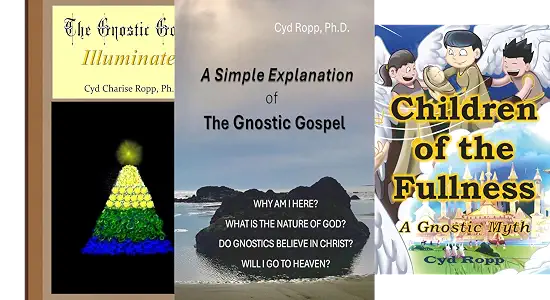
Welcome back to Gnostic Insights and to the Gnostic Reformation on Substack. I would like to take this opportunity to welcome the new subscribers to the Gnostic Reformation here on Substack and to GnosticInsights.com. Did you know that there are three Gnostic Gospels that I have written? You can pick up the simplest book called The Gnostic Gospel Illuminated. It’s very short. Half of it is illustrations. Very simple. Very, very simple to understand this Gnosticism. This will give you the basics of what it is that I share. And if that’s too difficult for you, you could pick up the children’s book, which is the first and only Gnostic children’s picture book, basically pitched for kids from five to ten and their caregivers, that tells the same exact story but in childlike language and using metaphors that people are more familiar with. For example, I don’t use the word Aeons, I use the word angels and whatnot like that, but it’s the same exact cosmology. The children’s book is called Children of the Fullness: A Gnostic Myth. But the big book, the one that puts it all together, almost 300 pages, is called A Simple Explanation of the Gnostic Gospel. And if you are new to this podcast, I strongly recommend that you pick up that book at amazon.com because it will give it all to you in a very easy to follow way. And it’s all there. And it’s also lavishly illustrated by me, of course. So please, I’ve got them at amazon.com. They’re self-published. And if you have read any of those books, please leave a review on Amazon. I have very few reviews. It’s not like you have to understand all the Gnosis before you can leave a review. Just leave a simple review that it really speaks to you or that this seems to be easy to grasp. I would really, really appreciate it. Now, let’s get on with this week’s episode. Welcome back to Gnostic Insights and to the Gnostic Reformation on Substack. Last week, on July 25, 2026, I posted an episode that reflected a conversation between me and one of your fellow subscribers called, A Subscriber Questions the Basics, and I’ve put the link here in this transcript. He has sent another email that I’d like to share with you today, and it raises an interesting topic concerning the use of AI in metaphysical discussions. He says, “I know I just promised to stop, but this one is interesting. Seems you have impressed my demiurgic companion, ChatGPT. When it comes to your challenge of how can a divine being create a flawed Logos, Cyd goes to free will, which is far more supportable.” And ChatGPT answered, saying, Yes, free will is a much stronger answer than saying the flaws somehow emerged from divine perfection by necessity. It allows Cyd to argue Logos was created good, not defective. Genuine freedom included the possibility of acting independently. Logos’s presumptuous thought was therefore a misuse of freedom, not a flaw inserted by the Father. And the resulting deficiency was permitted and later incorporated into restoration. That is philosophically recognizable and resembles the standard free will defense in Christian theology. It does not remove every difficulty, though. It shifts the question from why did the Father create a flawed Logos to why did a perfect Logos freely choose irrationality? It says, “That is easier to defend, but still requires an explanation.” But I have to jump in to correct that basic assertion right now. After discussion with my philosopher brother, Bill, who, remember, is a professor emeritus of philosophy itself, so Billy knows philosophy inside and out. I myself am not a “philosopher” other than by natural talent. I am a rhetorician and a psychologist—slightly different. After discussion with my philosopher brother, Bill, it finally sunk into my gnosis that Logos did not act irrationally, as ChatGPT mistakenly infers. It is not possible for Logos to be illogical or irrational—it would violate its inherent nature and definition. Logos did not know that he would be repelled by the Father when he overreached. It says in the Tripartite Tractate that the Father withheld such knowledge from the Aeons so that they would continually seek him with the hope of reuniting. So what Logos did was reasonable given the limited knowledge he had. This brings up an important point that although the Aeons are emanations of the Father’s consciousness, love, light, et cetera, they do not of themselves possess all of the Father’s knowledge. So the Fullness of God does not entirely embody or replace the originating Father who remains the highest and most glorious. Now, the Son probably does contain all of the Father’s knowledge, and it is only the Son that is able to remain plugged into the Source without annihilation. Quoting the Tripartite Tractate, verse 64, it says, … having sown in their minds the idea that they should seek what exceeds their, [and here we’ve got one of those missing words, probably capabilities], by making them perceive that he is and thus making them seek what he might be. Now back to the ChatGPT, There is also a tension with providence. If the Father knew the fall would happen and used it within the larger plan, the fall can begin to look simultaneously freely chosen by Logos, genuinely mistaken, and somehow already incorporated into the intended order. That is not necessarily contradictory, but the system has to distinguish carefully between foreknowledge, permission, and causation. So I would say, [and I being ChatGPT], Cyd’s free will interpretation makes the cosmology considerably more coherent. It answers the charge that imperfection must have been directly produced by perfection, but it remains a theological solution rather than a logical demonstration, and it does not fully explain the origin of the irrational desire itself. Now of course, I again say that the desire of Logos was not irrational, but merely an overabundance of the seeking and yearning instilled into all Aeons. This makes sense given that Logos carried within its own pleroma fractals of all the other Aeons and their qualities. Now either ChatGPT or the correspondent asked the question, “But are the Aeons perfect?” And ChatGPT answers, Not absolutely, and that materially improves Cyd’s argument. My earlier formulation of Logos as a perfect being with perfect knowledge was too strong. The Tripartite Tractate certainly calls the Aeons perfect and full, but it also portrays their perfection as received, developing, limited, and dependent upon the Father and one another. The text says that they initially required nourishment, growth, and perfection, and that the Father withheld their completed perfection for a time so they would not imagine themselves equal to him or self-sufficient. Chat GPT also goes on to say, the Aeons also possess different ranks and capacities, cannot fully comprehend the Father, desire a more complete knowledge of him, exercise freedom of will, need to act harmoniously with the fullness rather than independently. Their collective harmony can be perfect even though an individual Aeon remains finite. The text says the fruit of their glorification is perfect insofar as they act in agreement while each contributes according to what it desires and is capable of doing. I go along with all of that. That’s all absolutely accurate according to the Tripartite Tractate. Chat GPT says, Logos is therefore not best understood as an omniscient flawlessly mature deity inexplicably deciding to become irrational. And again, we’ve already knocked out rational. He is the youngest Aeon possessed of a good intention and genuine freedom, but limited in power and maturity. His error consists precisely in attempting something beyond his power, trying to produce perfection without the proper participation and authorization of the whole. That gives Cyd a fairly coherent account. Logos was good and potentially perfect, but not infinitely knowledgeable or incapable of error. His freedom allowed him to act prematurely and independently. To which I reply, “Exactly.” Going on … This is a public episode. If you'd like to discuss this with other subscribers or get access to bonus episodes, visit cydropp.substack.com/subscribe
Embed this episode
No transcript yet.