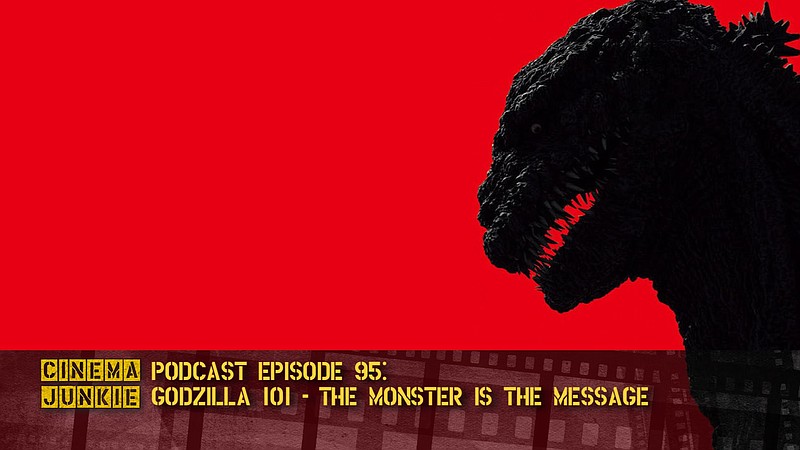
KPBS On Demand is supported by the Museum of Photographic Arts at the San Diego Museum of Art, presenting Cecil Beaton's Fashionable World through January 10. Spending the 1920s through 1950s, the exhibition includes fashion photography for Vogue, portraits of Hollywood stars, and more. Welcome back to another edition of the KPBS Cinema Junkie Podcast. I'm Beth Accomando. For the first time in 12 years, we have a new Godzilla from Japan in theaters on the big screen. So this is exciting news for anyone who is a fan of Godzilla and kaiju or giant monster movies. So for this podcast, I want to talk all about Godzilla. Godzilla, king of the monsters. Incredible titan of terror. Wiping out a city of six million in a holocaust of flame. Jet flame cannot destroy it. Bombs cannot kill it. All modern weapons fail. Is this the end of our civilization?
Can the scientists of the world find a way to stop this creature? For the answer, see Godzilla, King of the Monsters. You may wish to deny it, but your eyes tell you it's true. A tale to stun the mind. More fantastic than any ever written by Jules Byrne. More terrifying than any ever shown on the screen. Awesome. Incredible. Unbelievable. A story beyond your wildest dreams.
Dynamic violence. Savage action. Spectacular thrills. Godzilla, king of the monsters. Fantastic beyond comprehension. Gripping beyond compare. Astounding beyond belief. The mightiest monster of them all.
See Godzilla, King of the Monsters. But if you're not familiar with Godzilla, don't worry. We're going to have a little bit of a Godzilla 101 for you. And I have a professor here to talk about that. And this is Professor Rami Tataishi, who is an assistant professor at National University. He also serves as the program director of the Masters in Film Studies. And he's fortunate enough to be teaching a class on world cinema focusing on Japan. And in December, his students are going to be lucky enough to be focusing on Godzilla himself, big G. And I am so envious of both his students and the fact that he's being paid to teach a class on Godzilla. So Rami, welcome to the show.
show. Thanks, Beth. Thank you for having me. So to start off with, let me find out, how did you first get introduced to Godzilla? What is your first memory of Godzilla? The first Godzilla film I ever saw would have been, it was late night on TV. I think we just come from the airport or something like that. And I turned it on and it was Godzilla versus Megalon.
Which was fantastic as a kid. The older you get, the more you realize it's not a really great film. But as a kid, it was just fantastic. You saw all these, well, you know, I was a big fan already of Ultraman and Ultra 7 and these kind of shows. I grew up in Hawaii where we had all of these shows playing all the time. All of these superhero shows and monster shows, fantasy shows, science fiction shows from Japan. And so I was already accustomed to seeing Ultraman and all the monsters like that. But to see this movie, Godzilla, and it had, you know, multiple monsters in it. It was kind of that movie, Godzilla vs. Magalon, was sort of like a tag team version where you had Godzilla and his robot partner versus these other two monsters.
Just seeing something like that on a kind of a scale, that was just fantastic. Again, when you're a little kid. So that was my first experience seeing Godzilla. And what was it about Godzilla that appealed to you? Because for American audiences, a lot of people look at Godzilla and a lot of these kaiju films from Japan, and they see a man in a rubber suit acting as these monsters. So what was it about Godzilla himself, this creature, this monster, that appealed to you as a kid? As a kid, I think, again, if you grew up around these Japanese...
TV shows that feature kaiju every week. Typically, they're the villains. But now seeing a kaiju as a hero, well, that's a big difference. It's like a complete 180-degree shift. And it wasn't just that. It was that in those 70s movies, like I just mentioned Godzilla vs. Megalon, the first one I saw, was one of the 1970s films. Godzilla had become more of this sort of cuddly, heroic, friendly creature.
You know, that's just so interesting and so novel to see because, again, you're used to seeing these creatures as villains. In fact, one of the Godzilla suits was used as a villain twice in Ultraman, once in Ultraman and then again in Ultra Q. That was the first of these long-running Ultra series. So I think that was a big part of the appeal, just seeing that reversal, to see a kaiju or a giant monster as being the hero. And that was really neat. And, you know, eventually you learn that that was sort of unique to the 60s and 70s. If you go earlier, Godzilla was more, you know, Godzilla sort of changed his heroic or his villain status, you know, depending on what decade you were in. But starting with the 70s and the heroic Godzilla, yeah, that I think was the novelty of seeing Godzilla. Not just seeing a kaiju as a hero, but the fact that...
He was brought to life with such quirky personality by the suit actor. That was Haruo Nakajima in the 70s, who also played Ultraman monsters. But again, he had to play these monsters as villains. But playing Godzilla as the hero during that time period, he had this quirky little, you know, his happy dance when he would defeat the monsters and things like that. So he had that personality that came through that you don't get necessarily if it's a cartoon, like an animated monster. Well, I think that was the big appeal for me when I saw Godzilla was he had so much personality. And I felt like you could...
You got the sense that there was this actor inside the suit giving him this personality and endowing him with the kind of personality that you would expect from a human character. And that was just so appealing to me. It's interesting, too, how the movie monsters, because they had, you know, the suits were constructed, I guess, differently, you could say, than the kaiju for TV. The kaiju for TV, the latex was not as robust and the adhesive they used was not as strong. And so you got these very flexible sorts of monsters who could move more human-like on TV. In the movies, you know, they had, you know...
I guess I assumed they had bigger budgets and so they could spend more. And so you had these heavier monster suits with a stronger adhesive that didn't allow you as much flexibility. And that sort of contributed to the monster being heavier and moving more like a giant creature would, as opposed to looking maybe more human-like, I guess. And so I think that helped in the movies as well, with the portrayal of the monster. And you're talking about coming to Godzilla as a kid and seeing him in his incarnation that he was in the 70s. But for anyone who doesn't know, and even if you do know, let's go back to when Godzilla was born, which is 1954, and give us a little sense of...
Where did he spring out from? Because although we think of him as this pop culture icon, there's kind of a political context that he rose up from. Yeah, Godzilla arose from, well, it was one particular incident involving a boat and the crew got, you know, sick from the radiation from the bomb testing that was going on at the time. And so that led to this creation of a movie that dealt with that issue, but it got transformed into something much bigger and much different. And it took on this political, social, allegorical aspect when you introduce this creature. So you think, how can you...
express these fears and concerns about the H-bomb testing and the A-bomb testing. How do you represent that? And so it became this giant monster, you know, something that's indescribable and monstrous, of course, as a way of talking about these issues around the time. And for Japan in particular, it's the only country that's had two atomic bombs dropped on it. So they have very firsthand experiences with the horrors that that entails. And in the first Godzilla film, the actual Gojira that was screened in Japan, not kind of the Americanized one that inserted Raymond Burr into it, but this Japanese Gojira film.
had this sense of the horrors of having a nuclear bomb dropped on you. Yeah, there are scenes and shots that are just done very starkly, almost documentary-like, just focusing on, yeah, the carnage and just the devastation. There are scenes that echo what, you know, firsthand eyewitness accounts of the bomb going off was like. There are scenes like that in the film. Most notably, there's the scene where Godzilla fires his breath on the street and you just see this big wind.
sweeping down the street and then this big burst of light. And that's what firsthand accounts of the bomb going off is like. We saw a big wind sweeping everything away and then a big flash of light. Scenes like that had that allegorical dimension, definitely. And then when this film was initially imported into the U.S., it had a very different tone. Explain what happened. Yeah, Terry Morse gets credited with this Americanized version of Godzilla in which they inserted these scenes with Raymond Burr, I guess, for audience identification purposes. So the story is told through...
him as a reporter in Japan. And just that alone, just that framing device of Raymond Berg gives the film just a really different feel. So you're seeing everything filtered through this American eyewitness to everything that's going on, as opposed to just seeing the events unfolding amongst the three main characters like you would in the Japanese version. There's a new Godzilla movie out. But before we talk about that, which is what we're going to spend the bulk of this podcast talking about, I want to play a little round of Stump the Professor. It's not very often you can get a professor into a public radio station who teaches about Godzilla. And I just want to see how much he really knows. And actually, I'm pretty sure Raimi can get all of these because he's pretty much one of the biggest Godzilla geeks I know.
this CD that has sound effects from the Godzilla movies and in particular it has the sounds of all the different monsters and the different monsters from different times in their careers. So I want to play a cut of sounds from some of these monsters and you out there listening can do your best to see if you can identify which monster these are from. But I'm gonna play these and see how fast Remy can tell us who these creatures are. So first off let's play this one. Those are the cries of Mothra, who is one of my favorite, probably if I had to name a favorite monster, it would be Mothra of all of the Toho pantheon of monsters. Mothra is my favorite because it's the most limited in movement with just these two wings that flap. And so you really see the ingenuity of the creative team in placing this creature with very limited movement into these fight scenes. How do you make that visually interesting for, you know, these 10 minute climactic fight scenes at the end of a movie? So yeah, I think for that reason, Mothra is probably my favorite monster.
All right, so Remy's one for one. Those are the chirps of King Giedra's heads, the monster who was created in 1964. And I love those because it sounds like just like someone twiddling on an organ. But they tweak those sounds, and I think it sounds great for something that's just really alien-sounding, which, you know, Giedra's giant space dragon. So yeah, they did a great job with that. It's a very 60s-sounding organ, I think. Well, and Giedra is also one of the first more kind of overtly political creatures because the three-headed dragon represented China. Yeah, coming around in 1964, which was the first bomb test in China.
That was The War of Rodan, another one of these monsters who started off in his own movie and then eventually became the sidekick monster in a number of group monster movies. That's a great movie. I think the last half hour of the conclusion is just some really fantastic work. Damn, Rami, that's three for three. Seems like it's very difficult to stump you. Let's try one last one.
Okay, as a professor, I give myself an F if I didn't get that one, which is the roar of the original 1954 Godzilla. That's just a defining sound effect, not just in Japanese monster films, but I think just in general in science fiction and horror films. And can you give us a little background on what that sound was? Well, so there's differing accounts, but what they have in common is that it was the rubbing up and down by a leather glove or possibly a key or some friction-causing object on a contrabass string. rubbing up and down, and then manipulating the tape speed. That's how they got that sound effect. And interestingly enough, a similar technique was used to create the sound of Doctor Who's TARDIS, if you listen to that sound effect. All right. We haven't stumped the professor, but he has proved how much he does love and know Godzilla. And Godzilla has this long legacy. He's been with us for just over 60 years now, and we are now, this is the 30th film, correct? Something like that, yeah. So he's got this long legacy, and this year we have a brand new Godzilla from Toho Studios called Shin Godzilla.
It's exciting news for people. So we just came out of the theater from seeing it. So what is your initial response to this new Japanese Godzilla? I like this film. I would say it was more of a... Well, this is how I would characterize it. I would say it's more of a Hideaki Anno. Hideaki Anno is the director. I'd say this is actually more of a Hideaki Anno film about Godzilla rather than a Godzilla film. And in that sense, I really liked it. This director is sort of known for... He's a very kind of iconoclastic director. And he's really into sort of, I guess, being contrary or sort of defying expectations genre-wise. He's probably most well-known in the West for an animated series called Evangelion. Roger. Pod O2 Prime shifting into final mission orbit.
Similar to what I just said about his Godzilla film, if you look at Evangelion, I think one way of characterizing that series is it's not really a super robot series, but it's a Hideaki Anno animated series about super robots. So what he did is he took that idea of the super robot genre, which goes back in Japan to, I would say, the early 70s when the guy created these. super robots, these famous Majinga and Getarobo and Grandizer. I mean, that became like the super popular genre. And so Anno in Evangelion sort of deconstructed that genre. He sort of turned it on its head. And that's sort of what he did with this Godzilla film. Although in some ways, it's still kind of a traditional Godzilla film. So it's kind of both. But that's what I would say about it. I liked it as a Higeyaki Anno film about Godzilla. Well, it seems like a film that does have a lot of contradictions in it, because on the one hand, it seems like a film very much tailored to a Japanese audience. There are things in it that are very...
much part of Japanese culture that people in Japan would appreciate more than American audiences. Yet it also seems to be the film that in some ways acknowledges Godzilla's place in the world's global marketplace by having a number of scenes in English. It also seems very serious on some points and very jokey on others. So there seems to be like all these contradictions wrapped up in it. So let's tackle some of them. Sure. Let's start with kind of some of the cultural things that would play better to a Japanese audience that American audiences might not pick up on. Well, certainly there's a whole political dimension. I mean, much of the film is actually just dealing with actual...
politics, the political response to Godzilla. And again, this is sort of Anno's take on it. What he was showing was more of the society's infrastructural response to Godzilla, rather than being about Godzilla, in a sense, and being about identifiable characters, really. If you look at that first Godzilla film, it was really about this sort of triad of characters. There was scientists, this sort of tortured scientist, his girlfriend, and then a sort of rival to the scientist. And then there's also another elderly scientist, the father of the girl. And it was really through these characters that you got the story of Godzilla. Now, in this new Godzilla film, it's really more about sort of society's response to Godzilla and how to deal with this.
creature, again, on sort of this infrastructural, political level. I think one thing that Anno did, what I was just saying in terms of it being, you know, an Anno film about Godzilla rather than a Godzilla film, something that he really consciously did, and you can see this a lot in the beginning, he kind of lessens, he kind of lets up on this as the film goes on, but he really sort of limited audience identification with characters in the very beginning of the film. You see just these very quick cuts. I almost wanted to start timing it to see how quick these cuts were. These shots were lasting like, you know, five or six or seven seconds, and you didn't get a chance to really engage with these people on the level of being characters. What they were is, it was more important what position they held or what viewpoint they held, rather than thinking of them as being, you know, identifiable.
human characters. And you got the wide range of responses from all the different cabinet ministers. You know, how would this division of the government deal with it? How would this division of the government deal with the problem of Godzilla? And so that kind of focus, I think, really looking at the political infrastructural aspect is something that played, yeah, definitely plays more toward the Japanese audience, particularly in that, you know, it was this sort of satirizing, I don't mean to say parody, it's not a humorous intent, but it's critiquing and commenting on the government's reaction to the recent disasters that they've had in Japan, the earthquake.
Well, and also it's politics, but politics in a very Japanese context because American politicians behave a little bit differently. But here there's this incredible sense of like order and protocol and the proper way to present things and going through exactly. the right steps for everything, which I mean, I think the satire comes in and kind of looking at the bureaucratic red tape that goes on also. Yeah. And another part of that that was, I think, one of the themes of the film was how to manage or manipulate information. And that could be, you know, again, part of the political aspect that might play more to a Japanese audience than American audience. It's also partially the satirical aspect that you mentioned. But there's a lot of things about how do we know what we know and who controls what we know? How is knowledge managed and how is information managed?
Just all kinds of scenes in the opening of the film really lent themselves to that. Like I remember there's one part of the cabinet meeting where, and it's again, it's one of these shots that doesn't allow you to really identify with these characters as people. It's this panning shot and you just see, you're going from right to left and you just see all these people, this mass sea of people. And they're talking about their response to Godzilla. And at one point, the screen just cuts to black and says, information redacted. And then we cut back to the cabinet meeting, which brings up another theme, which is...
I think that was another theme in the film is whose perspective are we getting in terms of both telling the story and also who decides who gets to do what with Godzilla. There's a whole international sort of tussle over who owns Godzilla and who has the right to do, to carry out what kind of action to resolve this Godzilla problem. You know, Russia, China. The UN gets brought in. Yeah, the UN gets involved. Yeah. There is a movement centered on China and Russia to take Godzilla from under the control of the Japanese government and put it under the control of international organizations. Many countries are aligned with the opinion too. However, as for this government, we strongly hope that Japan and the U.S. can perfectly control Godzilla together.
Okay. Another shot I remember that dealt with this whole idea of information is there's the first shot that we get is the tail flailing in the ocean. And it's kind of a, this is a subjective view, I guess, but the way I looked at it, it wasn't a very well done shot. I mean, it wasn't super realistic. It looked kind of like a CGI shot of a tail flailing around. And then you cut to the scene of these professors that they brought in to ask, you know, they're asking their opinion of how do we deal with Godzilla. And one of them said, well, we have to judge is this even real? Maybe this footage is faked.
Well, there's thoughts, too, of when, because the film begins with this fountain of water spraying up in Tokyo Bay. They don't know what it is. It looks like, it looks pretty bloody in the water. You're not quite sure. You don't see anything of a creature at first. And in those initial stages, you have all these people with their cell phones standing, probably taking photos, posting on Instagram, whatever. So you get that whole sense of the world is kind of getting information from all these cell phone users. And the news is just like reposting some of this information. And then you get this professor or scientist talking about, well, we don't even know if that's real. So, I mean, all that stuff. What I find interesting about the film, too, is that it's very much.
a pop entertainment film. I mean, you can go into this film and not pull any political or social message out of it and have a good time watching it. But if you do look at it, there are all these other aspects that are being tapped into and addressed within that pop culture realm. Yeah, that whole dimension of people with cell phones and cell phone video, that adds a whole other layer to this idea of information and who gets to control what kind of information and how do we know what we know about Godzilla, which was a theme in the first film. This is one of the ways in which the film is both traditional and yet...
It takes a spin on it. In the original Godzilla, there was a whole sort of subplot about the public versus the government and the government withholding information from the public. And then there's this big citizen's forum and they demand to know what's going on. And if you take that same idea, but you put it into the 21st century, well, you've got to play it really differently because now everyone's got cell phones. And this idea of having proof or footage or whatever, that idea is just completely different. So you've got to deal with it differently. And this film did that by having these scenes with a cell phone video. And it's instantly just transmitted worldwide. So instantly the whole world knows about Godzilla. And no matter how much the government wants to keep anything a secret, they have no control over this public that's sharing on social media. Yeah. And there was a shot of text.
or cell phone transmissions, and the screen is just filled with all the Japanese characters of everyone texting about what's going on. There's a scene where this team that's charged with taking care of the Godzilla problem, they're looking at online forums and looking at what all these people are saying about it. So that whole idea of information is just, you have to think about it completely differently now in the 21st century as opposed to in 1954. And I think Anno did a good job handling that. Well, just the title alone, the American translation for the title has been called Godzilla Resurgence. But the Japanese title is Shin Gojira. And we were talking about what that word Shin means. And explain what that is, if you translate it more literally. Yeah, Shin.
Well, it's interesting because, you know, Japanese has a couple of different writing systems. If you use the pictograph writing system, that's kanji, and that's the system that was imported from China. Shin can be read two ways. It can mean either true or it can be new. And either of those are applicable to this new film. So if you call it Shin Gojira, it could be true Godzilla or new Godzilla. But they didn't use that pictographic character in the title of the film. They used katakana, which is the system that you use for writing.
foreign words. And so they spelled out Shin with these katakana characters, which on one hand is, it sort of fits along with how you write Gojira, that name. So it looked, you know, all the same. All the characters in the title are in that same katakana, as opposed to having Shin in kanji and then Gojira in katakana. But it's interesting that they did that. Well, in this film, this is kind of a rebooting of Godzilla. We've had 12 years without him from Japan. We've had an American film in between. And so to me, it feels like, okay, we've left this series for a little while. Toho's now coming back to it. They're looking to the future of possibly relaunching the franchise.
with a new series of films. And this, both a new Godzilla and a Godzilla that references his past. So we've got the sense of relaunching the franchise. So there's an interesting scene in this film because it's taking the perspective of these people have not seen this creature before. Godzilla hasn't existed in the past. So there is a scene regarding the naming of this creature, which was kind of interesting because the name comes up in a scene where a lot of the dialogue was in English because there's a Japanese-American envoy from the United States.
How did you read this scene? fascinating. That was such an interesting scene. I really want to look at that scene again. So apparently in this version, the name Godzilla comes from a scientist, the Japanese scientist who sort of did the first work on Godzilla and came up with a name. They discuss that maybe the etymology of it comes from God. So this creature is godlike. Later in the film, we talk about him possibly being immortal. But yeah, it's the Japanese-American character who brings up this possibility that maybe this scientist character named Godzilla with the root God in it. So the etymology of the name would be English then, if that's the case, which is interesting. So if Godzilla was originally an English word in this film, which it is, then you would render it in Japanese through these
characters. He's got the kind of characters. But now what was fascinating is there was a shot lasting just a couple of seconds. It's again one of these shots that I think Anno is... specifically designed to sort of frustrate your attempt at understanding what's going on or to limit your perspective or to manipulate information somehow, is that this one character holds up the professor's folder where he wrote the name of the creature. And he didn't write it in the way that, again, it's always been written since 1954. That name has always been rendered in the Katakana characters, Goji in Da. But in this one shot that lasts for just a couple of seconds, you see that the professor wrote the name Goji in these kanji characters where each character represents the idea or concept. So I really want to see which kanji characters the professor picked as being the ones to represent the sounds Goji in Da, because each one of those...
Now, as opposed to just being a syllable, the intent of which is to replicate the sounds, the American sounds of God, ze, and love. Now, each one of those characters has a meaning associated to it. So I want to know what those three meanings are. The name Godzilla has never been rendered that way. So I really want to see what that is. Can't wait for this thing to come out on DVD so I can pause it and take a look.
Well, the other thing about these cabinet meetings that are so prominent in the film is in the initial part of them, they are so orderly and symmetrical and everybody is kind of in the same blue suits. And that is such a stark contrast to what happens when Godzilla finally hits. And there's this absolute chaos. So you get, again, talking about these contradictions. There's another theme running through the whole film of idealism versus reality.
Certainly in the first part of the film, the first example of it is these very idealized orderly cabinet meetings, like you're saying, where, oh, let's discuss X, Y, and Z, and we'll discuss it to the nth degree. But on the outside, you've got just total chaos breaking out. And this theme... It takes a different form as we get into the later half of the film where you see the ideals of the people, you know, this team who we come to sort of associate with as being sort of the good version of the government. These are the ones who are going to get things done. The special task force that's been put together to deal with the Godzilla problem. You see their ideals versus the reality of how do we actually implement these things and what are the obstacles to us resolving the Godzilla problem. Well, in this team you talk about, they're identified specifically as like the lone wolves, the nerds, the rebels, the outcasts, which in Japan, that's an even kind of, that kind of puts you even further outside of the accepted circle because those values aren't quite.
looked upon the same way. In America, we kind of look at the lone wolf, the iconoclasts. We elevate them in our pop culture, not so much in our day-to-day life, but in pop culture. But in Japan, you can imagine those people being a bit ostracized from the mainstream a bit. Definitely. And you can see that again as sort of whatever perspective you want to take, if you want to look at the satirical aspect or the political aspect, that the actual politicians that we saw in the first half of the film couldn't get things done. So, okay, now it's these people's turn and let's see what they can do. Is this sort of...
idealized version of what government should be. Going back to the idea about information and communication, what we see when we get that second team in the second half of the film, the lone wolves and the outcasts and the rejects, is information becomes much more open and shared, not just amongst themselves, but you start to see greater cooperation between these people and the other aspects, the other components of society that they need to get this plan to work. They need to manufacture this chemical. They need to get the vehicles in order to... shoot the chemical. So anyway, everything starts working because they're sharing this information. I think part of the, if I'm remembering it right, part of the deal was that they agreed to share information with, I forget if it was Germany or France or something like that. France, I think, yeah. Again, that theme of manipulating or controlling information and knowledge, it sort of gets turned on its head and it becomes a different thing in the later half of the film where you start to see, okay, so this openness and this sharing of information as opposed to it being always sort of obscured and uncertain like it was in the beginning of the film. And that turns out to be one of the keys to resolving the Godzilla problem. Well, another aspect of the politics that's addressed is Japan's relationship to the United States, which...
has always been a bit problematic because of the way World War II came to a conclusion. And so in this film, there are a number of things that are raised that are pretty fascinating. One involves the United States suggesting a nuclear attack on Godzilla, which means dropping another bomb on Japan. And also, you know, this sense of how Japan deals with this notion of going to war or to militarize. I mean, there's a lot of aspects of it that address...
our relationship between the U.S. and Japan. What were some of the points that kind of stood out the most to you about that? The political dimension was really interesting because it starts off definitely with this U.S.-Japan relationship and they talk about should we do, you know, should our actions be these unilateral or bilateral actions? But eventually it becomes this geopolitical thing where they start drawing all these other countries into Russia, France, Germany, China. They all, you know, start taking a role in the scenario. So that was really interesting. That hadn't been done since I think Godzilla vs. King Gijo, which was in 91, where you started to see how does this Godzilla situation affect the global?
politics uh there was and it wasn't a real big aspect of that film but you did start to get a sense and it struck you as being really interesting in that film because the godzilla series had never done anything quite like that before with these really explicit mentions of you know the geopolitics at the time this film it just you know pushes that to such a degree where again it's really sort of that's kind of what the focus of the film is it's more of the infrastructural and political response to godzilla rather than being about godzilla anyway that's one way of looking at the film. Something interesting about the U.S. role in the film, I noticed a couple of times where the subtitles were a little, not off, I don't mean to say that, but things are translated a little bit differently. One scene that stood out in my mind, you're asking me about different moments that I perceived and how the U.S. was portrayed. When the U.S. does the bomb strike on Godzilla, they hit it, and for the first time it seems like Godzilla's finally showing some weakness, like he succumbs to the attack and he starts bleeding.
The Japanese were looking at it and saying, yeah, we can confirm that the bomb strike has made Godzilla bleed. One of the characters responds, Sasugano USA. That was subtitled as Way to Go, U.S. So it seems like it's this very positive reaction. What that line actually means is a more accurate translation would be that's what we expect of the U.S. So that's to be expected of the U.S. And so it's not as straightforwardly, you know, this positive affirmation of what the U.S. did. So there were moments like that that struck me. I can't remember any offhand, but there were times like that, I think, in the subtitling. Well, there were also interesting points where at certain points, the Japanese...
government or members of the cabinet are saying, oh, can't we just call the U.S. and have them come take care of this? And then at a certain point when the U.S. I think sends them a map of where they're planning to drop the bombs and they go, wait a minute, like this is more damage than Godzilla is doing. You know, these crazy Americans, look at what we have to put up with this lunacy from them. So there's this kind of tug of war that they seem to be having between depending on the U.S. to do certain things and then being frustrated that the reactions are not always exactly what they'd want to have. Yeah, that ambivalence is another thing that's very modern and contemporary about this film, but it's also very traditional. If you look back at all the Godzilla films, there's always this ambivalence about, well, I mean, in culture, too, about the...
the US-Japan security treaty. And so Japan has its own self-defense force, but it's sort of a negligible, I don't want to say it's kind of just for appearances, but it kind of is. I mean, if there really was some giant threat like Godzilla, yeah, Japan would probably have to rely on outside forces for help. And there's always great ambivalence about that. Typically in the Godzilla films, going back to, you know, again, the first one, standard military forces are always depicted as being completely ineffective against the monster. And you have to rely on these, you know, scientific, you know, these giant mazer tanks and things like that to actually be the ones that defeat Godzilla, or you have to count on another monster or, you know, something like that. So I think it's a reflection of that ambivalence that they feel.
One thing this film does in terms of kind of referencing its past is there's a lot of music from the original Godzilla film as well as new music. You're a musician yourself. How did you feel about this score? I thought it was a great score considering the type of film that it was, which, like I said at the beginning, it's more of a Hideaki Anno film about Godzilla rather than a Godzilla film. Just as I think Anno's technique, particularly in the beginning, was to frustrate your attempts to identify or to connect with the human characters. And so in that sense, it was putting the story more on the level of the societal infrastructure rather than human.
rehumanized characters. The music, the score for the film by Sanhisu, that's one of Ana's collaborators going back to Evangelion, there weren't really identifiable leitmotifs or themes that stand out, these really catchy melodies. Instead, the music just sort of reinforced tone or mood or atmosphere, as opposed to... having these themes that you associate really strongly with characters. You know, and say leitmotif, that's a technique going back to Wagner, who would associate clearly identifiable melody or musical phrase with a character. That technique is probably most well-known in Star Wars. It's probably the most famous example of it. You know, if you hear Luke's theme or if you hear the Force theme or the Empire's theme, the Empire's march, like you identify, you just hear, you know, the opening notes and you know, okay, this is meant to be the Empire.
And so that approach was not taken in this Godzilla film. Like I said, instead, the music was used to emphasize overall tone or mood rather than character. So in that sense, I think it was a great score. It befitted what the film was trying to do. There's one interesting track. I brought the soundtrack with me. Let's play a little bit of this track and just get a feel for, again, like the tone or the mood that this track instills.
All right, so when you listen to that theme, okay, very energetic with the rock beat and the pounding timpani, you think, okay, that's got to be the underscore of some kind of awesome action scene, right? Some super kick-ass action scene. Okay, that's the motif that's used for this Godzilla response team at work. And when you hear this music, typically what you see is this cue gets used, I think, three times in the film. And this music is underscoring, like, people typing on computers, looking at the screens, shuffling papers. It's these people in an office. Yeah, wasn't it also when they brought boxes in and put the Xerox machines?
Yeah. At one point, this Japanese-American envoy that we're talking about, she's like passing out this report to everyone. And you hear this really rockin' music underscoring that. So this, again, it's one of these interesting subversions that Anno does. And I think that, you know, the score...
you know, help this really well. The score that you would expect to underscore some big action scene, like when the helicopters come in and attack Godzilla. You would expect this with the Michael Bay thing. Yeah, right. But no, this is the music that accompanies the scenes when this Godzilla response team makes some kind of breakthrough or they get really inspired to go to work. That's when you hear this music. Stuff like that, I think is just great. And I think the score did a great job. Well, and also it opens with the original Godzilla music. So for fans of Godzilla, that opening scene, the Toho logo, and then hearing that music was like a little bit of goosebumps. Yeah, I love the use of the Ifukube music all throughout the film. It was interesting.
Yeah, that it goes back to this idea that it's a really new take on Godzilla, but at the same time, like we were saying, it's also traditional in a lot of ways. And so you get it in things like the original score by Sagisu, like we just heard the excerpt from. You get something like that, which is very, you know, modern. But then on the other hand, half the score, it seems like about half the score, was also these Ifukube tracks from the previous films, from a lot of different films. I noted in the ending credits, they credit both composers. With the music, they credit both Shiro Sagisu and Akira Ifukube. And they listed the films that they took the Ifukube music from, and they listed like six or seven films, Godzilla films that they took.
the music from. And it sounded like it was actually the scores from those movies as opposed to a new version of those scores. It was. It was the actual scores in mono. In glorious mono.
So, yeah, it was really tying into those memories of the past with not just a recreation of those original scores, but the actual soundtracks themselves. All right. I want to go into some territory that might have a few spoilers. So if people haven't seen the film and are very concerned about not knowing anything that wasn't in the trailers or that hasn't been pretty openly talked about, then maybe turn this off and come back to it later. But I want to talk about Godzilla himself. And I want to talk about the design of Godzilla and kind of where he's going. So, first of all...
The first time we see Godzilla, he is very far off from what we have known him in the past. He is this kind of googly-eyed, limbless, slug-like aquatic creature that slithers. He's adorable in the beginning. His eyes were like these big googly eyes. But he also has this kind of, I mean, there's like blood gushing out from his gills, which makes you think like, you know, I wonder if he's in a lot of pain as well. But it's an interesting introduction because he's not terrifying.
in a visual sense of how he looks, he's terrifying in the sense of how much damage he's creating. But what was your response when you first saw that creature come on? I thought that was just a great way to introduce this new version of Godzilla, this new iteration of Godzilla. Again, thinking about the director and how a lot of what he does is sort of deconstructs what you think about a certain genre. So you've got these Godzilla films where the introduction of the monster is this big, terrifying moment. Going back to the original 1954 Godzilla, there's all these techniques that are used to kind of build up, build up suspense. You hear mentions of the creature. People talk about him in such a frightening way. You hear the footsteps. That's very frightening. And it leads up to this big reveal of this terrifying creature rearing its head over the mountains. Now in this film...
So you sort of get that. You realize that there's all this mass destruction happening. But then when you see this creature, the incongruity of the design of this sort of this creature, you know, goofy. Yeah, yeah. The blood and even the design itself is sort of half terrifying, half cutesy. When I say cutesy, I guess I'm talking about the head and the face and the big eyes. But there's also kind of a horrific aspect, which, like you said, Beth, it's just gushing all this blood. I mean, that aspect of it is disturbing. But then that's that sort of is juxtaposed with the really cutesy face, the front half. And so, again, that's I think Ana did a great job of sort of overturning that expectations of.
your introduction, your first look at the kaiju of this monster film. And what this Godzilla film presents is this notion that Godzilla is a constantly evolving, or at least at this point in his lifespan, he's evolving. And he's evolving instead of, as they point out, not over generations of species and generations of time, but in this rapid fashion. He goes from this kind of slug-like creature to sprouting limbs and... developing into what we have more commonly come to expect him to look like. But he's not exactly the same as he's looked in the past. So as he evolves, what were your feelings about how the look of this new Godzilla was compared to how he has been in the past? I thought it was a great look for the creature because, you know, you want it to maintain some semblance to what you think of as Godzilla, but you want it to be something new at the same time. So I think they did a great job. You kept the silhouette.
You got the giant tail. You got the fins. You got these identifiable characteristics. But then you had the tiny little arms, the little T-Rex arms. You have the beady little eyes. You have the freaky teeth, all those rows of all those... Scraggly. Yeah, those really skinny, sharp teeth. And then the detail on the skin that really very finely detailed... I don't know what the word is. Yeah, kind of scraggly.
Look, the texture is really odd. There were certain parts of him, especially the first time he kind of forms his jaw to open and let out a roar. It had that look of kind of like from Hellraiser when you have the skinned body where you see kind of the raw muscle underneath. So you feel on a certain level like he's not fully formed and you're seeing kind of the raw muscle underneath what should have been skin. And you feel at a certain level you feel like, oh, it must be kind of vulnerable like that he's got that exposed. But you feel like you do get this real sense of this is something in the midst of evolving.
constantly changing. Yeah, it's this very primal, very visceral look. A lot of the blood is like this really consistent image that you associate with this Godzilla. So you associate that with kind of like the growing pains of him evolving. I think that design also did a great job of taking advantage of the fact that we have HD cameras now. And so you can see this really finely sculpted or realized.
detail in the creature that maybe you couldn't have before. Maybe you couldn't have designed a Godzilla quite like this or depicted it in exactly the same way 20 years ago because of our ability now to see this level of detail in the creature. The evolution of this monster, I think, is... I thought it was great that it went through all these different stages because it goes along with the theme, I think, of evolution in the film. It's this interesting question, what's the difference between mutation and evolution? You think of evolution as being this transformation in response to some kind of external stimuli. And like one of the scientist characters said, and like you just repeated too, it's taking place so fast as opposed to being this generational change. But also it reflects back on the society too. How does society have to evolve?
and change and adapt in order to meet the new realities or the new external stimuli or obstacles that are facing it as a culture, as a society. So you see this theme playing out on these two levels. And he also gets endowed with some new weaponry. We've known in the past that Godzilla has atomic breath, but this time out, he's got a lot more in his arsenal. Those scenes are just fantastic. And we're in spoiler mode now, so we can talk about it openly. We can talk about it openly. We've warned people. Yeah, that Godzilla can just fire lasers so unpredictably from all these parts of his body, from the mouth, from his fins, from his tail. Yeah, it was just fantastic and frightening. I mean, it did a great job of making him seem even more frightening than before. I mean, certainly just the breath. The scenes with the breath were...
I think fantastic. Really taking advantage of the fact that nowadays we have these really wide widescreen ratios. And so you can get this panning shot of Godzilla firing his breath and you see this horizontal just swath of destruction, this beam cutting through the city and all these skyscrapers falling. And I love the way his breath forms. So you get this sense that it's kind of he's charging up and then it starts and then it fine tunes to a very fine laser beam. And then when he gets to the end of it, it kind of retracts back in and just becomes flame as opposed to this atomic breath. And it was just this great transformation of the power that...
he's got within him. Yeah, I thought that was just fantastic visually and how that visually sort of reinforces the theme of evolution. So, you know, he started off with fire. Well, what's more destructive than fire? Okay, a laser. So he eventually, you know, finds a way to evolve to that. And so he's got these lasers that shoot out all over the place. It's interesting. The lasers are scary, I think, in two ways. One is that they're very directed. On one hand, they're very focused lasers. So when the bombers are flying overhead, you know, they just instantly get wiped out by these lasers that are targeting them. But another way of looking at those scenes, if you look at those shots, the lasers are just kind of firing in all different directions. And so that is terrifying in completely different ways, the randomness or the chaotic aspect of it.
So again, you sort of get both, you get hit with it in both ways. I think the very focused, you know, when he fires with his mouth or with his tail, you know, he's aiming that. But when you see these sort of long shots of him firing the lasers out of the back, you just see all these lasers kind of flying all over the place. And that is very scary too. Again, just the random chaotic aspect of that. And there's, I believe it was the first time he uses his atomic breath and blows it out. That had a...
A lot of resonance to the first film in terms of that feeling of a nuclear blast. I mean, it just fans out with this power and just kind of leveling things. And again, it felt very much. And there's a lot of talk about how much radiation is coming out of Godzilla. Yeah, that definitely is one of the ways that they carried on part of the tradition of Godzilla is to always talk about him in terms of being some kind of metaphor or symbol for.
You know, I remember in Godzilla vs. Destroyer, that was in the 90s. He was analogous to a nuclear reactor breaking down because that was sort of the zeitgeist at the time. That was kind of the fear. And you get that here again, too, with radiation. Yeah, they do mention radiation a lot. He's leaking all over the place. They talk about one of the incredible biological aspects of Godzilla is that he sort of creates his own nuclear fission. So that was a big part of it. And so, yeah, you see that represented visually, like you were just saying, in the way that the breath is depicted. I thought that was great. And these scenes go towards this image of Godzilla as being godlike or immortal. This is going back to talking about the name. And evolution is part of that, that he is, you know, evolving toward. What is he evolving towards? What is he...
becoming. I mean, he's becoming sort of better and better at each step. There's characters mentioned sometimes that he's greater than, he's like the most ultimately evolved life form that there is. And what does that mean? Does that mean that he has the greatest capacity to survive or to destroy or what? It's an interesting question to see what does that mean? So he's changing, but what is the aim or the goal of this transformation? What are all these transformations leading toward? And hopefully if there's more films in the series, they'll maybe address that thematically and also in the design of the creature. Well, and again, if we're referencing back to Godzilla's evolution across time through all these different films,
One thing to think about is he started as this force of nature that was kind of destroying Japan. And eventually he evolved into this hero that you met as a kid where he was defending Japan. And anytime there was a threat from outer space or anywhere, he would come and defend Tokyo. So now we're faced with him at this point in time. He is doing a lot of destruction. And the question is, is that is he only going to be a threat to humanity or is he at some point possibly going to be that?
defensive creature that helps protect Tokyo and Japan. That's a great question. I wonder what the director would do. If Hili Akeano, this director, stays with the series, assuming that Toho's going to make more of these films, I wonder what he would do. Would he find a way of sort of deconstructing this evolution of Godzilla from being the villain character to being the hero character and possibly teaming up with other kaiju? Would they introduce Rodan or Mothra or whoever into these new movies? And what kind of a twist would he put on that? How would he find some way to subvert these relationships between the monsters and the relationships between the monsters and humanity? How humans perceive and deal with the monsters? I wonder if he would try to find some way to deconstruct and put some kind of twist on that.
I don't know. Well, it's interesting, too, that when Godzilla develops his lasers that are fanning out from his fins, from his back spines, that occurs at the point where the American bombers are coming in. So you can say, well, that's just the normal course of his evolution. He was developing each of these weapons one at a time as he was continuing to evolve. Or you could say, well, it's when the Americans came in that he suddenly decided he needed a little more firepower because he felt they were more of a threat. I don't know. But it's interesting that he uses them specifically on the American bombers and later on these American drones that are attacking him. So maybe he's there to defend Tokyo after all.
in some way, shape, or form. That's a great point. Yeah, the first hint of offensive capability from Godzilla is when he's directly attacked by the American forces. Previously, the Japanese attacked him just with those Apaches, I think, and they were just shooting the Vulcan cannon and the missiles. It was nothing. It was like little pellets on an elephant or something. It didn't do anything. The film leaves us. Again, we're in spoiler territory, so don't listen if you don't want to know something from the very end of the film. But one of the fascinating final images we have is of Godzilla's tail. Again, he's not fully formed yet.
But his tail in particular is left at a point where we can look at it and see these things, these living, these, all right, I'm not exactly sure how to describe it, but you see these things fused to his tail. And I had a debate with some people when we came out of it the first time I saw it, and I saw it again with you, and we looked at it, and at certain points it looked like it was humans fused to the tail, as you might remember from... Images you've seen from what happened after the bomb was dropped on Hiroshima or Nagasaki. And also those images you have of those bodies kind of frozen in time from Pompeii or places where there have been volcanic eruptions. But on some of these humanistic kind of forms, we also see some like...
spines, like Godzilla's spines on his back. So could these be more kaiju? So that ending left you with a lot of very enticing kind of questions. Yeah, I didn't know what to make of that final image. I had like 10 different thoughts entered my head at once when I saw that. I wasn't sure what to think. Certainly what you just said was one of the things I thought. It was this reference back to these, the Pompeii reference that you made is great. It's sort of similar actually to the Hiroshima and Nagasaki reference where it was just innocent people who had no idea that this...
horrific thing was happening and boom, they were caught up in it. So yeah, there's that image. There's also, is it part of this idea of evolution? So are these like outgrowths of Godzilla? I don't know. They talk in the movie about how he might, they talk about his method of reproduction. Maybe he could sprout wings. Maybe he could just like, could he asexually just reproduce? Are those like possible like Godzilla offspring? I don't know. It could be that. It could also be, there's reference in the film to Japanese mythology. This is another theme that the film dealt with that's very similar to the original 1954 Godzilla, the use of folklore and mythic elements.
And this current Godzilla film that we're talking about references the story of Odo Island, which comes from the 1954 Godzilla. They were the ones who sort of found Godzilla. So you've got these references to Japanese mythology and folklore, like that ancient Odo Island myth. But also the story referenced Japanese mythology through the story of the ocean god, who was the brother of Amaterasu, the sun goddess. There's a scene where the Godzilla response team in the last part of the movie comes up with their plan to defeat Godzilla. And they name it after the wine that the sea god used to get the...
giant dragon drunk so that he could attack it. It was this giant dragon that had swallowed a bunch of people, the eight-headed dragon, Yamata no Orochi. And so Susuano, the sun god, fought it. And they named the Godzilla response team, named their plan, named their project after this myth, one of the elements of this mythic story, where this eight-headed dragon had swallowed a bunch of people. And so that's one thing I thought when I saw that...
those human-like figures popping out of the tail at the end. Was that a reference to this mythological dragon that swallowed people? That's another thing I thought. There's all kinds of ways of looking at that image. There's absolutely no commentary or anything. It's the final thing we're left with, and so it just raises more questions than anything. Yes, it makes me want to see another film, and hopefully soon. Let's talk a little bit about how the design was rendered on film, because up until this point, we've always had men in suits playing Godzilla, and this has been from sometimes cheesy to sometimes very high-tech in terms of looking absolutely gorgeous. This film credits a suit actor.
But there's also apparently puppetry, CGI, motion capture, a bunch of different things coming together. So part of me with this nostalgia was like, oh, I kind of miss the man in a suit. And part of me is thinking, oh, well, wait a minute. Toho needs to look to the future and try to figure out a way to maybe. bring all these things together. How did you feel about the final result of all these different kinds of elements being brought together to bring this particular Godzilla to life? I thought they did a great job with rendering this new creature and the combination of all of these different types of effects is, on sort of a metal level, you can look at it as being, you know, related to this theme of evolution that we've been talking about. Yeah, they have to evolve, I guess, in order to keep making these kinds of movies. If you think about the scale of destruction that they wanted to show, like in some of the scenes that we've been talking about, you know, like that great horizontal pan of the, you know, the breath destroying, wiping out the skyscrapers, and then these very long shots of, you know, the creature stomping through the city. You see, you know, the screen is just filled with buildings and buildings.
and you see the creature just walking and leaving this path of destruction in its wake. I don't know if you could achieve that satisfactorily using traditional methods. So I think they have to start using things like CG, like you were saying, or just a combination of whatever works, whatever it takes, to be able to realize the kinds of scenes on the scale and with the scope that they wanted. So I think it came out great. Some of those wide shots where you do see a massive amount of territory and Godzilla walking through it, and even though Godzilla is small in the frame, the vastness of him walking through entire cities and seeing...
how big that is. It gave him a different sense of scale that was really interesting. Yeah, this Godzilla was really the size and the scope of this creature, I think, was really emphasized in a lot of shots where you see him alongside these giant, massive skyscrapers, and he's on equal or larger territory, on equal or larger footing with these skyscrapers. And so things like the long shots, the panning shot of the breath, things like that really help to emphasize just how huge this creature is. And he's bigger than he's been in the past, correct?
It seemed like it, yeah. And it was interesting going back to that theme of evolution about the size. I think one of the professors was saying that he could retrogress actually in form, which is fascinating. So again, going back to this question of what does it mean to evolve or what is it that you're evolving toward? If he can also go back in form, that's interesting as well. And in doing that, why would he be doing that? What's motivating that? I guess if he has to go back into hibernation, bottom of Tokyo Bay, he might not need to be quite so big. Maybe it's for protection reasons or something.
When we leave him, his skin texture still seems to be in the midst of forming. But I've heard references to the fact that the way he looked at certain points was the way victims of the bomb, how their skin was scarred and burned. Yeah, and that ties in too with the point you made about the figures frozen in the tail at the end. Yeah, that's a good point. So this Godzilla, this Japanese Godzilla, is coming shortly after we've had an American Godzilla. Gareth Edwards did a Godzilla film, which was better than the one that we won't mention from the 90s, which everyone would like to try and pretend never occurred. But this one...
was flawed. The creature had some interesting elements to it. Some of the film worked. Some of it didn't. But one of the things that I think constantly comes up between American versions of Godzilla and Japanese ones is the sense Americans seem to have this sense that, damn it, if we put our minds to it, we have the technology and the willpower and the manpower to beat anything that's out there. And the Japanese seem to have more of the sense that Godzilla could be something.
indestructible, something that can't be controlled. And at the end of this film, we have this sense from the main character of Godzilla is something that humanity has to learn to coexist with. Do you see that there's still a cultural difference between the way Americans and Japanese look at something like this, at a monster like this? Yeah, I definitely think those references in the film are... They get at that sense that no matter how you're able to resolve the Godzilla problem, there is still something to be feared. If it's the fact that he might be immortal or that he could evolve into something even greater. At one point, one of these lone wolf outcast characters says humans are even more terrifying than Godzilla. They're the real threat. Yeah, that sort of sentiment still is always an undercurrent. I think that's the difference between the Japanese and the American approach. In that American film, it was really centered around the heroic actions of this very sort of stereotypically heroic.
one central figure, as opposed to, again, in this Godzilla that we just watched, the newest one, where, again, there was this team of outcasts and, you know, sort of rejects who aren't sort of stereotypically physically strong and, you know, these kinds of characteristics. My favorite of these characters is the one that I just referenced. That was the really sort of... Lain girl. Yeah, yeah. I was trying to think of a way to describe her. Yeah, she was my favorite, who's kind of socially awkward. She delivers her lines super fast. She's, like, speaking is such a, you know, horrific thing to her, so she has to just get out her information as quickly as she can. Kind of socially awkward, but, you know, she was just...
She's just my favorite of those characters. I think my favorite moment with her is when she suggests that Godzilla has, like, nuclear fission in him, and one of the other characters kind of looks at her and goes, like, ah, you must be joking. And she looks at him in this way where you think she's saying, joking? Like, this is not in my vocabulary. Yeah. Because she's so serious and focused. Yeah, I loved her. Well, one interesting thing that came up with this group of lone wolves and outcasts, when they're trying to figure out part of their solution, they have this document from the old scientist that they can't figure out what it means and what it could possibly be. And then they...
There's this flashback to where the document had been left, and it was a little origami crane. And one of them gets this notion, origami, why did he leave this as a piece of paper when he could have left it, you know, in some sort of form of data? And they realize that if they fold it, they can. But that's another kind of cultural thing of maybe the Japanese are smarter or better than the American counterparts, because it's this traditional, very simple thing of origami that leads them to a major breakthrough. Yeah, it's another example of this sort of tradition versus the modern. That again, that goes back to the very first film. You look at the traditional responses of the Odo Island people to Godzilla versus the more modern scientific ways of dealing with them. And so we get that in the form of that map that the professor leaves. Yeah, so the question, why not just have this as data that we could readily understand now in the 21st century, you know, just pop a thumb drive into a computer or something. But he represents it in this form. It goes back to that theme that I was mentioning before of manipulation of information. You know, the whole problem was that...
It wasn't just that they didn't know how to read it, but that was incomplete also. That was part of the problem. And so why did the professor leave out a crucial aspect? It was, again, this idea of frustrating your attempts at having a complete perspective or complete understanding of your object of study, whatever it is you're trying to comprehend. That's a great thematic touch. I think that the solution was this very traditional method. Let's look at Shin Godzilla in relationship to where he fits kind of in this legacy of Godzilla. We've got a lot of films. I think this is the 30th or somewhere in that range. And the last film or the...
The penultimate film, the film we had just previous to this, was Final Wars. And there were some people who had complaints about that film, that it wasn't the best. So is this film hopeful for the future of Godzilla? Is it something that you think fans or yourself are looking to and saying like, ah, maybe Godzilla's back on track. This is exciting. I hope so. Even if it's not, I can assume that, I can just imagine that this film is going to create, you know, vastly different opinions of people who love it and people who hate it. But I think that's good because they need to do something new. They really need to do something different. At one point, I remember in the 90s, that's when they sort of...
picked up with the Godzilla series again after a sort of hiatus. And I mean, I like those films and I, you know, I appreciate that they were making Godzilla films, but the sort of the sense of sameness kind of sort of took it over, you know, as it went on so that every December you're expecting, okay, it's going to be another Godzilla film. And we more or less know tonally what the movie is going to be like structurally. We could sort of figure out, you know, when the beats were coming and all this kind of thing. So I think it's good that they realize they need to, if they bring it back, they need to do something different. They've got to update it in some way. And so they did, they did a great job. And I would, yeah, I'd like to see where they...
Take it from here. So for people who are either not familiar at all with Godzilla or who maybe haven't seen a lot of the Godzilla films, if there are like three Godzilla movies that you would want to highlight for them to watch, I know this is hard or five, whatever. But if you wanted to tell people like, OK, to understand Godzilla and to really get a sense of how this new Godzilla kind of fits into his legacy, what films might you recommend people check out? Okay, so for these three Godzilla films, or possibly five, maybe it'll be five, you've definitely got to start with the first one, the origin story. You can see how this Godzilla film is, again, similar in a lot of ways, but also the ways in which it really radically diverged from that first film. So that's a great place to start. My two favorites, and I'd also say that I would also recommend these as being two of the best ones to see, would be from the two 1964 films, and that's Mothra vs. Godzilla and The Greatest Battle on Earth, where Godzilla started to team up with these other monsters. Dibra, the three-headed monster, battles Godzilla, Mothra, and Rodan for mastery of the world.
Men quake before the terror of their unleashed fury. All new, all never to be forgotten. A new high in screen terror. And this is where you started to introduce some of the political dimension to the stories, which you saw a great deal of in this new Godzilla film. And then another one that I'd say to recommend is the 1991 Godzilla vs. King Ghidra that I mentioned before as being the first one that sort of addressed.
a bigger geopolitical status quo outside of Japan and considered how Godzilla might fit in with the rest of the world. Again, it wasn't like a real pronounced theme like it is in this film, but it was the first one that sort of introduced that idea. And it was also a really good one in terms of taking past concepts and sort of refreshing them, which is, again, something that this film does. So yeah, I'd say the 1954 Godzilla, the original, the two 1964 films, that's Motha versus Godzilla and The Greatest Battle on Earth. And also along with that, I would probably say King Kong versus Godzilla, which I think is a great one.
King Kong versus Godzilla, heading for their colossal collision, shattering every obstacle that stands between them in the most fantastic rampage of annihilation ever recorded on film. See King Kong stab Tokyo into the ground, holding a beautiful girl in his grasp. See Godzilla destroy an entire army. See King Kong hack for the blazing barrier of a billion folks. On nothing, nobody can stop the great showdown. When King Kong and Godzilla meet, they'll fight for survival of the fittest.
Which they're talking about remaking. Oh, great. But they probably won't understand how to remake it. Because that one was actually more of a satire or a comedy, wasn't it? Parts of it were, yeah. That's where you started to get a more satirical element. Definitely how it satirized commercialism at the time. Capitalism. Yeah, so that was a big part of it. So I would throw that one in there. So Godzilla, King Kong vs. Godzilla, Motha vs. Godzilla, The Greatest Battle on Earth. And then from the 90s, from 1991, Godzilla vs. King Gidra. Those would be my picks. All right. Well, that's a great starting point for people. Do you have any final closing comments about Godzilla or this new one, Shin Godzilla? Yeah, in closing, I would just mention...
I think it was a really neat touch. The saying, which is do what you like or do according to your will, was a really key theme in the film. It gets sort of brought up subtly in the beginning, but it becomes more and more pronounced as the film goes on. It's a message that's left by the first scientist who discovered Godzilla, but it resonates really throughout the entire film. Again, because the film is focused on the decisions that all these characters have to make about how to deal with Godzilla. And so it becomes this really defining theme.
in the film. And it's something that we're left with. It's one of the last sort of meaningful dialogue exchanges in the film. And so message-wise, I think that's a great message to think about, you know, do what you will, but what is motivating that will? You know, is it for personal good or is it for greater societal good? You know, do as you please, but what is it that's motivating what it is you would like to see done is a key question that the film asks. And I think that's a great point for discussion. So yeah, I'd like to leave off on that comment. All right. Well, those are words to live by for the rest of us. And thank you very much, Ramey, for coming by and talking about Godzilla. Thank you. It's been a pleasure.
Thanks for listening to another edition of listener-supported KPBS Cinema Junkie podcast. If listening to Cinema Junkie is becoming something of an addiction, please consider supporting the podcast at kpbs.org slash feedthejunkie. And if you're looking for a cheaper way to support the show, just leave us a review the next time you're downloading an episode on iTunes. So, till our next film fix, I'm Beth Accomando, your resident cinema junkie. KPBS On Demand is supported by the Museum of Photographic Arts at the San Diego Museum of Art, presenting Cecil Beaton's Fashionable World through January 10. Spanning the 1920s through 1950s, the exhibition includes fashion photography for Vogue, portraits of Hollywood stars, and more.