Good Takes on Bad Things [No. 084]
from Greg's Newsletter Hosted by Greg Brown
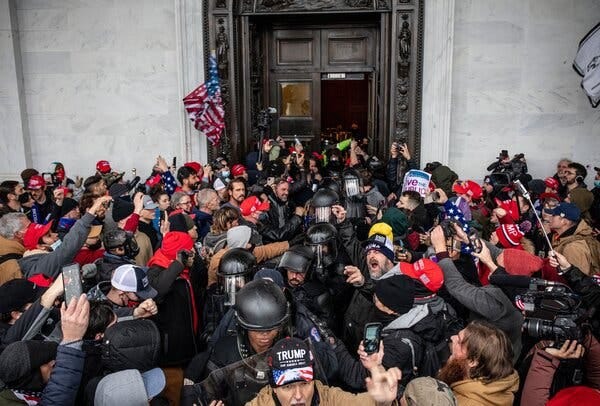
Earlier this week, I shared some thoughts on how language and calling people racist or insurrectionist, or fascists, is important. And how we may not quite have the vocabulary to define what's happening today yet. (Sidenote: we might. I probably need to do some digging and learning to say that with more certainty). But today's newsletter is going to be about some of the best, most important thinking that I've read since last week. My first, big, recommendation is “The American Abyss,” an essay by Timothy Snyder, Yale University history professor and political atrocity expert. He argues that the part of the responsibility for Trump's efforts to overturn a fair election (that he lost) falls to a large number of Republicans, who either saw Trump as a means to power within a democratic framework (the McConnells of the world) or as a way to break the system, and gain power without democracy (the Hawleys and Cruzs of the world). Combined, they helped hurl us to a post-truth, pre-fascist world. "The big lie"—that the Democrats stole the 2020 presidential election—is the scariest of all, as it imparts a fundamental lack of trust by its believers in: reporters, political experts, local to federal government institutions, poll workers, elected officials, and even the Supreme Court. Adding fuel to the fire, "social media provides an infinity of apparent evidence for any conviction, especially one seemingly held by a president." It feels like we have one chance to do... something. Anything. Snyder goes on: Trump’s coup attempt of 2020-21, like other failed coup attempts, is a warning for those who care about the rule of law and a lesson for those who do not. His pre-fascism revealed a possibility for American politics. For a coup to work in 2024, the breakers will require something that Trump never quite had: an angry minority, organized for nationwide violence, ready to add intimidation to an election. Four years of amplifying a big lie just might get them this. To claim that the other side stole an election is to promise to steal one yourself. It is also to claim that the other side deserves to be punished. Informed observers inside and outside government agree that right-wing white supremacism is the greatest terrorist threat to the United States. Gun sales in 2020 hit an astonishing high. History shows that political violence follows when prominent leaders of major political parties openly embrace paranoia. Our big lie is typically American, wrapped in our odd electoral system, depending upon our particular traditions of racism. Yet our big lie is also structurally fascist, with its extreme mendacity, its conspiratorial thinking, its reversal of perpetrators and victims and its implication that the world is divided into us and them. To keep it going for four years courts terrorism and assassination. The Republicans are going to have to act: do they stand on principle or acquiesce to the Trumpian/fascist faction of their party? Unfortunately, there is zero evidence to suggest the Republicans have a real interest in American democracy, at this point. Almost 150 Republicans voted to overturn election results mere hours after the Capitol was attacked by fascist thugs. Hours after they hid for their lives. I highly recommend reading Snyder's full essay. Elsewhere, Blair McClendon lays bare the myth that what happened on Wednesday "isn't America." In fact, it is! His essay "Long Lost Causes" over at n+1 goes further. We live in an immensely powerful country that continues to perceive itself not only as an innocent underdog, but as the land of lost causes. They grow vicious here, since those in power are not all that accustomed to serious repercussions for defeat. The most famous incarnation of the lost cause, the one about the Civil War, is itself more a story about frustration than annihilation. Trump and his ecosystem of conspiracist allies, sycophants, and media figures succeeded in creating such a narrative before there was even a loss to behold. On Wednesday his followers—as well as those who merely find them useful—acted boldly in defense of the murky cause. In response, Democrats have begun to demand new legal powers to act against “domestic terrorists.” New laws aren’t needed to protect the government. So who will they be enforced against? Who will enforce them? Presumably the same FBI that responded to the rise of Black Lives Matter by manufacturing the category of “Black Identity Extremists.” Or better yet, the local police departments whose unions endorsed Trump last fall. If things get out of hand again they can call in the military, which has been a locus of neo-Nazi and Klan recruitment… Some are dying and killing for [a cause] now and in Congress they’re still talking. Writing in the excellent newsletter, The Margins, Ranjan Roy called this "The first phygital coup" while also correctly pointing out that phygital is a bad word found mostly in marketing/digital contexts but also it makes sense here. "This is reality TV, but this is also warfare." He goes on: Last Wednesday felt like a breaking point where the weirdness of online life finally found its way onto the front page of every newspaper around the world and people lost their real, physical lives. The speed at which digital life coalesced with physical life was staggering. Just look at the waning minutes of the invasion as Congress reconvened. One sketchy online tweet ‘showing the shaman guy at BLM protests’ went absolutely viral and allowed Matt Gaetz to speak in the offline House of Representatives about how the invasion was led by Antifa. Even the likes of Brit Hume “asked questions” about leftist infiltrators while a Washington Times article (that is now also deleted) claimed there was some facial recognition company that identified Antifa people involved. Both that viral tweet and viral article are now disappeared from the internet, yet they did their job. They injected confusion. This is modern warfare. Finally, experts are warning that the right's embrace of conspiracy amounts to "mass radicalization." Let that phrase sink in. Mass. Radicalization. The only way to prevent more violence is to break through the echo chamber. How do you do that, when 77% of Trump supporters believe that Joe Biden stole the election? There is a ton of writing and thinking out there about everything going down with Twitter, Facebook, and the like banning Trump from their platforms. And Amazon banning Parler from its cloud hosting platform. Those decisions and developments are very much a part of this newsletter's remit, but news is breaking so fast and frequently it's hard to get a grip on everything. One thing is for certain: it is decidedly not good that the most powerful private corporations in the world are the ones making these decisions on-the-fly (and, arguably, way too late). We need a new tech and social regulatory apparatus now. But that'll be for next time. In the meantime, I'd rather sound the alarm about, oh, fasicsm and democracy. I love you all. Talk soon. greg.substack.com/subscribe
Embed this episode
No transcript yet.