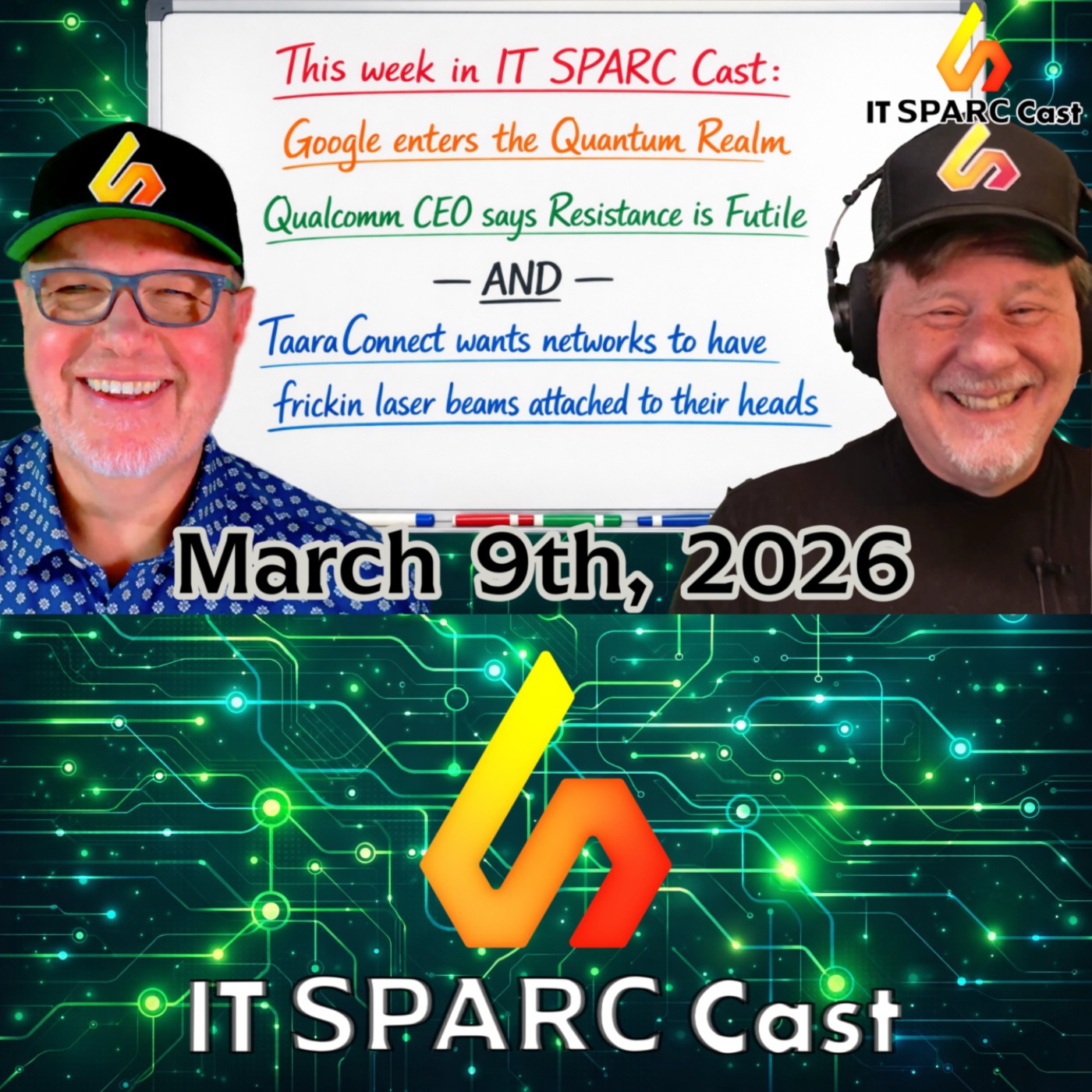
Google Quantum-Proofs HTTPS, 6G Hits 1 Tbps, and Internet Over LASERS?! | IT SPARC Cast episode artwork

EPISODE · Mar 9, 2026 · 22 MIN

Google Quantum-Proofs HTTPS, 6G Hits 1 Tbps, and Internet Over LASERS?! | IT SPARC Cast

from IT SPARC Cast

In this episode of IT SPARC Cast – News Bytes, John Barger & Lou Schmidt break down three major developments shaping the future of networking and internet infrastructure.Google begins testing a new quantum-resistant HTTPS certificate approach designed to defend the web against future quantum computing attacks. Meanwhile, Qualcomm’s CEO declares that the coming 6G mobile revolution will be essential for AI-driven applications, promising speeds up to 1 Tbps and sub-millisecond latency. Finally, TaaraConnect introduces a 25-Gbps laser-based networking system capable of delivering fiber-like speeds between buildings without laying cable.From quantum-safe encryption to AI-driven wireless networks and laser communication links, this episode explores how the next generation of connectivity will reshape enterprise IT infrastructure, data centers, and global networks.  ⸻Show Notes00:00 – Intro⸻📰 News Bytes00:51 – Google Quantum-Proofs HTTPS with Compact CertificatesGoogle and Cloudflare are testing a new method to make HTTPS certificates resistant to future quantum attacks.Instead of traditional signature chains, the system uses Merkle Tree Certificates (MTCs) to dramatically shrink quantum-safe cryptographic data from roughly 15 KB down to about 700 bytes, making it practical for real-world internet use.The experiment begins with about 1,000 TLS certificates, with standards work underway through the IETF. If successful, this approach could become a foundational component of post-quantum internet security.The big unknown: how much processing overhead these new cryptographic methods will require on older client devices.https://arstechnica.com/security/2026/02/google-is-using-clever-math-to-quantum-proof-https-certificates/ ⸻05:42 – Qualcomm CEO Says the 6G Revolution Is ComingAt Mobile World Congress, Qualcomm CEO Cristiano Amon argued that the AI era will demand 6G networks, dramatically increasing bandwidth and lowering latency.Projected 6G capabilities include:• Speeds of 100 Gbps to 1 Tbps• Sub-millisecond latency• Massive connectivity for billions of devices• AI-driven network managementThe shift toward AI-heavy cloud processing means network traffic will become even more north-south oriented, sending massive datasets between edge devices and cloud infrastructure.Early 6G trials are expected around 2028, with broader deployments beginning around 2029.https://fortune.com/2026/03/03/qualcomm-ceo-resistance-is-futile-6g-mobile-revolution-approaches/⸻13:31 – TaaraConnect Uses Lasers to Deliver 25-Gbps InternetTaaraConnect is developing a laser-based point-to-point networking system capable of delivering up to 25 Gbps over distances of about 6 miles (10 km).Instead of radio waves, the system transmits data using focused beams of light, creating fiber-like connectivity without physical cables.Key features include:• Adaptive beam alignment• Automatic power adjustments during interference• Redundant beam paths to mitigate disruptions• Low-latency high-bandwidth links between buildingsWhile heavy fog remains the primary limitation, the technology could provide a powerful alternative to expensive metro fiber deployments, particularly in dense urban environments.https://newatlas.com/telecommunications/google-taara-25gbps-internet-cities-light/⸻🔁 Wrap Up19:31 – Mail BagListener Xavier shares thoughts on the rising cost of compute power and suggests that bio-AI systems using living neurons could eventually deliver superior performance-per-watt compared to traditional silicon chips.The discussion highlights a growing industry focus on compute efficiency and power consumption as data center infrastructure scales to support AI workloads.⸻🔗 Connect With UsIT SPARC Cast@ITSPARCCast on Xhttps://www.linkedin.com/company/sparc-sales/ on LinkedInJohn Barger@john_Video on Xhttps://www.linkedin.com/in/johnbarger/ on LinkedInLou Schmidt@loudoggeek on Xhttps://www.linkedin.com/in/louis-schmidt-b102446/ on LinkedIn Hosted on Acast. See acast.com/privacy for more information.

In this episode of IT SPARC Cast – News Bytes, John Barger & Lou Schmidt break down three major developments shaping the future of networking and internet infrastructure.Google begins testing a new quantum-resistant HTTPS certificate approach designed to defend the web against future quantum computing attacks. Meanwhile, Qualcomm’s CEO declares that the coming 6G mobile revolution will be essential for AI-driven applications, promising speeds up to 1 Tbps and sub-millisecond latency. Finally, TaaraConnect introduces a 25-Gbps laser-based networking system capable of delivering fiber-like speeds between buildings without laying cable.From quantum-safe encryption to AI-driven wireless networks and laser communication links, this episode explores how the next generation of connectivity will reshape enterprise IT infrastructure, data centers, and global networks.  ⸻Show Notes00:00 – Intro⸻📰 News Bytes00:51 – Google Quantum-Proofs HTTPS with Compact CertificatesGoogle and Cloudflare are testing a new method to make HTTPS certificates resistant to future quantum attacks.Instead of traditional signature chains, the system uses Merkle Tree Certificates (MTCs) to dramatically shrink quantum-safe cryptographic data from roughly 15 KB down to about 700 bytes, making it practical for real-world internet use.The experiment begins with about 1,000 TLS certificates, with standards work underway through the IETF. If successful, this approach could become a foundational component of post-quantum internet security.The big unknown: how much processing overhead these new cryptographic methods will require on older client devices.https://arstechnica.com/security/2026/02/google-is-using-clever-math-to-quantum-proof-https-certificates/ ⸻05:42 – Qualcomm CEO Says the 6G Revolution Is ComingAt Mobile World Congress, Qualcomm CEO Cristiano Amon argued that the AI era will demand 6G networks, dramatically increasing bandwidth and lowering latency.Projected 6G capabilities include:• Speeds of 100 Gbps to 1 Tbps• Sub-millisecond latency• Massive connectivity for billions of devices• AI-driven network managementThe shift toward AI-heavy cloud processing means network traffic will become even more north-south oriented, sending massive datasets between edge devices and cloud infrastructure.Early 6G trials are expected around 2028, with broader deployments beginning around 2029.https://fortune.com/2026/03/03/qualcomm-ceo-resistance-is-futile-6g-mobile-revolution-approaches/⸻13:31 – TaaraConnect Uses Lasers to Deliver 25-Gbps InternetTaaraConnect is developing a laser-based point-to-point networking system capable of delivering up to 25 Gbps over distances of about 6 miles (10 km).Instead of radio waves, the system transmits data using focused beams of light, creating fiber-like connectivity without physical cables.Key features include:• Adaptive beam alignment• Automatic power adjustments during interference• Redundant beam paths to mitigate disruptions• Low-latency high-bandwidth links between buildingsWhile heavy fog remains the primary limitation, the technology could provide a powerful alternative to expensive metro fiber deployments, particularly in dense urban environments.https://newatlas.com/telecommunications/google-taara-25gbps-internet-cities-light/⸻🔁 Wrap Up19:31 – Mail BagListener Xavier shares thoughts on the rising cost of compute power and suggests that bio-AI systems using living neurons could eventually deliver superior performance-per-watt compared to traditional silicon chips.The discussion highlights a growing industry focus on compute efficiency and power consumption as data center infrastructure scales to support AI workloads.⸻🔗 Connect With UsIT SPARC Cast@ITSPARCCast on Xhttps://www.linkedin.com/company/sparc-sales/ on LinkedInJohn Barger@john_Video on Xhttps://www.linkedin.com/in/johnbarger/ on LinkedInLou Schmidt@loudoggeek on Xhttps://www.linkedin.com/in/louis-schmidt-b102446/ on LinkedIn Hosted on Acast. See acast.com/privacy for more information.

NOW PLAYING

Google Quantum-Proofs HTTPS, 6G Hits 1 Tbps, and Internet Over LASERS?! | IT SPARC Cast

0:00 22:19

No transcript for this episode yet

We transcribe on demand. Request one and we'll notify you when it's ready — usually under 10 minutes.

No similar episodes found.

No similar podcasts found.

Frequently Asked Questions

How long is this episode of IT SPARC Cast?

This episode is 22 minutes long.

When was this IT SPARC Cast episode published?

This episode was published on March 9, 2026.

What is this episode about?

In this episode of IT SPARC Cast – News Bytes, John Barger & Lou Schmidt break down three major developments shaping the future of networking and internet infrastructure.Google begins testing a new quantum-resistant HTTPS certificate approach...

Can I download this IT SPARC Cast episode?

Yes, you can download this episode by clicking the download button on the episode player, or subscribe to the podcast in your preferred podcast app for automatic downloads.
URL copied to clipboard!