Well, when I was 18, you know, I started taking trips to Henzo Gracie's in New York City. And at that time, you know, Danaher was the head instructor there. So, you know, I got to be in the room with a lot of those death squad guys when it was in its prime. I wasn't, you know, one of the high-level death squad people. I was just, you know, in the room training. But, you know, I got to train with a lot of them. And, you know, I was able to build confidence there so that when it came out to the competition, it's like, okay, I'm going against really good purple belts. But I'm so used to training with the best grapplers in the world that this doesn't even really faze me.
Hey, what's up, everybody? It is your friendly neighborhood BJJ podcast for Rappers Wars, coming to you with another great installment of The Grappling Hour. We have an excellent guest. We'll get to him momentarily, but before we get back to him, a couple quick reminders. First and foremost, if you like the merch, check this out. This, this, this, this, this, this. You can buy these t-shirts in multiple colors that we are running out on sizes and colors, but go put an order in now before we're completely out. It is 25 bucks for those. We've also got some hoodies. It's kind of cold out here in California. Like California cold, not real cold.
Not where he's from. Where he's from, actual cold. Here, pretend Hollywood cold. Still cold, I would argue. Just saying. We have all the seasons here in California. But if you need something to keep you warm, let's say you're out on the East Coast, you're bitter, you hate the rain, you're complaining. Oh man, did it snow again today? Hey, listen, put on a hoodie. You're going to be just fine. And you can find one of those at rapsparza.com backslash merch. And you can also find it at grapplinghour.com. So either one of those places will take you to where you can get some merch. All right. You can also like, comment, and subscribe on this video. If you don't know what you want to comment on just yet, just hang out. I'm going to give you a topic by the end of this episode.
Additionally, if you like these episodes, and I hope that you do, you can head on over to patreon.com backslash grappling hour and you can become a member to see these interviews 30 days before anybody else. So that means you can check those out and for a few extra dollars more. You can also check out our tape studies with athletes, where we talk about their fights and their matches, a segment called Roast Raph, where people roast my competition footage, and last but not least, mini-sodes that you, yourselves, the fans, get to pitch. So you can check all that out at patreon.com backslash grapplinghour. And finally, if you want to continue the discussions that we are having here on this broadcast, head on over to, right now, our Discord. Go on over to Discord. It's at grapplinghour. We appreciate it when you guys support us in all those different places. And if you can only do two, that's cool too. We just listed off four things you can do. So there's that. Our guest today is a reigning, defending...
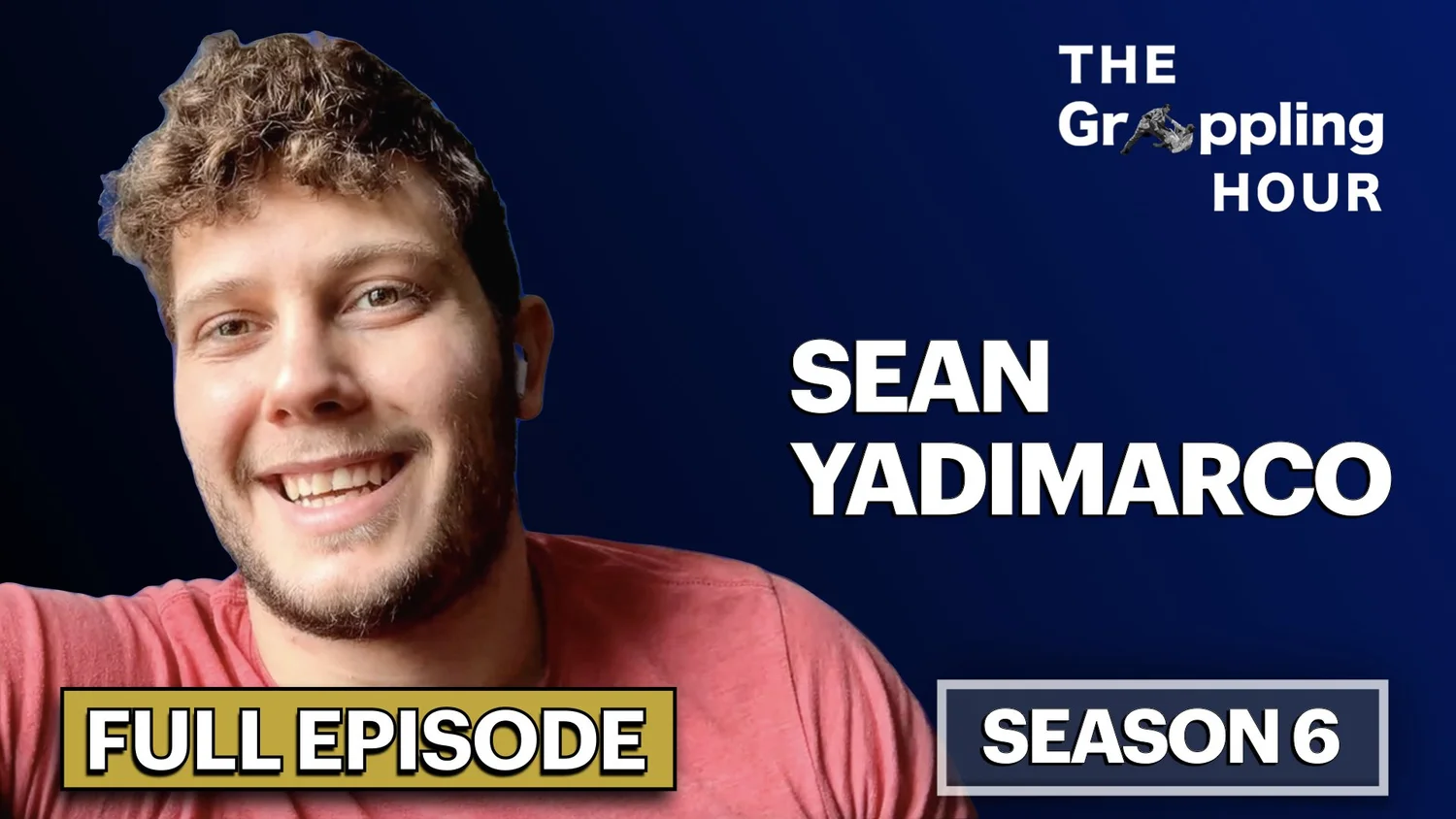
finishers, sub-only champion, and I'm stoked to be able to talk to him because guess what? He is somebody who's been tearing up the scene. You may have seen his work either through the IBJJF competition scene or through recently his very solid appearances at ADCC. We are glad to host him here on the show. Please welcome, not for the very first time, but yet also for the very first time, one, Sean Gattamarko. Sean, how are you doing, sir? I'm doing great, man. Happy to be here. Happy to be on this podcast. Can't wait to talk about a ton of exciting things.
Full disclosure to everybody watching. My man is putting on a good face. We are redoing the episode, even though we got about 15 minutes in. And I'm so happy that Sean has a good face here because some guests would have walked off, not Sean. So I appreciate Sean for working through this. Now, Sean, I want to ask this. Can you tell me a little bit about the competition that you just had over at Finish Your Sub Only? It looked like an excellent performance. And I would love for you to go and describe maybe if people didn't get to see what the match was, how it ended up going, sir.
All right, I'll give you guys a play-by-play. We started on the feet. My opponent tried a single-leg takedown on me, and I was able to grab a guillotine. I wasn't able to finish, but I put him in a dominant position off of it. He re-guarded, passed the guard again, and then I finished with my signature technique, the dart choker.
So just ballpark me here. In your opinion, how many darse chokes have you landed in this lifetime? I'm not looking for the exact number. I'm just saying ballpark us. Tell us what it is because you have the very solid body type that seems like that has been a consistent performer for you over the years. Are we talking about in competition or in training as well? Oh, I like that you qualify these because you're like, they're different numbers. I was like, oh, I know. So give me both now that you're willing and able to give just a rough estimation as to both.
Um, well, I've been doing jujitsu for about 12 years and the darts choke has been my favorite technique since white belt. So, you know, at least over a thousand total, I would say, you know, at least I'm in competition. I would say probably at least at the very minimum, probably 40. I mean, that's, that's not a shabby record there, sir. I have to ask this as well, because I don't know who you get to train with on a regular basis. And I don't know if you want to name names, but I'm asking for one here. Over the years, you mentioned a thousand darts. Is there one person who has been on the receiving end of a thousand darts is perhaps more than most other people?
Yeah, I mean, I... You know, I run my own gym now and I have, you know, a lot of young, hungry student competitors that, you know, I darse all the time and make them suffer. So, you know, definitely some of my guys that I train, like my guy Romel, you know, I'm constantly just attacking him every night because he's a young, hungry competitor. So he's definitely been on the receiving end a lot more than most. But he's a stud. He's a beast. He's super young. But, you know, you got to keep him humble. I mean, absolutely. There was a part of me that whenever somebody says, hey, yeah, they get me with this move. We all have our instructors, our good training partners that keep us within that realm. And I like to tell.
a lot of my students, I'm like, yeah, there's only like one guy that guillotines me right now. And it's not to say that other people can't, it's just I have an obtuse head. So half the time, if they don't have the right angle, I got a pocket of air and I'm just chilling. And there's that one guy who pops up and he's like, is that me? And I was like, actually, it's not you. And he's like, oh, but I got you in a guillotine. And I go, we'll win. And he goes, uh, shit, man. And I was like, last time is probably about November. He goes, how do you remember this stuff? I was like, I'm dumb for a lot of things, but the memory is very good for whatever reason. So yeah, it was November, dude. Sorry. And we always have tapes. I'm like, I can pull up the tape if you'd like, sir. I can verify it.
All the things I lack in jiu-jitsu, I know what I'm very strong at, and that is my favorite thing to do is to be able to tell people, especially when they try to quantify something, I go, hmm. Survey says no. Sorry, guys. That's an inaccurate answer. Though you are very good at jujitsu. Didn't do this. So... I just... Listen, I am always amused by this stuff. So it always makes me very, very... It makes me laugh a lot. Let's get back to you, though. So you end up doing this reigning defending. You've got this beautiful promo. And as you're cutting this promo, I notice that there's a very relaxed sense of you. You hold that belt well. A lot of pro wrestling fans, they win that championship belt. They get that posture like they won something, but most of the time they just bought it at Kmart. But you...
You want it. You carry it well. Where does that confidence come from, sir? Confidence comes from the training room. You know what I mean? Confidence comes from developing skills and training. Confidence comes from, you know, being in front of people all the time, which I am, you know, constantly competing on high level stages in front of people. I'm constantly teaching classes that have tons of people watching me. So that's where my confidence is built. And, you know, I'm proud to say my what I'm able to do in front of the camera. And, you know, I have no problem talking about it.
When did you know that you were teaching for 10 years now, right? Yeah, I've been doing martial arts my whole life. My first job ever was teaching like Taekwondo when I was like 13. So I've been teaching I'm 24 now. So I've been teaching martial arts in general for over 11 years.
Yeah, because you say that as if that's not a significant portion of your life. It just makes me laugh when I see this kid being like, yeah, man, I've been teaching for 10 years. I'm like, you're barely 14, guy. You know what I mean? To me, you're a kid, and I look at you and I go, yeah, no, I don't disbelieve you as saying 10 years, but that's a big chunk, especially when you're given that much authority and that much prominence to really take care of people and to be entrusted with that ability to teach people. Did you at any point at that young age feel any kind of stress from it or any kind of nervousness that, hey, man, I'm a 13-year-old kid teaching a lot of older people here?
For myself, I think it was actually more of a feeling of excitement. I wanted kind of that center stage. And I feel like, yeah, definitely wasn't the best at it at first. But in terms of being in front of people, in terms of having a center stage, in terms of sharing my knowledge, in terms of sharing my abilities, it was more of a feeling of excitement of me wanting to be in that position. Yeah. Okay. That's good. That is a good approach. I would tell you this though, as a person who has had younger kids teach over the years, there is that fine line of like, look at this kid. Look at how excited he is. Oh man. I want to roast him so bad, but I'm not going to. He's so excited. I'm going to this nerd. I want to get back to this though. We were talking about finish your sub only. And what I really wanted to know is you seem to be doing well. You've had two title defenses.
What are you looking to continue to do there? Because obviously there are other promotions that are going to start calling your name or that you're also going to become a little bit more on the radar if you're not forced justifying it by winning out things like ADCC trials and stuff like that. But what are you looking to do specifically with finishers sub-only, sir? I'm just looking to compete against other high-level talent. So, you know, whoever finishers can get me, you know, I'm down for. I want to, you know, try to fight the top names in the sport. And I feel confident I could beat anyone. So, you know, if anyone wants to strap, you know, come and try to grab it.
Okay. Look at that. That dude's making an open challenge here for everybody. I can appreciate that. Does that also extend to your own school, your own students? Because we have a rule where I go about where if I like your medal, I'll be like, yo, dude, I want to...
i want to take that medal can we have a match for that medal and uh they'll always have a good laugh at that but do your students ever look at that and go like yeah it's kind of shiny i want to take that off you yeah i mean we always uh make jokes and shit and you know they're always uh you know saying that they're gonna if they tap me then they have my accomplishments and stuff so you know we're always joking around making uh you know challenges like that and you know i always have to you know keep them humble um you know hold on i want to go back to your students this is a ruthlessness that i have not really heard before like you didn't steal your soul like i just want your belt bro like i'm not trying to be like no i'm making sure that you were never anything i took all of your jiu-jitsu power like I don't think that's how that works, guys. None of you guys are Mortal Kombat characters. Yeah, I guess in Jersey, you know, the water's a little different out here. We're a little bit meaner, a little bit, you know, the cold, the snow doesn't really treat us well out here. Listen, that's fair. I will tell you this. There is a ruthlessness that comes from some of us who do comedy. And what I do tell people is this.
I'm fully aware that people are going to beat me at jiu-jitsu, but it's going to be a very rare exception that somebody's going to beat me at the trash top. And I say this as somebody who, even while mounted, will still have the best jokes. Like, I'm not going to lose that part. So I come from a culture that has made sure that even if you're going down swinging, you are still making the best jokes. So I feel like your students, your brand, your group of folks are kindred spirits in that. So that's good. But man, taking your whole jiu-jitsu. Like, saying somebody had no accomplishments is just, it's a ruthlessness that I'm like, all right, I see you guys. That's good stuff. That's it. That's how we do it in Jersey.
Good for you guys. So, okay, that's what you're looking to do there. I did want to get this. You know, when we were talking previously, you had made mention to a few different folks. You had made mention to, you know, obviously like J-Rod and obviously the Hillbilly Hammer and also to Elder Cruz. I know it's because you had good matches with each of those and those were very good in close matches, but any specific reason why any, just of those three.
well they're just the top dogs in my weight class you know what i mean i want to be the top dog in my weight class and the only way to be the top dog in your weight class is you have to try to beat who is at the mountaintop so that's that's the only reason why you know what i mean it's nothing uh nothing against them it's just they're at the top of my weight and i want to be the top of my weight so you have to you know take down the best this wasn't like j-rod thought he had a better car than you or uh this isn't you stole the hillbilly hammers mountain dew one day no no i just uh you know i just want to be at the top of the mountain right so you gotta you gotta take out who's there yeah so it is very funny i want to say a couple friends from the show were suggesting you to come on and it's very funny to me because i have eyes on everybody and i love your match with elder cruise i love watching you like on that scene on the adcc scene and just being very very um aware of like You have some very solid skills. You're only 24. So you're going to be one of those people that's going to be a menace for ADCC trials for years to come, if not the actual worlds in itself. What has been that thing that has helped you to propel and get even, I guess, better at competition on big stages like that?
Um, you know, I've, uh, I've been competing on big stages, probably. Uh, you know, I've had my first super fight when I was like 16. So I have just been on these stages for so long. I've, you know, I've competed so much that I've lost every way possible. I've won every way possible. You know, now I just go out there. I just do jujitsu. Like it's just, you know, the lights, the stage and everything like that. It's just very mundane to me at this point. It's just, you know, I'm just there to do jujitsu. It doesn't even really faze me anymore because I've been in those positions so many times.
That does make sense. When did you feel like you actually became comfortable competing? Some people, it's not necessarily right away. Some people take some moments. And if so, what were the things that kind of helped you level the mindset that you feel has brought you the most success?
So I feel like I started becoming comfortable competing probably around Purple Belt. That's when I started really achieving high-level success. At Purple Belt, I was able to win the Purple Belt Nogi Pans. I medaled at the Worlds. I won the American Nationals. I beat a lot of high-level competitors at that state. And I was just able to keep it very mundane. I didn't let anybody watching really affect me. I didn't really let the lights or the stage really affect me whatsoever. I just try to keep a really cool, calm demeanor. And I'm just able to translate exactly what I do to training now to competition and avoiding that deer in headlights syndrome.
That does make sense. And I always wonder that for people because everybody has a different pathway, a different journey. But most of the times it's for competition on a local or a regional scene. It's when you get to that elevated status that you're like, oh, we're all Jedis now. Oh, okay. This is going to be interesting to see how this plays out. When was the moment that you felt like, though, was it at that purple belt level when you did win at IBJ JetPants? But when was that level that you felt maybe amongst other black belts or other individuals on that high competitive scene that you're like, no, I am one of you. This feels like we're all competing at the same level.
Well, when I was 18, you know, I started taking trips to Henzo Gracie's in New York City. And at that time, you know, Danaher was the head instructor there. So, you know, I got to be in the room with a lot of those Death Squad guys when it was in its prime. I wasn't, you know, one of the high-level Death Squad people. I was just, you know, in the room training. But, you know, I got to train with a lot of them. And, you know, I was able to build confidence there so that when it came out to the competition, it's like, okay, I'm going against really good purple belts. But I'm so used to training with the best grapplers in the world that this doesn't even really phase me.
I used to laugh because there was a time, believe it or not, where a young Gordon Ryan was interviewing with me. And Danaher would kind of, when I would interview with Danaher, he would kind of suggest like, I don't think you want to know how those rounds with GSP and Gordon go. And I was like, oh, I think I precisely want to know. But I get what you're insinuating, which is that at that time, even Danaher was trying to tell us like. Gordon's on a different level. Like you guys don't even get to see what it is. You just assume GSP is this world champion and that he's not nothing, but he's definitely being humbled in those rooms. And I was just like, that's such an impressive thing to do that even in those beginning days when we were seeing the emergence of Gordon, it meant that most people in that room are going to grow in ways that people in other rooms may not ever see in their lifetime. So even just being a part of that room, especially at that time, made that probably you grow from zero to like a hundred in a shorter amount of time than most other individuals. Yeah, just playing with the best rappers in the world, it's like.
okay, going out into this purple belt competition, you know, there's not really going to be anything I haven't seen before. Yeah. Especially when you're like, oh, that's cool. You pass well, but do you pass like Gary Tonin? You know, like, do you do ridiculous amounts of movement that will allow you to do X or Y or Z? So I'm sure that definitely makes you a little bit more aware of stuff. Now, if I'm really doing the math here, if you were training over at the blue basement, how old were you then?
Um, well, I think I was just taking trips, uh, to the blue basement when I was 18 and I really started training there full-time probably around 2019. Um, and then once they moved to Puerto Rico, I, uh, went under Tom DeBlas, who's my professor now and who I'm a black belt under. So yeah, 18, 19, 20 years old. Um, I was at Henzo's, but I was only there full-time for about a year. What was the biggest thing that you took away from your time with them? Um...
The biggest thing was just how cerebral, you know, John was and how they all just, you know, listen to him to whatever, you know, he said, you know, they were able to replicate as much of what he said as, you know, humanly possible, where, you know, I feel like there's a lot of other gyms where it's like you get to a certain level and you're like, you know, I really, you know, I can start kind of doing my own thing. I don't really need to listen to my coach anymore. But no, even, you know, Gordon's the best in the world. And, you know, he still listens to exactly what John does. It's just the level of the amount of respect they have for the instructor and the level of respect that, you know, they're able to just try to do exactly what he says.
how has that mirrored what you do in your classes then? Like, what have you taken away from John that kind of, or even from Tom, because Tom's also world-class competitor and instructor and also inspirationalist. So if you take away all those things, like what are the things that you have taken away and implemented into how you run and conduct your classes? I think, you know, in terms of technique-wise, you know, I've definitely taken a lot from John technique-wise. I think being able to be a motivator is what I've been able to take from Tom. You know, Tom's, you know, also super technical. But what, you know, really stands out to Tom is the way he's able to motivate and inspire his competitors, including myself. So I try to do the same thing with my own competitors, where John, you know, he wasn't really trying to motivate or inspire anyone. He was, you know, giving everyone, you know, world-class techniques and, you know, the most cerebral methods possible. So, you know, I guess those are the two elements I tried to take from both of those instructors.
It's very good. I mean, we have interviewed Tom in the past, and it was before I think he truly immersed even to the media figure that he is now. But one thing that struck me was just how focused he was and how I think he kind of tries to disseminate it from his perspective in terms of how to give inspiration. Because I think a lot of times... People take what they learn and they try to become inspirational, but they don't have the heft to it. They don't have the symbolism or the meaning. With Tom, it's like, well, he's been there. He's been to some really, really tough moments in competition. And we've seen his ups and downs in so many different ways. So I think when he speaks, I think he's trying to disseminate all those years. And he tries to like say like, hey, I've been down here. Here's what I've learned. Here's what I can impart upon you guys. So that is kind of what we've seen from our side of the world.
Yeah. I mean, Tom, he's extremely good with his words. He's able to really transfer energy really well into his guys. And whenever he's speaking, he's really good at sending clear messages to people and just being a really helpful individual to whoever he wants to help. That's very, very cool. Let's do this. Let's take a little bit of a trip down the path because we've been kind of alluding to your history. Whenever people come on the show for the very first time, we like to go into origin stories. So let's start here. Most people don't have this background. You said that you were taking Taekwondo first. So was that the first martial art or combat sport that you got involved in?
So, yeah, my dad was a boxer, but, you know, he wasn't like a famous boxer, but, you know, he boxed and he had lots of fights. And when I was a kid, you know, I started with Taekwondo and then I went into wrestling and jujitsu around the same time. And, you know, once I really started getting into grappling, you know, I stopped doing Taekwondo and, you know, I've just been running with grappling since. When your dad comes up to you and he says, all right, so we're going to do boxing and you have to come out to him as a grappler. How did that conversation go? If you're like, hey, dad, actually, I like grappling better. And he's like, no, son of mine. Or was it something entirely different?
Well, just, you know, jujitsu and stuff like that just wasn't really a big thing when my dad was, you know, training. You know, my dad, you know, was like, you know, 70s and 80s. And, you know, at that time, there really was no jujitsu. Wrestling was a thing, but it wasn't really that prevalent. Boxing was just the thing to do. You know what I mean? It was just, you know, grappling is a much bigger thing now. And it's, you know, a much more feasible thing to do. Back then, it just really wasn't popular. So it's just, you know, a completely different world to him, I guess.
So if that's the case, you share a language of combat sports though. So that does help because some parents, they don't have that. Some parents, they don't have the ability to relate to their athletic son or daughter. In this particular case, he's like, hey, I don't understand everything about it, but I knew that when I applied in boxing, and I feel like you're going to do some similar path here. When did your dad start to kind of get it? And was he one of those dads that was coaching for the sidelines and yelling out? Or how did that work for him?
My dad, he was always there when I was younger, competing and stuff like that. But he understood to let the coaches talk. It's not his element. So he always understood to let my coaches coach and to not be one of those parents that is going to constantly try to yell at their kids while they're competing or being active in their sport. Some parents, they don't understand the sport, but they still try to yell out advice to their kids and stuff. My dad was never one of those people.
He was able to help me with mindset-wise, but he always understood that, you know, it's a completely different sport, and he wasn't just going to, you know, try to yell out nonsense while I'm competing. So let's go both ways. Did your dad try to teach you boxing still? And then later on in life, did you try to get your dad to take a jiu-jitsu class? I mean, when I was a kid, you know, me and my dad would always, like, play fight. You know, he would hold paths for me, you know, sometimes when I was a kid. But we were always play fighting. We were always, like, even, like, play wrestling, like, play fighting. Like, we were always doing that stuff.
Um, I never got him to try to take a jujitsu class. You know, he's, uh, you know, he's just very into his own thing. Um, and you know, I knew that wasn't really something that he was going to be interested in doing. Copy that. Okay. Understood. You didn't just gift him a Christmas present. It's like, what is this? Is this a gi? No, I'm not doing it. Nice try. Nice try here, kid. So if that's the case, what do you remember distinctly about your first jujitsu class?
Uh, so my first like jujitsu class, I was, uh, I think I was like 12 or something. Um, it was when I was doing Taekwondo, my Taekwondo coach was like a blue belt. Um, and he just started running like a grappling class once a week. And that was the first really introduction to a jujitsu I ever had. Um, you know, it wasn't, you know, super high level jujitsu or anything, you know, it was a Taekwondo gym that had a grappling class once a week that was ran by a blue belt. So that was, uh, you know, my first introduction to jujitsu. And then, you know, doing that for a little bit, you know, I started to really want to get into it more. And so I started training at like an actual jujitsu gym.
Very nice. So what about it? We always like to ask this, like when you are painting that scene and you are getting taught by somebody, we talk about these mythical blue belts that didn't exist so many years ago. Like you had one blue belt and you're like, oh, thank God this guy knows everything. Like times have changed so much now that there should be a black belt almost on every corner. But back in the day, it was very difficult to find good training and especially very, very solid training from somebody who was knowledgeable. But I always like to ask this with people. This has become a career, a passion for you. When did this become something that you truly love? Like more than just a hobby that you actually wanted to do for the rest of your life.
You know, I always was into training. You know, ever since I was a kid, you know, I was always training all the time. And I think it just became, you know, it's a part of my routine. I'm a very routine based person. I like to do, you know, the exact same schedule just every single day. And once I made it a part of my routine, it just was something that I never wanted to slip out of my routine because I just, you know, was able to instantly see all the benefits. And over time, it was just I started getting really, really, you know, good at it. And it was just able to not only be something that I was doing that I enjoyed, but it also started to be something that was also, you know.
uh making income and um you know being able to grow my brand off of it and it was just uh you know it just kept building and building over time for me and i've just been running with it you know since day one i wanted to know this as well because you know you were competing so much and as a kid that does take a toll but you're not just competing at jiu-jitsu you're also competing in wrestling so were you doing them at the exact same time in terms of competing and how are you able to keep that focus on both So yeah, I wrestled in middle school and high school. I didn't wrestle collegiately. But I was training jiu-jitsu and wrestling at the same time. But the focus was kind of always jiu-jitsu. I started wrestling to supplement my jiu-jitsu. But yeah, I would go to school and I would finish wrestling practice probably around 5 p.m. And then I would do homework, eat and stuff. And then jiu-jitsu practice was at 7.30. So that's just what I did every single day. And it was just what I enjoyed doing. And like I said, I'm just a very routine-based person. So once I was able to make wrestling and jiu-jitsu a part of my routine every day.
um it it just became that it was just what i wanted to do every single day with that in mind though doing both is is tough because doing just one is different and i know that you say the focus was always on jiu-jitsu but it looked like you had a good time while you were doing your wrestling how were you able to merge the two because the competition on both sides is very different so what were you able to pull over the years from your jiu-jitsu side into your wrestling and vice versa what were you able to pull uh as you were competing more and more in wrestling from your jiu-jitsu side as well um well from jiu-jitsu that i think uh you know helped wrestling i think um You know, I was just able to, you know, be able to have like situational awareness a lot. You know, obviously in wrestling, you can't go to your back. But, you know, there's a lot of elements in, you know, jujitsu that just develops you overall as a grappler that's able to supplement wrestling. You know, same thing vice versa. It's kind of like, you know, if you're training boxing, you know, it could supplement, you know, if you're doing Muay Thai or like you're doing Muay Thai, it could supplement in some ways like to, you know, increase your boxing skill. It's just with jujitsu and wrestling, I guess doing one is just going to enhance your overall grappling ability and give you some awareness as a grappler that's able to, you know, help both.
That makes sense. What is your best advice to those individuals who do make the transition from wrestling to jiu-jitsu? Because you did allude to what you said off the back, and that is something that I work with a lot with our guys. Like, one of my favorite things that guys do from wrestling, let's say you get them in a turtle, and they start trying to hook around the leg. And one of my favorite things to do is tell them, like, the Black Panther, no, no, no, we don't do that here. Like, my friend, please do not give me an omoplata. Like, do not give me shit that I'm going to be able to get a crucifix off of. So I always have to give them a separate conversation, which is, you speak a language that is combat sports, but I want to dial you in so that you know better.
That's just kind of what I do on my side. What has been the best advice you give to those who make the transition from wrestling to jiu-jitsu? You know, just try to enjoy it at first. You know, if you're a wrestler coming into jiu-jitsu, if you're not having fun doing jiu-jitsu, you're not going to like it. So just try to make it an enjoyable experience for yourself at first. And once, you know, you really find that it's something fun for you to do, then, you know, you could really take that next step. But it has to be fun at first. You know, if it's not really something that you have fun doing every day, you're eventually going to stop doing it. So just try to learn to have, try to learn to enjoy training. You know, if you don't learn to enjoy training, you're not going to, you're not going to stick with it for a long time. So I think the first step is just to try to learn to enjoy
Okay, so this is a great answer. It means I understand your perspective. I'm with you on this. But I've also, in my experience, seen people who don't necessarily come to have fun. So how is it that you get that? Because maybe it's the competitive gene that's in them. From my personal perspective, it's a lot of a perfectionist nature, which is almost impossible to be. So it's a lot of mitigating that. For those folks who maybe don't look like they're having fun or they come for different reasons, how is it that you get them? Or how is it that you work best with those individuals who have that kind of like must win at all costs? This can't be fun. It's just got to be hard work.
well if uh you know someone's coming in and you know they're not uh you know if they don't enjoy it um or you know if their sole purpose is to just be a world champion um then you know i'll just you know trade with them you know as a you know as a world champion would trade and you know i'll give them my best then if they stick around they're eventually going to be you know that top dog um or you know you just keep beating them up and they realize oh it's not for them and you know it's probably what's best for them but if you know you're able to uh go super hard with them every day and they're able to uh you know keep throwing themselves in the fire um you know eventually they're going to be that top dog so it's just uh you know if they're really in there for the sole purpose of just being champion, then you know, I'll give them that champion level training.
I mean, to be honest, it's what I've learned over my years as both somebody who's worked as a coach in sports, in extracurriculars, in more cerebral, even crazier aspects of different life. I can tell you that you get a whole mix of different personalities. So whenever you are getting those personalities and if they ever say the words, I want to compete, you almost feel like you have to find the right thing that works for them. Like you find the thing that dials them in and gets them. And I swear to God, the amount of personalities I've had over the years, people who are like, Oh, this doesn't bother me. And they're amazingly great. And you go, great. Perfect. That's the right thing. They have this Zen-like approach to it. And then you have these people who beat themselves up and you're like, I mean, this is good. It means you're going to work hard, but don't beat yourself up to the point where it's actually hurting you and making you not as good. So those are just two of the personalities. That's amongst an array of different personalities who just compete and do things differently. But every once in a while, you'll get those guys who are just like, they're coming from wrestling. They know what it's like. And then you have to tell them like a little bit like, hey, man, chill out. Enjoy this. You're going to have fun. And at some point, you're going to find how to marry your competitive and your appreciation for this craft.
No, yeah, definitely. It's just, you know, I think the first step is just you have to try to enjoy it. I would agree. That's what I always come back to, even on my hardest days. I'm like, oh, no, I love this. I love this. This is annoying, but I do love this. I think you have to have the mentality that I get to do this every day, not I have to do this every day. You know, if your mentality is, oh, I have to do this every day, you're going to burn out. I always try to think, oh, this is what I get to do every day. You know what I mean? Very, very good perspective. Speaking of good perspective, you put this up one day.
And while roaming through, when I do the research here, I look to see things that kind of stick out to me. Now, amongst your many, many different nice belts and trophies and medals that you have on your Instagram, there was this post that you said, there's no better feeling in the world than getting your hand raised after you submitted your opponent. Great. Totally understand that. I truly feel bad for anyone who has an experience defeating another man in any form of combat. It started on your journey by coming to your gym. So when you say that, like, when did that epiphany happen for you? Because a lot of people say it in different forms. Some people say, like, you don't know what it's like getting your hand raised. Some people say they don't know what it's like to...
execute a plan. But when did that epiphany happen for you, sir? Well, you know, when you're getting your hand raised in, uh, you know, some type of a sport, especially a combat sport, um, you know, that's really not something that, uh, you know, money can buy when you're, uh, you know, you, you defeat, you know, someone in a combat sport. It's like, okay, this is something that you had to work for. This is something that you had to earn. It's not like, oh, uh, you know, something you like, like a watch where you can just buy it and just enjoy it. No, it's like, that's a, you know, this is a completely different feeling. It's like, you know, you defeated a man who was also working very hard towards a specific goal and their specific goal was defeating you. So, you know, being able to win, get your hand raised, um, that's, you know, in its own complete element of life. Understood.
So having said that, you know, we've touched a nice gamut of different moments in your early jujitsu career. What I'd like to know is, like, do you have favorite matches or moments from your own rich history of competing against people? Like, what is the most fun you have ever had competing? The most fun I probably ever had competing was, I would say, probably, it's a tough question, trying to think back, the most fun I've ever had competing, best match I ever had or something like that. Probably, like...
Probably at like PANS or American Nationals, you know, one of the finals matches, you know, against this guy Alejandro from Daisy Fresh. You know, we had a really good scrap in one of the Pan Ams. And that was definitely one of my most fun matches, I think I could say. What about that one in particular made it fun to you? Um, you know, Pedego, Daisy Fresh, they always bring, you know, a really hype energy to their matches. So, you know, I had a bunch of people cheering for me and, you know, they had their whole Pedego team cheering for their guy. So, you know, just all that energy. And then, you know, we didn't, you know, we didn't compete shy, you know, we came to scrap. So just all those people cheering for you and just, you know, you and your opponent, you and your opponent really just going out there and scrap just really made it a fun time for both of us. Conversely, what has been the hottest crowd or the most excited crowd you have ever performed in front of?
You know, I think when I was a blue belt, I competed at the Gi Worlds in the pyramid. And I don't know if you've ever seen like the Gi Worlds like finals and stuff like that. But, you know, I think because it was such like a team versus team event, you know what I mean? Like the crowds really like got into it and stuff. Whereas like the ADCC, you know, obviously they have cool crowds and stuff, but I feel like it's really just like an individual versus individual event. But I felt like back in the day at the Gi Worlds, it was like, you know, it was really team versus team. So whenever someone had a big team would compete, you know, they would have all of their guys. Like if it's like Gracie Baja or something, like their whole squad is out there.
cheering for their guys. So it was like, I think those were probably the most intense crowds they didn't have competed in front of me. As somebody who has frequented the pyramid many, many times, I can affirm what you were saying. It gets, um, I have brought guests with me and they have gotten scared and I'm like, no, no, this is normal. They're fine. Everybody's fine. They're like, have you seen how crazy this crowd is getting? I was like, ah, you know what? This is kind of a, they're a little quieter today. They're fine. But they're looking at me like, this is insane. Yeah. Like I said, I think it's because of the team versus team aspect. You know what I mean? Like it's like check Matt versus Gracie Baja, you know, versus Alliance where I feel like ACC, yeah, they have big, awesome crowds as well, but.
You know, it's much more of an individual thing. You know what I mean? Where I think the Gi Worlds, you know, especially like back, you know, a couple years back, I think it was, you know, really big team versus team. So the crowds would really get into it because, you know, it feels like they're supporting a team. I think that might change if ADCC put international crowds around. I think you would get something maybe similar than that. But for right now, yeah, it is very hard to describe how much pride and insanity runs through that team whenever they've gone. Because I've seen people, like it's soccer is what it becomes. It feels like a soccer stadium where people are going crazy. And they've got banners, they're coming through, they jump into the crowd. And I always think to myself, I go, I think he won by advantage. That's how insane it gets to the point of that. But I do think you're right. I want to kind of jump to this, which is...
Again, in doing some research, there's something very funny about you putting up a post that's about three years old where you said the following individual was going to be a future ADCC champ, and that was Big Dan. Now, it shows me that you've got some very, very keen astutic observations because maybe three years ago, people didn't see it. But now, that's a real possibility. Big Dan has been doing excellent work on a consistent basis, and that statement you made three years ago may actually hold true in some near future. Yeah, well, I think, you know, being at Henzo's, you know, I was there when Big Dan was there. And, you know, he wasn't really a popular competitor yet. But, you know, everyone who was in the room saw all the potential. He was, you know, super young, you know, 6'7", 260 pounds, and, you know, super flexible as well, super smart. So, you know, even though, you know, the rest of the world didn't see it, anyone who was in that room could obviously tell that, you know, this kid was going to be the next big seller in the sport.
maybe perhaps being slightly modest, but I would like to go ahead and tell you that you have a good eye for that. And maybe to kind of bring things full circle in a nice way. Many years, people were telling me that you should be on the show. As somebody who has your keen insight, I'd like to know who are those people that maybe we haven't been in the rooms with or that we need to be keeping an eye on because people very much did not let you out of my sights. So I'm always curious when those people get on the show, if we get to know who they think the people we should have their eyes on.
So someone who you haven't had on yet, who, you know, is like really high level or I guess someone you should have your eyes on. I mean, more eyes on because I like to pride myself on getting almost everybody. Like I've got a pretty good track record here, but on occasion, there's somebody who I haven't chatted with yet. Have you ever had Jason Rao on here? You know what? It's not for lack of, well, not for lack. No, I haven't tried to reach out to him yet. I have not had him on here, but it's not for lack of talent. Like that dude has been so consistently good. The hard part about doing a topical show.
is that I like to try and tight in after major wins or something big. Jason's in this other stratosphere of techniques that like I watch his videos and I go, you know, there's not a topical time for him. He's just consistently evergreen. So it hasn't aligned yet, but I definitely am in all of his work and I've stolen a few of the things I've seen in his videos. No, yeah, Jason was kind of like a, you know, an OG Danaher guy. And, you know, he's in Long Island, so I'm probably like 45 minutes away from him. So I've gotten a chance to train with him a lot. He's definitely one of the best grapplers I've ever experienced in my entire life. So he's someone you should definitely look at.
I think we will look to make that happen now. I just knew. It's so funny when you look at it and I'm like, I sometimes think to myself, I'm like, yeah, there's one or two people that have kind of slipped through the cracks. But I think we could do that. I also like this. This is a hard thing to explain to people. Meeting people virtually is weird. Like, I don't love sending messages to people because it doesn't feel like a human touch. We all sound like idiots when they're like, hey, bud, come on show. You like show talk? Jiu-jitsu? Mayhaps? Come on. I like it when somebody introduces me and I can go, how are you doing, sir? I'd like for you to do the interview sometime in the near future. That's so much easier, but we just haven't run into that circle really yet.
Well, yeah, I feel like what's going to happen here is we're going to start to close this pretty soon. And I will send that note on out. So I will put the booking out. But yeah, it's very difficult to explain. As much as we're extroverts on these shows, as soon as these things are done, I'm like, back to introvert world. I'm good.
No, yeah. I mean, no, I feel you 100%. It's like, you know, you want to meet people in person, but unfortunately, it's like, you know, there's so many scattered competitors throughout, you know, not just the country anymore. It's like, you know, the whole world is really diving deep into this grappling sport where it's like, you know, it's becoming harder and harder to be able to meet all these people in person just because everyone's, you know, all throughout the world. Well, think of it this way. This would be under very different circumstances if I was at sub-only finishers and I did get to say like, hey man, can we set up an interview in like three weeks or two weeks? I'd love to do one ASAP or whatever. I always feel like that conversation is so much different.
than just doing the, hey, you want a thing. You're great. I like you. Be friends now. Because to me, if people don't know who you are, it just makes it all the more different. And my thing is always this. I get a lot of people who know what I've done because I've interviewed other people, but it legit still will surprise me because they're like, oh yeah, I know who you are. We're doing one. I go, oh, okay, cool. I love your videos. I love this. And I go, oh, thank God. Okay, good. But that still hasn't changed and I don't anticipate that ever will. So having said all that, I would say this.
With all those different things, what have you learned most from being a 13-year-old kid instructor to being the instructor you are now? What is something that makes an excellent instructor, like period, but then what's something that makes a great instructor at such a young age? And what can you give us advice for that? It has to be a passion. I think if you're not passionate about this sport or passionate about the sport that you're coaching, you shouldn't be coaching. I think it has to be a passion for you. It has to be more than just a job. If it's just a job for you, you're not going to be a good coach. It has to be something that you're legitimately passionate about. And if you are legitimately passionate about it, then you just have to hit the ground running with it. Understood. I think that's a very good series of a way to look at it. And more importantly, what really stands out to me is...
It seems like throughout a consistent series of advice or things that you have kind of laid out in this interview is just the importance that passion plays in this, whether it's competing, whether it's showing up to class, whether it's showing up to competition class. It seems like the most recurring thing is passion in jujitsu. How would you describe your passion for this sport or this art? You know, I think with jujitsu, it's not really the. you know the prize isn't really like the medals and the stuff like that uh the prize is what it makes you right it's like i think uh if you take jiu-jitsu seriously and i think if you do it with good intentions it will make you um who you want to become right i think jiu-jitsu it really gives you the confidence to be who you actually are um i think jiu-jitsu you know it doesn't really make you a bad person or a good person so to say jiu-jitsu gives you the confidence to be who you actually are and i think that's a you know that's a big part of um what it gives you I want to say this and it's only because it's something I can relate to. And I would normally not point this out, but there's nothing quite like delivering a wonderful point and having your earbud fall out. Now, the reason why I say that is, is because I cannot tell you the amount of times during an interview myself, somebody who does not have cauliflower ear that extensively.
will have this thing start falling out, my inner ear. So, like, there's so many times during my interviews where it's just hanging on by a thread and I go, I'm trying to look professional here, and then it just falls out. Yeah, it just is what it is, man. I just have to accept it. But you know what, though? For grapplers, for the athletes, nobody gives you bets. I feel like we are the only people as broadcasters who do this thing where this falls out. Like, you don't see this happening in golf. You don't see it happening in the NFL. When they have their inner ear in. Yeah, their inner ear stays in. I feel like the joking guy over on the side being like, hey, guys, here. Oh, hold on.
Let me, I have to do that like real deep broadcaster thing of like, yes, yes. And so you'll routinely see me in interviews fixing my inner ear. But when you were making such a great point and I saw it fall out, I was like, yeah, it is what it is. It was bound to happen. You know, cauliflower ears is unforgiving. It truly is. Well, sir, we're going to start rounding third here. But what I always like to do in terms of closing is I always like to give you the opportunity to shout out friends, family members, anybody who helped you in the past, let's say even year. But the floor is going to be yours. And feel free to shout out sponsors and great folks who were able to help you put on a great performance like you did over at Finisher Subway, sir.
So, yeah, I would like to shout out my gym, my guys at Bergen County, JJ in Dramus, New Jersey. I'd like to shout out my professor, Tom LeBlanc, who, you know, I'm here and everything I have is possible because of, you know, all the guidance that Tom has given me. And yeah, my sponsor, Robless, you know, they help me have the freshest gear and they help me with all my competition. So, you know, those are my three people I want to shout out. My gym, Bergen County, JJ, my professor, Tom LeBlanc, and my sponsor, Robless. So hold on, before we start closing on that, I'm doing the math here, 24 now. At what age did you open up your gym? I think it was recently. So you were, what, 21?
Yeah, so we've been open for two years now. So I was 21, 22 around that age. Definitely was not doing that when I was 21 or 22. That's a fairly insane thing to do. In terms of, sure, at that point, you're a seasoned vet. You've been doing it for a long time. You've trained with some of the best in the world. But I hope you understand how rare it is to have your shit together in such a way that you, at that young of an age, not only know what you want to do, but you're pursuing it in a way that is incredibly mature.
Yeah, I mean, this is, you know, this has just been what I've been doing my whole life. So, you know, I'm just, you know, I'm really grateful to have what I have now. But, you know, this is also what I expected of myself. I'm a, you know, I'm a very goal setting oriented person. And this was one of my goals. And, you know, I just hyper focused on it every single day. And that's why I'm at where I'm at now. Well, since you're such a goal oriented person, what is the goals that you have set for yourself in 2024?
Um, you know, I want to win the trials and I want to win, you know, a Pan Am championship and, you know, try to get on top of that world podium. You know, it's only the mountain peaks from here on out. Good, man. Well, Sean, it has been a pleasure to get to know you better here today. It's no surprise that you have such great success, but I really do want to make sure that you do understand. It seems like you are wise beyond your years, and I do get that that comes from being a kid who transitions into this wonderful instructor. But I hope you understand that there's in front of you so many great possibilities and things that I think are yet to come or avail themselves. So I think the perspective you hold on passion is very good. And just keep up the great work, man. Your work has definitely caught my eye, and I'm glad that we were finally able to make this interview happen.
No, yeah, I'm thankful for you having me out here. And you know, my goal is to, you know, surpass everyone's expectations, not just meet them, try to surpass them. As always, great stuff. Sean, I'm going to say bye to you off air, so I hope you don't mind hanging around for a second. I'm just going to close this up and we'll do an official, you know, like not the showbiz goodbye. Like I'll actually talk to you in a second. Yeah, sounds good. Talk to you in just a second, sir. All right, you guys, thank you so much for watching today's installment of Grappling Hour. I hope you got to know Sean better. I know I did. And I have to tell you, it's actually very warming to hear such great passion because a lot of times I think that people get lost in that little sauce. They kind of get so heavy in the realm of jujitsu that they forget, oh, I should really like this. So to see somebody at his level that is so in tune with that is...
Very, very comforting. So great stuff. All right. What is this? It's a t-shirt. You should buy it. Go on over at rapistbarsupbackslashmerch.com on that. Look at this. Other one. This is the cream. That's the black. We got white, gray, military green. All of those going well. Some of them are selling out in very, very fast regions. So I hope you're an odd size. I've seen the demos. I think you might be.
I'm just saying I know my audience very well. So go check those things out. Additionally, you can check out these interviews 30 days before anybody else. If you go on over to patreon.com backslash grappling hour, you can also pay a few extra dollars to support this show. It really means a lot to me in this age of deadspin and bloody elbow and all these other independent media sources dying more by the day. You want to support those people who put out good work, and I hope you think I do. So if that's the case, check that out. For our premium folks, you get tape studies with the athletes, and we go over matches and fights with them. It's really cool. I learn a lot. You can also roast my competition footage with our athletes. I think it's pretty funny.
And you can check out future mini-sodes of this show. So you can do lots of stuff. And you can even pitch the topics at our premium. And like, comment, and subscribe if you haven't already. And I did tell you guys we would give you a prompt by the end if you made it all this way. And the prompt is this. In the comment section, I would love for you to tell us what is the thing that keeps you passionate about jiu-jitsu. Because if you guys have a great perspective, maybe you can help to continue bringing that out of other people and individuals in this sport. So go ahead and put that down there. And then last but not least, join us on our Discord because you can continue the great conversations that we have here on the show. Ladies and gents, that's going to do it for us here at the Grappling Hour. Thank you so much for watching. It's been a great day for grappling.
We'll see you back on the Mets.