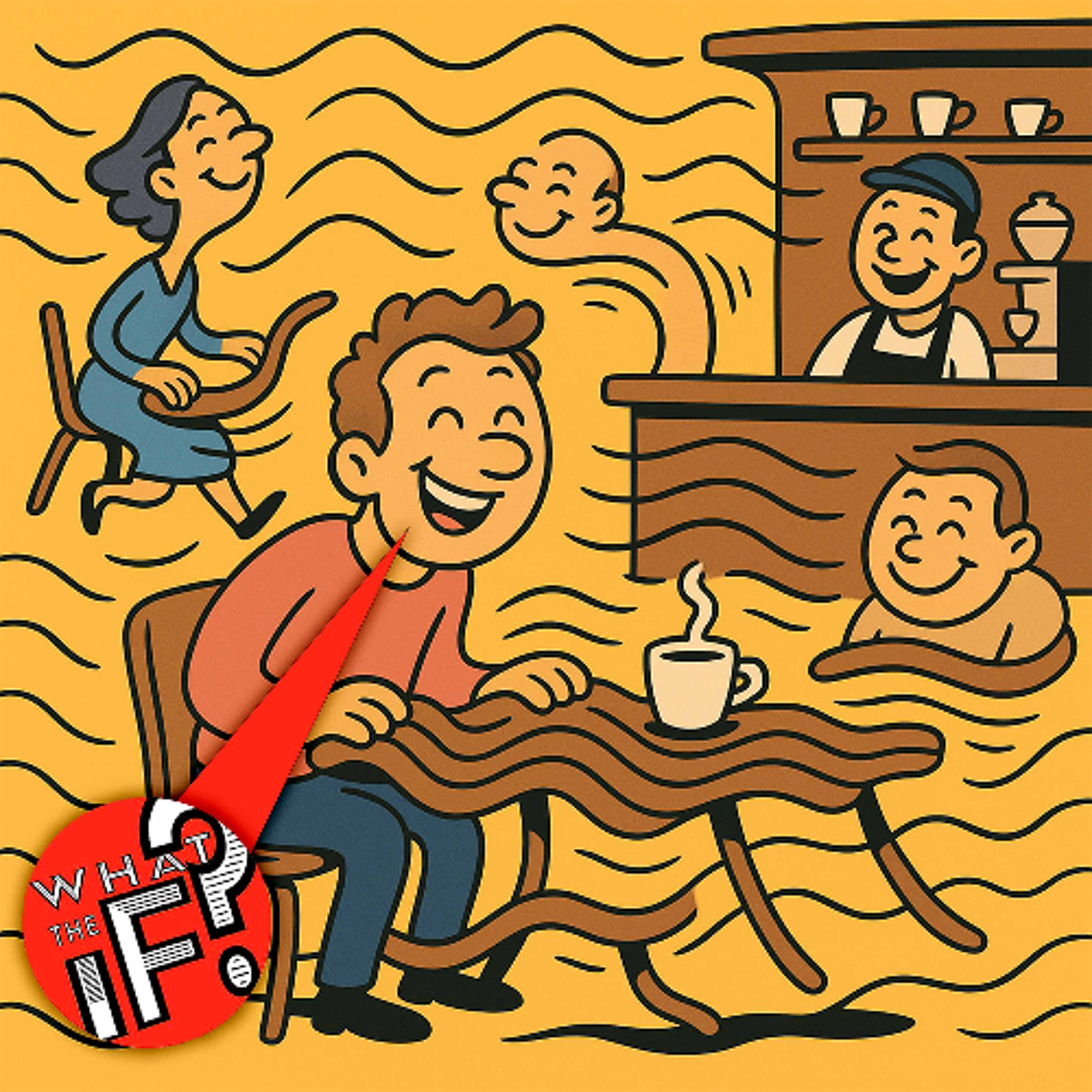
Gravity Waves Go WIGGLE episode artwork

EPISODE · Sep 19, 2025 · 49 MIN

Gravity Waves Go WIGGLE

from What The If? · host Philip Shane, Matt Stanley, Gabrielle Paniccia

What the if gravitational waves were big enough to see and feel? Instead of measuring distortions smaller than a proton, imagine watching your coffee table accordion in and out as ripples from distant black hole collisions pass through your local cafe. Every time Charlie the cat bats a toy mouse in Greenwich Village, sugar cubes scrunch in Williamsburg cafes. Brain surgeons would need to ask all of New York to sit perfectly still during operations to avoid gravitational interference. Even parking lots would seem impossibly far away one moment and right next to you the next as space itself stretches and compresses. From squirrels disrupting billion-dollar physics experiments to the strange world of noise-canceling gravity waves, discover why LIGO's incredible ability to detect universe-shaking events that distort space by one ten-thousandth the width of a proton might actually be humanity's most impressive scientific achievement. Based on "Happy Birthday, LIGO. Now Drop Dead." by Dennis Overby, published in The New York Times on September 10, 2025: https://www.nytimes.com/2025/09/10/science/gravitational-waves-ligo-black-holes.html?unlocked_article_code=1.nE8.QM2f.ag_83DD_kR8e&smid=url-share Learn More: "Gravity's Kiss: The Detection of Gravitational Waves" - https://mitpress.mit.edu/9780262535120/gravitys-kiss/ Matt mentioned sociologist Harry Collins' nearly 900-page masterpiece about gravity wave detection as the first book he ever reviewed; find this comprehensive account of one of science's most remarkable discoveries written by someone embedded in the gravitational wave community for over 40 years. Professor Tiffany Nichols - https://cssh.northeastern.edu/faculty/tiffany-nichols/ Matt recommended his friend Tiffany's dissertation (soon to be a book) about how LIGO chose their detection sites; explore her research on the epic story of selecting locations for these mile-long instruments and how surrounding environments become part of the scientific process. What are Gravitational Waves - https://www.ligo.caltech.edu/page/what-are-gw Learn about the ripples in space-time that we imagined making visible in our thought experiment, including how these waves from colliding black holes create distortions 10,000 times smaller than an atomic nucleus. What is LIGO - https://www.ligo.caltech.edu/page/what-is-ligo Discover how this unique observatory uses 4-kilometer-long laser interferometers to detect the universe's most violent events, from the instrument that Matt described as humanity's most sensitive measurement device. --- Find out more about Gaby's science fiction short story! Here are the links for the anthology. The physical copy can be ordered here : https://www.neonhemlock.com/books/luminescent-machinations-queer-tales-of-monumental-invention The ebook can be ordered here: https://www.neonhemlock.com/ebooks/luminescent-machinations-queer-tales-of-monumental-invention

Episode metadata supplied by the publisher feed · Published Sep 19, 2025

What the if gravitational waves were big enough to see and feel? Instead of measuring distortions smaller than a proton, imagine watching your coffee table accordion in and out as ripples from distant black hole collisions pass through your local cafe. Every time Charlie the cat bats a toy mouse in Greenwich Village, sugar cubes scrunch in Williamsburg cafes. Brain surgeons would need to ask all of New York to sit perfectly still during operations to avoid gravitational interference. Even parking lots would seem impossibly far away one moment and right next to you the next as space itself stretches and compresses. From squirrels disrupting billion-dollar physics experiments to the strange world of noise-canceling gravity waves, discover why LIGO's incredible ability to detect universe-shaking events that distort space by one ten-thousandth the width of a proton might actually be humanity's most impressive scientific achievement. Based on "Happy Birthday, LIGO. Now Drop Dead." by Dennis Overby, published in The New York Times on September 10, 2025: https://www.nytimes.com/2025/09/10/science/gravitational-waves-ligo-black-holes.html?unlocked_article_code=1.nE8.QM2f.ag_83DD_kR8e&smid=url-share Learn More: "Gravity's Kiss: The Detection of Gravitational Waves" - https://mitpress.mit.edu/9780262535120/gravitys-kiss/ Matt mentioned sociologist Harry Collins' nearly 900-page masterpiece about gravity wave detection as the first book he ever reviewed; find this comprehensive account of one of science's most remarkable discoveries written by someone embedded in the gravitational wave community for over 40 years. Professor Tiffany Nichols - https://cssh.northeastern.edu/faculty/tiffany-nichols/ Matt recommended his friend Tiffany's dissertation (soon to be a book) about how LIGO chose their detection sites; explore her research on the epic story of selecting locations for these mile-long instruments and how surrounding environments become part of the scientific process. What are Gravitational Waves - https://www.ligo.caltech.edu/page/what-are-gw Learn about the ripples in space-time that we imagined making visible in our thought experiment, including how these waves from colliding black holes create distortions 10,000 times smaller than an atomic nucleus. What is LIGO - https://www.ligo.caltech.edu/page/what-is-ligo Discover how this unique observatory uses 4-kilometer-long laser interferometers to detect the universe's most violent events, from the instrument that Matt described as humanity's most sensitive measurement device. --- Find out more about Gaby's science fiction short story! Here are the links for the anthology. The physical copy can be ordered here : https://www.neonhemlock.com/books/luminescent-machinations-queer-tales-of-monumental-invention The ebook can be ordered here: https://www.neonhemlock.com/ebooks/luminescent-machinations-queer-tales-of-monumental-invention

PodParley-generated summary based on available episode metadata and transcript content.

NOW PLAYING

Gravity Waves Go WIGGLE

0:00 49:54

No transcript for this episode yet

We transcribe on demand. Request one and we'll notify you when it's ready — usually under 10 minutes.

Frequently Asked Questions

How long is this episode of What The If??

This episode is 49 minutes long.

When was this What The If? episode published?

This episode was published on September 19, 2025.

What is this episode about?

What the if gravitational waves were big enough to see and feel? Instead of measuring distortions smaller than a proton, imagine watching your coffee table accordion in and out as ripples from distant black hole collisions pass through your local...

Can I download this What The If? episode?

Yes, you can download this episode by clicking the download button on the episode player, or subscribe to the podcast in your preferred podcast app for automatic downloads.
URL copied to clipboard!