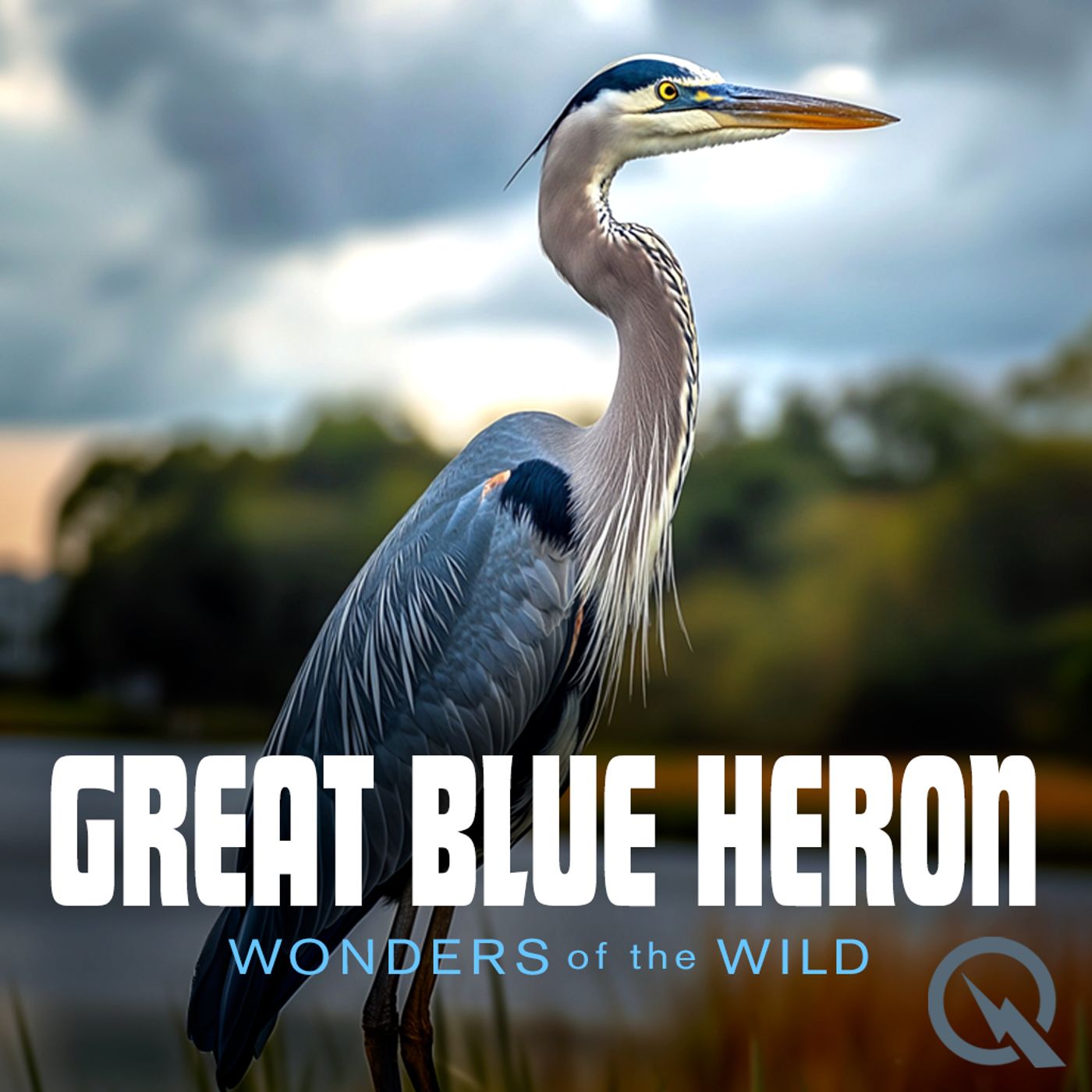
Great Blue Heron episode artwork

EPISODE · May 31, 2024 · 7 MIN

Great Blue Heron

from Great Blue Heron · host Inception Point AI

The Great Blue Heron, a majestic and awe-inspiring bird, is a true icon of North American wetlands. With its striking blue-gray plumage, impressive size, and elegant form, this regal wading bird is instantly recognizable and beloved by nature enthusiasts across the continent. Standing tall at the water's edge, the Great Blue Heron (Ardea herodias) is a sight to behold. With a height of up to 4.5 feet and a wingspan that can exceed 6 feet, it is the largest heron species in North America and a true giant among the continent's avifauna. Its long, sinuous neck, dagger-like bill, and stilt-like legs give it an almost prehistoric appearance, as if it had stepped straight out of the pages of a dinosaur book. But there is nothing primitive about the Great Blue Heron's plumage. Its body is draped in a rich, deep blue-gray, with a subtle purple or rusty wash on the neck and shoulders. The head is adorned with a striking black cap and a clean white face, punctuated by a fierce yellow eye and a long, sharp bill. In flight, the heron's broad wings are marked with a distinctive black band, and its long legs trail behind, creating an unmistakable silhouette against the sky. The Great Blue Heron is found throughout much of North and Central America, from Alaska and northern Canada all the way down to the Caribbean and parts of South America. It is a highly adaptable species, able to thrive in a wide range of wetland habitats, from freshwater marshes and riverbanks to coastal estuaries and even urban parks and golf courses. Some populations migrate long distances between breeding and wintering grounds, while others remain in the same area year-round. As a wading bird, the Great Blue Heron is perfectly adapted to life in shallow water. Its long, sturdy legs allow it to navigate through muddy or rocky substrate with ease, while its wide, splayed toes help distribute its weight and prevent it from sinking into soft sediment. The heron's keen eyes and lightning-fast reflexes make it a formidable hunter, able to spot and capture prey with incredible precision. When hunting, the Great Blue Heron is a study in patience and stealth. It stands motionless in the shallows, its body tensed and its gaze fixed on the water, waiting for an unsuspecting fish or frog to swim within range. Then, with a sudden, explosive motion, it strikes, spearing its prey with its sharp bill and swallowing it whole. Herons are known to eat a wide variety of aquatic animals, from small minnows and crayfish to larger fish, frogs, and even small mammals and birds. Despite their solitary nature, Great Blue Herons come together in large numbers during the breeding season, forming nesting colonies known as heronries. These can be truly spectacular sights, with dozens or even hundreds of nests crowded together in a single tree or grove. Heronries are often located on islands or in other isolated spots, where the birds are protected from terrestrial predators like raccoons and coyotes. Within th This content was created in partnership and with the help of Artificial Intelligence AI.

Episode metadata supplied by the publisher feed · Published May 31, 2024

The Great Blue Heron, a majestic and awe-inspiring bird, is a true icon of North American wetlands. With its striking blue-gray plumage, impressive size, and elegant form, this regal wading bird is instantly recognizable and beloved by nature enthusiasts across the continent. Standing tall at the water's edge, the Great Blue Heron (Ardea herodias) is a sight to behold. With a height of up to 4.5 feet and a wingspan that can exceed 6 feet, it is the largest heron species in North America and a true giant among the continent's avifauna. Its long, sinuous neck, dagger-like bill, and stilt-like legs give it an almost prehistoric appearance, as if it had stepped straight out of the pages of a dinosaur book. But there is nothing primitive about the Great Blue Heron's plumage. Its body is draped in a rich, deep blue-gray, with a subtle purple or rusty wash on the neck and shoulders. The head is adorned with a striking black cap and a clean white face, punctuated by a fierce yellow eye and a long, sharp bill. In flight, the heron's broad wings are marked with a distinctive black band, and its long legs trail behind, creating an unmistakable silhouette against the sky. The Great Blue Heron is found throughout much of North and Central America, from Alaska and northern Canada all the way down to the Caribbean and parts of South America. It is a highly adaptable species, able to thrive in a wide range of wetland habitats, from freshwater marshes and riverbanks to coastal estuaries and even urban parks and golf courses. Some populations migrate long distances between breeding and wintering grounds, while others remain in the same area year-round. As a wading bird, the Great Blue Heron is perfectly adapted to life in shallow water. Its long, sturdy legs allow it to navigate through muddy or rocky substrate with ease, while its wide, splayed toes help distribute its weight and prevent it from sinking into soft sediment. The heron's keen eyes and lightning-fast reflexes make it a formidable hunter, able to spot and capture prey with incredible precision. When hunting, the Great Blue Heron is a study in patience and stealth. It stands motionless in the shallows, its body tensed and its gaze fixed on the water, waiting for an unsuspecting fish or frog to swim within range. Then, with a sudden, explosive motion, it strikes, spearing its prey with its sharp bill and swallowing it whole. Herons are known to eat a wide variety of aquatic animals, from small minnows and crayfish to larger fish, frogs, and even small mammals and birds. Despite their solitary nature, Great Blue Herons come together in large numbers during the breeding season, forming nesting colonies known as heronries. These can be truly spectacular sights, with dozens or even hundreds of nests crowded together in a single tree or grove. Heronries are often located on islands or in other isolated spots, where the birds are protected from terrestrial predators like raccoons and coyotes. Within th This content was created in partnership and with the help of Artificial Intelligence AI.

PodParley-generated summary based on available episode metadata and transcript content.

NOW PLAYING

Great Blue Heron

0:00 7:27

No transcript for this episode yet

We transcribe on demand. Request one and we'll notify you when it's ready — usually under 10 minutes.

The Field Priest Methodius Chwastek The Field is a place of cultivation and of battle. In the Church, we learn to cultivate a life pleasing to God. This life is shaped in the spiritual battle. This series examines, chapter by chapter, the Christian classic The Field, by Saint Ignatius Brianchaninov. Please join me as I explain this great work in terms the modern Orthodox Christian can understand.  Hiking Grand Canyon This series contains great information for those who will be hiking the Grand Canyon. A variety of topics are discussed, including safety measures to take, camping suggestions, and how to preserve the canyon. Vampires of the Paper Flower Consortium Elizabeth Guizzetti Come for the evening, stay for eternity! Paper Flower Consortium is a podcast from the largest vampire coven in Seattle. Their stories are told by Loretta Fabron Onfoy, coven historian and librarian, in the hope that the modern vampire's way of life is not lost during the next great language transformation. Some tales in this anthology are horrific, some are droll, some are filled with misadventure--just like any eternal existence. Episodes sponsored by the Paper Flower Consortium's Business Community. The history is followed by questions from curious initiates. Want to ask Lady Loretta a question about vampirism? Have a topic you want to see discussed? Email [email protected] Blue Light News Archive Blue Light News is an innovative new Internet radio show devoted to covering the news of Unicoi County in a unique and interesting way.

Frequently Asked Questions

How long is this episode of Great Blue Heron?

This episode is 7 minutes long.

When was this Great Blue Heron episode published?

This episode was published on May 31, 2024.

What is this episode about?

The Great Blue Heron, a majestic and awe-inspiring bird, is a true icon of North American wetlands. With its striking blue-gray plumage, impressive size, and elegant form, this regal wading bird is instantly recognizable and beloved by nature...

Can I download this Great Blue Heron episode?

Yes, you can download this episode by clicking the download button on the episode player, or subscribe to the podcast in your preferred podcast app for automatic downloads.
URL copied to clipboard!