
EPISODE · Oct 21, 2026 · 39 MIN
Grid Enhancing Technologies
from The Innovation Attorney Podcast · host The Innovation Attorney
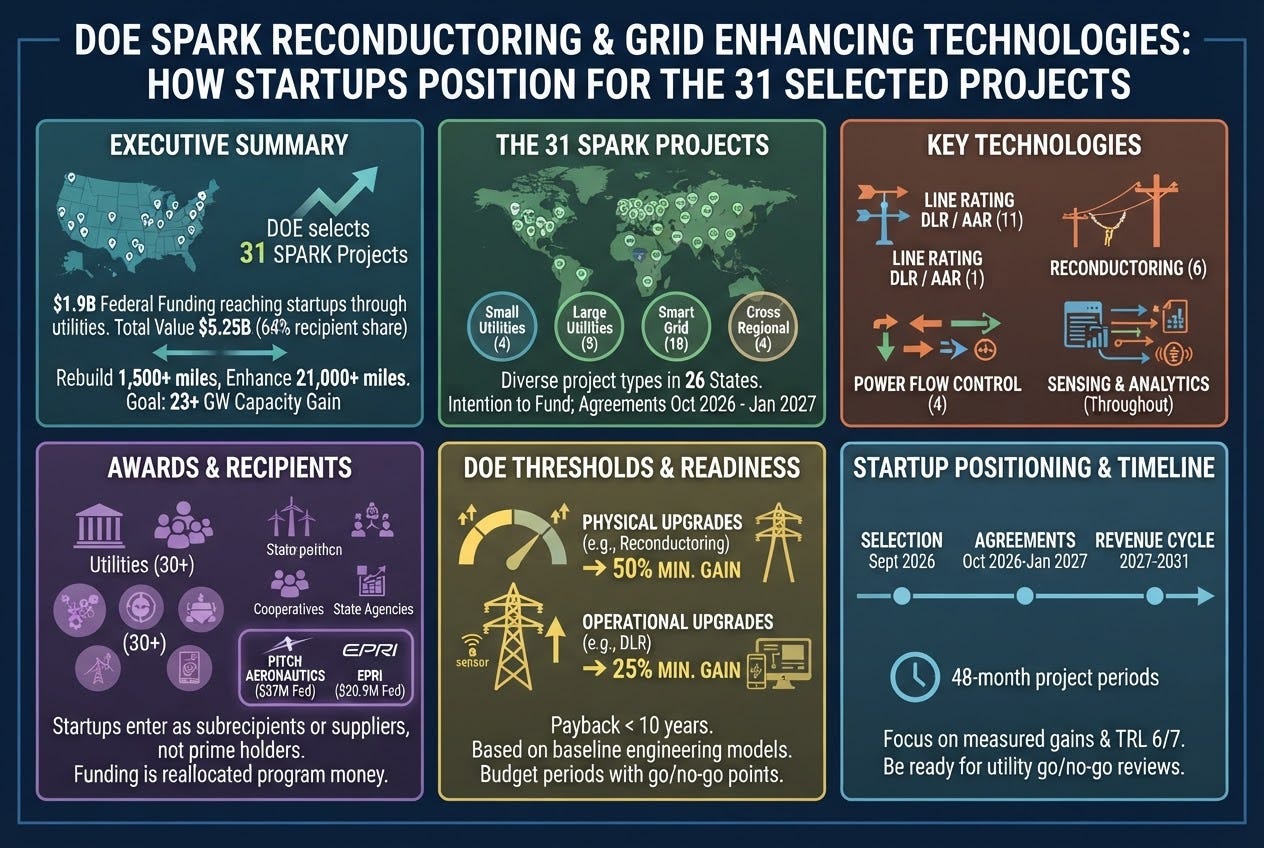
The Department of Energy selected 31 SPARK reconductoring and grid enhancing technology projects on September 24, 2026, committing about $1.9 billion that startups can reach through utility recipients. Total project value reaches $5.25 billion because recipients contribute $3.35 billion, about 64 percent of the total. The projects will reconductor or rebuild more than 1,500 miles of line and apply grid enhancing technologies across nearly 21,000 miles, a ratio of about 14 to 1, for a stated gain of more than 23 GW. Money per mile explains where startup contracts will land. The Entergy project covers about 1,125 miles at a total value of $27.4 million, roughly $24,000 per mile. The PPL Montour rebuild covers 29.3 miles at $142.9 million, roughly $4.9 million per mile. Sensing, line rating software, and power flow hardware cover far more wire per dollar than conductor does, so the larger number of vendor contracts goes to the cheaper technologies, while conductor makers win fewer and larger orders. Startups hold almost none of the awards. Utilities, cooperatives, and state agencies hold them, with two recipients outside that group: the startup Pitch Aeronautics at $37.0 million federal and the Electric Power Research Institute at $20.9 million. Selection is an intention to fund. Agreements are expected between October 2026 and January 2027, project periods run up to 48 months, and the notice sets minimum capacity gains of 50 percent for physical upgrades and 25 percent for operational technologies. Startups should position now around measured, contractable capacity gains and the technology readiness levels the notice requires, because utility purchasing follows the signed agreements. Detailed Findings What Did the Department of Energy Select Under SPARK? DOE selected 31 projects in 26 states on September 24, 2026, funded from the Grid Resilience and Innovation Partnerships program that the 2021 infrastructure law authorized at up to $10.5 billion over five years. The money is reallocated program funding. DOE describes the selections as intentions to fund, and the figures stay preliminary until agreements are signed. The notice of funding opportunity, number 0003580, issued on March 12, 2026, with applications due May 20, 2026. DOE’s program page lists different dates, February 25 and May 5; the notice document itself controls here. The 31 divide into four small utility projects, five large utility projects, 18 smart grid projects, and four cross regional projects. Summing the federal shares in DOE’s list gives $1,893 million, which matches the $1.9 billion headline: $476.4 million in the grid resilience topic area, $606.5 million in the smart grid topic area, and $810.4 million in the grid innovation topic area. Total project value sums to $5,252 million. The four cross regional awards, to Colorado, Oklahoma, Ohio, and Indiana, take 43 percent of the federal dollars. DOE describes one of them, the Three Corners Connector between the Southwest Power Pool and the Western Interconnection, as a new high capacity transmission link, which places it outside the reconductoring work. Which Technologies Appear in the 31 Project Descriptions? Line rating technology appears in more project descriptions than any other single technology. Eleven of the 31 descriptions name dynamic line rating or a line rating or capacity rating system: Kit Carson Electric Cooperative, Rocky Mountain Power, the Tennessee Valley Authority, American Electric Power, Entergy, Eversource, New England Power, NorthWestern Energy, Orlando Utilities Commission, Pitch Aeronautics, and Public Service Company of New Mexico. Four descriptions name power flow control or stabilization hardware. NorthWestern Energy pairs advanced power flow control with dynamic line rating on a Montana and Wyoming transfer path, at $26.5 million federal on $53.0 million total. CenterPoint Energy Houston Electric lists an advanced transmission system stabilization device at $50.0 million federal. Duquesne Light lists stabilization devices at $22.2 million federal. The New York Power Authority lists a static synchronous compensator at the Marcy site, $50.0 million federal on $270.0 million total. Together the four draw $148.7 million in federal funds. Reconductoring appears by name in a smaller group. Arizona Electric Power Cooperative, Kit Carson, PPL Electric, Orlando Utilities Commission (high temperature low sag conductor), Pitch Aeronautics (targeted wire upgrades for Ameren Missouri, Ameren Illinois, and Farmington Electric Utility System), 1803 Electric Cooperative (wire replacement), and Indiana (reconductoring across the PJM and MISO seam) each carry conductor work. Several other projects list transmission line upgrades without stating a conductor type. Sensing and analytics appear throughout. Kit Carson pairs line rating with advanced sensors and data analytics. New England Power lists targeted field sensors and automated operations software. Powder River Energy lists real time sensors and AI models for planning and predictive maintenance. Guam Power Authority lists AI enabled operational tools. The Orlando project lists AI tools that reduce the number of sensors required, which states a design goal of fewer physical sensors per mile through modeling. What Does the 14 to 1 Mile Ratio Mean for Vendors? The ratio means grid enhancing technology vendors will see more contracts and conductor vendors will see larger ones. DOE’s totals give nearly 21,000 miles of grid enhancing technologies against more than 1,500 miles reconductored or rebuilt; some of the enhanced miles may overlap rebuilt lines, and DOE has not published the overlap. The two examples with public detail show the spread in cost. The Entergy project covers about 1,125 miles of existing line for $27.4 million total, about $24,000 per mile, with dynamic line rating, targeted surveys, substation and terminal upgrades, and hardware integration over four years. The PPL Montour project rebuilds 29.3 miles of a 230 kV corridor for $142.9 million total, about $4.9 million per mile, roughly 200 times the Entergy figure. The scopes differ: the Entergy figure includes substation work across 1,125 miles, and the PPL figure includes new structures, dual optical ground wire, and distributed acoustic sensing. The performance each buys also differs. Entergy states a minimum 25 percent increase in transfer capability on selected corridors, with early modeling showing 29 to 61 percent more available capacity across the project area. A 2024 study from the Goldman School of Public Policy at the University of California, Berkeley and GridLab found that advanced conductors raise line capacity 50 to 110 percent, usually cost about half as much as a new line for the same capacity, and take 18 months to three years to build. A rebuilt line carries more current in every hour. A line rating system releases headroom when weather cools the wire, and one trade report puts the gain at 20 to 40 percent on cool, windy nights, with less on hot, still days. That figure comes from a single secondary source and should be treated as a vendor range, not a measured result. Published coverage reports no split of the 23 GW between firm and conditional capacity. Who Receives the Awards and Where Do Startups Enter? Utilities, cooperatives, and state agencies receive nearly all of the awards, and a startup reaches the money as a subrecipient or a supplier. Two recipients sit outside that group. The Electric Power Research Institute receives $20.9 million federal on $41.7 million total to deploy advanced transmission technologies on FirstEnergy and Salt River Project systems. Pitch Aeronautics receives $37.0 million federal on $75.6 million total for weather based dynamic line rating software and targeted reconductoring at three host utilities. The Pitch structure shows a software company can carry the prime award while utilities serve as host sites. The notice permits for profit organizations as subrecipients. It bars entities of concern, requires a written waiver for each foreign subrecipient with no appeal of a denial, and requires all work to be performed in the United States unless DOE approves a waiver. Public vendor ties already exist. CTC Global announced that its carbon core ACCC conductor is part of the PPL Montour project, which also includes dual optical ground wire and distributed acoustic sensing. Ameren’s Illinois transmission company runs a pilot with Heimdall Power sensors, 15 installed and 15 more planned in 2026; the public record does not tie that pilot to SPARK, yet it places two rating approaches inside the same utility family that Pitch will serve. What Performance Thresholds Does the Notice Impose? The notice sets a 50 percent minimum increase in transfer capability for physical upgrades such as reconductoring and a 25 percent minimum for operational or digital upgrades such as dynamic line rating, topology optimization, and dynamic protection. The smart grid topic area requires a quantified increase with baseline and projected values in MW and percent but states no percentage threshold. Every topic area requires baseline and post project transfer capability supported by engineering models, simulations, or validated performance data. Technology readiness minimums apply: level 6 for advanced transmission technologies and high performance conductors, level 7 for all other technologies. Projects must show a payback of ten years or less when claiming the affordability benefit. Awards carry one budget period with go or no go decision points, so continued federal funding depends on measured performance. DOE plans to feed project data into its Metrics and Benefits Program. Cost share runs at least 50 percent of total project cost in the smart grid and grid innovation topic areas, and at least 25 percent for eligible small utilities in the grid resilience area. These conditions function as acceptance tests that the funder wrote into the grant, and every vendor contract under a SPARK award will inherit them. How Should Reconductoring Hardware Startups Position? Reconductoring startups should sell guaranteed capacity gain per mile and installation speed, because the 50 percent threshold favors advanced conductors over conventional rebuilds. A conductor that raises capacity 50 to 110 percent clears the threshold with margin, and the buyer needs that margin to survive a go or no go review. One trade report prices advanced conductor at two to four times conventional conductor per foot; that figure is single source and unverified. The incumbents named by one trade commentary, without contract evidence, are CTC Global, TS Conductor, Nexans, and Prysmian Group, so a new entrant competes against suppliers that utilities already know. Differentiators that a utility project manager can verify include sag performance at rated temperature, compatibility with existing structures and hardware, crew installation rates per day, and domestic manufacturing capacity, since the notice requires domestic performance of work. The notice directs applicants to the Build America, Buy America regulations at 2 CFR Part 184; the funding restrictions text was not available for this report, so each vendor should read the domestic content terms in its customer’s signed agreement. A second market exists at the state level: one trade report states that Virginia passed H.B. 862 in 2026 requiring utilities to consider advanced transmission technologies in upgrade planning, and that similar bills have been cited in Colorado, California, Maryland, New Jersey, Utah, Indiana, and Montana. That report is the only source located for these state laws. How Should Dynamic Line Rating and Sensing Startups Position? Dynamic line rating and sensing startups should sell measured transfer capability, since eleven projects and a 25 percent threshold make this the broadest contract category. FERC Order No. 881, approved December 16, 2021, requires transmission providers to use ambient adjusted ratings for near term transmission service and does not mandate dynamic line rating, so every utility already needs a weather data feed. A sensor or software vendor must therefore show value above ambient adjusted ratings, meaning accuracy at the individual span, conductor temperature, and ice or wind events that a regional weather model misses. Two product approaches compete. Pitch uses weather based software with targeted reconductoring. Hardware vendors such as Heimdall Power clamp sensors on conductors, and trade commentary names LineVision, Ampacimon, and Gridware in the same group. The Orlando project’s use of AI to reduce sensor counts threatens per sensor pricing, so contracts priced per mile or per verified MW fit the buyer’s incentives better. On a nuclear submarine, a reading outside the design basis was not believed until a second independent instrument agreed. Utility operators apply the same discipline to a rating above the static rating, so a sensor startup should plan to run beside a second measurement path during the first year of a deployment and should write that comparison into the acceptance test. How Should Power Flow Control Companies Position? Power flow control companies should position beside dynamic line rating, because the one project that names advanced power flow control also names dynamic line rating. NorthWestern Energy’s $53.0 million Montana and Wyoming project buys both to raise interstate transfer capability. Four projects, $148.7 million federal, name power flow or stabilization hardware, and the New York Power Authority’s static synchronous compensator carries the largest total at $270.0 million. One trade commentary lists Smart Wires among likely beneficiaries without contract evidence. The notice lists dynamic line rating, topology optimization, and dynamic protection as examples of operational upgrades subject to the 25 percent threshold and lists reconductoring as the example of a physical upgrade subject to 50 percent. The notice excerpt reviewed does not say which threshold applies to power flow control hardware. A vendor should obtain the classification from the host utility’s project file before quoting a performance guarantee. How Should Grid Software and Analytics Startups Position? Software startups should sell the baseline and post project verification that DOE requires, since every project must document transfer capability before and after in MW and percent. Software that produces those values from engineering models and validated data, in a form a utility can submit into DOE’s metrics program, answers a requirement every recipient has. The smart grid topic area also requires cybersecurity measures consistent with DOE and NIST smart grid guidance and NERC reliability standards, so a software vendor without a documented security posture will stall in utility review. Named buyers exist. Eversource and New England Power, affiliated companies, received $47.7 million and $49.7 million federal for rating and analytics projects. Public Service Company of New Mexico lists line rating software. Powder River Energy lists AI models for planning and predictive maintenance. The notice also states that application information is subject to Freedom of Information Act release regardless of protective markings and that DOE may process application information, including proprietary content, with AI tools. A startup that supplies technical detail to a utility’s application should assume DOE and the public can read it. What Role Do the AI and Data Center Projects Play? Three projects name AI or data center load, and they account for about $371.0 million of the $5.25 billion total, about 7 percent. They are the Tennessee Valley Authority project at $159.7 million total, the Alabama Power project at $183.9 million total, and the Entergy project at $27.4 million total; the federal share of the three is $143.6 million, 7.6 percent of the federal total. The other 28 projects rest on congestion relief, reliability, wildfire and storm resilience, and regional transfer capability. The June 2026 FERC large load interconnection proceedings sit outside this report. A startup pitch built entirely around AI load addresses a minority of the awards. DOE’s Speed to Power request for information, launched September 18, 2025, drew 369 responses covering 238 unique projects and 162.9 GW of capacity targeted for service by 2030, with 85 transmission projects totaling 31.4 GW. SPARK’s 23 GW is comparable in size to that transmission tally. The pipeline of utility projects seeking federal support therefore extends beyond the 31 selections, which widens the customer list for startups willing to qualify against the same thresholds. What Does the Award Timeline Mean for Sales Cycles? Utility purchasing follows signed agreements, so vendor revenue opens in 2027 and runs through 2030 and into early 2031. DOE expects agreements between October 2026 and January 2027, with periods up to 48 months ending between October 2030 and January 2031. The notice favors projects that use existing rights of way and deploy quickly; reconductoring builds take 18 months to three years in the Berkeley and GridLab study, while greenfield lines take five to 15 years. A startup should hold price quotes valid for twelve months, align its own financing to purchase orders instead of selection announcements, and budget engineering time for the technology readiness evidence the notice demands. A utility facing a go or no go review will ask vendors for performance guarantees, so a vendor with field data from a prior deployment holds a stronger position than one with a laboratory result. What Contract Terms Should Startups Negotiate? The acceptance test and the data license decide more than the unit price does. Three decades of drafting supply and license agreements for hardware companies show that a vendor gets paid when the acceptance test matches how the customer will be measured. Here DOE has set the measurement: a baseline, a post project value, and a go or no go review. A vendor should tie its acceptance test to the measured transfer capability the utility reports to DOE, and tie milestone payments to the budget period. Data terms need attention. DOE integrates project data into its Metrics and Benefits Program, and the notice lists Government Rights in Data at section VIII.A.4. The text of that section was not available for this report, so a vendor should read it in the signed agreement before granting a utility any right to sensor data or model outputs. Flow down the domestic work, entity of concern, and foreign subrecipient conditions in the subcontract, because the utility carries the obligation and will pass it to the vendor. Which Reported Figures Are Contested or Single Source? Several figures differ across sources. Recipient cost share is $3.35 billion in DOE’s totals and most coverage; one trade article reports $3.25 billion, which appears to be a typographical error because the federal and cost share figures must sum to $5.25 billion. DOE’s capacity figure is stated as both about 23 GW and more than 20 GW. The population served is given as about 100 million Americans in one report, 39 million customers in a vendor announcement, and 16 million homes in a third article, and the three figures use different bases. The notice dates differ between DOE’s program page and the notice document, as described above. Dynamic line rating gains of 20 to 40 percent and conductor price multiples come from one trade report each. Open Questions Conversion of selections into signed agreements at the stated figures is unknown. DOE calls the selections intentions to fund and the figures preliminary. Signed agreements expected between October 2026 and January 2027 will show which projects keep their scope and budgets. The answer matters because vendor pipelines forecast revenue from selection announcements, and any reduction in scope reduces the purchasing a startup can count on. The method for verifying the 25 percent and 50 percent gains is not published in the material reviewed. A line rating gain varies with weather, so a measured gain depends on the hours and conditions chosen for the baseline. DOE guidance on measurement protocols, and the first reported go or no go results, would settle the point. It matters to every vendor whose payment depends on a measured result. The classification of power flow control hardware and static synchronous compensators under the physical or operational threshold is stated nowhere in the notice excerpt reviewed. A reading of the full notice or a DOE clarification would resolve it. The classification sets whether a hardware vendor must deliver 25 or 50 percent. The purchasing method each recipient will use is not public for most projects. Utilities may name vendors in applications, issue competitive requests for proposals, or use existing supply contracts. State commission filings and utility procurement notices during 2027 would show which. The answer determines whether a startup without a current utility contract can enter at all. Domestic supply of advanced conductor and sensors against a 48 month schedule is unverified. Manufacturer capacity, lead times, and the Build America, Buy America terms in signed agreements would answer it. A supply shortfall would delay projects and affect go or no go reviews. State commission treatment of the $3.35 billion in recipient cost share will affect how utilities buy. One trade report attributes slow adoption of these technologies to regulated profit incentives that favor traditional capital investment. Rate case decisions in 2027 will show whether operating expense technologies such as rating software earn recovery comparable to conductor. The effect of Order No. 881 implementation on the value of dynamic line rating is unmeasured. Compliance filings and utility reports on ambient adjusted rating results would show how much headroom ambient adjustment captures before dynamic line rating adds more. The answer sets the price a sensor vendor can charge above a weather feed. The next piece in this series prices a line rating contract so that the go or no go decision points in a SPARK award do not fall on the vendor, and it sets out the acceptance test language that protects a startup when a utility’s baseline is disputed. Source List Sources are ranked from most to least authoritative. Dates are publication dates; the notice and program pages carry the year of issue. Primary Technical and Official Sources 1. U.S. Department of Energy. Notice of Funding Opportunity DE-FOA-0003580, Speed to Power through Accelerated Reconductoring and other Key Advanced Transmission Technology Upgrades (SPARK), Part 1, Modification 1. 2026. https://files.simpler.grants.gov/opportunities/6ce21142-b06c-40c7-86ab-76735a317a42/attachments/d5bafbac-f7cd-499b-8dda-3c008f3f36f9/DE-FOA-0003580_SPARK_NOFO_Part_1_MOD_1.pdf Supplies topic area funding, award sizes, cost share, the 50 percent and 25 percent capacity thresholds, technology readiness levels, 48 month periods, and the March 12 and May 20, 2026 dates; the text retrieved was truncated before the Buy America and data rights sections. 2. U.S. Department of Energy. Selected Applications, DE-FOA-0003580 SPARK. September 2026. https://www.energy.gov/documents/selected-applications-de-foa-003580-spark Lists all 31 selected applicants with project titles, states, federal shares, total values, and technologies, which supports every sum and per mile calculation in this report. 3. U.S. Department of Energy, Office of Electricity. SPARK program page. 2026. https://www.energy.gov/oe/speed-power-through-accelerated-reconductoring-and-other-key-advanced-transmission-technology States the 31 projects, 26 states, 1,500 miles, 21,000 miles, and 23 GW totals and the award window; its listed notice dates differ from the notice document. 4. U.S. Department of Energy. Why DOE Launched Speed to Power. 2025 to 2026. https://www.energy.gov/node/4860097 Gives the September 18, 2025 launch, the November 21, 2025 response date, 369 responses, 238 unique projects, and 162.9 GW of capacity by 2030. 5. Federal Energy Regulatory Commission. News release on the final rule to improve transmission line ratings, Docket No. RM20-16, Order No. 881. December 16, 2021. https://ferc.gov/news-events/news/ferc-rule-improve-transmission-line-ratings-will-help-lower-transmission-costs Establishes the ambient adjusted rating requirement, the absence of a dynamic line rating mandate, and the related proceeding AD22-5. Economic and Market Sources 6. Howland, Ethan. Reconductoring could add four times the transmission capacity by 2035, Goldman School of Public Policy and GridLab study coverage. Utility Dive, April 9, 2024. https://www.utilitydive.com/news/reconductoring-power-lines-transmission-capacity-goldman-gridlab/712643/ Reports the 50 to 110 percent capacity gain, 18 month to three year build time, cost about half of a new line, and $85 billion in savings by 2035. Trade Publications and Energy Journalism 7. Howland, Ethan. Advanced transmission projects get $1.9B in DOE funding. Utility Dive, September 2026. https://www.utilitydive.com/news/doe-advanced-transmission-projects-spark-funding/831259/ Confirms the September 24, 2026 announcement, the totals, and the cross regional recipients. 8. Canary Media. Advanced grid tech gets a $1.9B DOE boost. September 24, 2026. https://www.canarymedia.com/articles/transmission/advanced-grid-tech-doe-boost Describes advanced conductors and dynamic line rating approaches and attributes slow adoption to regulated profit incentives. 9. Gerke, Paul. A bipartisan SPARK for the grid. Renewable Energy World, September 28, 2026. https://www.renewableenergyworld.com/energy-business/new-project-development/a-bipartisan-spark-for-the-grid-factor-this-brief/ Reports state level advanced transmission technology consideration laws and a cost share figure that differs from DOE’s. 10. Drazga, Audra. The Demand Surge Is Here: How SPARK and GRIP Are Accelerating Transmission Technology Deployment. Energy Central, March 19, 2026. https://www.energycentral.com/energy-biz/post/the-demand-surge-is-here-how-spark-and-grip-are-accelerating-52WG4L28fYKcYg0 Names vendors in conductor, grid enhancing technology, and monitoring categories; the article is opinion and gives no contract evidence. 11. Howland, Ethan. Ameren dynamic line rating pilot with Heimdall Power. Utility Dive, March 30, 2026. https://www.utilitydive.com/news/ameren-dynamic-line-rating-heimdall/816090/ Reports 15 sensors installed and 15 planned for 2026 on congested lines. 12. Data Center Dynamics. DOE unveils $1.9bn in funding for 31 grid upgrade projects to speed data center connections. September 25, 2026. https://www.datacenterdynamics.com/en/news/doe-unveils-19bn-in-funding-for-31-grid-upgrade-projects-to-speed-data-center-connections/ Identifies the Alabama Power and Entergy projects as tied to data center growth. 13. Talk Business and Politics. US Energy Department awards Entergy $13.7M to strengthen grid. September 2026. https://talkbusiness.net/2026/09/us-energy-department-awards-entergy-13-7m-to-strengthen-grid/ Supplies the 1,125 miles, four year duration, 25 percent minimum gain, and 29 to 61 percent modeled gain. 14. mGrid. DOE picks 31 reconductoring projects in 26 states and puts $1.9 billion against 23 GW of capacity. September 24, 2026. https://mgrid.org/2026/09/24/doe-picks-31-reconductoring-projects-in-26-states-and-puts-1-9-billion-against-23-gw-of-capacity/ Confirms the totals, the intent to fund status, and the reallocation of program funds. 15. Infraday. DOE selects 31 grid projects for a $5.25 billion upgrade program. September 28, 2026. https://infraday.com/2026/09/28/spark-31-grid-projects-september-2026/ Confirms the totals and the October 2026 to January 2027 award window. 16. Government Market News. $5.25B in grid projects target transmission capacity across 26 states. September 2026. https://govmarketnews.com/doe-spark-grid-projects-1-9-billion/ Reports the Speed to Power submission counts and the project priorities. 17. Tech Times. SPARK picks 31 grid projects. October 2, 2026. https://www.techtimes.com/articles/328398/20261002/spark-picks-31-grid-projects-reconductoring-doubles-capacity-without-new-land.htm Source for the three AI linked projects at about $371 million, the dynamic line rating range, and the conductor price multiple; single source for the last two. Industry and Vendor Sources 18. CTC Global. DOE SPARK investment advances grid modernization with PPL Electric Utilities and ACCC conductor. September 25, 2026, modified October 1, 2026. https://ctcglobal.com/doe-spark-investment-advances-grid-modernization-with-ppl-electric-utilities-and-accc-conductor/ Vendor announcement placing its conductor in the Montour project; claims are the vendor’s own. 19. Heimdall Power. Three things utilities need to know about DOE’s SPARK funding. 2026. https://www.heimdallpower.com/news/three-things-utilities-need-to-know-about-does-spark-funding Vendor summary of the notice; it lists concept paper and application dates that match the notice, and its figures were checked against the notice. Bibliography CTC Global. 2026. DOE SPARK investment advances grid modernization with PPL Electric Utilities and ACCC conductor. September 25, 2026, modified October 1, 2026. https://ctcglobal.com/doe-spark-investment-advances-grid-modernization-with-ppl-electric-utilities-and-accc-conductor/ Canary Media. 2026. Advanced grid tech gets a $1.9B DOE boost. September 24, 2026. https://www.canarymedia.com/articles/transmission/advanced-grid-tech-doe-boost Data Center Dynamics. 2026. DOE unveils $1.9bn in funding for 31 grid upgrade projects to speed data center connections. September 25, 2026. https://www.datacenterdynamics.com/en/news/doe-unveils-19bn-in-funding-for-31-grid-upgrade-projects-to-speed-data-center-connections/ Drazga, Audra. 2026. The Demand Surge Is Here: How SPARK and GRIP Are Accelerating Transmission Technology Deployment. Energy Central, March 19, 2026. https://www.energycentral.com/energy-biz/post/the-demand-surge-is-here-how-spark-and-grip-are-accelerating-52WG4L28fYKcYg0 Gerke, Paul. 2026. A bipartisan SPARK for the grid. Renewable Energy World, September 28, 2026. https://www.renewableenergyworld.com/energy-business/new-project-development/a-bipartisan-spark-for-the-grid-factor-this-brief/ Government Market News. 2026. $5.25B in grid projects target transmission capacity across 26 states. September 2026. https://govmarketnews.com/doe-spark-grid-projects-1-9-billion/ Heimdall Power. 2026. Three things utilities need to know about DOE’s SPARK funding. https://www.heimdallpower.com/news/three-things-utilities-need-to-know-about-does-spark-funding Howland, Ethan. 2024. Reconductoring could add four times the transmission capacity by 2035, Goldman School of Public Policy and GridLab study coverage. Utility Dive, April 9, 2024. https://www.utilitydive.com/news/reconductoring-power-lines-transmission-capacity-goldman-gridlab/712643/ Howland, Ethan. 2026. Ameren dynamic line rating pilot with Heimdall Power. Utility Dive, March 30, 2026. https://www.utilitydive.com/news/ameren-dynamic-line-rating-heimdall/816090/ Howland, Ethan. 2026. Advanced transmission projects get $1.9B in DOE funding. Utility Dive, September 2026. https://www.utilitydive.com/news/doe-advanced-transmission-projects-spark-funding/831259/ Infraday. 2026. DOE selects 31 grid projects for a $5.25 billion upgrade program. September 28, 2026. https://infraday.com/2026/09/28/spark-31-grid-projects-september-2026/ mGrid. 2026. DOE picks 31 reconductoring projects in 26 states and puts $1.9 billion against 23 GW of capacity. September 24, 2026. https://mgrid.org/2026/09/24/doe-picks-31-reconductoring-projects-in-26-states-and-puts-1-9-billion-against-23-gw-of-capacity/ Talk Business and Politics. 2026. US Energy Department awards Entergy $13.7M to strengthen grid. September 2026. https://talkbusiness.net/2026/09/us-energy-department-awards-entergy-13-7m-to-strengthen-grid/ Tech Times. 2026. SPARK picks 31 grid projects. October 2, 2026. https://www.techtimes.com/articles/328398/20261002/spark-picks-31-grid-projects-reconductoring-doubles-capacity-without-new-land.htm U.S. Department of Energy. 2025. Why DOE Launched Speed to Power. https://www.energy.gov/node/4860097 U.S. Department of Energy. 2026. Notice of Funding Opportunity DE-FOA-0003580, SPARK, Part 1, Modification 1. https://files.simpler.grants.gov/opportunities/6ce21142-b06c-40c7-86ab-76735a317a42/attachments/d5bafbac-f7cd-499b-8dda-3c008f3f36f9/DE-FOA-0003580_SPARK_NOFO_Part_1_MOD_1.pdf U.S. Department of Energy. 2026. Selected Applications, DE-FOA-0003580 SPARK. September 2026. https://www.energy.gov/documents/selected-applications-de-foa-003580-spark U.S. Department of Energy, Office of Electricity. 2026. SPARK program page. https://www.energy.gov/oe/speed-power-through-accelerated-reconductoring-and-other-key-advanced-transmission-technology Managing Transmission Line Ratings, Order No. 881, FERC Docket No. RM20-16 (Dec. 16, 2021) (news release). https://ferc.gov/news-events/news/ferc-rule-improve-transmission-line-ratings-will-help-lower-transmission-costs Interested in analysis about the intersection of tech, policy and the law? Check out my Substack channel. https://theinnovationattorney.substack.com/ This is a public episode. If you'd like to discuss this with other subscribers or get access to bonus episodes, visit theinnovationattorney.substack.com/subscribe
Embed this episode
Ready to play
Grid Enhancing Technologies
No transcript for this episode yet
Similar Episodes
No similar episodes found.
Similar Podcasts
No similar podcasts found.