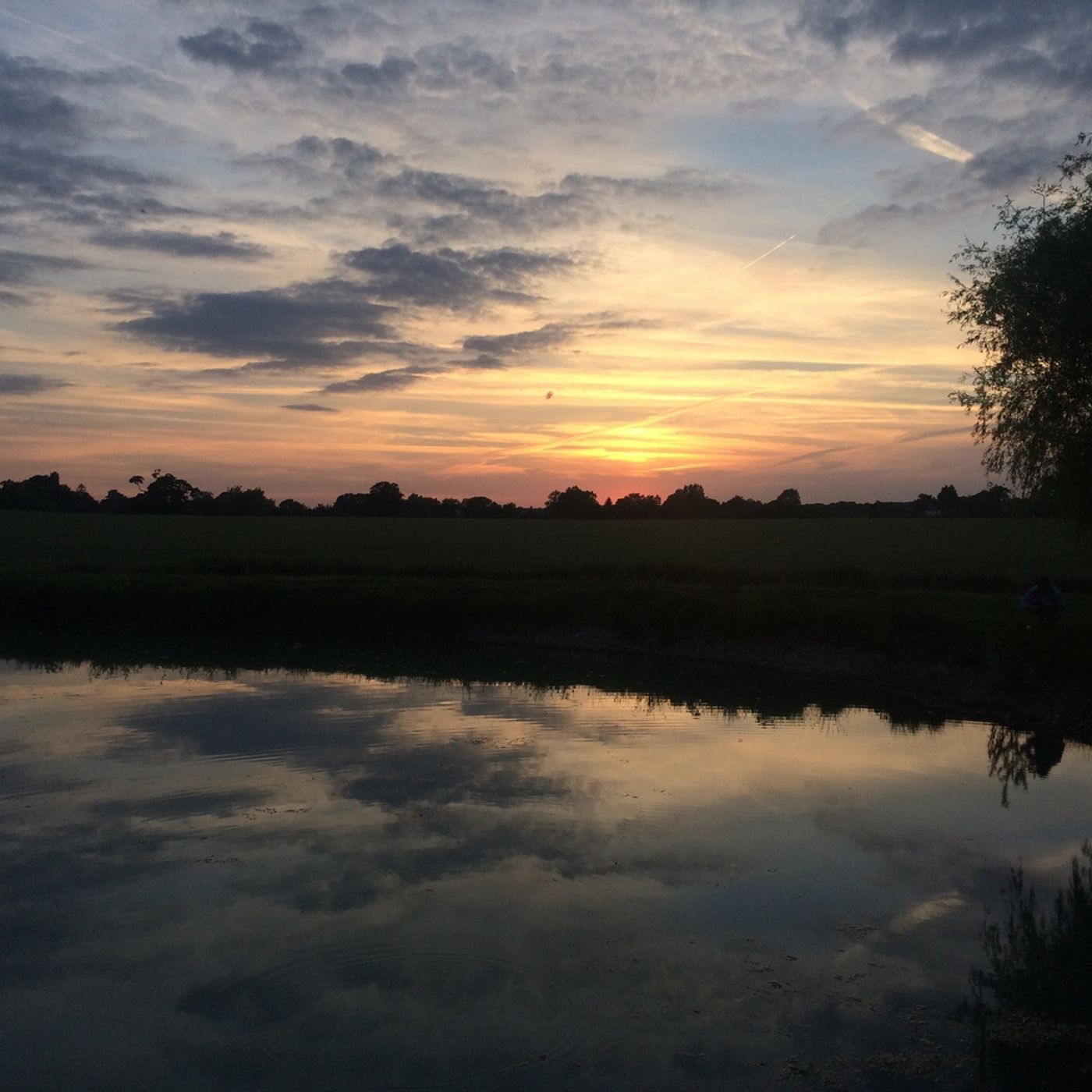
Hello, welcome to Growing Wild, sponsored by Infinity Foods here on Radio Reverb 97.2 FM, online and on digital. I'm Charlotte Pett, and today's show is all about wild swimming. We'll be hearing from the Outdoor Swimming Society, photographer and swimmer Vivian Rickman-Paul. We're going to hear a little bit of Alexandra Hemansley's book, Leap In. And finally, we'll hear how me and my friend James got on when we went for a splash in the local reservoir.
But first of all, let's have a song. All of the songs on this month's show will be water-themed. So the first one we have is Otis Redding and Sitting on the Dock of the Bay. That was Otis Redding and Sitting on the Dock of the Bay. It reminds me of my friend, my friend Carly, who's a singer-songwriter, and she used to sing that out busking in Brighton and could never get the whistling bit right. It was always a point of hilarity. OK, so this month's show is going to be all around wild swimming. It's something that I deeply love.
And I wanted to share with you some people who are really into this and have produced some lovely work as a result of being into world swimming. And then also we're going to hear from the practical side of things from the Outdoor Swimming Society about, you know, how to be safe and things to look out for and things like that. So I read, I actually listened to a book. I listened to a lot of books because of my work, because of being a gardener and having that kind of time where I can absorb it via my ears instead of my eyes. I listened to a book called Leap In.
And it's by a woman called Alexandra Hemminsley. And it was one of those books that you hear or read and it just completely inspires you and you need to immediately get out and do the exact thing that they're talking about. So this is all about her kind of journey into wild swimming, as much as I hate using that word, it's the only one that really describes it, into wild swimming and what that brought to her life and how it also sort of sat alongside some difficult times she was having in her life and how you can overcome things in one area, it helps you to overcome things in another area. This is her taking part in her first river swim and it's an event that took place in Arendelle. The water tasted like nothing I had experienced before. There was no salt, despite us being so close to the sea. It was exactly what I would have imagined this shade of earthy green to taste like. Mint and mud, Virginia Woolf called it, and I understood in those moments what she meant. It was silty but fresh, calling to mind the chlorophyll intensity of spirulina or similarly verdant powders so beloved of health food shops. There was nothing of the familiar chlorine burn in my nose, nor the sting of salt on my lips or eyes. It was fresh.
I daydreamed about this former self, the one who'd never tasted a river, and after ten minutes or so I looked up, trying to get my bearings. The river was wider than I'd expected, much wider than it was in Littlehampton, and the three of us, swimming at a similar pace, were taking wide zigzags rather than staying tight to its curves. I'd never seen a river this wide from within. The banks seemed high and inaccessible, whereas we were low, eyes at water level, seeing the world as a duckling might. Like them, I was unable to fly, making our sunken position between the banks an inescapable one. The only way out of the river...
was to finish the course. I steadied my breath, chose a tree in the distance, and told the others I was aiming for that, then planning to take another pause to get my bearings. And so we continued, swimming for ten or twelve minutes at a stretch, pausing to right our course, checking that we were all still feeling strong, then onwards. I'd swum for an hour continuously in the pool, but it had always been punctuated by pauses in the shallow end. I'd at least practised in open water by now, if only for about fifteen minutes of continuous swimming, but this was unlike anything I'd ever experienced. We were inaccessible, plunged into nature, swimming our way home.
A beat started to form as I felt my stroke lengthen and become more confident. My breath, my body, my surroundings. This, I suspected, was as close to the state of flow as I had ever felt. This was entirely new sensory territory, with almost nothing to look at beyond my hands' repeated motions and the bubbles they were creating, nothing to hear except the roaring of the water being forced forward by my exhalations, and nothing to taste other than the river itself. My senses seemed to reach a deep state of relaxation.
It's lovely, isn't it? And it just makes me want to get in the water straight away. She'd done a lot of sea swimming before that event. Locally to Brighton, there's a swimming school, and they do something called Pool to Pier. And it teaches you how to go from swimming in a pool, and then you swim between the piers in the sea. And she'd done that, and then this was her first experience in the river. So the book's just lovely, and it's of her experience, but then it's also got a whole section on all of the practical things, you know, what kit you need, tips on breathing. It's always breathing with swimming that seems to trip us up. It certainly trips me up. I end up sort of consumed with water.
Yeah, so it's a great book. It's called Leap In. I'll put that on the show page, the Growing Wild show page on radioreverb.com. That excerpt is actually also from a book called Watermarks, and it's just come out. It's just been published, and it's a lovely book. It's a collection of writings from wild swimming fans, just outdoor swimming fans, and it's supported by Pels Pool, which is an outdoor pool in Lewis. It's really lovely, and it just seems to show how deep people's connection is with the water and how it seems to affect people so richly, which is an experience, actually, that my first guest, Vivian Rickman-Paul, has very much had, and we'll hear from her after this song. I can't do it.
a show about water and not play, Cry Me A River by Justin Timberlake. That was Justin Timberlake and Cry Me A River. It's so old, that song, but you wouldn't know it, would you? Sounds fresh as a lazy. OK, next we're going to hear from Vivian Rickman-Paul. Now, she is a photographer.
and an artist and also a swimmer, a wild swimmer. And she combines these two things so beautifully where she takes shots of her body underwater in various different bodies of water. And her Instagram account is just gorgeous. And I would urge you to go and have a look. Her handle is just at Vivian Rickman Poole. I first saw her in The Guardian, actually. They did a piece about these small films that had been made for a film festival and hers was called Afterglow. And it's just stunning. And again, I'll put links to this on the show page, on the Growing Wild show page on Radio Reverb.com. And I just have a watch of it. It's just so glorious. She's originally from...
the new forest she now lives just by snowdonia in wales and we were having this great chat before the interview even started so i finally got around to talking to her about wild swimming and here we are how did you come to find wild swimming and because it's obviously a big love for you it feels like more than just a hobby or like a play a playful thing which i'm sure it is as well but it seems to run a lot deeper um how did you come to find that it was it was something that was going to be so important for you It's something I've always done ever, you know, since I can remember. Mum was a swimmer from, I mean, from the days when swimming, you swan outside because you had no other choice. I think we had a harbour pool they might have swam in. She just made sure we always swam. And, you know, like everyone did, summers were spent at the beach or in river pools or an old gravel pit we used to swim in in the forest. But yeah, it was always just part of life. And I think she had aspirations. She used to swim for her county and she had sort of aspirations that I was going to be some great championship swimmer.
Which didn't happen. I didn't have the same imagination. Yeah, as I got older, I just sort of grew out of it a bit. And then, yeah, just as I came up here, obviously, it's a big outdoor life up here. So I'm always doing lots of swimming. And that's where, when I moved up here, I started to do more of that. And then my mum passed away. And I didn't notice. It was totally subconscious that I was swimming more and more after she passed away. And I actually did a film for Elbow for one of their singles. And it wasn't until we were making that film that it came out that it was possibly why I was swimming so much.
was because my mum had passed away. So it's actually been a bit of a healing experience in a way? If it was, it was totally subconscious. But I swim a lot alone. But while I'm swimming, I'm not thinking about my mum or anything like that. Because I think when you're swimming, I'm just in the moment, I'm just thinking about my next time I've got to get my head up to breathe and that kind of thing. But the taking photos came about because I've always messed about with cameras and being experimental with making pinhole cameras. And at some point, the swimming started to get quite obsessive.
With all our creativity and the subject that you're interested in, I find that it's... For it to be really meaningful, it ends up being all encompassing in your life. And at some point, the cameras went in the water with me, and that's when it all took over and became encompassing. Yeah, it kind of fed into each other, so you had this... Yeah. You love the photography intertwined with being in the water. Yes. I did an article for Elementum Journal, and I was talking to... I'm not a great speaker, but I was talking to the editor. She helped write the article, and she picked up on this sort of...
swimming for healing or i mean i don't like the word healing particularly but um yeah she picked up on the um the fact that i was swimming alone and wanting to sort of capture the being alone in the water and she picked up on the maybe it was something connection to random yeah because it's very striking in your images i've got to say i've picked up on that it's very it looks like you use it very much for time that you've carved out for yourself you know just to have some space and it seems quite almost expansive in a way it's like it looks like you breathe in the water there's i don't know like a spaciousness about you would that be fair to say yeah absolutely and i'm actually This is getting really deep. I'm also, I'm a twin, but I've lost my twin. She was, I say she, I don't even know who she is. She was born early and didn't make it. It's almost like I'm trying to create, through self-portraits, trying to create an image of a double of myself. Like almost embryonic, healing, grieving process is there again. Me being interested in, my twin came up when my mum passed away. Okay.
But I do find something about the water. For me, I'm going out a lot more and spending time in the water a lot more. And, yeah, wild swimming is becoming quite a large part of my life, actually. And I'm finding it quite emotional. And, yeah, there's something in learning to trust the water that it holds you. If you stop sort of flailing around and thinking, oh, it's getting up my nose or whatever, when you can be so still, it's such a minimal movement to stay afloat. And there's something in that change of mindset.
I don't know, it feels quite, it does, it really resonates, it goes quite deep. Yeah, and I have, I sometimes have this absolute craving to have the pressure of the water around me. And it's almost like being cuddled by the water. Yeah, yeah. And I don't have any desire to dive into the water. I quite like my head above it. But I like that feeling that my body is immersed in it. Yeah. You know, I like to have my shoulders under and it's the cool.
The coldness is quite a big thing for me as well. I like the coolness all over me. And enveloped. Enveloped in the water. Enveloped. It's a good way to... I think Roger Deacon uses that in his book, Waterlog. Enveloped in a silky softness. Yeah, that's lovely. Yeah, it does feel that way. So cold water. You go in the water all year round. Yes. I think they do say it's addictive, this cold thing. Yeah. Because you get... They call it afterglow.
this rush of warmth when you get out. And then it sort of colds your bones inside. And it's a nice feeling. You might get it the first time that you go swimming. And then you get it if you've been for a bit longer. And then it kind of disappears the more and more that you do it. And then perhaps the colder that you go, you'll get it. And I rarely get it now. But then I've got into, yeah, going in winter is nice. And I guess you're ever searching to get that feeling back. And I've been out in Finland last year for a month doing...
cutting ice holes with the chainsaws and things, quite exciting stuff. And I can't say I had afterglow once. No, really? I had a brilliant time. Yeah, isn't that fascinating where our bodies acclimatise and then we don't get, it's just like drugs or something, isn't it? Or caffeine or, you know, we kind of get to that level of just not quite getting that rush anymore. Yeah, so searching for our natural minds. I think something that comes up quite a lot for, I think especially women that get into the water, is...
Body image comes up quite a lot, I find, when talking about this. And it seems to be a hurdle for people to get over, or for women to get over, actually, in terms of just getting into the water because of all the hang-ups of what you look like. How have you found that? Have you had to overcome anything like that? Or has it helped you become more confident? I think the reason I don't often, I'm headless, is for that very fact, it's kind of like, it's not a statement because that's a really strong word, but my wife's definitely about body image, is that in water.
We're all beautiful, graceful, elegant creatures. You know, we all feel confident. And that's, you know, why is that? Why do we all feel incredible in the water? And I notice when I take photos of other people, they all feel amazing in the water. And when you show an image and say, can I use this? They're like, yeah, no worries. But when you take a photo of someone's face, they want to have a look at it straight away. In fact, don't use that, don't use that. Isn't that interesting? Our face is that we want to edit.
So a question I found that comes up quite a lot when you talk about going out in open water is the fear of what might lurk beneath. I mean, we've all watched yours. I know, right? Even in swimming pools, I can get that feeling. Oh, gosh, what if it burst through the wall? Completely irrational. But I think we all saw it at a tender age and it seems to have affected us. Have you had to overcome those thoughts or do you get freaked out by something brushing your leg ever?
All the time. One of the reasons that I started taking a camera in the water was that very reason, was that I was petrified of, you know, everything. And I'd rush home to have a look at the photos and then find out there was nothing. There's nothing there. I mean, I didn't use to lift my eyes on the water because I was frightened. You know, every kind of thing that moved, you know, would throw me into, like, fits of screaming.
It's our imagination, isn't it? That's almost the biggest thing we have to overcome is what we bring to it ourselves. I've developed a love for deep water, which is quite unusual because most people like to stay in the shallows because they feel safe. But to me, that's where the beasties live in the shallows. That's where we're going to see fish and things. Whereas in the deep water, it's just an empty abyss of nothingness, which is what I like looking at. But a lot of people hate that. So we're all different, aren't we? Yeah, yeah. I think I like it when I know that I can touch the bottom. But I feel like it's going to be part of this experience is being able to be in the middle of...
of the water and just feeling okay with that and yeah seeing with that because it is it's a very special feeling um can you tell us a bit about your uh the snowdonia project that you're doing yeah so i mean it came about purely from not i mean i i like change maybe a little bit too much one of those people who never want to do the same thing twice which can be slightly problematic i've got a beautiful lake literally a minute walk from my house and um But going to swim in there every day would just drive me crazy. So I started swimming in a lot of different lakes. And then, you know, you stare at the map and you're like, wow, there's loads of lakes. I want to go to all of them. And then I found a lovely book called The Lakes of Smadonia. And it said there were 250 lakes of significance, you know, storied legend, size, depth. And so I made up my mission I was going to swim all of them. I mean, some of them are swamps, which you wouldn't want to go anywhere near. But at least I wanted to go to them and document visually or, you know, write something about them.
It's become a bit of a life's work now. How many have you done? How far in are you? I'm about 130 now. Wow, craggy. I have little spurts, so I might get 30 done in a few weeks and then back straight off. What would you say to somebody who hadn't done anything like this before? What's a good introduction into wild swimming?
I would say, yeah, just give it a go, even if you just dip your toes in. Because a lot of people, it's the cold. I mean, my husband is, I say he's allergic to water, but it's the cold for him. You know, what I just get in and say feels like a bath to him is like getting inside a freezer. But, you know, just dip your toes in. If that's all you can manage, then that's all you can manage the first time. Maybe next time you've got to your knees. And I bet it gives the same joy as it does if I swan up with the lake and back, you know.
And I think that's the important thing is you do something for the joy that it brings to you, not to me, not to the person, someone else. Finding your own level with it. Yeah, finding your level. And the other thing is a lot of people get hung up on whether you wear a wetsuit or a swimsuit or whether you wear your birthday suit. It doesn't matter what you wear. It's what you want to.
Sound advice there from Vivian at the end. I think that's so true. It's just finding your own level with these things. I loved that interview. I really enjoyed speaking to her. You can probably tell because it was quite long and I cut that down from at least half an hour. So if you want to find out more about the work she does, then I will put links to that on the show page. And you can just look her up on Instagram. It's Vivian Rickman Paul. And the images are gorgeous. So do check her out. She's brilliant. And how inspiring. What a lovely story.
What a lovely story. And that really resonates with that book I mentioned earlier, which is called Watermarks, and the collection of writings in there as well, and people's experience and connection with the water and just how it helps them with their life. It's just so beautiful. OK, I'm going to play a song, and then we're going to hear from Robert from the Outdoor Swimming Society, who is going to speak to us on a more practical level about what to expect when we go out into the waters. But first, this is I Can See Clearly Now by Jimmy Cliff.
That was Jimmy Cliff and I Can See Clearly Now on Radio Reverb 97.2 FM. This is Growing Wild and I'm Charlotte Petz. OK, next up we've got the Outdoor Swimming Society. I had a chat with Robert and he talked me through some of the things that you can encounter when wanting to get into an outdoor body of water and some things to be aware of. And this is him just telling us a little bit more about what the Outdoor Society is.
The Outdoor Swimming Society was set up about 10 years ago to promote recreational outdoor swimming. No other organisation was doing that, and it was becoming more and more difficult to go outdoor swimming. There was lots of people putting signs of no swimming just because they thought they had to, and they didn't. So there was an issue a lot of landowners thought, oh, liable if someone drowned. So that's the reason we produced this guide as well to outdoor swimming, so landowners are aware of their liability. What is their liability? Is it not right that they would be liable? There is some liability, but generally if you're going at your own risk.
It's down to you. Basically, the only thing they need to do really is if there's an obvious danger or a concealed danger like there was a sluice or something in the water or hidden objects. Generally, if you go swimming in a lake, you have to accept that you're taking that risk yourself. If the owner of the land knew there was like a sudden drop or there was a strong current or water was being pumped through a sluice, they'd have to put signage to warn you. That's all they'd have to do. Oh, right. So, yeah, you've created something called the Inland Bathing Area Guide, and that guide is predominantly, well, for both parties, for those that own the land that the water is in, and then for those... Councils, landowners, the National Trust, and things have changed a lot now. The National Trust have opened up areas for swimming, such as at Church Dretton Reservoir. They've got basically safety signage warning you, because there's so many people going swimming in their reservoir at Church Dretton. They kept telling them to get out, and in the end, as soon as the wardens had walked away, the people went back in, so they said, right, we don't want to stop people having fun.
They did a risk assessment to put safety signage up, and that's in the guide. It showed you how to swim safely. And the Lake District National Park, they've opened up nearly all of their natural lakes are open for swimming now. They provide guidance, and you don't get your own risk, but they give you safety advice. So you can swim. And they encourage swimming now in the Lake District.
So that's great. And also, most rivers you can swim in. There's some restrictions down in London on the tidal temps, but generally, natural rivers, you can use your own common sense normally. If you can't walk in, climb in, then you won't be able to get out. We've put all that on the website about safety for wild swimming, so really doing a bit of research. If you go to the Outdoor Swimming Society website, it tells you all you need to know.
Yeah, it's interesting, isn't it? Because for me, I would have thought, and I assume this is what a lot of landowners think, is that they would be liable and so they get frightened and they put up all of the massive red letter, no swimming signs up. So it's really good to get that information out there that they won't be entirely liable if they just put out a few guidelines and highlight any risks that might not be visible to the naked eye. That's really interesting. And it's funny, isn't it, that it gets called wild swimming and probably not that long ago it was just called swimming. Yeah, wild swimming is the only way it's not...
it's not a special facility where you've made a special facility for like a Lido an outdoor swimming pool or a special buoyed off area of a lake that would be a facility for outdoor swimming where while swimming generally you just go at your own risk in a river or a lake and you use your own common sense when you're taking the risk yourself there's more chance of you getting having an accident getting killed crossing the road than there is while swimming and that's been tested in the courts so it is down to you using your own common sense and occasionally accidents happen but that's you know That's just living, isn't it? That's just being alive, I think, yeah. Another safety issue, I guess, that people think of is the level of pollution that could potentially be in the water, which has obviously increased over the years. Yeah, the river has ever been at the moment. Is that right?
You can check on the Environment Agency's website. They'll give you the level of... You're going to swim in a river, check on the Environment Agency's website, and they'll tell you what the level of pollution is in various rivers. They're a lot cleaner than there were in the 1970s. So it's actually, yeah, it's not that polluted. It's not that unsafe. No, no. I mean, they talk about virus disease. It's very, very rare, and it's more prevalent on the continent. It's only mainly if you're swimming in something which is like stagnant water or...
a ditch or something like that, generally, if the water looks nice and clean, it's okay. So there's a lot of scaremongering used to go on about things. I mean, if you've got a cut, put a plaster on it, and you feel unwell, go and see the doctor. But it's pretty rare, very, very, very rare. So there's more chance of you getting knocked down across the road.
Yeah, I think it ties into a few different things, even with our food and things. While going foraging, there's a lot of fear around picking the wrong thing and being poisoned. We just seem to have been given a lot of fear around our natural environment. So to bring that back and make people aware that it's actually quite safe and really enjoyable. It's a second, doing a bit of research, getting the right advice.
That's a way forward. And that's why we put all this advice on our website for outdoor swimming so people can do it and take reasonable steps. I mean, when I go, I usually put a good thing to use is swim shoes. I wish you can get them from most sports shops now. They're quite cheap, swim shoes are. Because if you're standing on, if you're going while swimming, then you don't know what's underneath. It can be very rocky. Swim shoes, a shorty wet suit, that gives you a bit of buoyancy.
If it's really warm, I'll just use trunks and swim shoes. But if it's a bit cooler, then you short your wetsuit and it gives you a buoyancy as well and keeps you a bit warmer so you can extend the season. So there's a lot of useful kit out there now. Yeah, yeah. And all that information is available on the Outdoor Swimming Society website? Yeah, that's on there on the Outdoor Swimming Society website, yeah. Anyone who's got queries about wanting to set up a bathing area or get access to waters in their area and having problems with a land out there.
they can put a queer and we can respond. As regards to our rights to swim in water and in rivers, I read that we have permission for only 2% of our waterways. Is that right? Or if you are, say, walking alongside and you see a river and you want to jump in, are we allowed to do that? Or could somebody come along and say, oi, get out? You probably get someone who will tell you to get out. As far as Magna Carter goes, the English constitution written in the Middle Ages, we have access to any physically navigable by a canoe.
small boat or anything which is strictly navigable some people dispute that but it's in writing that you can and many are used natural natural rivers and you can and many are used for canoeing these are um many places like the river trend beyond the because the navigation rights are controlled in the way you have motorboats and then beyond that it's generally free navigation but um there's no legal basis to say you can't go in those waters. I think generally if you get, if you see someone fishing, just give them a wide berth because they're paid for the fishing right. If they don't go in the water, they're paid for the right to fish. As long as you're not fishing illegally, you can swim in there. And generally most of them are all right, but you'll always get one or two grumpy. So-and-so's. Just give them a wide berth. Yeah, because we're both just trying to enjoy the river, aren't you? So, you know, it's just having some respect and it's sort of like a cyclist and a motorist, isn't it? It's sort of a, what do you think, what do you think we gain from wild swimming? What do you think, what benefits do you think it brings to us? It has little or no impact on the environment. It encourages.
people, especially children, to spend more time getting healthy exercise because they're having fun. Yeah. And consequence improvements in their health and well-being. Cold water's very good for us, isn't it? It's been proven to generate certain things. I mean, you go slowly, slowly immerse yourself into it when it's a bit colder. If you jump straight in, then you can start panicking and your heart rate. Just go in, always walk in slowly and acclimatise yourself to it. But yeah, I always feel great after I had an outdoor swim.
That was Robert Aspey of the Outdoor Swimming Society. Their website is outdoorswimmingsociety.com. All of that information is on there. It's absolutely a brilliant resource. I will put the link on the Growing Wild webpage on radioreverb.com. I think my favourite bit of that is the fact that we can reference the Magna Carta when wanting to jump in a river and if somebody says, or you get out, you say, no, no, the Magna Carta says it's fine. Brilliant.
I made a little reference there to the effects of cold water and how good they are for us. If you wanted to find out a little bit more about that, then there's somebody called Dr. Rhonda Patrick, who is amazing and covers all sorts of things and has done into nutrition and into our health generally. And she's a huge resource. And she talks about some tests that they've done with cold water.
or just sort of or cryogenics as well actually but some just some highlights of some of what cold water exposure can do for us it can lower inflammation it may increase immune cell numbers it can increase your metabolic rate and a release of certain hormones which have an effect on our mood our vigilance and focus and tension so there's just a wealth of goodness in in being in these bodies of water that are outside so if it's the cold that's putting you off then actually that's probably the thing that is the best thing for you um i will put some information about that again on the show page and if you were interested in what she has to say it's absolutely brilliant i just didn't have time to fit it into this show unfortunately OK, I'm going to play a song. And then I did a little outing with my friend James. And well, I'll tell you a bit more about it after this. This is Credence Clearwater Revival. And there's a bad moon.
That was Credence Clearwater Revival. Wasn't that lovely to hear as well from Robert that the rivers are actually the cleanest they've been in years? I was very buoyed by that information. OK, so next up, I wanted to get a taste of what it's like to actually go out into the water. All of this talk about it, if you're like me, just makes you want to go out and just get in it, really. Where I live, there's a reservoir, which I do kind of sneak in and have a little swim in here and there. And I went out there with my friend James. He does often need a little bit of cajoling, but I thought that was quite nice because...
It's quite a realistic portrayal of what it's like for a lot of people when you're going into some water that isn't a swimming pool and there are other things living in there and there's other activity and other life. So this is me and him on the verge. It's been such beautiful weather lately, so it was a warm evening. The sun was just starting to set over on the horizon. And this is us just outside of the water and James faffing around with his little towel.
Well, there's not nearly enough sun to dry us off at the end of it. It is rather setting over there. I might just get only halfway in. Why? Because I'm scared of the cold. You're scared of the cold? I don't do cold well. So don't splash me. I don't want to get too cold unexpectedly. Can you feel the stones through your little wetsuit booties? Yeah, but it's taking the sharp edges off.
So he's supposed to do it gradually because if you jump in, then that's when your body goes rah and freaks out. So if you gradually acclimatise... Right, slow. I can do slow. T-shirt's coming off. Going in. No, I'm not going for it. I can't do that. You can't get halfway in and just stand there. Yeah, I can. I'm going in. I'm going in. Oh, a big warm patch. Can you do a wee? No. Lovely. Oh, that's a cold bit. You've just got to keep finding the warm patches.
Oh, it gets deep, quick. Goodness me. Get your shoulders in, come on. I feel like a bully. Well, you are. It doesn't count unless you get your head in. That's enough of watching your pitch. Now I'm just acclimatising. Right, head in. Oh, belly button in. Oh, into your time. I'm up to the ribs. I'm going to walk backwards, it makes me feel a bit better about it. You can see it's off quite quick. Yeah, it does.
It's nice, isn't it? Yeah, but you've got to keep moving. Do you think those three ducks are just laughing at me? What lava? Yeah. I'm not a strong swimmer, that's my issue. Yeah. If you just lie on your back, and, you know, flat, so your ears are... Submerged. Yeah. All you need to do is put your head back. Right. So that you're quite flat. Yeah. All you need to do is just gently move your hands side to side, and that's enough to keep you afloat. Yeah. But your head has to be quite flat, so otherwise your legs drop. Yeah, that's what I'm doing right now.
That's the first time I've tried that. I don't think I've ever really trusted, like, trusted the water. You know, like, it will actually hold you. I've always sort of flailed around quite a lot. Once you reach a certain level of confidence about the fact it's outside. I can't hear anything because my ears are in the water. That is going to be a belter of a sunset. It's always worth it. Yeah. Whatever hesitation you may have.
At the beginning, as soon as you're in, it's like it all just melts away. Yeah, it's just that first step, isn't it? Well, actually, it's not the first step, it's about the 14th or 15th step. I want to see if, you know, wash your armpits. Yeah, acclimatised. Acclimatised in your own unique way. I dream of that on hot days when I'm working. Yeah, me too. It's the best thing. These shoes are well worth it, though. Make all the difference. Yeah. It's that sort of ungraceful clamber over the rocks. Or these suspicious... It's always what's under your feet that can freak you out. Yeah, right.
The unknown. Imagination is... What lies in the deep. What lies in the deep. Right, the thing is about having a towel the size of a fennel is you may well get a flash of my arse. Oh, done taken. Quite tender to go back in. You're a flaming noonsick. Go on then.
So that was me and James having a splash around. I've got to admit, the edit of that makes me sound like I got really impatient with him because I was talking about how you acclimatise to the cold and then the next second I'm saying, come on, get in. I'm very aware of sort of sounding like this little anchovy kind of splashing around him and cajoling. But it was good fun and he does always love it. It's fine and it wasn't that cold. So that's just the sort of, I think that's quite a good portrayal of the experience of going out in the water. There's usually a huge amount of hesitation until you're used to it and then just the lovely feeling afterwards of how worth it always is.
Okay, so we've come to the end of the show. This has been Growing Wild, sponsored by Infinity Foods. I'm Charlotte Hetz. Thank you very much for listening. You can get in touch with me via Instagram and Twitter on at growingwildfm or via email, which is growingwildreverb at gmail.com. I just really want to encourage you to go out and have a swim. I hope this has been some sort of inspiration for you to do so. And if you do, it'd be great if you let me know. I'd love that. I'm going to play you out with a couple of songs. The first one is Johnny Cash, and then it will be followed by George Harrison. Both water-themed, obviously. Again, thank you for listening, and I'll be back next time. Go well.
I don't want you, but I hate to lose you. You got me in between the gentle and deep blue sea. I forgive you, cause I can't forget you.
You got me in between. Whatever and a deep blue sand.