GRPO is Secretly a Process Reward Model
from Best AI papers explained Hosted by Enoch H. Kang
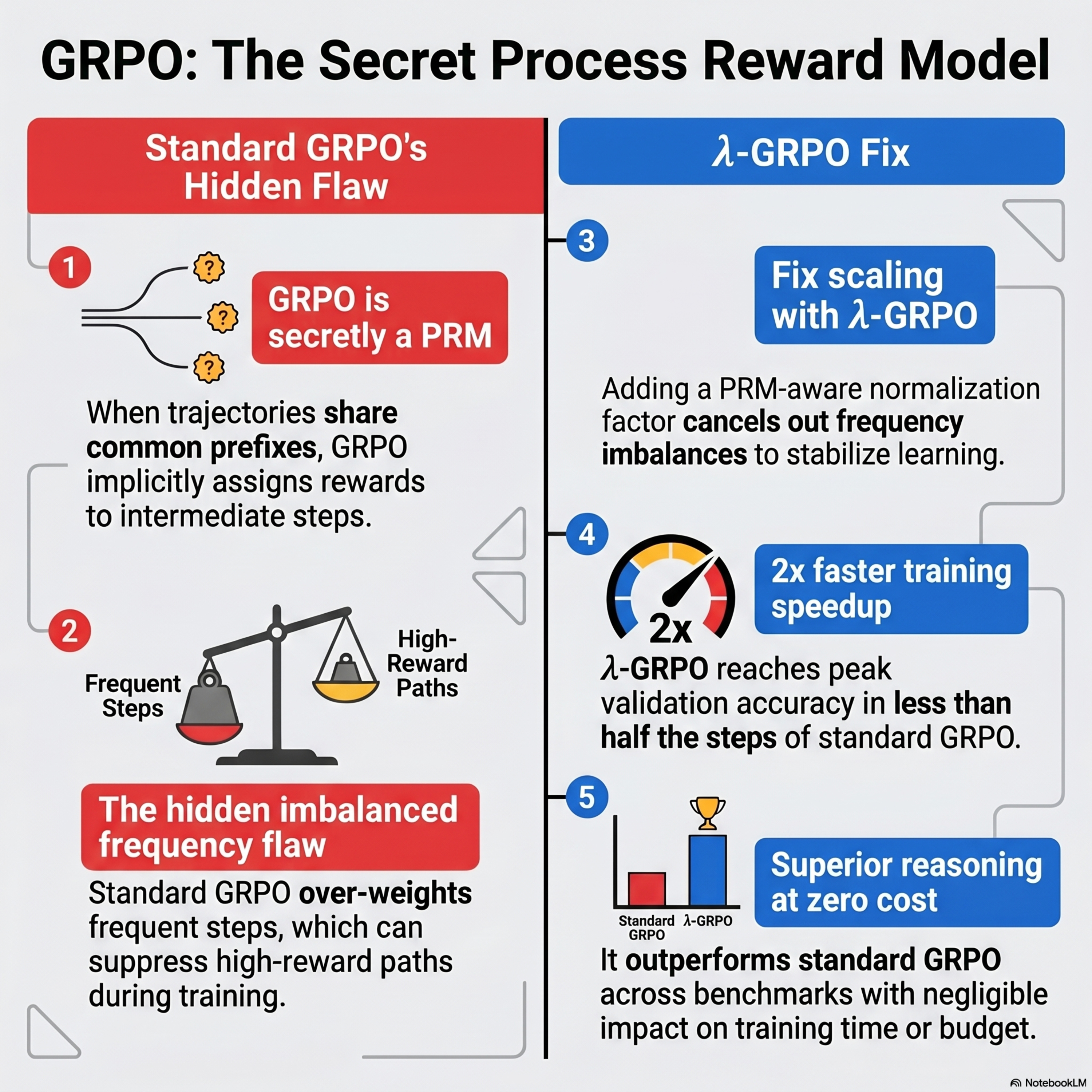
This paper establishs that Group Relative Policy Optimization (GRPO), while appearing to use only final outcome rewards, inherently functions as a Process Reward Model (PRM) through its implicit sub-trajectory credit assignment. By analyzing groups of trajectories that share identical prefixes, the authors prove that GRPO naturally computes step-level rewards using a Monte Carlo approach. However, this hidden structure reveals a flaw where imbalanced step frequencies can skew advantages, inadvertently suppressing high-reward paths and hindering efficient model training. To fix this, the researchers introduce $\lambda$-GRPO, a modified objective that scales token-level losses to neutralize these frequency imbalances. Empirical testing shows that $\lambda$-GRPO enables Large Language Models to achieve superior reasoning performance significantly faster than the standard algorithm. Ultimately, the work demonstrates that the built-in PRM structure of GRPO can be optimized to boost efficiency without the need for expensive, manual step-level annotations.
Embed this episode
No transcript yet.