
EPISODE · Feb 23, 2024 · 3 MIN
GTO2-3-04: Limitations of VCG
from Higher Signal: Get Smarter. Faster. · host Higher Signal
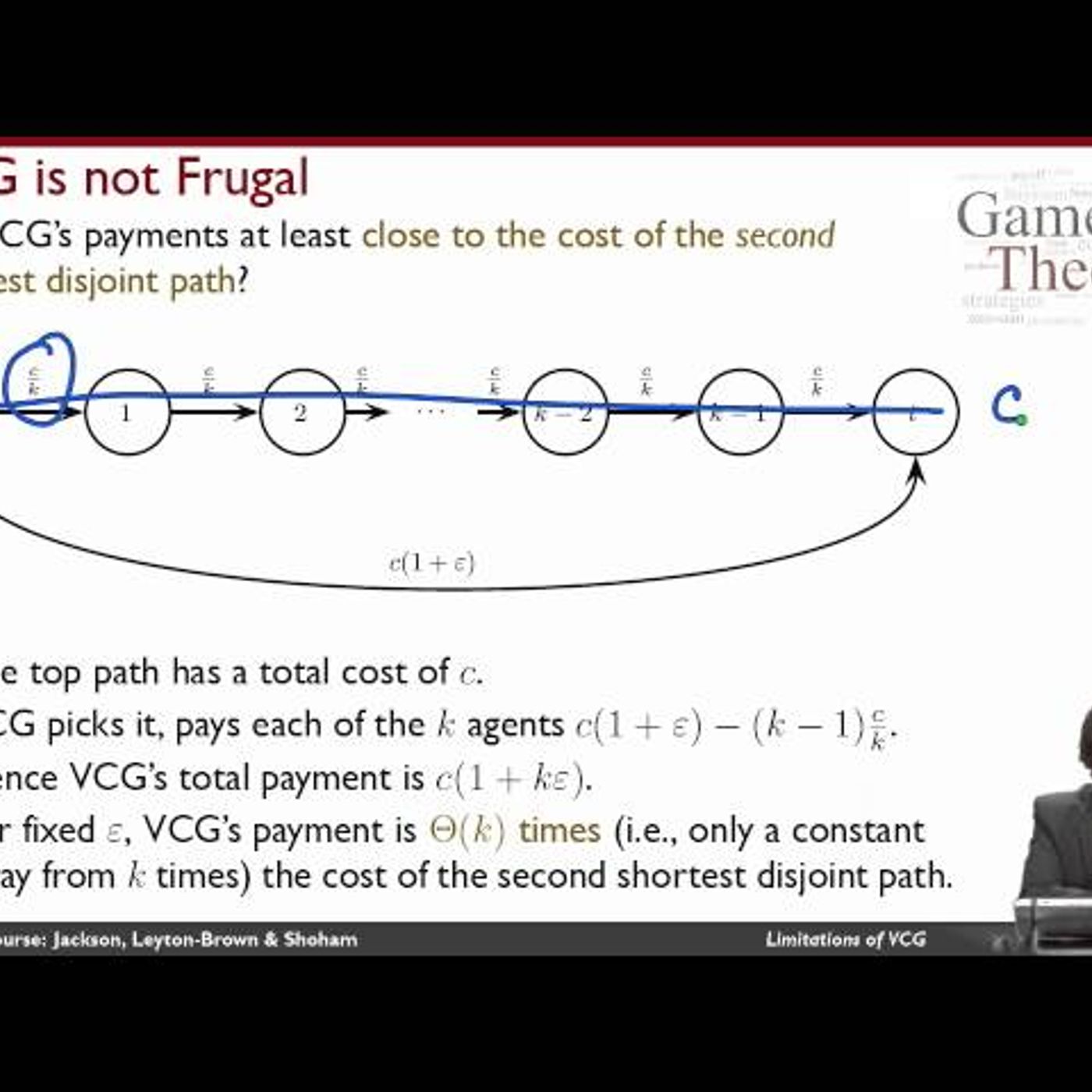
1. VCG requires complete disclosure of private information, which may not be ideal in environments where agents compete across multiple interactions, possibly necessitating a mechanism that reveals less information.2. VCG is susceptible to collusion, demonstrated by cases where agents benefit by coordinating valuations to reduce their payments.3. VCG is not frugal; payments can greatly exceed an agent's actual costs, illustrated when agent payments are dependent on the cost of alternatives rather than their own valuation.4. VCG lacks revenue monotonicity, meaning that adding agents may paradoxically decrease or eliminate revenue instead of increasing it, as might intuitively be expected.5. Rebating the VCG profits to the agents alters their incentives, breaking the VCG mechanism. Even using the profits for external purposes like charity or benefiting the local economy can inadvertently change their utility and incentives.6. It's possible to return a fraction of the revenues to the agents without breaking VCG incentives, but fully refunding profits is not feasible without introducing skewed incentives.Key questions answered in the transcript:- How does the requirement of complete information disclosure in VCG pose a limitation? VCG's requirement may not be suitable when agents have future competitions to consider, as revealing private information could hinder their future strategic opportunities.- How can agents collude in a VCG mechanism? Agents can coordinate and manipulate their declared valuations, which can reduce their individual payments, benefiting them at the expense of the mechanism's intended fairness.- Why is VCG not frugal with regards to payments? VCG payments can vastly overshoot an agent's willingness to accept because they are based on the cost of alternatives, leading to unbounded discrepancies between actual costs and VCG payments.- What is revenue monotonicity and why does VCG not satisfy it? Revenue monotonicity is the expectation that revenue should not decrease with the addition of more agents. VCG, however, can show a decline in revenue when an additional agent's presence negates the pivotal status of other agents, leading to no revenue.- Why is rebating VCG profits to agents problematic? Rebating profits changes agents' incentives, affecting their decisions within the VCG mechanism. Agents may alter their behavior to increase their share of the rebate, thus disrupting the mechanism's intent.Core Takeaway:The core problem described is the limitations of the Vickrey-Clarke-Groves (VCG) mechanism, which can lead to non-ideal outcomes like collusion, excessive payments, revenue issues, and incentive misalignment. Not understanding or addressing these problems can result in mechanisms that are neither efficient nor cost-effective, and may be exploited by strategic agents. To address these challenges:1. Mechanisms must be designed to protect privacy and limit the information disclosure required from agents, which ensures they are comfortable participating without jeopardizing future competitions.2. Anti-collusion measures should be incorporated to maintain the integrity of the mechanism against coordinated manipulation by participants.3. Rebating procedures or profit distribution must be handled with caution, ensuring they do not interfere with the original incentives designed into the mechanism.Tags here: Vickrey-Clarke-Groves (VCG) mechanism, information disclosure, collusion in VCG, frugality of VCG, revenue monotonicity, agent incentives, rebating VCG profits
Embed this episode
NOW PLAYING
GTO2-3-04: Limitations of VCG
No transcript for this episode yet
Similar Episodes
No similar episodes found.
Similar Podcasts
No similar podcasts found.