
EPISODE · Feb 23, 2024 · 3 MIN
GTO2-4-06: Optimal Auctions
from Higher Signal: Get Smarter. Faster. · host Higher Signal
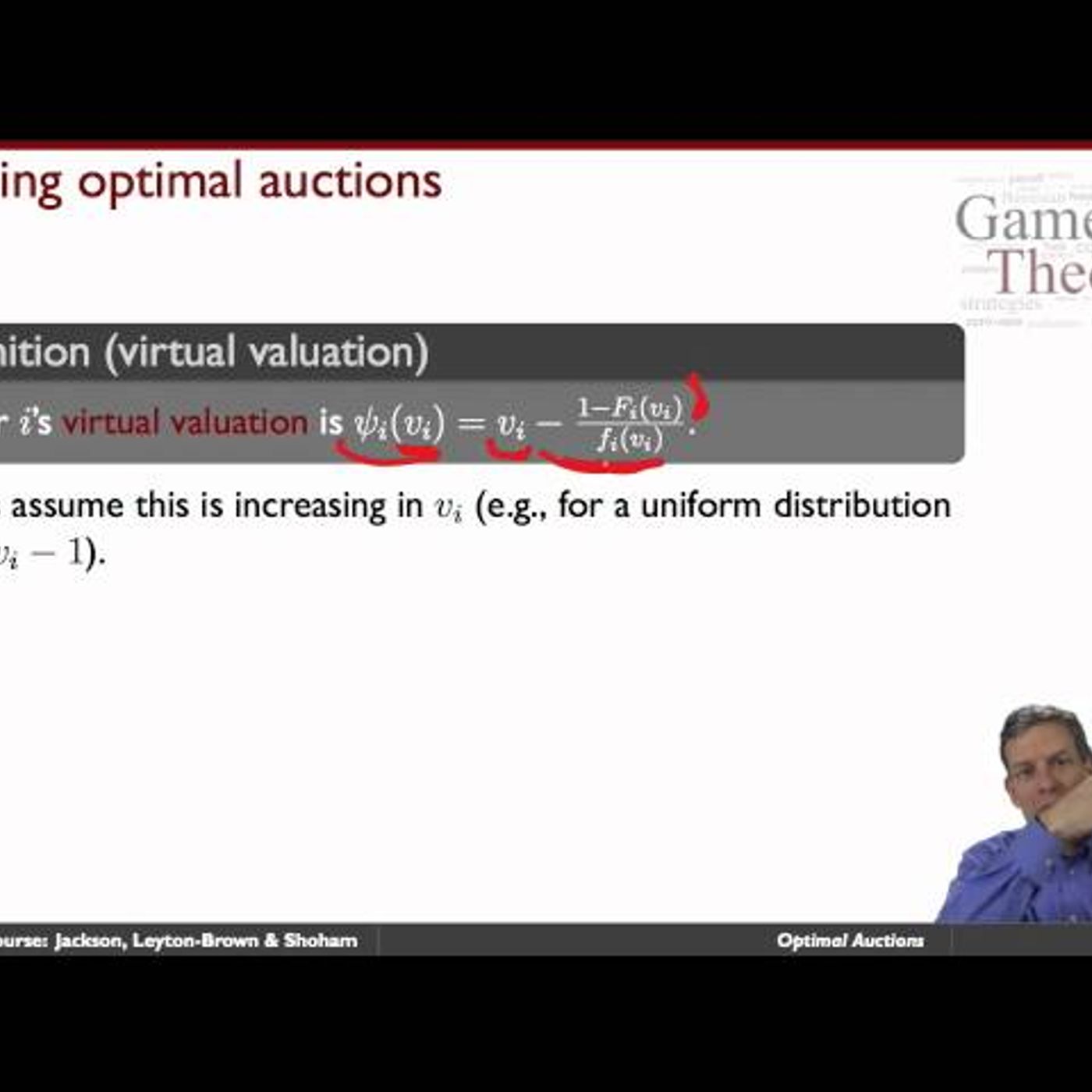
1. The transcript discusses the concept of optimal auctions designed to maximize the seller's expected revenue while considering possible losses in efficiency such as the risk of not selling the good or selling it to someone other than the highest bidder. 2. It examines auctions in a simple setup with one good being sold, private valuations, risk-neutral buyers, and values drawn from a known cumulative distribution function.3. The transcript introduces the concept of a reserve price in auctions, analyzing how setting a reserve price can lead to higher expected revenue. A simple example demonstrates that for a second price auction with uniformly distributed bidder values between zero and one, setting a reserve price at a half maximizes the seller's expected revenue.4. It describes virtual valuations as an adjustment of true values according to the probability distribution, which are used instead of direct valuations in optimal auctions. These virtual valuations are fundamental in defining bidder-specific reserve prices.5. The Myerson's theorem is presented as a key result defining optimal single good auctions. The optimal auction sells to the person with the highest virtual valuation above their reserve price and charges the smallest valuation that the person could have declared and still been the winner.6. In symmetric settings, where all bidders have identical value distributions, the optimal auction is essentially a second price auction with an individual-specific reserve price. For uniform distributions, the reserve price is a half.7. The transcript highlights the importance of the seller's ability to commit to not selling the object if the bids are below reserve price, to ensure the mechanism's effectiveness.8. It discusses how reserve prices serve as competitors in auctions by increasing the payment of the winning bidders and how virtual valuations help weak bidders compete with strong bidders.9. The transcript concludes by emphasizing that problems in mechanism design are well-defined and have solutions that can be found through optimizing the desired objectives (e.g., societal welfare, revenue) subject to incentive compatibility constraints.Here are a few memorable quotes:- "The optimal auction here we're going to be looking at is maximizing the seller's expected revenue subject to some form of individual rationality."- "What's really going on... is adjusting things to capture relatively how much of the distribution is at high values compared to lower values."- "Mechanism design, you can put down whatever objective you want in terms of what you're trying to maximize."Core Takeaway:The core problem described is how to design an auction that maximizes seller's expected revenue while considering the risk of inefficiencies like failing to sell or selling at lower prices.Not understanding or solving this problem could result in sub-optimal auction designs that fail to maximize the seller’s revenue or lead to inefficient market outcomes.1. Implementing a reserve price can increase expected revenue by simulating competition, although care must be taken not to set it too high to avoid losing sales.2. Virtual valuations should be used instead of direct valuations, taking into account the probability distribution of bidder's valuations to adjust the bids, and maintaining incentive compatibility.3. The design of optimal auctions considers symmetric settings, where the optimal auction structure simplifies and can be regarded as a second price auction with a strategically set reserve price determined by the value distribution statistics.Tags here: Optimal Auctions, Reserve Price, Expected Revenue, Virtual Valuation, Myerson's Theorem, Incentive Compatibility, Mechanism Design
What this episode covers
1. The transcript discusses the concept of optimal auctions designed to maximize the seller's expected revenue while considering possible losses in efficiency such as the risk of not selling the good or selling it to someone other than the highest bidder. 2. It examines auctions in a simple setup with one good being sold, private valuations, risk-neutral buyers, and values drawn from a known cumulative distribution function.3. The transcript introduces the concept of a reserve price in auctions, analyzing how setting a reserve price can lead to higher expected revenue. A simple example demonstrates that for a second price auction with uniformly distributed bidder values between zero and one, setting a reserve price at a half maximizes the seller's expected revenue.4. It describes virtual valuations as an adjustment of true values according to the probability distribution, which are used instead of direct valuations in optimal auctions. These virtual valuations are fundamental in defining bidder-specific reserve prices.5. The Myerson's theorem is presented as a key result defining optimal single good auctions. The optimal auction sells to the person with the highest virtual valuation above their reserve price and charges the smallest valuation that the person could have declared and still been the winner.6. In symmetric settings, where all bidders have identical value distributions, the optimal auction is essentially a second price auction with an individual-specific reserve price. For uniform distributions, the reserve price is a half.7. The transcript highlights the importance of the seller's ability to commit to not selling the object if the bids are below reserve price, to ensure the mechanism's effectiveness.8. It discusses how reserve prices serve as competitors in auctions by increasing the payment of the winning bidders and how virtual valuations help weak bidders compete with strong bidders.9. The transcript concludes by emphasizing that problems in mechanism design are well-defined and have solutions that can be found through optimizing the desired objectives (e.g., societal welfare, revenue) subject to incentive compatibility constraints.Here are a few memorable quotes:- "The optimal auction here we're going to be looking at is maximizing the seller's expected revenue subject to some form of individual rationality."- "What's really going on... is adjusting things to capture relatively how much of the distribution is at high values compared to lower values."- "Mechanism design, you can put down whatever objective you want in terms of what you're trying to maximize."Core Takeaway:The core problem described is how to design an auction that maximizes seller's expected revenue while considering the risk of inefficiencies like failing to sell or selling at lower prices.Not understanding or solving this problem could result in sub-optimal auction designs that fail to maximize the seller’s revenue or lead to inefficient market outcomes.1. Implementing a reserve price can increase expected revenue by simulating competition, although care must be taken not to set it too high to avoid losing sales.2. Virtual valuations should be used instead of direct valuations, taking into account the probability distribution of bidder's valuations to adjust the bids, and maintaining incentive compatibility.3. The design of optimal auctions considers symmetric settings, where the optimal auction structure simplifies and can be regarded as a second price auction with a strategically set reserve price determined by the value distribution statistics.Tags here: Optimal Auctions, Reserve Price, Expected Revenue, Virtual Valuation, Myerson's Theorem, Incentive Compatibility, Mechanism Design
NOW PLAYING
GTO2-4-06: Optimal Auctions
No transcript for this episode yet
Similar Episodes
Jun 15, 2022 ·8m
May 25, 2022 ·20m
May 19, 2022 ·16m
May 15, 2022 ·34m
May 12, 2022 ·1m