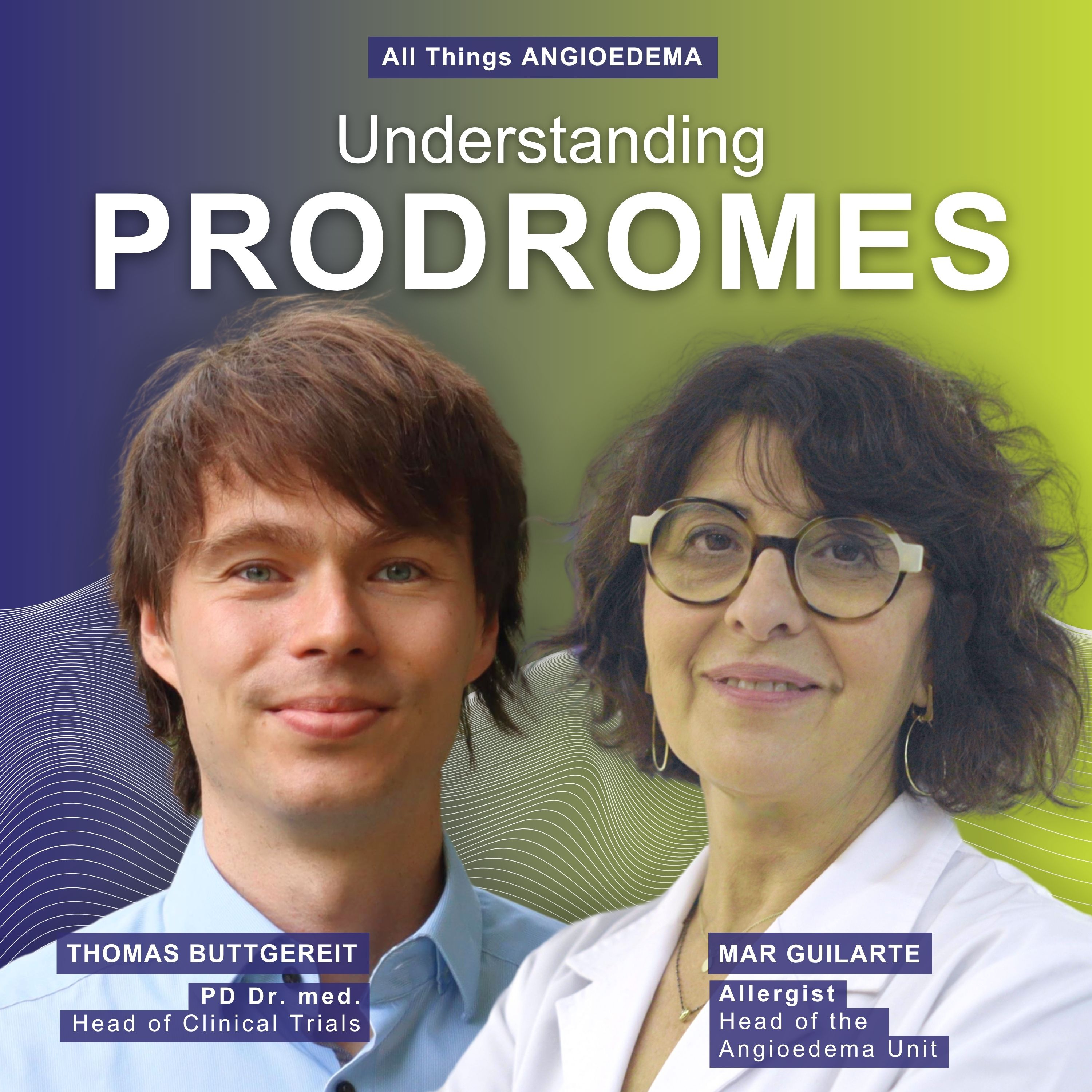
HAE Prodromes: Early Warning Signs & Why They Matter episode artwork

EPISODE · Aug 5, 2025 · 16 MIN

HAE Prodromes: Early Warning Signs & Why They Matter

from All Things Angioedema – Learning about angioedema with Dr. Thomas Buttgereit · host ACARE, the Global Allergy and Asthma Excellence Network for Angioedema

In this episode, Thomas welcomes Dr. Mar Guilarte, allergist at Hospital Universitari Vall d’Hebron in Barcelona, to explore an often overlooked topic in HAE care: prodromal signs — the early symptoms that may signal an HAE attack. They discuss:🔹 What are prodromal signs, and how common are they in HAE patients? 🔹 Do patients treat their attacks differently based on these signs? 🔹 How do UK and Spanish patients compare in their treatment decisions? 🔹 Could biomarkers help us distinguish true HAE prodromes? Dr. Guilarte shares findings from her recent research, conducted with HAE patient groups in the UK and Spain, and discusses how early treatment can shorten attack duration and severity. She also explains how signs like erythema marginatum, abdominal discomfort, irritability, and fatigue vary across patients — and why clear definitions, education, and better diagnostic tools are urgently needed. Join us for a thought-provoking discussion on the complexity of HAE prodromes — and how understanding them better can help optimize treatment and outcomes. Key Learnings from the Episode:Prodromes are early signs or symptoms that precede HAE attacks — up to 60–80% of patients report them. Common prodromal symptoms include erythema marginatum, bloating, nausea, abdominal discomfort, irritability, and fatigue. Each patient tends to have consistent prodromes, which can help predict attacks, though subjective symptoms vary widely. Spanish patients tend to treat later than UK patients, possibly due to less specialist guidance or medication access. Treating attacks early reduces duration and severity, but definitions of “early” vary — especially with injectable medications. Oral on-demand therapies may encourage earlier intervention, as they’re easier to carry and administer. Not all prodromes lead to attacks, and the severity of a prodrome does not always predict the severity of the attack. There is a need for biomarkers to help determine whether a prodrome will be followed by an actual HAE attack. Erythema marginatum is the only objective prodrome, but can be confused with urticaria, leading to misdiagnosis. Education of both patients and physicians is critical to recognizing and acting on prodromal signs. Chapters 00:00 Introduction to Angioedema and Prodromal Signs03:13 Understanding Prodromal Signs in HAE04:04 Research Findings on Prodromal Signs05:37 Common Prodromal Signs Reported by Patients07:11 Comparative Analysis of Patient Responses08:43 The Importance of Early Treatment09:00 Challenges in Defining Early Treatment11:23 Unanswered Questions in Prodromal Research13:25 Differentiating Erythema Marginatum and AngioedemaDo you have suggestions for future episodes? Please provide feedback and offer your suggestions for future topics and expert selection here.Feedback form ATA: ⁠⁠⁠⁠⁠⁠⁠⁠⁠https://forms.office.com/e/ZWxx3D4Cmr⁠⁠

In this episode, Thomas welcomes Dr. Mar Guilarte, allergist at Hospital Universitari Vall d’Hebron in Barcelona, to explore an often overlooked topic in HAE care: prodromal signs — the early symptoms that may signal an HAE attack. They discuss:🔹 What are prodromal signs, and how common are they in HAE patients? 🔹 Do patients treat their attacks differently based on these signs? 🔹 How do UK and Spanish patients compare in their treatment decisions? 🔹 Could biomarkers help us distinguish true HAE prodromes? Dr. Guilarte shares findings from her recent research, conducted with HAE patient groups in the UK and Spain, and discusses how early treatment can shorten attack duration and severity. She also explains how signs like erythema marginatum, abdominal discomfort, irritability, and fatigue vary across patients — and why clear definitions, education, and better diagnostic tools are urgently needed. Join us for a thought-provoking discussion on the complexity of HAE prodromes — and how understanding them better can help optimize treatment and outcomes. Key Learnings from the Episode:Prodromes are early signs or symptoms that precede HAE attacks — up to 60–80% of patients report them. Common prodromal symptoms include erythema marginatum, bloating, nausea, abdominal discomfort, irritability, and fatigue. Each patient tends to have consistent prodromes, which can help predict attacks, though subjective symptoms vary widely. Spanish patients tend to treat later than UK patients, possibly due to less specialist guidance or medication access. Treating attacks early reduces duration and severity, but definitions of “early” vary — especially with injectable medications. Oral on-demand therapies may encourage earlier intervention, as they’re easier to carry and administer. Not all prodromes lead to attacks, and the severity of a prodrome does not always predict the severity of the attack. There is a need for biomarkers to help determine whether a prodrome will be followed by an actual HAE attack. Erythema marginatum is the only objective prodrome, but can be confused with urticaria, leading to misdiagnosis. Education of both patients and physicians is critical to recognizing and acting on prodromal signs. Chapters 00:00 Introduction to Angioedema and Prodromal Signs03:13 Understanding Prodromal Signs in HAE04:04 Research Findings on Prodromal Signs05:37 Common Prodromal Signs Reported by Patients07:11 Comparative Analysis of Patient Responses08:43 The Importance of Early Treatment09:00 Challenges in Defining Early Treatment11:23 Unanswered Questions in Prodromal Research13:25 Differentiating Erythema Marginatum and AngioedemaDo you have suggestions for future episodes? Please provide feedback and offer your suggestions for future topics and expert selection here.Feedback form ATA: ⁠⁠⁠⁠⁠⁠⁠⁠⁠https://forms.office.com/e/ZWxx3D4Cmr⁠⁠

NOW PLAYING

HAE Prodromes: Early Warning Signs & Why They Matter

0:00 16:05

No transcript for this episode yet

We transcribe on demand. Request one and we'll notify you when it's ready — usually under 10 minutes.

MG Show MG Show The MG Show, hosted by Jeffrey Pedersen and Shannon Townsend, is a leading alternative media platform dedicated to uncovering the truth behind today’s most pressing political issues. Launched in 2019, the show has grown exponentially, offering unfiltered insights, comprehensive research, and real-time analysis. With a commitment to independent journalism and factual integrity, the MG Show empowers its audience with knowledge and encourages active participation in the political discourse. Breaking News Show | eTurboNews Juergen Thomas Steinmetz News is relevant to the global travel and tourism industry, human rights and global issues.Breaking news when it happens and only from the source. Eat to Live Jenna Fuhrman, Dr. Fuhrman Our health is our most precious gift and smart nutrition can change your life. Each month, join Dr. Fuhrman and his daughter, Jenna Fuhrman as they discuss important topics in the world of nutrition. Eat to Live will change the way you eat and think about food. French Your Way Jessica: Native French teacher founder of French Your Way Boost your French listening skills and test your comprehension with this one of a kind series of podcasts. Get the chance to listen to a real conversation between native speakers talking at normal speed AND customise your learning experience through carefully designed sets of questions (2 levels of difficulty) available for download at www.frenchvoicespodcast.com. All interviews also come with the transcript. French teacher Jessica interviews native speakers of French from around the world who share a bit of their life and passion. Where else would you meet in one same place a French yoga teacher based in Melbourne, a soap manufacturer from Provence, or a couple cycling around the world?

Frequently Asked Questions

How long is this episode of All Things Angioedema – Learning about angioedema with Dr. Thomas Buttgereit?

This episode is 16 minutes long.

When was this All Things Angioedema – Learning about angioedema with Dr. Thomas Buttgereit episode published?

This episode was published on August 5, 2025.

What is this episode about?

In this episode, Thomas welcomes Dr. Mar Guilarte, allergist at Hospital Universitari Vall d’Hebron in Barcelona, to explore an often overlooked topic in HAE care: prodromal signs — the early symptoms that may signal an HAE attack. They discuss:🔹...

Can I download this All Things Angioedema – Learning about angioedema with Dr. Thomas Buttgereit episode?

Yes, you can download this episode by clicking the download button on the episode player, or subscribe to the podcast in your preferred podcast app for automatic downloads.
URL copied to clipboard!