Welcome to the Tweed Trends podcast. Hey, Evette, what's trending today? Hey, I'm Evette. Hey, girl.
And you are tuned in to Tweed Trends. It's the quickest way to find out what's trending today. Hey, here we go again. Let's get started.
Hey there, welcome back to Tweed Trends. We are talking about hair once again. And honestly, this hair situation, it was a recurring topic that kept coming up this past week. And I can't help but to go ahead and speak on it, because I feel like something's tapping on the shoulder, like, hey, hey, I need you to go ahead and have a discussion about this.
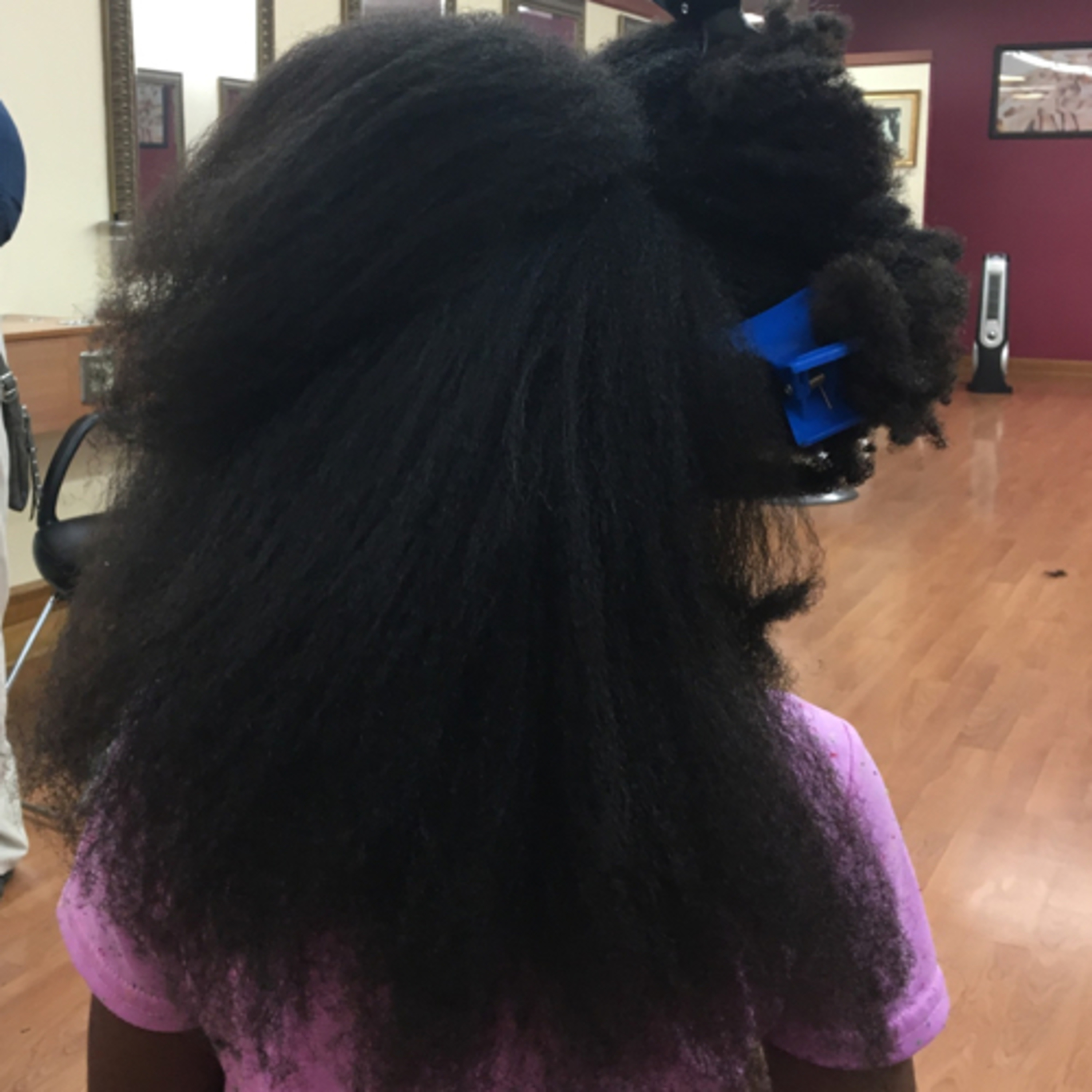
I don't know who needs to hear this. But let me tell you what happened. Wednesday was Picture Day. Normally, my daughter wears her hair in protective styles, which for anyone who may not know what a protective style is, twists, braids, anything that is kind of keeping the hair in a way that is going to stay that way from the time you leave the house to the time you come back.
Well, for Picture Day, I let her wear her hair out. We took those twists out and she wore twist out, which basically means you have your hair twisted. Your hair takes on that curly type wavy look. Untuist it.
Bam, you got an automatic hairstyle. I'm aware that our hair is magical. I'm aware of that. I've been an African-American female all my entire life.
So I am aware of the attention that it draws. I know that it acts like a living, breathing, thinking thing. It does what it wants to do. It could be one length when you leave the house.
And by the time you come back home, you look completely different. It is not the same style you had. It grows upward. I can literally take my hair out, stand it straight up, and it will stay that way.
It's not going to fall down limp. It's like, hmm, look at me. Yes, I got power. I got strength.
I got all the things. I'm like, yes, hair. Do it. Do it.
Yeah. Go back to my daughter. So Picture Day was Wednesday. She wore her hair out.
And quite often, we have to reiterate the whole hair conversation. Yes, we have to have hair conversations with our daughters because we need to make sure that they are setting boundaries because people who don't have hair like us are intrigued. They are drawn to it. They want to touch it.
And I had to let her know you are not an animal in a petting zoo. No one needs to be petting you on your head. Nobody needs to be touching your hair. Tell them no.
OK? OK, Mommy. So that was Wednesday. Thursday night.
And she's going to bed. She's like, hey, Mommy, can we talk about that hair thing again? I'm like, sure. What do you want to talk about?
She says, well, so I'm not going to call any real names. These are all made up fictitious names here. Valerie asked if she could touch my hair. OK, then what happened?
I told her no. Oh, very good. Then what happened? Well, she touched it anyway.
Mm, really now. Yeah. And then so Angelica did the same thing. Oh, really?
And then James came along and he did the same thing too. OK, now we have a problem. One, because all three of these people are little, like they are shorter than my daughter. And I'm thinking you should have been able to duck and dodge that pop those hands away.
No, no, I told you no. I'm touching my hair, period. But they're her friends, right? And we don't want to upset our friends, right?
So we kind of waffle on what we say and what we mean and what we do and what we allow. No. That's not what we do. So we had to have that whole conversation.
And I'm letting her know. I'm like, so when you allow them to disrespect you, to disrespect your boundaries, you are not teaching them how to interact with you. You're letting them know that although you say no, they can do whatever they want to do, and you're going to be fine with it. That's not the message that you want to send.
You need to be sending the message like, look, I said no. I meant no. Don't touch it. Period.
But that's not the route she went. So then I had to kind of reiterate the whole, the other thing you don't want to do, you don't want to set Mama Bear off. Because if I have to come out there and talk to little people about what they will and won't do, they're not going to like it, but guess who else is going to like it? You're not going to like it because I'm going to have a little conversation with you too.
Because this is unacceptable. Three people in a setting right there at the same time. So this wasn't three individual situations. This was all everybody was at the same place.
And so the one person did it. And now we got Monkey C. Monkey do. OK, now we have a problem.
So it's unfortunate that as a black woman, we have to have the hair talk with our daughters. And I imagine with our sons too. But we do. Because people will readily blow right past whatever we say and do what they want to do.
For some reason, they think that they're entitled to do that. They'll walk right up to you and say, oh, wow, look at your hair. And we reach them for it, no boo. I don't do that to you.
So please don't feel like you need to do that to me. Thank you. Keep it moving. So remember I was saying that hair kept coming up as a topic.
The other thing that happened was that Simone Biles got married. Olympic gymnast, you know the girl. And people about lost their ish about the way she wore her hair for her wedding. She wore it in a ponytail.
And they could not believe that she didn't get extensions or weave or wig, that she didn't do something dramatic with her hair. The fact that she chose to wear it, her own hair, and a ponytail, people found issue with that. Why does this woman have to justify why she chose to wear her hair in a ponytail? And she went on to say, hey, guys, I live in Texas.
It's hot. I did what I did because of the heat. Simone, baby, you don't have to justify anything to anyone about how you choose to wear your hair on any day of the week. It doesn't matter if it's your wedding or your funeral.
Nobody needs to have anything to say about how you wear your hair. Period. And so the frustrating thing about this whole discussion is that the people that are finding fault with the fact that she wore her hair in a ponytail were people that look like her. And that's problematic to me.
I don't understand why people have so much free time that they can go around criticizing people on how they chose to wear their hair on a particular day. I don't get it. Not at all. Nope.
It's disturbing. Gabby Douglas got the same type of flack about going to these gymnastics competitions and how she would wear her hair and whatnot. And then you go and you think about it. And there are people in places where, I'm sure, all of us, black females, have been where we've heard somebody make a negative comment about the way somebody has their hair.
I'm not even going to lie to you. I low-key feel some type of way. If my hair looks good and my daughter's hair doesn't, because I fear that if we go somewhere, somebody's going to say something. And they may not even say it out loud, but they're going to be saying it in their head.
Like, mmm, look at her. Mama got her hair done and got this baby looking like who done it? That's low-key in the back of my head. So when we go places, I always make sure that if we both, if I'm looking good, we both looking good.
If I'm busted, then it's cool if she's busted too, because we're matching set. But it shouldn't be that way. I shouldn't care one way or the other, because people don't know what my time is like, what our schedule is like, why she may have just come back from swimming lessons or something and is looking a hot mess. You know what?
And that's our thing. That's for us to figure out. That's not for you to criticize. That's not for you to have something to say about.
But even we've seen the articles and the news reports about young ladies in schools where schools are kicking them out of school because of how they wear their hair, because they wear braids, because they wear extensions, because their hair is a different color. And man, I tell you, I've seen a lot of kids with a lot of different color hair. But for some reason, when we do it, it takes on a whole new life. And everybody's got something to say about it.
And I don't understand. I don't understand how the way I wear my hair is going to, one, keep you from learning. If I'm blocking the board and you can't see, well, that's one thing. I'll sit in the back, because big hair don't care, okay?
So if you can't see through my fro, I'll sit further back so you can move closer up to see. But that doesn't mean I should have to stay home because of it. I can't help the way that my hair grows out of my scalp. None of us can.
Now, many of us alter it. One for personal reasons. It might be like, man, it is just so much easier if I just go in and get this thing relaxed. And I can just look it down and do whatever.
That's mine. That's on you. But if I choose to be natural, like I am, that's on me too. It should not have anything to do.
My hair shouldn't make you feel any kind of way. So once again, the fact that I'm in a black woman all my life, I've seen it within the community. You'll get blasted to your face in the community. Someone will tell you that your hair is nappy and you just wrong for that type thing.
Outside of the community, it gets labeled as other things. We want to say this, but we're not going to come out and say this. We're going to call it something else. There are rules.
And in the rule book, it says this, and you don't fit that. So you've had people at sporting events that are having their beads taken off of their braids, their locks cut out. You told you can't come to school, all sorts of stuff where people have put rules in place. That's that whole systemic thing that we're always talking about that people are like, oh, that's not a thing.
Oh, but it is. But it is. Open your eyes and close your mouth. And maybe you'll be able to see it.
But so going back, I was like, you know, why is it that it's so apparent in the community? It's one thing if there's people outside the community that's doing it and we can fight back against them. But when you have to fight your own, that's when it becomes an uphill battle. So I was like, you know, thinking myself, like, why is it that it seems like black women or other black people are so critical of hair?
Why is hair so important? And it was like the light bulb went off. We're not inherently critical of each other's hair, but it's been socialized and internalized because the Eurocentric standards of beauty have been what everything has been built on. You know, if we go back to the times when they were enslaving black people, then you know that when they brought us over from Africa, one of the things that they did was to strip us of our cultural identity.
And one of those things was shaving our heads. Well, you may be saying, well, what was the purpose of that? You have a shaved head, you know, well, because it was, it was advertised for lack of better words. It was advertised that our hair was was problematic.
It was dirty. It's nasty. And so if we cut it off, then that's one thing that you don't have to worry about. No disease, no mites, no nothing like that.
But if we go back to what it was in Africa, the way that the people wore their hair, it spoke of who they were in society. So when you come from a place where hair represents more than just a covering on your head, but maybe what your job is, what family you belong to, what tribe you belong to, those types of things, and then you get brought to this new place, you get your hair cut off. Now you can't distinguish one person from the next because everybody's got a bald head. You know, you just took a part of me away.
And so, you know, you have that going on. And then these terms like nappy used to describe fabric or thread when it comes unraveling, it's just looking disheveled and all over the place. You know, those types of terms were historically used in a derogative way to make us feel some type of way. It's tough when you look back at the history and you realize where a lot of this comes from and the fact that it's just been ingrained, it's been put there for so long that it then, I don't necessarily want to say that it was embraced, but it's almost like just what happens.
So you have to be intentional about doing things different, about speaking on it differently, about reacting to it in a different way. So I'd like to say now I feel like there are a lot more women that wear their hair natural and they, I don't want to say they don't care, but they're taking ownership of who they are and how they present. And I can appreciate that. When I found out I was having a daughter, I went into a mini panic mode because I was like, oh my gosh, I got to figure out how this hair thing is going to work.
You know, I didn't want her to come into this world and see me with my hair relaxed and assume that that's what she should look like. I had already started my natural journey and I wanted to make sure that it was a good one because I want her to embrace her hair. I want her to love the way that she looks and love the things that she can do with her hair and the things that her hair will do on its own. I want her to love all of that.
So I had to come to grips with my own stuff, you know. I had to learn what my curl pattern is and how to care for it. And now she's at that place now and she loves her hair and I love that she loves it. Now we just have to get over these other hurdles where other people that don't understand it, you know.
We got to now figure out that part. Thanks for listening to today's episode. Bottom line is it is so important to recognize the historical and the cultural context of hair discrimination everywhere and then to support and uplift black women in their hair journey, whatever they choose for it to be rather than perpetuating harmful stereotypes and judgments and causing them to then be hyper critical not only of themselves but of each other. So whatever that means to you however you feel like you can help that cause then by all means, you know, please and thank you.
Please go out and do those things, make the adjustments to how you react when you see certain things because it's kind of like when you have a mother and a child and the child is behaving badly in your eyes and then you may not know it but this child may have autism or something like that and so where you think this child is acting out really this is what this mother deals with every day. Same thing with our hair. You may be seeing one thing and want to judge it on face value where it is in that moment that you are seeing it but you have no context of how we got to this point, why it's like this and what we may have to do to get it to be better, to look better, to look different. So I guess that's my long round about way of saying mine your business.
If you don't have anything nice to say, don't say anything at all. All of those types of things, okay? You know, if it's not your hair, don't worry about it. It's not going to harm you.
Hair doesn't attack other people so don't you attack the hair, okay? Thanks for listening. You know where to find me, Twitter and Instagram at he. That's at h-e-v-e-t-t-e or just look at the hashtag tweet trends and yeah, yeah, help us with this one.