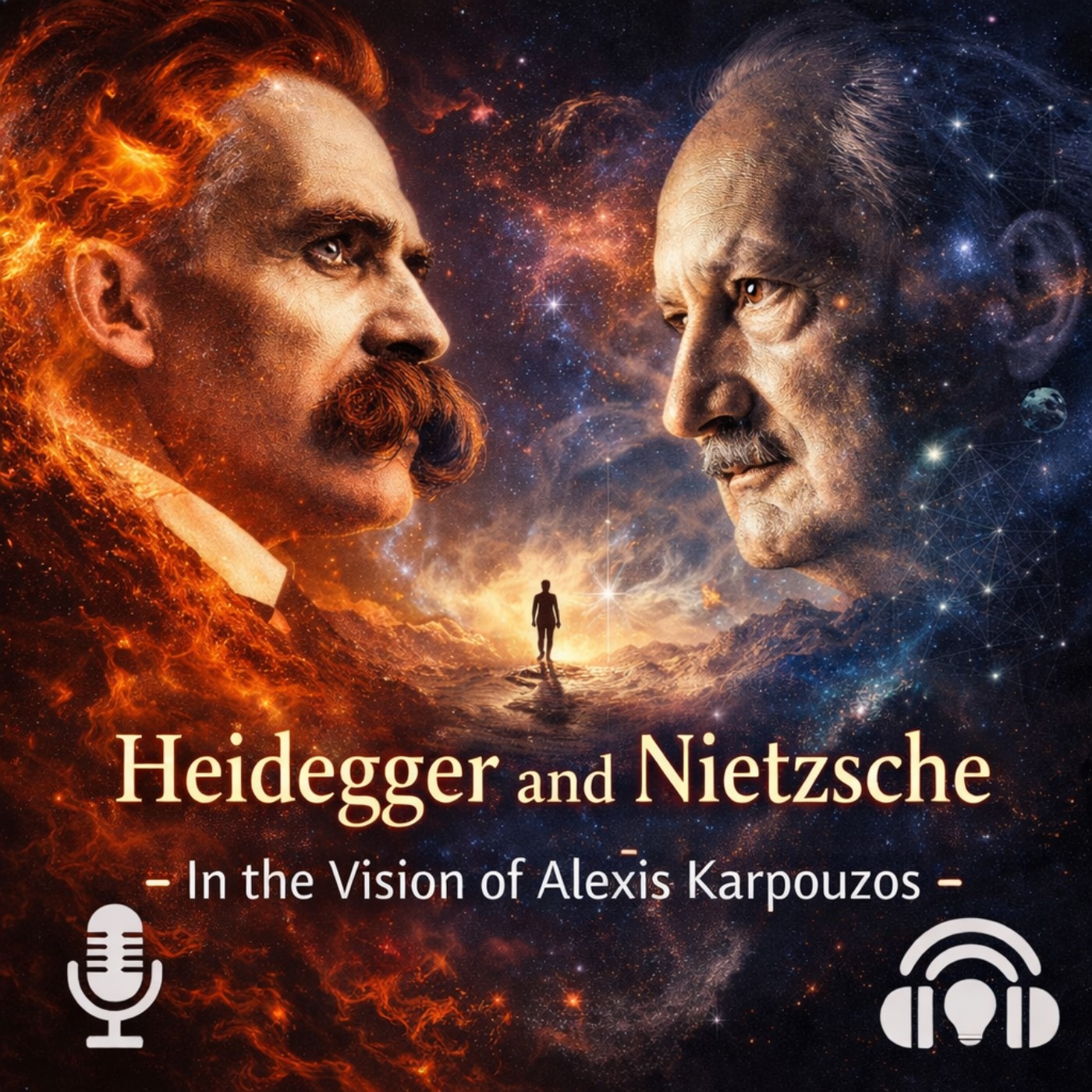
HEIDEGGER AND NIETZSCHE - ALEXIS KARPOUZOS episode artwork

EPISODE · Dec 23, 2025 · 5 MIN

HEIDEGGER AND NIETZSCHE - ALEXIS KARPOUZOS

from alexis karpouzos's podcast

Heidegger and NietzscheIn the Vision of Alexis KarpouzosThe encounter between Nietzsche and Heidegger is not merely a dialogue between two philosophers, but a decisive event in the history of Being itself. In the vision of Alexis Karpouzos, this encounter unfolds as a tragic and luminous tension between the end of metaphysics and the possibility of a new beginning. Nietzsche appears as the last metaphysician and at the same time as the one who announces the collapse of metaphysics; Heidegger emerges as the thinker who listens to this collapse and seeks, through it, the still-unspoken truth of Being. For Karpouzos, Nietzsche’s proclamation of the “death of God” is not a simple atheistic gesture, but an ontological earthquake. It signals the exhaustion of all transcendent guarantees of meaning and exposes humanity to the abyss of becoming. Yet this abyss is not merely nihilistic; it is creative, Dionysian, and open. Nietzsche’s will to power and eternal return are not doctrines but cosmic gestures: attempts to think existence beyond fixed identities, stable truths, and moral absolutes. Being, for Nietzsche, is not what is, but what becomes.Heidegger, however, hears in Nietzsche’s thought a deeper and more troubling resonance. According to Heidegger, Nietzsche does not escape metaphysics but brings it to its extreme fulfillment. The will to power, in Heidegger’s reading, becomes the final metaphysical determination of Being as availability, domination, and calculability. In this sense, Nietzsche is both the destroyer of metaphysics and its final prophet. Karpouzos emphasizes that this paradox is not a failure but a necessity: metaphysics must fully exhaust itself before another way of thinking can emerge. At the heart of their relationship lies language and silence. Nietzsche breaks language apart—through aphorism, poetry, irony, and song—revealing its masks and its creative violence. Heidegger, by contrast, seeks to listen to language, to let it speak from the stillness of Being itself. In the vision of Karpouzos, Nietzsche shatters the old words, while Heidegger waits in the clearing created by their collapse. One dances with language; the other dwells within its silence.This tension reveals a profound ontological contrast. Nietzsche affirms becoming without ground, a world without ultimate foundation, where meaning must be created again and again. Heidegger seeks the groundless ground—the Ereignis, the event of Being that grants presence and withdrawal simultaneously. For Karpouzos, these are not opposing paths but complementary movements of thought: Nietzsche opens the abyss; Heidegger learns how to remain within it without reducing it to concepts.Both thinkers confront nihilism, but in different ways. Nietzsche attempts to overcome nihilism through affirmation, through the creation of new values and the transfiguration of existence into art. Heidegger sees nihilism as the forgetting of Being itself, a historical destiny that cannot be “overcome” by will, but only thought through and endured. In Karpouzos’ vision, nihilism is not an enemy to defeat but a threshold to cross—a night through which thinking must pass. Ultimately, Nietzsche and Heidegger meet in the question of the human. Nietzsche dissolves the human as a fixed essence, opening the path toward the Overhuman as a figure of transformation. Heidegger dec enters the human in favor of Dasein, the being that stands open to Being. Karpouzos sees here a shared intuition: the human is not a substance but a passage, a site where the cosmos becomes conscious of itself.The most central and famous concept of Alexis Karpouzos is that the World is neither pure order, nor chaos, nor a simple dialectical contradiction - it is an open and creative play of forces. Man does not dominate the world, but man and the world cooperate and co-form. Hosted on Acast. See acast.com/privacy for more information.

Heidegger and NietzscheIn the Vision of Alexis KarpouzosThe encounter between Nietzsche and Heidegger is not merely a dialogue between two philosophers, but a decisive event in the history of Being itself. In the vision of Alexis Karpouzos, this encounter unfolds as a tragic and luminous tension between the end of metaphysics and the possibility of a new beginning. Nietzsche appears as the last metaphysician and at the same time as the one who announces the collapse of metaphysics; Heidegger emerges as the thinker who listens to this collapse and seeks, through it, the still-unspoken truth of Being. For Karpouzos, Nietzsche’s proclamation of the “death of God” is not a simple atheistic gesture, but an ontological earthquake. It signals the exhaustion of all transcendent guarantees of meaning and exposes humanity to the abyss of becoming. Yet this abyss is not merely nihilistic; it is creative, Dionysian, and open. Nietzsche’s will to power and eternal return are not doctrines but cosmic gestures: attempts to think existence beyond fixed identities, stable truths, and moral absolutes. Being, for Nietzsche, is not what is, but what becomes.Heidegger, however, hears in Nietzsche’s thought a deeper and more troubling resonance. According to Heidegger, Nietzsche does not escape metaphysics but brings it to its extreme fulfillment. The will to power, in Heidegger’s reading, becomes the final metaphysical determination of Being as availability, domination, and calculability. In this sense, Nietzsche is both the destroyer of metaphysics and its final prophet. Karpouzos emphasizes that this paradox is not a failure but a necessity: metaphysics must fully exhaust itself before another way of thinking can emerge. At the heart of their relationship lies language and silence. Nietzsche breaks language apart—through aphorism, poetry, irony, and song—revealing its masks and its creative violence. Heidegger, by contrast, seeks to listen to language, to let it speak from the stillness of Being itself. In the vision of Karpouzos, Nietzsche shatters the old words, while Heidegger waits in the clearing created by their collapse. One dances with language; the other dwells within its silence.This tension reveals a profound ontological contrast. Nietzsche affirms becoming without ground, a world without ultimate foundation, where meaning must be created again and again. Heidegger seeks the groundless ground—the Ereignis, the event of Being that grants presence and withdrawal simultaneously. For Karpouzos, these are not opposing paths but complementary movements of thought: Nietzsche opens the abyss; Heidegger learns how to remain within it without reducing it to concepts.Both thinkers confront nihilism, but in different ways. Nietzsche attempts to overcome nihilism through affirmation, through the creation of new values and the transfiguration of existence into art. Heidegger sees nihilism as the forgetting of Being itself, a historical destiny that cannot be “overcome” by will, but only thought through and endured. In Karpouzos’ vision, nihilism is not an enemy to defeat but a threshold to cross—a night through which thinking must pass. Ultimately, Nietzsche and Heidegger meet in the question of the human. Nietzsche dissolves the human as a fixed essence, opening the path toward the Overhuman as a figure of transformation. Heidegger dec enters the human in favor of Dasein, the being that stands open to Being. Karpouzos sees here a shared intuition: the human is not a substance but a passage, a site where the cosmos becomes conscious of itself.The most central and famous concept of Alexis Karpouzos is that the World is neither pure order, nor chaos, nor a simple dialectical contradiction - it is an open and creative play of forces. Man does not dominate the world, but man and the world cooperate and co-form. Hosted on Acast. See acast.com/privacy for more information.

NOW PLAYING

HEIDEGGER AND NIETZSCHE - ALEXIS KARPOUZOS

0:00 5:13

No transcript for this episode yet

We transcribe on demand. Request one and we'll notify you when it's ready — usually under 10 minutes.

That Hoarder: Overcome Compulsive Hoarding That Hoarder Hoarding disorder is stigmatised and people who hoard feel vast amounts of shame. This podcast began life as an audio diary, an anonymous outlet for somebody with this weird condition. That Hoarder speaks about her experiences living with compulsive hoarding, she interviews therapists, academics, researchers, children of hoarders, professional organisers and influencers, and she shares insight and tips for others with the problem. Listened to by people who hoard as well as those who love them and those who work with them, Overcome Compulsive Hoarding with That Hoarder aims to shatter the stigma, share the truth and speak openly and honestly to improve lives. The Small Business Startup School – Business Notes | Financial Literacy | Retail Psychology – For Professionals & Entrepreneurs The Small Business Startup School Inc. Starting or buying a small business? While personal circumstances may vary, business patterns remain timeless. On The Small Business Startup School, we explore strategies, insights, and practical solutions to help entrepreneurs confidently navigate their journey.Hosted by Ola Williams—a retail entrepreneur, fintech founder, and financial coach with over two decades of experience—this podcast marries financial awareness and retail psychology with optimism to deliver actionable takeaways.Join us to learn, grow, and connect as we uncover the keys to business success.Let’s continue to learn together and be encouraged to keep on connecting! DIOSA. Carolina Sanper This podcast is a sacred space created by Carolina Sanper where you connect with your inner wisdom and embody your magnetic feminine power.It is the realization that the mystical realm is where you plant the seeds of your desired reality.It is a portal to your true essence: awareness, presence, and receiving with ease. Welcome home, DIOSA. 🖤 XXX Tech by SOVRYN Dr. Brian Sovryn The crossroads between technology, sensuality, and metaphysics - and the longest running anarchist podcast in the world! Brought to you by Dr. Brian Sovryn.

Frequently Asked Questions

How long is this episode of alexis karpouzos's podcast?

This episode is 5 minutes long.

When was this alexis karpouzos's podcast episode published?

This episode was published on December 23, 2025.

What is this episode about?

Heidegger and NietzscheIn the Vision of Alexis KarpouzosThe encounter between Nietzsche and Heidegger is not merely a dialogue between two philosophers, but a decisive event in the history of Being itself. In the vision of Alexis Karpouzos, this...

Can I download this alexis karpouzos's podcast episode?

Yes, you can download this episode by clicking the download button on the episode player, or subscribe to the podcast in your preferred podcast app for automatic downloads.
URL copied to clipboard!