
EPISODE · Jul 30, 2026 · 8 MIN
Heritage
from The Values Sort · host Nick Walton
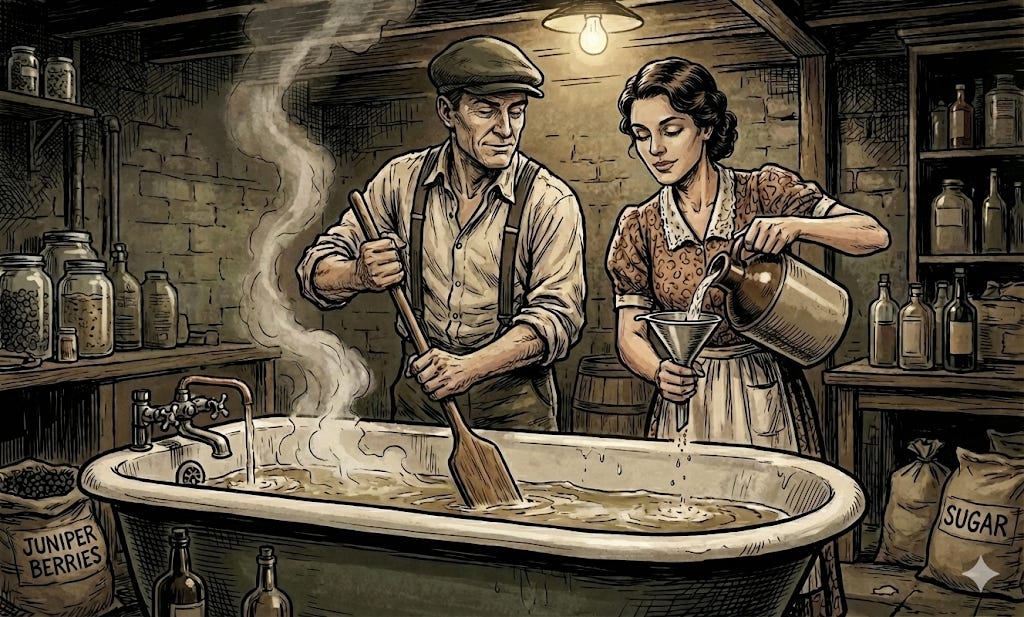
Let’s talk about my heritage. Let’s talk about booze. For thirteen weird years alcohol was prohibited in these United States. It was a master class in the foolishness of attempting to legislate morality. You might be shocked to learn how much alcohol was still produced, transported and consumed under the pious noses of a government tasked with guarding the purity and upstanding character of its citizenry. My great grandparents, my mom’s mom’s folks made bathtub gin. Which I’ve always been a little curious about. Bathtub Gin is how people colloquially referred to all manner of garbage-liquor containing cheaply produced grain alcohol diluted with water, juniper berry juice and even glycerine. They would have been experts at procuring this grain alcohol, probably legally produced for medical or scientific uses and, umm, diverted for domestic consumption. They would have used their metal or porcelain bathtub(s) to blend the final beverage, bottled and distributed throughout the community. And they would have known their way around distilling, even if “bathtub gin” didn’t typically involve the actual distillation process. When you distill liquor, you start with grains. Grains soaked and boiled in water, often with herbs and spices and other goodies, until the mash is separated from the feedstock. The feedstock is the alcoholic liquid that will be distilled into whatever spirit you’re distilling. And the remainder, the porridge-like grains mixture that’s been all boiled up is called the mash. The spirit is what you’d be going for in this scenario. That’s the marketable material. But in the end there’s a lot more mash than there is spirit. Many years after prohibition ended my great grandparents, the gin-runners, would come to visit us in Oregon from time to time. When they came, they drove their sedan, and in the trunk of said land-yacht they had a special suitcase. Ornate and beautiful, it contained a full bar. Or, a travel sized bar. But a fairly complete bar. I do not really even drink. An occasional summertime beer. A neat whiskey from time to time with a good friend ‘round a backyard autumn fire. But this is my heritage. One of my family’s love languages is firearms. We share them, we hand them down through generations. There are some old guns rattling around in this family. And some very neat old pieces of engineering they are. I grew up around guns, and I’m not afraid of them. I’m not unfamiliar with them, with their operation and function, and I’m not oblivious to their power and allure. Once, when I was learning to shoot larger firearms, we had a series of vegetables which we were invited to compare to the texture of our own bodies. Does the pumpkin feel softer or harder than my stomach? Does it seem more or less impervious to a bullet’s piercing power? And then of course, we shot the vegetables. And they were obliterated and I was convinced—guns were not toys. They were tools, in my home, for hunting. But I am not a hunter; I bear neither the need for a winter’s meat, nor the sporting desire. The world has changed, and I will not hand guns down to my children. My parents may not like reading this. My grandparents would not like reading this and my deeper-forefathers are likely rolling over in their graves. I will not hand the weapons themselves down to my children, but more than that I will not work to hand down a value for them. It’s not that they’re not beautiful on some level, but they’re powerfully destructive and have become representative of an ugly culture that’s grown up around them in recent years. There is a part of me that laments the loss of this culture of hunting and sportsmanship. It is largely overshadowed by aggressive fear-of-neighbor and protectionism, and I am repelled. Love of craft engineering, sportsmanship, these things are the spirit of my heritage. The rest is just mash. My dad’s mom is in assisted living now. She is old, and she is in need of community and care and she’s able to find both in her current living situation. But it’s required her to downsize, and so we have begun, as a family, the process of sorting her life like so much tonnage. Who gets the rolltop desk? Who gets the Ray Eylery paintings? Who will be responsible for these things moving forward.k I have her biscuit bowl. Her fried chicken-flipper. I have the rolling pin she received for her wedding and a very well-used potato masher with a lot of life left in it. These things are tonnage. These things are mash. The spirit of my relationship with my grandmother is the time she excitedly told me I had a baby sister. And later a baby brother. The spirit is not the biscuit bowl, it’s the memory I carry of her making the biscuits, and the recipe I contain within my brain today. Grandma is the grandparent I have been the closest with throughout my life. Her husband died when I was just about five, and my other grandparents were somewhat distant. I wrote about my grandfather in craftsmanship. But grandma was normal. She took us on errands. She watched us on regular days. We knew which of her phone books worked best for sitting up a little higher at her table for predictable meals of green beans and iceberg salads and, yes, fried chicken and biscuits. That’s the distillation of my relationship with her. The normal. My other grandparents were exotic and different and unknowable to me. Grandma was everything knowable. I treasure my memories and I treasure her. What is this value I feel for my own past? My family’s past? What’s that about? I wonder. There is so much in the present I don’t understand. So much about the future that I cannot predict. They say if you don’t understand your past you’ll be doomed to repeat it. I’m reaching into my past, not for tonnage, but for meaning. For a thread linking things of worth and value from the past to my future. One day in the not too distant future my grandmother will go on to the next thing. And she will exist only in memories. My dad and I will both carry the tonnage of a childhood lived alongside that woman. But what will my kids remember? Hands knurled from arthritis. The same few stories told over and over. Oil of Olay. All mash. I have grandma’s biscuit bowl. But one day I will let it go. Because it is also the mash, and not the spirit. I have already decided. One day I will have a ceremony, and I’m not yet sure how it’ll look. Maybe when I’m about sixty years old. Or seventy. Or fifty. I’m trying to think it through now. I will let the mash of my heritage go. I will let it die, and be done. I will encourage my kids to remember their grandparents! I will share stories while I yet may. I will encourage them to harvest my belongings for items that might have some meaning to them. And then I will take the rest and perhaps I will have a cleansing fire. I will write a story for my children, I will contain the past for any of my grandchildren who care to observe it. I will attempt, like my ginny-forefathers, to distill and refine, only my refined spirit will be an attempt to send something of value forward into the future. I will dig a hole, while my body will still dig, I will gather my grandchildren and hand them shovels, and I will tell stories about the biscuits of my youth, the subtle, and not-so-subtle racism that existed in my childhood and will doubtlessly exist still, the deaths that came too soon, the fried chicken, the appreciation for fine engineering, and together we will bury the past and allow it to die. Because our heritage isn’t the mash, it’s the distilled spirit that’s rendered at the end. Get full access to Nick Walton at nickfromoregon.substack.com/subscribe
Embed this episode
Ready to play
Heritage
No transcript for this episode yet
Similar Episodes
No similar episodes found.