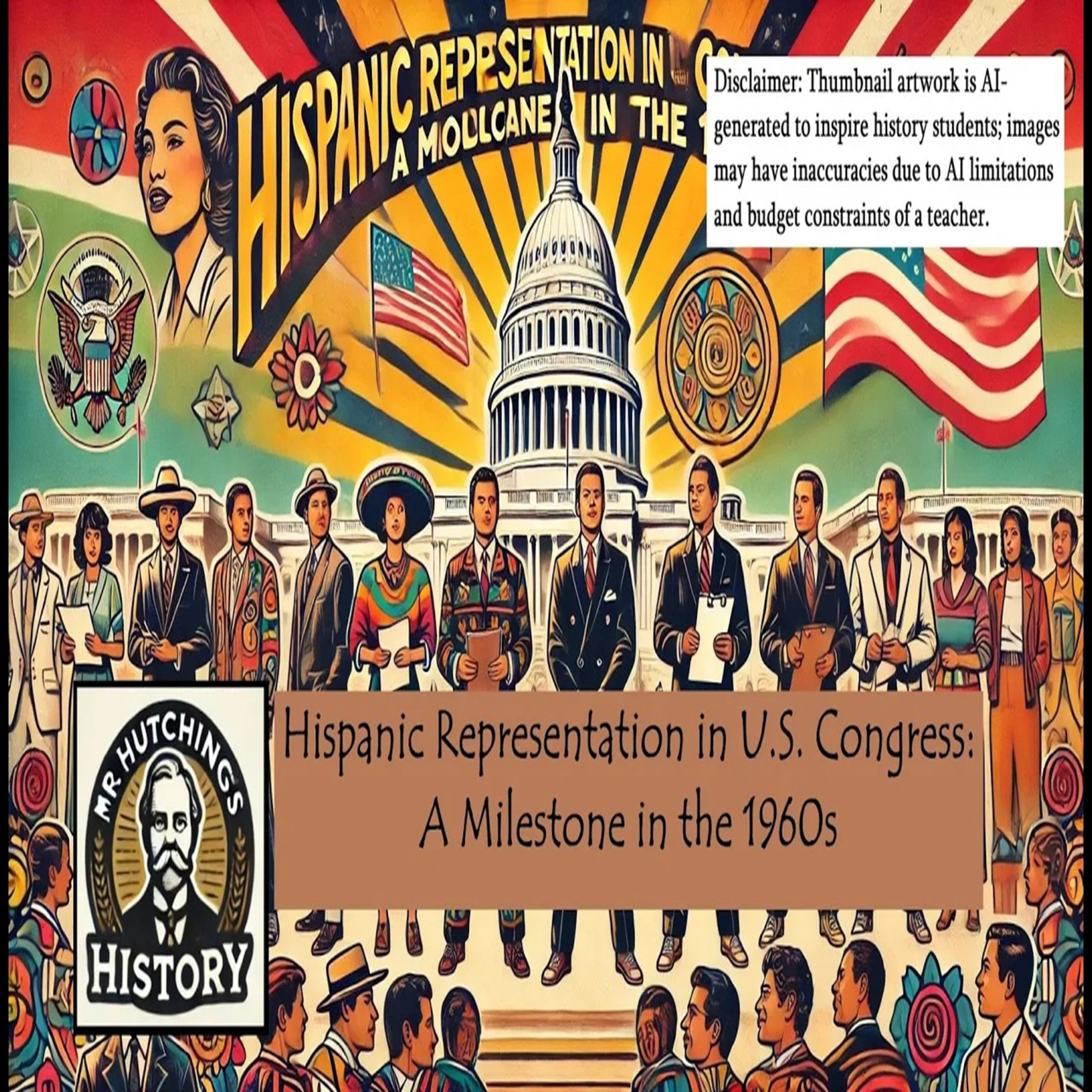
Hispanic Representation in U.S. Congress: A Milestone in the 1960s episode artwork

EPISODE · Dec 7, 2024 · 21 MIN

Hispanic Representation in U.S. Congress: A Milestone in the 1960s

from Mr. Hutchings History · host Produced, created, and written by Harold M. Hutchings

In this episode of Mr. Hutchings History, we explore the rise of Hispanic representation in the U.S. Congress during the 1960s. The decade marked a significant shift as Mexican-American and Hispanic leaders broke barriers and took political office, forever changing the landscape of American politics. We focus on key figures such as Henry B. González, Edward Roybal, Joseph Manuel Montoya, and Manuel Luján Jr., who became trailblazers in the fight for civil rights, healthcare, education, and immigrant rights. This lecture covers: The political marginalization of Hispanic-Americans before the 1960s. The impact of the Voting Rights Act of 1965 and its amendments in increasing voter participation. The establishment of the Congressional Hispanic Caucus in 1976. How these leaders addressed systemic inequalities and their influence on future generations. Learn how these milestones in representation were the culmination of years of organizing and activism, which ultimately empowered Hispanic communities and provided a voice in U.S. legislation. This episode delves into the broader civil rights movement that fueled these achievements and their lasting impact on American politics. #Paper3HLoption2 #HispanicAmericanMovement #CesarChavez #ImmigrationReform #MexicanAmericanRights #CivilRights #PoliticalRepresentation #VotingRightsAct #CongressionalHispanicCaucus #HenryBGonzalez #EdwardRoybal #JosephMontoya #ManuelLuján Works Cited González, Juan. Harvest of Empire: A History of Latinos in America. Penguin, 2011. McWilliams, Carey. North from Mexico: The Spanish-Speaking People of the United States. Greenwood Press, 1948. Navarro, Armando. Mexican American Youth Organization: Avant-Garde of the Chicano Movement in Texas. University of Texas Press, 1995. Rosales, F. Arturo. Testimonio: A Documentary History of the Mexican-American Struggle for Civil Rights. University of Houston, 2000. Ruiz, Vicki L. From Out of the Shadows: Mexican Women in Twentieth-Century America. Oxford UP, 1998.

NOW PLAYING

Hispanic Representation in U.S. Congress: A Milestone in the 1960s

0:00 21:30

No transcript for this episode yet

We transcribe on demand. Request one and we'll notify you when it's ready — usually under 10 minutes.

The 48 Laws of Power by Robert Greene (Full Audiobook) Robert Greene Amoral, cunning, ruthless, and instructive, this multi-million-copy New York Times bestseller is the definitive manual for anyone interested in gaining, observing, or defending against ultimate control – from the author of The Laws of Human Nature.In the book that People magazine proclaimed “beguiling” and “fascinating,” Robert Greene and Joost Elffers have distilled three thousand years of the history of power into 48 essential laws by drawing from the philosophies of Machiavelli, Sun Tzu, and Carl Von Clausewitz and also from the lives of figures ranging from Henry Kissinger to P.T. Barnum.Some laws teach the need for prudence (“Law 1: Never Outshine the Master”), others teach the value of confidence (“Law 28: Enter Action with Boldness”), and many recommend absolute self-preservation (“Law 15: Crush Your Enemy Totally”). Every law, though, has one thing in common: an interest in t The Laura Ingraham Show Laura Ingraham The most-watched woman in the history of cable news brings her no-holds-barred political and cultural commentary to podcasting with The Laura Ingraham Show. A bestselling author, breast cancer survivor, and mother of three internationally adopted children, Laura was the most listened-to woman in talk radio before launching her own podcast. A trailblazer across media platforms, she brings a unique perspective to this twice-weekly show, drawing on her experience as a white-collar criminal defense litigator and a Supreme Court law clerk.New episodes drop twice a week—delivering the clarity, courage, and common sense America needs. Vampires of the Paper Flower Consortium Elizabeth Guizzetti Come for the evening, stay for eternity! Paper Flower Consortium is a podcast from the largest vampire coven in Seattle. Their stories are told by Loretta Fabron Onfoy, coven historian and librarian, in the hope that the modern vampire's way of life is not lost during the next great language transformation. Some tales in this anthology are horrific, some are droll, some are filled with misadventure--just like any eternal existence. Episodes sponsored by the Paper Flower Consortium's Business Community. The history is followed by questions from curious initiates. Want to ask Lady Loretta a question about vampirism? Have a topic you want to see discussed? Email [email protected] WW2 - the Key Questions, answered by Laurence Rees. Laurence Rees A former Head of BBC TV History programmes, Laurence has specialized in writing books and making television documentaries about World War Two, the Nazis and Stalinism for thirty years. He won a BAFTA and a Peabody for his TV series 'The Nazis: A Warning from History' and a British Book Award for his book on Auschwitz, which is also the world's best selling book on this notorious camp. His book 'the Holocaust: A New History' was described by the Times as 'exemplary' and by the Daily Telegraph as 'the best single volume account of the atrocity ever written'. Educated at Oxford University, for several years he was a visiting senior fellow at the London School of Economics, London University. He holds honorary doctorates from the University of Sheffield and the Open University. Professor Robert Service, of Oxford University, described Rees as 'one of the world's experts on the Second World War'. Sir Max Hastings wrote in the Sunday Times, in a review of Laurence Rees' 'World War Two: Behi

Frequently Asked Questions

How long is this episode of Mr. Hutchings History?

This episode is 21 minutes long.

When was this Mr. Hutchings History episode published?

This episode was published on December 7, 2024.

What is this episode about?

In this episode of Mr. Hutchings History, we explore the rise of Hispanic representation in the U.S. Congress during the 1960s. The decade marked a significant shift as Mexican-American and Hispanic leaders broke barriers and took political office,...

Can I download this Mr. Hutchings History episode?

Yes, you can download this episode by clicking the download button on the episode player, or subscribe to the podcast in your preferred podcast app for automatic downloads.
URL copied to clipboard!