KPBS On Demand is supported by the San Diego County Toyota Dealers. The updated all-hybrid Camry combines technology, performance, and a modern design with features supporting a connected driver's experience. Visit your San Diego County Toyota dealer or toyota.com. We make it easy. And the Oscar goes to... Go to the host, Charlie Wattell, David Rabinowitz, and David Wilmot. Thanks for her.
The 91st Academy Awards served up a record number of Oscars for black artists, including Spike Lee's first win for Best Adapted Screenplay for Black Klansmen. We all connect with our ancestors. We will have love, wisdom, and we will gain our humanity. It will be a powerful moment. The 2020 presidential election is around the corner. Let's all mobilize. Let's all be on the right side of history. Make the moral choice between love versus hate. Let's do the right thing.
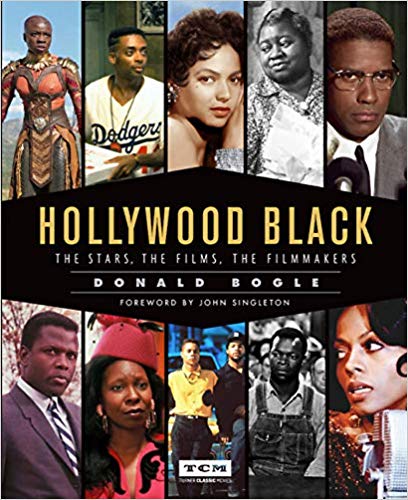
African Americans in Hollywood have had a long, troubled, and complicated past. I'm going to explore that history with Donald Bogle, author of the new book, Hollywood Black, The Stars, The Films, The Filmmakers, from Turner Classic Movies. Welcome back to listener-supported KPBS Cinema Junkie Podcast. I'm Beth Accomando. This month, yet another incarnation of Shaft hits theaters, and it includes the original John Shaft, Richard Roundtree. Plus, the Sundance hit The Last Black Man in San Francisco opens, and Jordan Peele's layered horror film Us comes out on Blu-ray. So not a bad time to focus attention on blacks in Hollywood. Bogle has been writing about blacks on screen and in Hollywood for decades, and he serves as a host and commentator for TCM. His book, Hollywood Black, just came out, and it offers a comprehensive look at African-American films, stars, and directors from the silent era and up to Black Panther.
But before we get to my interview, I need to take a short break, and then I'll be back to talk about Oscar Michaud, Blaxploitation, and the films you absolutely need to see, according to Donald Bogle. Here in Southern California, we know all too well the devastation wildfires can cause. That's why our mission is to stop the next one before it starts. I'm Brian D'Agostino, leader of SDG&E's wildfire and climate science team, and we've built one of the most advanced wildfire prevention programs in the country with a team of world-class meteorologists using artificial intelligence and real-time weather data, all to help keep our communities safe. We're also building a stronger grid and using public safety power shutoff when necessary, because believe me, I've seen firsthand how unpredictable wildfires can be. But here at SDG&E, we face that uncertainty head-on to help keep you safe. Learn more at sdge.com slash wildfiresafety.
I began my interview with Vogel by asking him to talk about his first book, and about what led him to writing about blacks in Hollywood and the image of African Americans on screen.
I also want to just reference back to your first book. When you wrote that, the book really tackles stereotypes in film. And I was wondering if you felt like that initial motivation to write a book was really to tackle some of that and challenge some of those images. And was that the first thing that you wanted to write about?
So I wanted to deal with stereotype these performers with their great talent, but they didn't so much roles as they played against them. And a good example, I think, is Hattie McDaniel, who, with the wind, it is this mammy character, but she has a degree of agency. She's assertive. She's got power. Hattie McDaniel has this big sonic boom. And when you hear her, you know that she was born. She's not necessarily to take them. Oh, now, Miss Scarlett, you come on and be good and eat just a little. No!
I'm going to have a good time today and do my eating at the barbecue. If you don't care what folks say about this family, I do. I just told you and told you that you always tell a lady about the way that she eats in front of folks like a bird. And I ain't aiming for you to go to Mr. John Wilkins' and eat like a field hand and dive like a hawk. Biddle-dee-dee. Ashton Wilkins told me he likes to see a girl with a healthy appetite. What gentlemen said and what they think is two different things. And I ain't noticed Mr. Ashley acts in front of Mary. So I was dealing with that as well in Thompson's, but it very much was a very old look at going through and these distorted images as well as achievements.
And that's what I did with that book. This book, Hollywood Black, it opened into the new millennium. And it does look at images, but not what Tom Cruise did. I mean, they're two different. They're companion pieces. And so a number of his films.
Well, you mentioned this notion of the power of the image. And it seemed like that was one of the things that Spike Lee was addressing in his recent film, Black Klansman, because he's showing Birth of a Nation being screened at a white supremacist meeting. And then he's also having his characters talk about some of these images in blaxploitation. And it seemed like one of the things he was addressing in the film was the power of the image and also, you know, that the filmmaker needs to think about what those images are that are going on the screen. Yes, very much. And I like that aspect of one of the things with this, the fact that D.W. Griffith's Birth of a Nation was a huge hit by AACP protest Hollywood Black.
D.W. Griffith, it's interesting that after Birth of a Nation, Hollywood kind of controversy that we see with Birth of a Nation didn't want a controversy that might enter the box office. It opens and idealized in the film sexual black men. Nonetheless, with the industry backed off, you get to see in the movies what the black men we would see after were to be comic non-threatening figures and non-sexual. For a long time, you had people like Step and Set, someone like Bilbo Jangles, Robbins. These were people who had talent, but they were very much boxed in by the roles. That's the thing, the black exploitation group of black filmmakers, Mark Senior, who directed
who we call the Learning Tree, and the Parks Jr., who does Superfly. They like the buck figure. You mentioned Oscar Michaud, who made films in the silent era. Do you feel that these films are overlooked, and is it mainly because there aren't that many of them that survive, or do you just feel because they're silent films people tend to not want to watch them as readily? But he seems like such a groundbreaking figure in Hollywood's black history. He is groundbreaking, but he also did do Sailing Birth of a Nation. There are people making movies with positive images. But Michaud got in very, very in the teens.
Thomas Noble Johnson was a black actor who worked in Hollywood. But nonetheless, I think that what happened, some of his movies rediscovered in later years. I mean, to find actual prints of them. One of the ones is Within Our Gates. And there, Michaud is dealing with, and dealing with Ray C, someone that movie 1920, to see someone that early, affecting an audience, emotional, with the silent films. That may be the part that people don't look at silent as much, any kind of silent film, but I think he's deafened by the intensity. Now, some of his films, but there are others around, and then there are the sound. They kept working until 1947.
People working outside of the house who were making movies for black audience have become known as race movies. A number of them. Some got lost, disappeared. Others are still around. They're the black westerns done in the late 30s with Herb Jeffries. Herb Jeffries was a terrific singer. He performed with Duke Ellington. And he was a real heartthrob. And he's a singing cowboy in his movies. He did Harlem Rise, The Range. And he also did Bronze Buckaroo and others. And those are great fun. With my rope and my saddle and my horse and my gun, I'm a cowboy. So when the day...
That's Herb Jeffries singing I'm a Happy Cowboy from Two-Gun Man from Harlem. I'll have more film clips as well as more of my interview with author Donald Bogle after this short break. Here in Southern California, we know all too well the devastation wildfires can cause. That's why our mission is to stop the next one before it starts. I'm Brian D'Agostino, leader of SDG&E's wildfire and climate science team, and we've built one of the most advanced wildfire prevention programs in the country with a team of world-class meteorologists using artificial intelligence and real-time weather data, all to help keep our communities safe. We're also building a stronger grid and using public safety power shutoff when necessary, because believe me, I've seen firsthand how unpredictable wildfires can be. But here at SDG&E, we face that uncertainty head-on to help keep you safe. Learn more at sdge.com slash wildfiresafety.
I want to jump a little bit ahead in history and return to blaxploitation because I was very attracted to blaxploitation films because of actresses like Pam Greer and Tamara Dobson and seeing strong women on the screen, whether they be white or black. But that, you know, was a big attraction for me. But TCM recently screened Sweet, Sweetback's Badass Song. And I was impressed by how fresh the film still felt and how it was still able to kind of jolt the audience because it seemed like it was not only revolutionary in terms of the content, but also in terms of just. the film grammar it used, the storytelling. So I just want to talk to you a little bit about those blaxploitation films and kind of how they changed the landscape. Well, they very definitely changed the landscape. I mean, just one black actor who made a name for himself, and that was Dorothy Dandridge, had also made an impact in Hollywood. But nonetheless, his movies really were part of it. When you get to blaxploitation, really, 60s, that America has gotten Van Peebles. Van Peebles with Sweet, Sweet, Back, Badass, becomes this, in that film, a black man taking his destiny into his own hand, fighting corruption. And in Shaft, it's interesting that Gordon Parker,
with the first Shaft with Richard Roundtree, that the opening of that film, you see Shaft coming up from the subway into the Times Square area, and it's really this idea that this black man has been underground, and now he's coming to the film. And you're going to see him, and you're going to have to deal with him. And it's interesting that Shaft is really walking against track, and he's got to break the rules in order to survive, to be changed. The black quotation is saying that kind of thing. Superfly, which was directed by Gordon Parks Jr., He wants to get out of the business, and he sees it's correct, and he wants something else for himself. So you have black men announcing themselves, and then you get Pam Griesen, these black women now, who are just the black men around them. They're not shrinking violets, and they, too, are taking things in their own hands. That's the idea. The rest of your boyfriend is still around, and I hope you two live a long time, and then maybe you get to feel what I feel. Death is too easy for you, bitch. I want you to suffer.
And they become figures. If you see Pam Greer in Foxy Brown, you see Tamara Dobson in Cleopatra Jones, the community, the black issue to the drug dealers, not exclusively announcing a new day. It's a great thing to see them. And by the way, you know, Pam Greer did have this as this positive figure. They put her on the cover of the old one who's not so well remembered today, and she's no longer living. If I ever hear you selling so much as a cough drop, I'm coming down on you so hard.
Tamara Dobson, the Soul Sister's answer to James Bond, and the most exciting new star in years, Six Feet Two of Dynamite, and it's all stacked. She very much is her own woman. And there's a great singer in the past, and he's a tough wizard, and she's the one who they see. I should also say with blaxploitation, there was criticism of the African-American community. There were images during that period. Lee Tyson, who gives a magnificent Oscar-nominated performance. It's a romanticized version. Blaxploitation really doesn't last. I would say roughly, blaxploitation goes roughly. They've been influenced by blaxploitation. Spike Lee, she's got to have it.
In your introduction, you mentioned that you say rarely do you go to the movies to learn anything, but we learn something nonetheless. And is that one of the reasons that kind of drives you to write these books, to kind of put these films into a context so that people do think a little bit more about them? I don't go to think, but there are some things into our unconscious and distortions that are in our head. We're trying to sort them out, really thinking that we're trying to sort them out. So with my books, it's it. And to sort out what I see as distinction and writing about, I've got an energy about it. And this is film, music. To write in that way so you can read.
really wants a comment. You know, I go to the movies. I used to go to screenings. Now I do to be there with an audience and to see the way. And girls, I mean, black men enjoy it. And this is basically women's film. Men see these films, too. And so caught up. They picked up something from the audience and many of the women and what they were. For me, in writing, history is important and bringing certain... And it's not answering everyone's questions. And we often have conflicted feelings. Every black film, white film, whatever. We can have conflicted feelings about what we're seeing on screen. And it's not to dismiss and understand what...
what we do like and understand what may. I mean, your book is very comprehensive and kind of looking at this whole history of Hollywood black. If you could pick three films that you feel people really need to see that they probably haven't seen, are there three you would point to and say, like, if you haven't seen these, you're really missing out? I'll tell you two. I'll tell you two that have, and this is back to me. One is the movie Carmen Jones from 1954. And Carmen Jones has an all-star woman nominated for an Oscar. Addie McDaniel had won his Best Supporting Actress, but Dandridge Best Actress, Harry Belafonte's in it.
But Carmen Jones, one, to see Dandridge, and she's in a world controlled by men, and she is fighting. There's that aspect of Carmen Jones, and then there is a great sequence in Carmen Jones that was directed by, and then you see his name right there. There he is, and the people dancing, there's the young Alvin Ailey who's dancing. There's a lot in that. So Carmen Jones has a certain for me, and then I would say Boys in the Hood that I've seen many times, and that movie came out in 91, but that movie still, Charles Burnett would say, I think Spike Lee's film do the right thing. And I would say Black Panther. You see that, the thing about it.
You don't know where that movie's going. You have no idea. But you can't stop watching, and it injects race into this, what might be, you know. Moving forward, what are you seeing possibly happening in this Hollywood landscape, and what are you hoping for in terms of what might change or what might improve? Well, the thing is, I mean, we're seeing more American filmmakers come to the film, also in television. It's quite interesting what's happening with, it's really an interesting period, and it's interesting that we're in a, we're getting these, many people now are getting a chance to work, a chance in previous Viola Davis, and that in the past.
But now she's gotten a chance for something else. I'm thinking mainly of, you know, it's a vital period. I don't think, I see this, it's another that would once again limit the opportunities for really benefiting the whole culture. It's speaking in another audience as well. And that's, I hope it's going to continue. That was author Donald Bogle. His new book is Hollywood Black from TCM. I'll be back in two weeks with a podcast on the new film Ophelia that reimagines Hamlet from Ophelia's point of view. So until our next film fix, I'm Beth Accomando, your resident cinema junkie.
Here in Southern California, we know all too well the devastation wildfires can cause. That's why our mission is to stop the next one before it starts. I'm Brian D'Agostino, leader of SDG&E's wildfire and climate science team, and we've built one of the most advanced wildfire prevention programs in the country with a team of world-class meteorologists using artificial intelligence and real-time weather data, all to help keep our communities safe. We're also building a stronger grid and using public safety power shutoff when necessary because believe me, I've seen firsthand how unpredictable wildfires can be. But here at SDG&E, we face that uncertainty head-on to help keep you safe. Learn more at sdge.com slash wildfiresafety.