KPBS On Demand is supported by the San Diego County Toyota Dealers. The updated all-hybrid Camry combines technology, performance, and a modern design with features supporting a connected driver's experience. Visit your San Diego County Toyota dealer or Toyota.com. We make it easy. Welcome back to another edition of listener-supported KPBS Cinema Junkie podcast. I'm Beth Accomando. Cinema Junkie is taking a holiday break, but we'll be back with new episodes in February. To tide you over, I've pulled out some popular archives for you to listen to. It seems only right that since I started the year with Batman, I should end the year with him. So from the archives, here's holy nostalgia looking at the Batman exhibit at the Hollywood Museum.
On January 12, 1966, this happened. Suck. Pow. Suck. That's right. The Batman TV show arrived and delivered a pop culture burst of sensory overload. It's amazing. The colors were like, wow. It was done in such a way that nobody had ever seen anything like that before. You know, even the bat fight words that were in the burst, you know, those colors, you know, coming at you on the screen.
Although canceled after just three energetic, tongue-in-cheek seasons, the show has remained a fan favorite. Last month, on the 52nd anniversary of the show's premiere on ABC, the Hollywood Museum opened its Batman 66 exhibit, an eye-popping explosion of pop culture goodness conceived by Roger Neal. Holy Hollywood. One of my best memories of Batman is when we got our first color television set, I was in second grade. And the first show I watched in color was Batman. And it was always a two-parter. Can this, I mean this, be happening? Batman being made into a pineapple frosty freezy and Robin into a lime one?
Has the diabolical Mr. Freeze outwitted the dynamic duo, after all, with some fancy ice work? And I would get so nervous at the end of the first part of the episode, Batman and Robin were, oh no, something's gonna die, something's gonna happen to them, and I had to tune in the next Thursday night, you know, to see if they were gonna be okay. Hope for a miracle, and stay frozen in your seats until tomorrow, same time, same channel. And that was neat, too, having that cliffhanger that, okay, you don't know if Batman and Robin will escape. Batman was trapped and ready for the barbecue. It was getting very warm.
But wait, the worst is yet to come. But if you tune in tomorrow night, same bad time, same bad channel, you'll find out if they get out and how they get out of their caper. In 1966, ABC launched the Batman TV show starring Adam West and Burt Ward as DC Comics' Batman and Robin, a.k.a. the Caped Crusaders or the Dynamic Duo. And audiences went bat-crazy. Kids were dressing up like Batman, teenagers were dancing the Batusi, and you could hear people employing Robin's holy whatever exclamations or signing off with Same Bat Time, Same Bat Channel. It was so popular that a Batman movie was conceived and released in between seasons one and two.
too. Tell them Robin. It's really exciting. Soon, very soon, Batman and I will be batapulting right out of your TV sets and onto your theater screens. That's right Robin. Our first full-length motion picture feature in color opens a whole new world of thrills.
This podcast is dedicated to Batman 66, the exhibit and the show, and to how both elicit a sense of joy. I'll be talking to exhibit organizers, including collectors who loaned objects to the museum, plus some fans who relived the show's impact on them. And finally, to the boy wonder himself, Burt Ward, who played Robin in the TV show and in two recent Warner Brothers animated features. Holy resurrection! The evil extractor! Robin, what are you doing? Get out of here before it's too late. I don't think so.
But to start, I'm going to let Roger Neal give you a quick tour of the exhibit, which you can see a video of at kpbs.org slash junkie podcast. Hey, I'm Roger Neal. I am the exhibit organizer for the Batman 66 exhibit here at the Hollywood Museum in Hollywood, California. Let's take a little tour and I'll show you around our exhibit. First, this is, we wanted to recreate Wayne Manor, but recreate the study, because that's one of the most famous parts of Wayne Manor, is when you see Bruce and Dick go into the study, to the library, and then they get the call from the commissioner, and then they open this famous Shakespeare bust, and then the bat poles open, and we wanted to show the bat poles, and I never realized, actually, until this exhibit, that Bruce Wayne's bat pole was bigger than Dick Grayson's. And why was that? Because Dick was a teenager, and Bruce was an adult. So let's go over to the Batcave, shall we? I think the centerpiece is...
Adam West's original costume, which is here, and Bert Ward's original costume, which is there. Now Bert, people may not know, Bert is allergic to wool. So in his vest, in his vest, they had to put lining in the vest. And that's how we know that this is Bert's original costume, because the vest has lining in it, and of course his initials are in it from wardrobe, as are Adam's. The Batmobile. Who doesn't love the Batmobile? Now this is a screen-accurate replica of the Batmobile that a collector graciously loaned out. And it's street legal, by the way. This was driven here, down Hollywood Boulevard, and it caused quite a stir. Back there, the original...
Bat Computer. That is the Bat Computer, the original one used in the show. On all these big areas, if you read what's along, when you come, if you read what's along the wall, you'll get a lot of information about Batman that you may not have known. And if you think you know all about Batman, there's always something new to learn. And as we come around the Bat Cay, we see the Bat Cycle. And then, of course, Batman 66 is not complete without those heinous villains.
Those heinous villains that we just, we loved to hate them, didn't we? Catwoman, Riddler, Joker, Penguin. It's awesome. I love it. I love it. I just love it. Come on over to see the collectibles from 1966. Original collectibles that when I was a kid in 1966 and probably when you were a kid or your grandparents or your parents were kids, this is what you could buy at the store because Batman was just that huge. Then we come over to our smaller collectible cases. There's some great things in here, like this is the actual script.
from 1966 from the Batman movie. And you can see it has a Burgess Meredith autograph on it, Lee Meriwether, Frank Gorshin as the Riddler, Burt Warden, he signed it as well, Adam West signed it. So that's a really great item to have right there. And these production call sheets are from the estate of Magic Lake and Harriet. These are her actual call sheets. This is a Neil Hamilton script. Neil Hamilton's notes are inside the script. He played Commissioner Gordon, of course. I hope you've enjoyed.
Neil had to tap fans who were collectors to get some of the items in the exhibit, like a screen-accurate and street-legal Batmobile and some original costumes. Zolt's love for the show proves its longevity because Zolt wasn't even born when Batman debuted on ABC. It was actually my brother's fault because we went to the 1989 Tim Burton movie and I was nine years old at the time and that giant black bat scared me. And so I went home and on the family channel they were showing the TV series but as a nine-year-old I didn't realize that it was in reruns but I loved it. I loved the action adventure. Yeah, you know, it was so colorful, so many different props and that's why I started collecting some of the props or even building some of them because it was so neat to see this giant bat shield like this one here that Batman would take out his utility belt and then he'd hold it like this and would repel the bullets or anything coming at them. So that was something, it was just, you know, from the gadgets to the cars, everything was labeled.
bat ring, bat computer. That was just fun. And then, like I said, later, hearing Adam deliver the lines, something that is so funny, but he did it so incredibly straight. And it was just a fun show on so many different levels. But Zolt has since become a devout fan and collector. He contributed some items to the exhibit. And then that's a bat shield right down there, which I love. And I'm a pianist, and so what was fun for me with the bat shield was it actually uses piano hinges. And then I riveted it together. So that's one of my props that I make. Knowing that I have some of my collection in here, it's exciting, it's honoring.
to be able to be a part of it, but at the same time, it's a little weird because I'm able to, at home, go up and enjoy my collection. If I want to hold something, I can. But right now, everything is behind glass. Usually, that stuff's sitting in his office. They say your office should be a fun area, and so mine is. So I have a Batman, a Robin, a Batgirl replica. So when you walk into my office, I've never not had anybody not smile. The exhibit was guest curated by Wally Wingert, who's not just a fan, but also a voice actor who's done work for the Batman video game. He recalls how he was introduced to the Batman 66 show. Details are sketchy.
but I do remember watching the show originally when it came on the air. Back in 1966, I was five years old. Everybody was watching it in the neighborhood. Everybody at school was watching it. It came on January 12, 1966. I have photos of me shortly after that time in my homemade Batman costume with a bath towel safety pin around my neck and gloves on. My dad wore gloves, and that was my homemade Batman costume. But by my fifth birthday in 1966, May, I had been given by my parents an official Ben Cooper Batman cape and mask set. So I pretty much remember it almost to the day it began airing.
upon reviewing some of the episodes on Blu-ray recently, there is certain imagery that pops up where I can remember that as a kid, things that were particularly disturbing, like Bruce Wayne strapped to a gurney, curling down a mountain road and about ready to careen off of a cliff. I also remember Bruce Wayne being strapped to some sort of conveyor belt heading into the fire. The flaming end of the Caped Crusader. Can Bruce possibly escape? For Batman's sake, keep your bat fingers crossed until tomorrow. Same time, same channel. I remember that as a kid and I saw the stuff on the Blu-ray going, oh my gosh, I totally remember this as a kid and it did frighten me. So yes, I have a pretty good memory for that. What do you think it was about the show that captured your imagination and captured the imagination of kids and adults all over the place? Since I wasn't watching it initially in color, we had a black and white set. I can't say the color. It was the action and it was the performances of the cast. They had a wonderful ensemble cast with great chemistry between, of course, Batman and Robin, but also between the villains in Batman and Robin. And it was the performances that shot right through that black and white.
fuzzy black-and-white image on my television and just grabbed my attention. Once, of course, I saw it in color, my life changed considerably. But it wasn't about the color, it wasn't about the clarity, because I was watching it under neither of those circumstances. It was simply the performance of the actors, the chemistry, the writing, and the adventures that they went on. So what was it like to be approached to guest curate a show on Batman 66? Being asked by Roger Neal and the Hollywood Museum to do this was a bit of a dream come true.
About 30 years ago, about 1987, 88, I was a big fan of the Movie Land Wax Museum down in Buena Park. And I said, boy, they really need a Batman and Robin Batcave display as part of their television tribute. I sketched up a rough Batman and Robin Batcave with a Batcomputer, Batmobile, everything idea and sent it to them as a pitch saying, you know, I can help you with this if you want. I know how to make the costumes and I know guys that own Batmobiles and so forth, but of course they never responded and then the museum went out of business shortly thereafter. So it was an idea that I had to do something like this for 30 years. So when the Hollywood Museum came up with the actual idea to do it, but needed the contact to the collectors to actually make it happen.
I said, oh, yeah, no, I've been trying to do something like this for 30 years, so I'm with you. Now, you are not just a fan. You've also gotten to kind of partake in the Batman universe as well. Tell people where they can hear you as some of these characters. Well, as a voiceover actor, I've gotten to do a lot of different things, including working with Adam West on the Family Guy TV show. I've known Adam since 1980 when he came to visit Sioux Falls, South Dakota, and a show called World of Wheels. So I've been friends with Adam for about 37 years, and he was very complimentary, very encouraging for a young guy and a young radio DJ at the time in the Midwest. I was 19 at the time. Or, you know, following your dreams and coming out to Hollywood.
So eventually I'll get into radio and then get into voiceover doing characters, and a character called the Riddler for the Batman Arkham video games, which was quite a different Riddler from the one on the TV show, played so brilliantly by Frank Gorshin. But I would do occasional nods to him in my performance as this Arkham City Riddler. And then later, when I found out that they were going to do animated films based on the old TV series, or loosely based, inspired by the original TV series, I said, boy, I really want to be the Riddler, but I want to be that Riddler. I auditioned and got the role, and in the first film I was the Riddler, and in the second film, Batman vs. Two-Face, I got to be the Riddler, and King Tut.
Yet another dream come true to be in this with Adam West and Burt Ward, Julie Newmar, Lee Merriweather, and William Shatner. But now, in retrospect, to be involved in what would become Adam West's final appearance as Batman was a mix of emotions. It was a weird mix of emotions. I was proud to be involved, but yet sad under the circumstances that it was going to be Adam West's last appearance. What did you tap into for the Riddler? Can you give us a little sample of, let people out there hear what your Riddler sounds like? Frank Gorshin had such an amazing energy as that character. He was the first villain in the series, and I believe that he very much set the tone for all subsequent villains that would happen throughout the course of the remaining 120 episodes.
Frank was a great impressionist, and when I was trying to lock into his Riddler voice, because I've been listening to it since I was a kid on not only the episodes, but also the record album that I had of the soundtrack from the series, so I always loved his Riddler voice, but as an impressionist, I was always trying to figure out who he was impersonating as the Riddler, because first I wanted to lock into that, and then I could probably add his other little nuances on top of that, and I never really did figure out who he was impersonating in his Riddler characterization, but Frank had a very unique cadence in the way he would speak, you called Claude. So he wouldn't just say his lines. As Adam West had with his cadence when he would perform, he had a very specific way of talking, and it gave that character life. And Frank did pretty much the same way, where he wouldn't just blow through a line. He would add nuances and pauses and stretch certain words out.
a very unique characterization that wasn't easy to come by, but once I locked into it, I said, yeah, I think that's pretty much it. You got the laugh down. Oh, thank you. Well, it was really all about the laugh. And the laugh, too, a lot of people just think it's a laugh, but the way Frank would go into it would almost be like a slight cough. You hear how that happens with a slight, you know, going into it. And I said, oh, that's a neat little nuance of how he would do that. And, of course, he would vary it. It would go really high-pitched, and then he'd go... So he would go down low, and then he'd go high, depending on what was going on in the scene. But he was absolutely brilliant.
In putting together the exhibit, it's really fun for somebody who loves the show because you've kind of divided it up into some sections and scenes. So explain kind of how you wanted this laid out and how you wanted specific areas. Well, I assembled a really great group of people who not only know this show frontwards and backwards as well as I do, but also cosplay these characters at conventions. And once I assembled the crew, I said, well, let's go up and see the space that we will be given to fill the areas. And I said, well, all right, but logic would dictate that you have to have the Wayne Manor study.
So Pat Evans immediately said, well, I can make bat poles. That's easy to get some PVC pipes. And I knew we had to have the famous Shakespeare bust with the red bat phone, and we'd have a mannequin there with a Bruce Wayne attire and a mannequin there with Dick Grayson attire. And then we moved on to the next area, which was slightly bigger. And I thought it would be a great Batcave for Batman and Robin, both replica Batman and Robin mannequins, but also original Batman and Robin mannequins wearing the original costumes that a friend of mine has in San Francisco that he agreed to loan. So you can compare where you go what the costumes would have originally looked like back in 1965 with a costume designer named Jan Kemp, who was a friend of mine, very brilliant costume designer, that just did not get enough credit for his creations on that show, how he would have constructed them back then versus how they look now 52 years later.
So we also added a Batgirl. We had a Batcycle Batmobile. We had an original Batcomputer that was actually on the set back in the day. And then on this much, much bigger area, this is where all the villains will be, the Rogues Gallery of Villains, the United Underworld, today Gotham City, tomorrow the world. Of course, also with villain props that people had made, the dehydrator, and we have an original Penguin's Nest sign from one of the episodes that a collector loaned us. So we fill the area pretty well, and we have one of the original dresses worn by Ida Lupino as Dr. Cassandra in an episode called The Entrancing Dr. Cassandra.
So it's a pretty colorful setup. Then the museum came in with photos and signage and monitors and video clips and kind of peppered that around those mannequins as well to really fill the area. We wanted it to be really super busy, just so overwhelmingly dazzling that you just couldn't take your eyes off it. And they did a really, really great job. And then I said, well, you know, as a kid, the toys and collectibles that came out in relation to the show back in the 60s were such an integral part of the success of that show. There were two main companies doing Batman toys that were licensed to do Batman toys. Strangely enough, none of them were Mattel, which was the big toy company at the time. There was a toy company called Ideal.
It came out with a lot of Batman stuff, puppets, costumes, masks. And there was another company called Marks, M-A-R-X, which came out with a bat phone and several other plastic-oriented collectibles. So the other triangular area we filled with large toys and collectibles, some of the larger ones like a ride on Batmobile where a kid could actually drive it through the neighborhood, and some other costumes and different things. And then, of course, the small jewelry cabinet was for the smaller toys and collectibles where people would really want to get a close-up view of some of these. like flicker rings that you get out of the one-cent gumball machines, some of the little buttons that you'd wear that says Charter Member of the Batman Fan Club, you know, that kind of thing. Well, walking through there, I was reminded I'd completely forgotten about the color forms, those vinyl stickers. I saw that, and I was like, oh, my God, I remember those. The color forms is actually from my collection, actually, so thank you for noticing that. Oh, yeah, that brought back memories, I have to say. Yep. I mean, one of the things I appreciated is that either as a fan or even as somebody who may not know that much about the show, there's some really fun information that you share through a lot of the signs and stuff that are in the exhibit.
Thank you. Yeah, the signage was an extra added feature that I got to do. They said we needed not only toys and collectibles and costumes and props, but we also needed some signage that explained what people were seeing. And I said, well, you've come to the right guy. It tickles me to see pictures online that people have taken at the exhibit. And you can see people in the background actually reading the signs. I'm like, yes, they're reading the history behind it. They're not just going with the eye candy. They're actually learning about how this was created and concocted and the ideas and concepts behind it. Well, it's fun to get all the fight words in one location to compare. My favorite is whack it.
And they had, like, the Archer, which was a very medieval kind of vibe. They put an F on the back of, like, you know, whack it, slam it, bang it. You know, that's pretty funny. And I had actually forgotten a couple of the villains when I looked through your list. It was fun going through that. I had completely forgotten about the Puzzler. Yes, well, the Puzzler was an actual Riddler episode that they had wanted to do, but Frank Gorshin was having contract problems with the show, so they changed it to the Puzzler.
really, you know, look at that episode, you can see where it would have been a Riddler episode. I think the only Riddler episode they did in the second season was with John Astin in his one-time only appearance as the Riddler. And John Astin's a terrific actor, and I love everything he's done, but he just really was not the Riddler. Hard to top that Frank Gorshin performance. But Frank actually settled everything, and by third season he had come back as the Riddler for a couple of episodes.
And you also have a nice list of the, I believe, the Batmobile specifications, too, for anybody who wants to particularly nerd out about that. Yes, we were lucky enough to get a lot of signage from the Barris family, from the George Barris family, who brought in posters and specs on the original Batmobile that it was, you know, an original Ford Futura because George was on some board of Ford Motor Company and it allowed him access to some of these experimental prototype cars. Actually allowed him to buy the prototype car for a dollar. Best dollar ever spent. And he turned it into the Batmobile and became the most famous.
movie and TV car in history. In putting this together, did you have a favorite item that you were able to track down? Something outside of your own collection, but was there something that you were just like, oh, yes, I'm so glad we got that? Well, here's how things work in the scheme of things. I have a friend named Rob Klein who's a collector like myself. He collects all sorts of different things. And I said, oh, by the way, Rob, let me show you what we're doing. And I broke out the water-colored conceptual sketches for the museum. And I knew there was a Batman fan as well. And I said, yeah, we have this. We're going to have this area. We're going to have this area. We're going to have this. It's the Batcave. He says, well, you know I have one of the original Batcomputers.
And I said, what? He said, yeah, I found it rotting in a field somewhere at an electronic store. And I said, is this for sale? And if it is, how much? And the guy told him the price and said, get a truck over and get it out of here. The guy wanted to get rid of it. It was one of the original console units. I think it wasn't the bat computer. It was the bat scope, the bat scope, where it was like a circular radar panel that was tracking the radar. And he had that. So I said, oh, my gosh, would you consider loaning? He's like, yeah. This is terrific. So that was a big surprise. And it just made me go, yep, that's how things work in this business. It was meant to be.
I always said curating something at a museum where, I mean, when you're dealing with something that's pop culture related, you have to go to the fans to get the items kind of, you know, because the fans are the ones who sometimes recognize early on that something might be worth keeping. They're the ones who kind of hold on to things and allow you to have kind of this wealth of stuff to dig into. Well, thankfully it was due to the insight of a couple of, back in 1968 when the show was canceled, they were, you know, shredding a lot of the stuff and just throwing it away. And a few insightful people said, well, this is going to be valuable. I'm going to take this Batman and Robin costume. I'm going to smuggle it out of the studio. Well, I'm going to take this piece of equipment and I'm going to smuggle it out of the studio. So it's only because of those people that that stuff is even still around today. It was because they basically broke the law and stole stuff, but it was in the interest of history and in the long term it's kind of forgivable. Because a lot of people are like, we've got to get another show in here. This is canceled. Let's go out on stage. We tear it all down and throw it all away. Some of it, of course, was given a Western costume for rentals.
which really put the wear and tear on the pieces because different sized people pulling it on and pulling it off for Halloween and other movie companies renting different things. It's amazing that the stuff that has survived is still around anyway. We're happy to have what we can find. And of your own collection of Batman items, what was the thing that you really wanted to make sure got in the exhibit or a couple of things that you were really excited to show to other people? Well, out of my own personal experience, Two things that I really wanted to convey in this exhibit were, first of all, to recognize, finally, after all these years, the incredible work of my friend Jan Kemp, who we became friends in 1989. Jan was an unassuming British gentleman, and I asked him, I said, did you keep anything from the show? And he said, oh no, that wouldn't have been proper. He didn't even keep his own drawings, his own conceptual sketches that he did for the costumes because it was the property of the studio. He wouldn't even, he wouldn't dream of taking that stuff with him. So unfortunately, he didn't have anything, but I really wanted him to get the heavily costumed like Batman. It's really strange that he wasn't given a credit.
But he is now, and he's a friend and contact. I was actually able to find a couple of them on the set dressing on Napier Alfred the Butler as Batman when he would have to sub in as Batman. when Bruce Wayne and Batman needed to be seen in the same place at the same time. And also him working on dressing Victor Buono as King Tut. So like I said, he was a very unassumably British gentleman. He didn't want to have his face out there. He wanted the stars to be the stars. So finding photos of him on the set and at work was a pretty difficult task because of the scarcity of photos of him on the set. But we did find some through the grace.
some other collectors. I also wanted to exhibit a piece that had been given to me by a guy who worked at the Culver Studios back in the 60s and when Adam West's bicycle, he had a roll fast... Stingray Bicycle. Well, when that bicycle, when the show was canceled, that bicycle had to be reassigned to another actor. So he took off the little hand-painted wood name plaque that went between the sissy bar and the lower bar down by the gears. He kept that name plaque that was bolted onto Adam West's bicycle. So he said, I'm going to give this to you. This is my gift to you. So I have Adam West's personal hand-painted wood plaque that was on his bicycle. He would ride around the studio a lot for three years. So it's such a rare thing. It wasn't ever screen used. But just the backstory to it is so interesting. I said, yeah, I want to definitely get this in to the exhibit. Boy, if that sign could talk.
What do you think it is about the Batman show and that Batman movie that has given it this longevity that people can come to it decades after it came out and still find it appealing and fall in love with it? The overall thing that makes that show appealing is they didn't just present to children and they didn't just present to adults. They wrote it on two separate levels. So the adults would get a joke occasionally and the kids would get the action and the color and the crazy villains and all the excitement. But they put just enough in it for the adults to enjoy as well. And there's very few shows that families can enjoy together.
It won't be long until you're old enough to get a driver's license, Robin. Then you'll be able to drive the Batmobile and other vehicles. Remember, motor is safety. Gosh, Batman, when you put it that way... There was enough in there for kids, and there was enough in there for adults. They could all sit down and watch it together. The adults got their jokes, the kids got their action in color, and the bam-pows and whams and zaps. And it all worked, and that's why it's still living to this day, because it's pretty much the ultimate family-friendly television series that everybody can enjoy together and get something out of it in their own unique way. And do you have a favorite episode or villain? I do. It's probably a true or false face, Holy Rat Race. Boys, we are about to double-dizzy Batman and Robin until the dexterous duo is duped, decoyed, and diabolically destroyed.
I have planned the greatest creation of my covert criminal career. False Face will stamp his disguised image on all Gotham City. It was a one-time only villain played by Malachi Throne, but just everything in that episode works down to the creepy Halloween mask that Malachi Throne wore as this master of disguise known as False Face, to the way the costumes looked and the way the acting was and the way it was shot, and just kind of the darker... semi-darker tone that it took on as opposed to the second season and beyond episodes that got kind of silly. And I love the false face character and I was disappointed it never came back because he had this great voice that was projecting behind his Halloween mask. And it was like we just never really saw his face because it was hidden behind a series of masks and there was so much mystery created by that character.
It's all space. In disguise, Tristan. And I became friends with Malachi Throne, you know, years later, of course. And he's like, oh, I hate that character. And they made me wear that stupid Halloween mask. And I wanted to do prosthetics and do all these characters. And I said, Malachi, that was one of my favorite characters. I love that Halloween mask. And the fact that you can see your mouth moving behind the translucent Halloween mask, it's extra, extra creepy. And, of course, the amazing voice. So then once you realize that the fan...
following for False Face was actually pretty enormous, and he started to kind of embrace it more. And one time, it was a proud moment of his life, I think, when he was at a convention, and my friend Adrian, his False Face costume as the old lady, is actually on display in the museum. And Malachi saw the False Face old lady character at a convention, and he leaped up from his table, and he ran out on the floor, and he grabbed Adrian's face and gave him a kiss right on the mask. He was so happy somebody was cosplaying him for once. Well, I want to thank you very much for taking some time to talk about the Batman 66 exhibit. Oh, thanks. My pleasure. Go see it. It's there through April, I believe. And a lot of people complain, oh, it's nowhere near me and it should come to me. No, no, no. That's why they create airplanes. That's why people fly. You fly here to Hollywood. This is where the show is filmed. While you're here, if you really want to, you can go up to Bronson Cave and see the actual Bat Cave. You can drive around and see a lot of the other locations they used during filming Rancho Park, the golf course where they filmed a lot of the Archer episode, 20th Century Fox, the Culver Studios. It's all here. So if you want to do a huge Bat Tour, heck, you can even take a tour of the Warner Brothers lot.
And drive by the steps to Commissioner Gordon's office. So it's all here. Come to Hollywood. Come to the Hollywood Museum. See the Batman 66. Holy Hollywood history. Batman 66 retrospective. And you'll be glad you did. That was voice actor and Batman fan Wally Wingert. He also guest curated the Batman 66 exhibit at the Hollywood Museum.
David Glanzer is spokesperson for Comic-Con International, a mecca for pop culture fans and a place where fans of Batman 66 have had opportunities to meet actors and creators from the show. Glanzer recalls how he came to the TV show. I don't remember if I saw it first run. I'm sure I didn't. But I was a huge fan of George Reeves in Superman. I loved superheroes. And I happened upon this TV show, which was...
I mean, I don't know. It was like a comic book come to life because it was so dynamic. I mean, the colors and the action and the dialogue and all of that was just like, it was like going to the park, going to the zoo, going to Disneyland or whatever, but on television. Tonight, once more, we can all sleep peacefully in our beds, secure in the knowledge that, as I assured my small son, Harold, just eight years old. Yes, Harold, I said, there is a Batman and Robin the boy.
When I watched the show, I can think it was campy. I mean, you look back on it now and there's a certain camp element, and I think that's an element that people really enjoy, but I don't think I recognize it as such. I recognize it as being a really over-the-top, fun, exciting, thrilling. half hour of television. I mean, it was, it really, I mean, look at the costumes, look at the color. You know, I look at Star Trek, Star Trek with their bright blue and red. There was a lot of color in the late 60s, I guess. And for a little kid, that was certainly an attraction. But then to hold my attention from the stories they did, good versus evil, and even the evil had shades to it. I mean, Eartha Kitt, right? I mean, there's just so much about it that's wonderful. I'm glad that there are young people today who really appreciate it. Well, it seemed to have struck the perfect tone in that everybody in it appeared to be taking everything very seriously. And yet,
From above that, you could tell that the show wasn't taking itself seriously. So it had this perfect kind of, you could take it as a kid and totally get sucked into the kind of the believability of what those superheroes were doing. And then as an older person, you could look at it and go like, oh, they're kind of doing a little wink. Well, you know, it's a great observation. When I was younger, I did some acting, and I really enjoyed acting. And one of the things as an actor, you really have to commit to the role you're playing, whatever that character happens to be, good, bad, whatever. And you're absolutely right. I think each of those people, and they had some really stellar actors on that show. I mean, it's amazing when you think back on that, the caliber of talent that they had.
And not only were those really great actors, they took these roles that would be really a challenge to, I think, you know, anybody, and they committed to it 100%. And so as a kid, I think you're caught up into that. I believe them because they believe in themselves. Excellent. I might even go so far as to say exquisite. I don't think anybody really realizes when they're working on something, whether it's the Rocky Horror Picture Show, whether it's Star Wars, whether it's Batman, what the longevity of that will be. Is it something that will be successful and people forget? Is it something that won't be successful and people forget? But I think you have to commit to it and hope that what you're doing resonates at least during the first run. And so I think that the cast, Adam West and the rest, I think they really committed to it and it shows. Chief O'Hara, you have said it for all of us.
Our only hope is that towering power for right and justice that kicked Crusader. And you know what? To look back on it today, yeah, there is probably a camp element, but you can still see their commitment to it. And I think they worked really well together. It was like magic. I mean, they really turned to like these Hollywood legends like Vincent Price and Ida Lupino and George Sanders, like these amazing people.
These are people who have, like, real acting chops playing these kind of ridiculous characters. Well, you know, I wonder about that. If the directors and the creators had, like, an inside, not joke, but an inside feeling that, you know what, there are these great talents that are out there that may not be working as much as they used to. We've got this show. Let's see if they'll come on. And if they do, I mean, it's a win for everybody. But how amazing that you had, like you said, Ayla DiPino and all these other people who were really incredible talent who the television audience may not have remembered.
And yet here they were on this hit show. And of course, they would be spectacular. And they all really were spectacular. This is the kickiest weapon you ever dug, Batman. My own unpatented Alvino ray gun. And it's the last thing you're about to see. And it also seemed like they cashed in on the fact that they were kind of allowing these people to play against type or play the types of characters that they may not have ever tackled before. I'm sure that's the case. And how great is it for Cesar Romero or for, you know, Eartha Kitt or for whoever to be able to really...
be as big as they could be. You know, it used to, in acting class, you know, the instructors would always say it's easier to bring somebody down than build them up. And here was these incredibly talented people who were just so over the top. And, you know, and it worked. It really did. And I have to tell you, to this day, Eartha Kitt, you know, every time I would hear her, I mean, when she spoke, she purred, right? And even, you know, later on throughout her career and my life watching her, I couldn't help but in the back of my mind think of, you know, of Catwoman. She was just perfect. The mere thought of pulling a caper without your masks to meddling would be most perturbing to me. Perfect. Exactly. Exactly. Did you have a favorite villain?
You know what? That's a great question. I was going to say the Joker. But the Riddler, I think Gorshin was incredible. And of all the characters, I thought they were all, how can I say, fun in a villainous way. But Gorshin was the only one that was a little scary to me because he just seemed so not right. And a testament to his talent that as a little kid watching this, as enthralled and amused and entertained I was by it, there was still an edge to it too that made me a little uncomfortable.
At last, Boy Wonder Robin, you and Crusader both are set. And as a kid, were you also attracted to the gadgets and the Batmobile and those kind of elements? Oh, you just brought a memory that I totally forgot about. I think everybody wanted to have some of his gadgets. And it reminds me now that a girl who lived up the street from me had a little Batmobile, like a pedal Batmobile. And I forgot about this memory. She let me drive it once. And I was like, you know, it was the best thing in the world. It was fantastic. Now you can be Batman.
And did you have any favorite episodes from Batman? I think I remember a scene with Batman, and I want to say, was it Julie Newman, Catwoman, where there was a scene where they almost, I think, were going to kiss. And I think when I saw it, I was like, what?
Kissing is one of the most natural things in the world. Some people kiss almost every day, I'm told. Well? Come on, Batman, the police are here. Boy, blunder. Catwoman, may I take a rain check on that kiss? Certainly, Batman. Anytime.
Even today, I'm transfixed by that. It makes me not want to go watch that episode to see if my memory serves accurately. But that was something that really just stuck out in my mind, that you have the epitome of all that's good, and the epitome of all that's bad, and yet there's this connection. And you know what? I think for a kid, that was a very adult thing. And it was a fun thing. And today, I'm smiling thinking about it, and I want to watch that episode.
That was David Glanzer, spokesperson for Comic-Con International. One artist you can find at Comic-Con every year is Dan Boyce, and his work has clearly been influenced by Batman 66. He, too, came to Batman through his love for the George Reeves Superman TV show. I love that show. I love it so much that off the kitchen in the house we had in Ocean Beach was a little doorway, a little room off the driveway that we had our sparkless water. So I would put my Superman costume on underneath my clothes, and I'd put my clothes on, and then I'd go out, and Superman would come on, and they'd have a little teaser about, you know, and then after the commercial, I'd run into that little room.
And take my clothes off and go watch the episode in Superman. So I was just really tuned into Superman. And I thought Superman was real because he was on the I Love Lucy show. And I thought I Love Lucy, I just thought TV was real people doing their life. I didn't know it was a script. So I thought, man, Superman must be real because he's talking to Lucy. And Lucy and Ricky, you know, they're real people. But then they started having advertisements for Batman. And I was like, oh, I can't wait. You know, it's going to be so exciting. Week after week, the Kid Crusader copes with the tricky traps of vicious villains.
Will the time arrive when the Cape crime fighters come too close to the jaws of death? Holy metronome, what a fate. Punched in a player piano roll. Watch Batman in color on ABC. So Batman 66 came on, you know, January 12th, 1966, and we saw it, unfortunately in black and white. But oh man, that really got me. But the thing that got me the most was the Batmobile. I love the Batmobile and I love the Batcave.
All the gadgets. I've always been a gadget guy. I like robots and gadgets. But the Batmobile was great. And then Batman was cool. It's just, you know, his costume and the music. And that's great. But, and then, you know, the cliffhanger. Oh, man, what's going to happen? So then the next night you watch it. And it's kind of like those Flash Gordon serials where they leave something out. But then the next episode they show the little, oh, this is how he saved himself. Like behind that rock was a trap door that Flash and Dale dived. Oh, so, you know. My most emotional episode was the Mr. Freeze one. And I loved George Sanders' Mr. Freeze. And I liked how he had the little freeze sections in his lair that he could make the air warm for his thugs.
and Batman when he captured him, but he could keep it cold for him. I forgot that you have not the same reverse metabolism as I have. There, nice warm 76 degree temperature from kitchen to table. But I found out later that was too much. Special effects cost too much, so that's why later on he just put the guy in the helmet and he stayed there. So at the end of the first episode, they froze. He froze Batman and Robin. I cried. I could barely get through school the next day. I thought Batman and Robin were dead. I couldn't believe it. Can no one save our noble pair of human popsicles?
Answers tomorrow night, same time, same channel. And then so Thursday night comes and they had their bat thermals on. It's saved, you know. So that was the most traumatic one. Yeah, it was bat mania. It was real. It was crazy, you know. And then I sent away for the Burry, no, through Burry Pies, the Aurora Batmobile. And I got that and I built it. Oh man, I played with that. I played with that till it's destruction. So I always had a strong connection. I just love that show.
And then later on, though, the third season, it just got kind of silly. But then Yvonne Craig came along and, oh, yeah. As long as you're holding class as Penguin, perhaps you'd include Batgirl, too. Batgirl? Batgirl? Batgirl! Batgirl? Bats! I'm surrounded by bats! When I started going to the Comic-Con and started doing art and selling my art, I just had a... I love the Batmobile. So I had picked up a...
A fan-made book a guy had done about the Batman 66 show. It had good drawings of all of his equipment and the costumes and the Batmobile. So I used that as a reference and I watched some episodes and got some colors and I made that Batman print, the Batmobile print. And man, that thing sold like hotcakes. I couldn't print enough of them. Then I met Scott Sebring and Wally Wingert and Adam Zolt and they were, Wally Wingert had helped produce the...
costumes for the Return of the Batcave movie. And he worked with Adam West on Family Guy. And Scott was a Batman cosplayer, 66 Batman cosplayer. And he had it down perfect. He had that Adam West, I would say, do the voice. And you do the Adam West voice. And the same stutter or mannerism. And Adam, I mean, Alex Zolt, he's a pianist, like a classical pianist. But he wears the Robin costume. He's an excellent Robin. So when him and Scott are together, they're like the dynamic duo. And then I got to have a...
Yvonne Craig, who played Batgirl, at my table in 2006, knowing Wally and Scott, and I got in contact with her, and she was just wonderful. What do you think has given the show its longevity? Because there are fans now who are in their 20s who obviously weren't around when the show first came out. But what do you think it is that has made the show last so long as a favorite? I think just the color.
and the production, and they shot everything on a Dutch angle because they were crooked. You know, the bad guys. And I'm like, oh, you know, that's just diamond. That's just magic. And the Batmobile and the dialogue and just the tongue-in-cheek and the goofiness of it. I mean, you know, they always say it was on two levels. As the kids, we just ate it up because it was Batman. And as the adults, it's funny. I mean, it's funny. The stuff he says and, you know, later on when he meets Catwoman and just all the, you know, Vincent Price's egghead, everything's exactly as you expect. And, you know, it's just funny. It's just funny. I think it just has legs because it was done so well. You know, and the first season is the best because it's based on actual comic scripts.
And now, and plus now you can watch it anywhere, anytime, MeTV, online. If you buy the Blu-ray set, you can digitally download it. You know, it's just, I don't know, it's just, it's got some, it's just something that's, that it's enjoyable no matter how old you are or what, what you, what you like. And for people who want to check out your art, can they find you online? Yeah, I'm on Instagram. I'm at Daniel R. Boyce and my Etsy store is www.danvoicegraphics.etsy.com.
That was artist Dan Boyce. Another artist you'll find at Comic-Con is Bat and Lash. He recalls the impact the Batman TV show had on his young life. For one day and one day only, in St. Thomas Aquinas, a Catholic school, I was the big man on campus because I was the only one that read comics in those days. So everyone rushed up to me and said, did you see Batman last night? To their credit, they all knew it came from the comics. They were all my age and they were all enjoying it.
They thought it was camp or ridiculous or took it seriously. But then the following day, it was business as usual, and I was the class schlub. Now, part of what the exhibit has is a lot of collectibles, things that people bought as kids or as collectors, Batman skates, Batman puppets. Do you remember it being this kind of phenomena where there was all this kind of merchandise around? Yeah, there was a toy store called Christie's on Avenue N in Brooklyn. And we would go, me and my best friend would go and just ogle.
all the Batman stuff, wishing we could afford Batman helmets, Batman utility belt. The most we could afford is Batman trading cards. And I think I have a couple here. And they were only a nickel. So I think the...
Batman Utility Belt was something like a whopping $9.99. And that was out of our price range. By March, the show premiered in January. By March, everyone suffered from Batmania, especially when Adam West was on the cover of Life magazine. I mean, that was maybe the high point of Batmania.
One of the things that's fun about going through the exhibit is that it does have a lot of props. And one of the things about Batman was not only did they have props, but they were all exceptionally well labeled in the show as to what they were. We'll use our anti-crime computer in the Batcave. Right, Robin? When you see Batcomputer, you'll sit back and you go, oh, yeah, yeah, yeah. Because the comics did the same thing, at least in the 50s. But when you had bat shock repellent come out of the utility belt, it got a little...
Really ridiculous. Did you enjoy those gadgets as a kid? I loved the Batarang, and I wish I had one. And that's from the comics, too. You know, the Batarang, the smoke bombs. I mean, stuff from the comics. I mean, I'm a comics person, first and foremost. So anything from the comics. I have a saying, all roads lead to comics. And tell people about your comic, Supernatural Law. Oh, it is...
Beware the creatures of the night. They have lawyers. Wolfenberg, counselors of the macabre, deal in a specialized field of law, the supernatural, and the supernaturally afflicted. So who's scarier than Frankenstein? His attorneys.
That was Bat and Lash, creator of Supernatural Law Comics. Adam West passed away last year, but Burt Ward, the actor who created Robin on the TV show, is still alive and well and acting as an ambassador for the show. He recently completed voice work for the Warner Brothers animated film Batman vs. Two-Face, featuring the last performance by Adam West as Batman, and with Wally Wingard, voicing the Riddler and King Tut. I began my interview with Burt Ward by asking what opening night at the exhibit was like. It was fantastic.
scripts and all of the details and to the Batmobile and to the Batcopter. I mean, it's everything. It's a recreation of 1966. I mean, it's there. For example, one of the things that was fantastic is they had all of the villains custom.
Now, as you know, over time, things age. And they were pristine, but still late age. Next to those were new recreations so that you could see not just the real one that was used, but what it looked like back in 1966, 67, and 68. I mean, it really makes you feel like you're there. And it's a beautiful exhibit. I mean, thousands of bad things.
So great with so many villains and villainesses until you really see them in totality. You can't really grasp how spectacular it was. I mean, and what a gigantic thing. I mean, 120 episodes. That's a big deal. Were you surprised by anything that some of the fan collectors who contributed stuff, were you surprised by any of the things that they brought to the exhibit?
Well, I'm amazed that anybody would have it, you know? I mean, you just don't think that so much could be still maintained. And the collectors, I mean, they provide an incredible, I mean, some of them have special rooms where, you know, the filtered air and all of this kind of stuff to maintain this. It's just fabulous. And there's so much to see. I mean, it's one of those things you could be there for three days and still not see everything.
Now, a couple of the collectors that I met who were there are young, so they weren't around when the show first started back in 66. What do you think has contributed to the longevity of the show and to its ability to win over new fans decades after it was done? Because there was no other show on television like it. Especially at that time, in 1966, when we came out, if you were watching television, say you were watching a police show or something, you know, they're trying to apprehend some real-life villain type thing, where it's recreated to look like it's real life. If you're watching a medical show, they're trying to save somebody's life, and everything is so serious and all of this. But here it comes Batman, where you have...
such color, such unbelievable color that I've never seen any television show or movie have the brightness of the colors and the momentum from the, you know, the Batmobile rushing down with the sound effects and the turbine engine and the fire coming out of the back and the Batman-themed music and the pows and zaps from hitting the villains. You know, I mean, this was just like total sensory overload. And for kids, because it was, we played it very straight, the kids loved the hero worship. I mean, Who wouldn't want to be writing in the Batmobile, climbing walls, fighting heinous villains, saving damsels in distress? I mean, it was every kid's dream. Now, for the adults, it was the nostalgia of the comic book. They grew up reading a two-dimensional comic book on paper, and all of a sudden, now it's brought to life.
And then there was that third audience, which at the time, it was almost impossible for any of the networks to get teenagers and college kids to watch television. Television at that time was just not something that people wanted to watch. These people wanted to go out and go skiing or boating or jogging or whatever they do. But Batman drew them in because... We took the stuff that was written, and we found ways to give it double meanings and insinuations and all kinds of stuff that these kids, who were so rebellious in 1966, everybody was rebellious. Even if you're a good kid, you were rebellious. And it's just this irreverent fun.
Although we did get a lot of trouble with the censors at the time. But nevertheless, it was something for everybody. And that's what made it so big. So why is it continuing? Well, the people that were children that watched it then are now grown up. They have their own children. And they introduced it to their kids. And, you know, our action was wholesome. There was no blood from the fight scenes. There was nothing that really made you feel somebody was really hurt. Even though tables and chairs were broken over people's heads, people popped up again, you know? I mean, it was just a hoot. So much fun for the whole family.
Well, it seemed like it nailed the perfect tone because while everybody in it is taking it seriously, the show itself never takes itself too seriously. And that helps it to, I think, not feel dated because it feels kind of like it's clever. Yeah, yes. But I will tell you this. My dear friend Adam West was a master at comedy. You know, you can have comedians who tell jokes, OK, to make people laugh.
But that's not, in my mind, real comedy. Real comedy is things that are physical and mental that are just amazing ways to look at life and find humor in it. You know what I mean? I mean, Adam was just a most wonderful man. We were dear friends for 52 years. And you put the two of us together, and we wouldn't even have to say a word, and people start laughing.
There's just something about the extreme nature of my character as Robin, full of energy, boyish, you know, wild and crazy, but in an all-American apple pie way. And then you have Batman, this stoic. I mean, and Adam was really like that, you see? I mean, for example, he thought of himself like Winston Churchill, you know? I mean, he once said to me that he fully understood what it was like to play Batman, okay? When he watched Charlton Heston play Moses in the Ten Commandments and part the Red Sea. I mean, oh my God!
And people say to me, well, wait a minute. You know, that very stilted kind of strange way that he was Batman, was he really like that off camera? And the answer is yes. He was exactly off camera when he was on camera, which made him hilarious. And yet he knew everything that was going on. He just had a way, an amazing way of chemically creating this illusion that made every people, everybody was saying, is he putting me on? I can't tell if he's serious or not. People loved it. Gee whiz, Aunt Harriet. What's so important about Chopin? All music is important, Dick.
It's the universal language. One of our best hopes for the eventual realization of the Brotherhood of Man. Gosh, Bruce, yes. You're right. I'll practice harder from now on. Well, and the other element the show had, too, is for the villains, a lot of times you guys turned to actors who were kind of old-school Hollywood and had genuine acting chops like Ida Lupino and George Sanders and Vincent Price, and that really kind of elevated them. Every one of these, Burgess Meredith, you know, Frank Gorshin, Julie Newmar, and then we have some of the very classic, I mean, Tallulah Bankhead, George Raft. I mean, these were stars when I was a kid growing up, watching them on television.
or in movies. And it was just an absolutely, every one of these actors, I mean, Cesar Romero, oh my gosh. And these people, theseers, loved doing Batman because it wasn't the typical acting gig. They could be bigger and badder and grander and, you know, and everybody loved that about the show. It was just so much bigger than life. Hey, when you monster, you wouldn't dare hurt my father. Oh yes, I would. And I will. Now you make up your mind.
And it got to such a point where you had people clamoring to do those cameos when you did the walk up the walls. Well, they created that because of the demand. Every celebrity actor who had a child were being pounded by their children to get on that show. Oh my gosh, pounded. So what the producers did, because there's only so many villains, you know, 120 episodes, you can't have more than 120 villains. And you've got thousands of superstar actors.
that wanted to be on our show, so they created this scene where in every show we'd be walking up the side of the building and the window would open up, you know, only about 80 stories tall, so it wasn't too high. No, I'd be facetious, but seriously, you know, and a Sammy Davis Jr. would open up. I mean, the great Sammy Davis Jr. Hey, Batman and Robin, what are you guys doing? Just routine crime fighting. Would you like to come inside? I'm rehearsing. Thank you, citizen, but our pursuit of justice allows us a few diversions. Oh, be seen. Hey, you guys come and catch my act sometime. I dig yours. Or Colonel Clink, or Lurch, or Don Ho, or Betty White, or...
all these people that everybody knew. And now, you know what I mean? They have their moment on Batman. Their kids loved it. Everybody loved it. I mean, Batman, it's so funny because when I meet people, you know, a lot of people are like celebrities. But when you say Batman, there's a twinkle that gets in people's eye. There's that special smirk that comes across their face because they know we were different than every other television show.
And do you remember getting called in to do the show? How did you get cast as Robin? Yes, I remember very exactly. There was, I would say, a pretty good amount of competition. There was 1,100 young actors interviewed for this role. I remember when the executive producer, William Dozier, came to me and said, we decided, Bert, to pick you, and would you like to know why? I said, yes, I would, sir. And he said, because in our mind, forgetting television, if there really was a Robin, I mean, real, for the real thing.
We think you, Burt Ward, would be it. So we don't want you to, quote, act. We really just want you to be yourself and be enthusiastic. And how was it to play a character that was so iconic and became so popular so fast at that young an age? Well, you know, for me, I guess maybe because I hadn't been turned down a thousand times and didn't have a, you know, I mean, a grudge or a chip on my shoulder. For me, I just I don't think I changed at all. I was the same person before and after. And I saw everything in a very sincere, you know.
kind of healthy light. You know, I've never been involved with any kind of drugs or alcohol or smoking. I mean, I always wanted to, you know, be aware of my senses. And my wife, Tracy, we're married 28 years, incredibly happy. She's very health-oriented. And we just go out and try to make a good life. And in fact, you know, I like to say I was the Kate Crusader, and now I'm the canine crusader. Because as part of what my wife and I do is that we rescue dogs. And anything that I do, I guess I do to the extreme, because my wife and I now operate the world's largest giant breed dog rescue called Gentle Giants. I mean, it's just something we love to do.
And in fact, I would like to add one thing. I have a brand new movie out from Warner Brothers called Batman vs. Two-Face. And now this is a full-length animated feature, fabulously done. It does have the voice of Adam West playing Batman. My voice is Robin. And portraying Two-Face is none other than William Shatner.
In looking at the exhibit when you were there, did anything spark any particular memories about an episode or about one of the actors that you worked with? Well, one thing that sparked something is when I saw those tights of mine and I started to break out in a rash. No, I mean, really, you know, I must tell you, man was not built for tights. And I used to call them my python pants because they nearly strangled me to death. And I'll never forget, for my screencast, I actually screencasted with Adam West, which is really kind of unusual.
They told me, oh, you have to go back here, and you've got these two wardrobe men that are going to help you get dressed. I thought, oh, I can get dressed by myself. Oh, you don't understand, Bert. You go back there, and they're going to put this thing on you. Well, they put this most incredibly, horribly uncomfortable costume on me. And I remember distinctly, I could barely walk. Everything hurt. Everything hurt. And I turned to these men as I was stepping out of the dressing room and said, it's a good thing that I'm doing the screen test, and it'll be done in 15 minutes, and I'll never have to wear this costume again. But, you know, and yet at the same time, I loved the show. I loved it. It was so much fun to do, and the people, everybody, the crew.
Everybody had as much fun as Adam and I did, and I loved working with Adam. Oh, my gosh. He could make you laugh. Even when I look at him in his cape and cowl, I don't know if you ever noticed, but his eyes were crossed when he had that cowl on. And I could hardly keep from laughing every time I looked at him. And the directors would say, wait a minute. Adam, Bert, stop laughing. You're going to laugh me out of the business. I've got to get the show shot.
But we just laughed and had such a good time. And you know something? People knew that what we were doing was in a relaxed, wonderful, fun-loving way as opposed to something that, you know, you don't want to do. You just want to go in and do it and get it done. Oh, no. We loved King Batman. Loved it. What proved to be the greatest challenge in shooting the show? The greatest challenge in shooting the show was, in a one-word answer, survival. Let me explain. This was incredibly dangerous. Incredibly dangerous. The first four of the six days that I worked on the show, I went to the emergency hospital.
with either second-degree burns, a broken nose, and gas inhalation. Oh, I had never even been in an emergency hospital. For example, day one, the very first shot, they say, Bert, got to get in the Batmobile. It's in this Bronson cave now, and you're going to come out at 55 miles an hour, and then there's going to be a fast turn, and we're going to see you up close. So you just go ahead and get in the Batmobile. And so I went and got in the Batmobile, and I'm wondering, jeez, what this is going to be. And I looked over, and I thought I saw Adam, but it wasn't that. It was somebody else dressed in a Batman costume.
I said, who are you? He said, my name is Hubie. I said, why are you here? He said, because this is a very dangerous stunt. They don't want to take a chance of Adam West getting hurt. I said, oh, really? Dangerous? Oh, yes. We have to come out at 55 miles an hour. We have to make a sharp turn. I've got to make sure the car doesn't roll over. And he's telling me this stuff. I said, wait a minute. Do I have a stunt, man? He said, oh, yeah, you do. I said, well, where is he? That was the last time I saw him. He was having coffee with Adam West. And now I can hear him say, okay, roll up the thing. Let's go. I said, wait a minute, wait a minute.
The director came over and said, Bert, what's the problem? I said, this man is telling me that this is a very dangerous shot. He said, it is. I said, yeah, but he's telling me I have a stuntman, and he's over drinking coffee with Adam West. He said, that's true. I said, well, why isn't he here sitting in this seat risking his life instead of me? He said, we can't use him. Why can't you use him? Well, he doesn't look like you. I said, look like, why would you hire a stuntman to be my stuntman if he doesn't look like me? And honestly told, wonderful stuntman, but he looked like Cyrano de Bergerac. I mean, not like me. He said, no, you have a very small mask. We can see your face clearly.
It came out at 55 miles an hour. They made that sharp turn. But unfortunately, unexpectedly, my door flew open. And when it flew open, I nearly fell out of the Batmobile. I managed to catch my little finger on the gear shift knob, which pulled my finger out of joint. The door flew and knocked the cameraman off his camera truck, knocked a big arc lamp over. Somebody could have been killed by that giant arc lamp. Anyway, they rushed over, and they picked me up because I was, like, hanging out of the car. And they said, oh, my gosh, Bert, you know, is something wrong with your hand? I said, yeah. I looked down, and my little finger was twice the same.
that it normally should be. They said, we've got to get you to an emergency hospital. I said, great, show me, where do I go? And they said, oh, do that now? We've got 80 guys on the crew, cost us too much money. I think I'm doing a very dangerous show. Well, I didn't know any better. But I'll tell you, the studio got a gigantic life insurance policy on me. And I'll tell you, I had to be in a burning car, and I was supposed to jump out, and just when I started to jump out of the car, all I remember is coming around at, like, incredible speed. Wow, I mean, these are things that, I mean, I was tied down on a table of the butler directed, and my arms are tied down to my side, and Batman's supposed to break through this subway.
with a small charge to rescue me and go to build what they call a breakaway set, where it becomes a part easy. Build a breakaway set. It was like building a house. They have it done right then. So what did the entire soundstage down? And my arms were tied at my side, and a two-by-four came down, hit me on the nose, and broke my nose to the emergency hospital. I'll tell you one thing. I should have been suspect that something could have happened because, let me tell you, it was 8 o'clock in the morning. I'm tied down on a table, and as these special effects guys were walking past me, I could smell liquor on their breath.
That's a bad sign. So aside from the accidents that happened, do you have a favorite show that you remember shooting or one of the episodes that you enjoyed working on where you maybe didn't get injured? There are very few happy-go-lucky that with the injuries I still managed to have fun. You know what I mean? And I love working with all these great stars. Oh, my gosh, like Vincent Price. He came on the set, and I remember as a child watching him in a movie that just scared me to death. I think it was The Raven or something. And when I first saw him, I had that tingle, you know what I mean, with fear. And I realized that he was a really nice man, and it was fun to work with him.
amazing how, as a child, if you watch television or movies, you can preconceived idea of what that actor is like, because it wasn't even what the actor was like, it was like the role of the actor. And do you have memories of any of the other guest villains that you worked with? Oh, every one of them. I mean, it's like, I mean, Joan Collins was a siren, and Zsa Zsa Gabor, and Cliff Robertson was Shane, and I mean, just so many great actors and actresses. Barbara Rush was Nora Clavicle, and she was there at the museum, I mean, in her 90s, and amazingly beautiful. And this museum event, I mean, it was like...
It was so crowded, you could barely move an inch in any direction to enjoy the New Orleans hideout. And then they had a whole collector's section where all the various things collected. Is there much of a difference shooting the TV show versus the movie, or did it feel kind of like one continuation? Well, the Batman, your budget, it was more time. It's much more involved, more special effects. It was, you know, our characters were our characters. And for me, it was very easy for us to the fact that we were so comfortable in doing it.
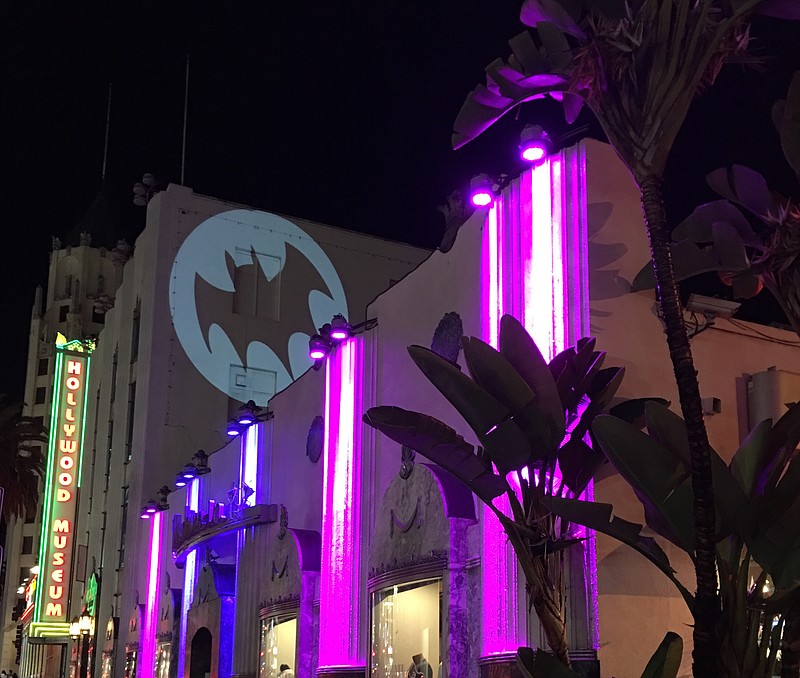
it resonated with the audience. Well, I want to thank you very much for taking some time to speak with me. And I got to go to the exhibit and it was so much fun, I have to say. Yeah, and like outside with the bat signal projected on the two of them on the building and the way they had lit it up. And the Hollywood Museum is a very special place with filmmaking. Well, and I was fortunate enough also to, after going to the exhibit, my friend knew where the Bronson Caves were. And so we made a little side trip out there and got to see those. Oh, that's great. Yeah.
And it's funny, at the time I filmed it, I didn't think too much of it. And yet, you know, practically in the opening of just about every show, whenever we leave the Batcave, they use that, and it's, oh my gosh, it's so famous. And there they had, speaking of that at the museum, they had that famous sign, that original sign, Gotham City, 14 miles. I mean, it was just, for me, so wonderful. And, you know, I was very touched. People that came there, the celebrities, the press, everybody was so loving, kind of like, you know, but we still have you, and we want you to know how much all of us grew up loving Batman and how much it means to us. I was very touched. I was very, very touched.
Well, I was six years old when the show came on, and I immediately fell in love with it, and I remember singing that Batman theme all the time. Yeah, well, it just changed. Oh, well, thank you. Yes, I mean, the music, every time I share on opening night, that meant in North America, which includes not just the United States, but Canada and Mexico, that 55% of all the televisions that were turned on at national stations, all those were sharing 45%. How this translates is, if you're watching on the TV, I had not seen it put together. Remember, as an actor, you're just doing little tiny pieces 30 seconds at a time. I didn't know about the music. I didn't know about the colors.
sound effects. I mean, it was involved, whether you were the person doing the sound effects or you were the person doing the optical, you know, zaps and powers, or you were the person writing the music to perform. Everybody did their best. After seeing the first finished episode where you got to see all those elements combined, did it change the way you were playing the character? Did you feel like more a sense of how your performance was going to play in kind of the bigger picture of the series? It didn't change how I portrayed Robin, but my performance and Adam's performance in the totality of the show. And it just, if anything, made Adam and I love the show more and realize.
Directors by that. Wardrobe people. I mean, everybody got it. You know what I mean? I don't know if ever there'll be another show like it, really. I will tell you, it's not only got what we did back in 1966, but it's updated to include references to the movies, which are a little darker, and it combines it in a way that is very... And this is now out on DVD and Blu-ray, and it's Batman versus Two-Face. So, you know, your viewers really, if they want great entertainment, it's very current. All right. Well, thank you very much. Well, thank you, citizen.
Atomic batteries to power, turbines to speed, to Batman 66 before it leaves. And if you want to extend the tour, check out Bronson Caves just a few miles away. It's the location for the Batcave, and you can get your geek on walking through. Hold on, hold on, I'm going into the Batcave. Da-da-da-da-da-da-da-da-da-da-da-da-da-da-da-da-da-da-da-da-da-da-da-da-da-da-da-da-da-da-da-da-da-da-da-da-da-da-da-da-da-da-da-da-da-da-da-da-da-da-da-da-da-da-da-da-da-da-da-da-da-da-da-da-da-da-da-da-da-da-da-da-da-da-da-da- Cinema Junkie will be back with new episodes in February. To get you through the month of January, I have two popular archive episodes picked out. The first one is going to be Real Science, where scientists talk about movies. And the second one is a focus on ace editors. When an editor does their best work, nobody notices. And nobody should notice, because like I said, the editing is that element which kind of invisibly strings it all together. And these are Oscar-nominated editors who can kind of get you in the mood for the Oscar nominations that'll be coming out later in January. So thanks for listening. Until our next film fix, I'm Beth Accomando, your resident cinema junkie.
KPBS On Demand is supported by San Diego County Toyota Dealers. The Toyota Tundra offers a full-size pickup capability with power of up to 437 horsepower and 583 pound-feet of torque. Visit your Toyota dealer or toyota.com. We make it easy.