
EPISODE · Dec 26, 2025 · 9 MIN
Honda’s Strategic Battery Ownership and the Market Shift toward Flexibility
from Breaking News To Trading Moves
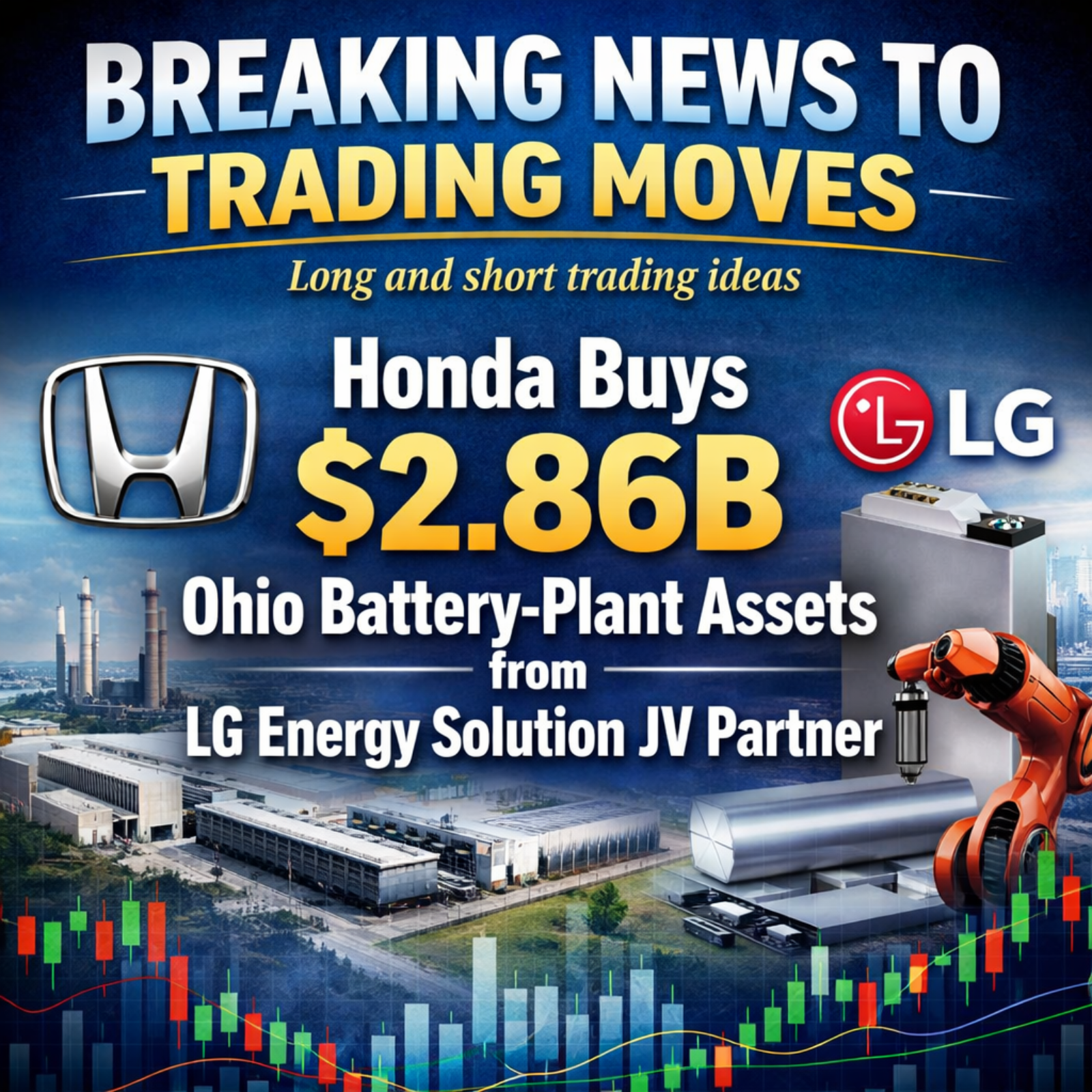
Honda buys $2.86B Ohio battery-plant assets from LG Energy Solution JV partnerWhat happened LG Energy Solution will sell a factory building and related assets at its Ohio battery joint-venture site to Honda’s US unit for about $2.86B. The deal excludes land and equipment, and LGES said the goal is to improve joint-venture operational efficiency. LGES is exiting the JV, and production is expected to begin next year. Why this matters for marketsOEMs taking more ownership of battery manufacturing footprints is a sign the supply chain is shifting: less “outsourced batteries,” more direct control over cost, flexibility, and ramp timing.The story also lands during an industry mood swing: slower EV demand and policy uncertainty are pressuring EV-only timelines, while hybrids and “flexible” powertrain strategies are getting priority. Winners -OEMs with flexible EV + hybrid strategies (battery control = optionality)Reason: If the market leans more hybrid near-term, OEMs with flexible production planning and secured battery assets can adjust mix without fully abandoning electrification.$HMC (Honda Motor ADR)$TM (Toyota Motor ADR)US battery materials and supply-chain beneficiaries (more domestic buildout still supports demand)Reason: Even if EV adoption is choppy, keeping big battery plants moving forward supports longer-cycle demand for lithium and related inputs.$ALB (Albemarle)$LAC (Lithium Americas)Factory electrification, automation, and power management (capex still flows into “making batteries”)Reason: Battery plants are power-hungry and automation-heavy. Ownership changes don’t stop the need for controls, electrical systems, and industrial automation—often it accelerates execution.$ETN (Eaton)$ROK (Rockwell Automation)Losers -EV-only automakers (soft EV demand = tougher funding + pricing environment)Reason: Reuters frames an “EV pullback” backdrop; when the market narrative shifts toward hybrids and slower EV adoption, EV-only names can face multiple compression and higher capital costs.$LCID (Lucid)$RIVN (Rivian)Public EV charging networks (hybrid tilt slows utilisation growth)Reason: If consumers delay full EV adoption, charging growth can lag expectations, pressuring already tight business models.$CHPT (ChargePoint)$EVGO (EVgo)Independent battery startups (OEMs internalising assets can squeeze suppliers)Reason: As OEMs move closer to controlling manufacturing assets and timelines, smaller battery developers may have less negotiating leverage and longer paths to meaningful scale.$SLDP (Solid Power)$FREY (FREYR Battery)That’s the tradeable takeaway: this isn’t just a one-off asset transaction - it’s another signal that the EV supply chain is reorganising around flexibility and direct control. If you’re tracking winners and losers, keep an eye on OEM flexibility, battery materials, and the “picks and shovels” industrials - while EV-only and charging names remain more headline-sensitive.#StockMarket #Trading #Investing #DayTrading #SwingTrading #EV #ElectricVehicles #Batteries #AutoStocks #Manufacturing #SupplyChain #EnergyTransition
Embed this episode
Ready to play
Honda’s Strategic Battery Ownership and the Market Shift toward Flexibility
No transcript for this episode yet
Similar Episodes
No similar episodes found.
Similar Podcasts
No similar podcasts found.