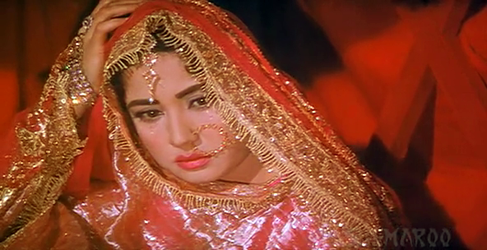
KPBS On Demand is supported by the San Diego County Toyota dealers. The Toyota Corolla is a compact sedan with a spacious interior, contemporary design, and features for everyday travel. Visit your local San Diego County Toyota dealer or Toyota.com. Toyota, we make it easy. There's nothing quite like a Bollywood film. It's about impossibly gorgeous stars, deliciously overripe melodrama, spectacular production numbers, an explosion of colors, and music with such an irresistible beat that even someone with two left feet feels inspired to get up and dance. Welcome back to another edition of listener-supported KPBS Cinema Junkie. I'm Beth Accomando. This month, in honor of Indian independence, I look to Bollywood cinema.
I adore Bollywood cinema and the unabashed way it embraces certain tropes and formulas. It delivers exactly what you expect, but in the most seductively over-the-top and wildly fun manner. Yeah, it's like a drug, and I just get high watching these movies. In order to tackle the huge expanse of Bollywood cinema, I decided to invite the trio of MovieWalla's podcasters onto the show. They've been on the air for more than 10 years and almost 500 episodes talking about movies and film festivals. So today, in part one of Hooray for Bollywood, they helped me define Bollywood cinema and its golden era. And then next time, in part two, we'll look to modern Bollywood films and offer a list of must-see movies.
But before we get to that discussion, I need to take a quick break. And I want to have Nora Fiore, aka the Nitrate Diva, take us into the break with the latest Share Your Addiction. Nora will be joining me in November for a podcast on film noir and femme fatales. I hope her passion for film and her unique addiction will whet your appetite for our discussion. So take it away, the Nitrate Diva.
Hi, I'm Nora Fiori. You may know me online as the Nitrate Diva, and one of my movie obsessions is recognizing recycled props, costumes, and set pieces in movies from Hollywood's golden age, particularly movies made at RKO and Warner Brothers. For instance, there's a distinctive iron staircase that's the centerpiece of the set in The Man Who Came to Dinner, but over the years, you can see it in The Big Sleep, Dark Passage, Highway 301, and any number of Warner Brothers films. There is a film called Journal of a Crime from 1934, where there's a beautiful black dress on a minor character with a glittery metal top, and I think, oh, I've seen that before, and then I realize, oh, Barbara Stanwyck wore it in Babyface the year before. In a film called Flying Leathernecks, at one point, a white...
is opening a telegram from her husband on the home front. She's in a beautiful white dressing gown with some little gold detailing on the collar. Weirdly enough, a femme fatale wore that dress a few years earlier in a film called Born to Kill. So there's a shared context between the two. Thanks, Nora. I'll be right back with the Movie Wallace crew to celebrate Bollywood cinema.
Here in Southern California, we know all too well the devastation wildfires can cause. That's why our mission is to stop the next one before it starts. I'm Brian D'Agostino, leader of SDG&E's wildfire and climate science team. And we've built one of the most advanced wildfire prevention programs in the country with a team of world-class meteorologists using artificial intelligence and real-time weather data, all to help keep our communities safe. We're also building a stronger grid and using public safety power shutoff when necessary, because believe me, I've seen firsthand how unpredictable wildfires can be. But here at SDG&E, we face that uncertainty head on to help keep you safe. Learn more at sdge.com slash wildfiresafety.
Welcome back. For this Bollywood edition of Cinema Junkie, I took a field trip to the Movie Walla's home studio. Let me introduce everyone here. We have Yazdi Pathalova. Hello, Beth. And Rashmi Gandhi. Hi, Beth. And Joseph Jan. Hey, Beth. Thank you all for joining me. So when I decided to do this podcast, I thought that getting together at your place would be great because you have four microphones and KPBS right now is closed down for the pandemic in part. I did not expect to come over to the house with incense burning and Bollywood music playing.
And even better, intermission food. So, Rashmi, what did you have prepared? Oh, my God. Well, Beth, you just gave me the perfect excuse to go and indulge. And so we had some samosas and we had what we call deli chaat and we had some chevra. So all little snacks that you can get in between the intermission. But I just remembered Yazdi describing the experience of being in an Indian cinema and wanted to kind of recreate that experience for you, Beth, for all of us.
to get us in the mood. Yeah, I mean, I grew up in India watching movies every Saturday. Every Saturday was a thing our family did. And, you know, as a kid, maybe I wasn't so interested in the movies, but I always look forward to the intermission because you would have these hot samosas and you would get two of them in a little paper, like a wax paper bag, and it would be all crinkly. And my parents would actually use that. If you were naughty, then you would say, you are not going to... And I've watched movies without getting samosas and my sister is eating them. So it was very good incentive. But yeah, you get samosas, you get popcorn, and you get chibras, you get peanuts. It's a whole thing. And, you know, when there's a huge rush and nobody in India knows anything about cues, you know, at least they did not when I was growing up.
up so there would be like 20 people on that stall like you know like like think of the world's busiest bar and they're all cloying and trying to get at things it was quite fun OK, well, this is perfect because the new Cinema Junkie is now doing some themed food YouTube videos to go with each podcast. So Rashmi has given me all sorts of inspiration for what we can do on these YouTube videos. So we are going to do some intermission food that you can watch these videos and learn how to make your own perfect little Bollywood evening. And, you know, we're doing Bollywood in August because, one, Bollywood is wonderful for summer, especially if you can have a little outdoor screening and have some food with that. It's also important because August is the month of Indian independence. So what does that mean in terms of the holiday that's celebrated?
It's August 15. It's India's independence from British rule. And it's great. You get a day off from school. And just like you're in Hollywood, a lot of the big budget blockbuster movies get released late June, early fall, around that time frame. So everybody looks forward to those releases. So we're going to talk about Bollywood cinema. And Bollywood, for those of you who don't know, it is playing off of Hollywood. And Bollywood cinema is huge. And it follows some similarities to Hollywood in terms of having big studios and stars and all this. But for each of you, what does Bollywood mean? And I'll start with you, Yazdi, because you were raised in India and you were at the heart of this.
Bombay on the west coast of India, now Mumbai, was and is the main center of filmmaking in India. And at one point, they had more film studios in Bombay than any other city in the world. I don't know if they still hold the record. For me, Bollywood is a package. It's something that you build your free day around. It's something of celebration. It's something you and your friends or you and your family goes. And it's not just that hour and a half. It's, you know, the whole preparation for it, sitting down together, talking at the screen, enjoying the intermission. Yeah, it's a whole big entertainment package. And so in my mind, Bollywood is that movie which creates that perfect entertainment package. It has, you know, music and color and preposterous things.
and there's comedy and action and a love interest and a sidekick comic. There's a whole package. Growing up in London and England, I feel like Bollywood to me always, I always think of family. It was a way for those people who are Indian at heart to remain connected to the motherland. And so our parents, it was definitely a time when we all went together, all watched on VHS growing up. Music, dancing, preposterous, unbelievable stories that are difficult to follow, where everyone is related to everyone. Reincarnation, mythical, stupid things happening, people hiding behind trees, but joyful always.
And your father was involved in a certain way with actual Bollywood film. He was. So he was actually a film distributor in London and England. And so we often had, you know, film reels lying in the house and the big Indian posters. And so on weekends, they would run the cinema. And so you would see the diaspora come out and enjoy being in touch with their motherland. The community would come together. So yeah, Bollywood was definitely a huge part of my life growing up. Unbeknownst to me, it was something that just happened. And I always describe my life as kind of Alice in Wonderland. I lived in a very Western culture outside. And when I opened the front door, I went down the rabbit hole.
And Joe, what does Bollywood mean to you? I didn't grow up with it, unlike Rashmi and Yazdi, so I think I had very much the cliché opinion of it for a long, long time. I think now, over the years, I've really come to appreciate it with knowing these guys, obviously being married to Rashmi. Movies like Shole, some of the old Indian classics, they blew up the whole image they had of these singing, dancing, over-the-top type of things. So yeah, it's still a really interesting category of cinema. I can't say I'm really into it, but there's so much more access to it now, so those movies are kind of entering my mind space in a way. So it doesn't have a specific connotation other than the cliché to me, but I mean, I love the films that come from there. So how did you seduce him into Bollywood cinema?
Sholeh. I think Sholeh is a great entry point for anyone who wants to understand what Bollywood is about. It's a mid-70s film. It's part of the kind of de coit genre of movie about... It has everything in it. It's a masala western is how we would describe it. So, yeah, I think Sholeh was the first... Look, I was trying to impress you. Okay, there you go. There you go. I was like, these films look terrible. But I'll sit down and sit and watch one with you. But they were great.
So what do you see are the defining qualities of a Bollywood movie? What do they look like? You know, are they packaged around stars? How would you kind of point out the things, the elements that have to be there to define a Bollywood film? It has to be a musical. There has to be musical numbers, although there have been, you know, in the last couple decades, good Bollywood movies without any music in them. But predominantly good musicals, they do have big action stars or big film stars in general. There's always been a very clan-like Indian cinema royalty, a dynasty, and, you know, their kids and kids have continued to be in cinema. Big name actors, a lot of music.
Usually what we call an item number, which is, you know, a song picturized on somebody who's not a main character in the movie, but they're just there to provide the glitz and the chhatka. Spice. Yeah, the spice to the whole movie. And for the longest time, Hollywood movies did have a formula. At the risk of sounding repetitive, it's this whole package. There's a little bit of fighting, you know, a little bit of action, a little bit of comedy. Oh, and it has to tug on your heartstrings. I mean, it's very manipulatively.
created to kind of tug at you and you know there's a lot of built-in morality which goes with a lot of Bollywood films like you know your mom comes before anything else you know your your greatest responsibility is to your parents and you know there's there's a lot of old-school morality which is tied with Bollywood films and frankly some of it has been damaging over the years but so be it it's that package. Yeah I feel like inherently they used to be about good versus evil there's always a really good guy and then there's a really bad guy forbidden love or unrequited love that adds angst. I feel like they were a good mechanism to overcome discussion about caste or wealth or gender. Gender not so much. Maybe now in recent years it's more about gender. But definitely this kind of caste or boy meets girl, boy and girl shouldn't be together and how they fight for their love. There was a lot of that. And when we use the term Bollywood cinema, this is not covering...
all the films that are made in India, there was a lot of this kind of international art house films that were starting to get popular like late 50s and definitely in the 60s. So how do you define kind of the difference between those kind of things? Or what other kind of cinema are you finding in India that is maybe overshadowed by the term Bollywood? There's always been alternative cinema, Indian cinema, I think as early as the 50s, 60s. And when I was growing up, there was no real difference between the two.
You knew that there was, you know, this big flashy movie which is coming on with the big names and big directors and so forth. And then there were smaller movies which kind of tackled more socialist ideals. They were kind of more neorealistic, if you will. I mean, Satyajit Ray's films, you know, they're almost... documentary like they were very quiet very subtle just just observing life around the camera wouldn't move too much but that was also part of cinema it never felt like outsider to me it just felt like something else yeah and i think inherently beth one of the things that strikes me about bollywood is ultimately it's about escapism you have a billion people in a subcontinent and then you know billions of people who are of indian origin outside of india all wanting to escape and connect and so i think bollywood movies represent this ability to just sink into another world and escape hence the big dance numbers and music and people dancing in the aisles even along with the song Yeah, not uncommon at all. Or people just literally jumping out of their seats and like, you know, clapping and, you know, while the song's screaming. And that's commonplace all the time.
You know, exactly to what Rashmi said, it's the great equalizer in India. You know, India has always had this caste system, the very rich and the very poor and whatever, but the typical Bollywood fare is made to kind of serve everyone. It kind of meets, you know, it crosses all those genres. And tickets are relatively cheap, so no matter whether you are very rich or very poor, you are able to get lost for a period of time. And that's why you get this whole package, because you're paying some amount of money and they want to put you in an air-conditioned cinema in the middle of sweltering heat and give you escapism for three hours. That's also the reason why I think the movies tend to be so long, because people want their money's worth. Plus you've got to fit in two reincarnations somewhere.
Yes, and at least one intermission. There were a couple movies which had two intermissions. They were so long. Oh, wow. Two lots of samosas. Yum. Yes. Miranam Joker and Sangam, there were two movies which came out in the 70s. They had two intermissions. Wow. Wow. Well, the way you describe that, it makes me think of Shakespeare in the sense of, you know, he had to please the rich people in the boxes and the groundlings on the floor, and he had to have humor that played low and humor that played high and, you know, really reach across all sorts of different social levels.
I need to take one more quick break, or you can call it an intermission, and then I'll be back with more Bollywood cinema history. And let's have Nora Fiori, the nitrate diva, take us into the break again, but this time with her cold turkey rant. Now, I'm not the kind of person who likes to tell other people what to do, but something that I've been trying to do less of late is buying films solely to stream them or renting them from platforms like Amazon. The temptation is always to want the instant gratification. I get that. In this internet age, we are so conditioned to want things at the click of a button. But increasingly, what I've been trying to be more intentional about doing is not just caving into my immediate need and buying it on a streaming platform, but rather to invest in the physical media, whether it be a Blu-ray or a DVD. All things being equal, veer towards buying the physical media because you're sending a message to the couple.
Thanks, Nora. I'll be right back with more of my interview with the Movie Wallace Podcasters. Here in Southern California, we know all too well the devastation wildfires can cause. That's why our mission is to stop the next one before it starts. I'm Brian D'Agostino, leader of SDG&E's wildfire and climate science team. And we've built one of the most advanced wildfire prevention programs in the country with a team of world-class meteorologists using artificial intelligence and real-time weather data, all to help keep our communities safe. We're also building a stronger grid and using public safety power shutoff when necessary, because believe me, I've seen firsthand how unpredictable wildfires can be. But here at SDG&E, we face that uncertainty head on to help keep you safe. Learn more at sdge.com slash wildfiresafety.
Okay, intermission's over. Hope you enjoyed some nice snacks and are ready for more discussion of Bollywood with the movie Wallace Crew. Let's get back to it. India was a British colony when films first began. So what was early Indian cinema like and when did the idea of Bollywood really come into play? So, you know, the first silent movie, as I think you mentioned, Yazzie, was Raja Harishchandra, which was in 1913. And I think most of those early films were very much based on, you know, the holy book, the Mahabharata epic battles, good versus evil. And I think once we get into the talkies, it changes things a little bit. You know, later on, we have...
Between the 30s and 40s, you've got the Great Depression, World War II, Indian Independence, Partition. These all create for a very rich tapestry of different types of movies. Bollywood, for me, the term Bollywood, I feel, comes around, you know, the 40s to 60s maybe, a little bit later when you've got those established studios that Yazdi was talking about and established names in cinema like the Gurudats, the Raj Kapoor's, and then a whole host of films that come out of that era. You know, during the time that India was going through its battle to kind of get independence from British colonialism, film actually played a very, very big role in terms of kind of putting forth these patriotic ideals. I don't think the fact that India was colonized by the British directly resulted in the Britishization, if you will, of Indian cinema. Indian cinema remained always very Indian, and they were always built around Indian mores and, you know, Indian sensibility. And so, if anything, they kind of helped create this social change within the country, a sense of, you know, we need to be independent and get out of it. So I think from that perspective, it helped out.
And now we tend to use Bollywood as kind of this umbrella blanket term, but India is an incredibly diverse country. There's not one language spoken. So when we say Bollywood, does that reflect this kind of style of filmmaking that appeals across the country? It depends on who you ask. I grew up in Bombay. And so for me, Bollywood was primarily Hindi cinemas, which is the national language of India. But, you know, over the years, there has been Tollywood, which is Tamil Bollywood. And, you know, there's...
at least for the last, I want to say, three or four decades, there has been regional cinema, alive and well, you know, Tamilian movies, Malayalam movies, Marathi movies, Gujarati movies, all of these. And they have their own little infrastructure. And what do you consider the golden age of Bollywood cinema? I mean, for me, it's the 60s and 70s, I would say, because that's really when I recognized my parents obviously loved that era. And so those were the movies that were playing a lot of the time. And I think that golden age continued right through from, you know, the 60s through the early 80s. And then there was a...
complete change with the event of vhs i would say and vhs changed everything but definitely the 60s and 70s early 80s for me yeah definitely i think two things which kind of overlap with each other i think in terms of craft you know things got to be really really sharp and just all the craft pieces came together, you know, in those starting the late 60s or so forth. So just gorgeous cinematography, great sound, great dance and technicolor came about and 70mm screens came around. So, you know, the filmmakers just had this completely wider, bigger palette to play on. And that combined with some really good, you know, writing at that time resulted in, I think, you know, the golden age in the 60s and 70s. And a lot of those movies, they hold up remarkably well, both in terms of visual splendor, as well as the economy with which a very complicated story is told. And the musicality is just incredible. I mean, that was the music I was playing when you came in, just because it's so enjoyable and it's just in our...
psyche and i think i told you the anecdote of many of those sort of like the rock and roll era i would often hear my dad singing in the kitchen and if he and my mom had argued he would sing to her um which was both strange and cute and i think cute now i look back but weird at the time We heard the music all the time. So I think that's what resonates with me. Yeah, and during those decades, what you would hear on radio would be primarily, you know, Hindi movie songs. So it really became part of your bloodstream. That's what you were hearing in the background, you know, when you go to a store or when you're in a public transportation system. Indian television at that time was just starting to pick up as well. And the most popular television show used to be on Thursday evenings. It was a half hour show where it was like a review of songs from different movies.
And I've spent many a Thursday evening like, oh, I wish it's a song from a movie I like. And then it would be some random thing. And you would kind of wait for the next song to come along. So movies were just so inextricably tied into the culture of the people there. I can't think of life without movies. And I can't think of life for any other Indian without movies.
Yeah, I was going to say, yes, you just reminded me, the fashion. I often remember my mother telling me that they would see some famous actress like Sharmila Tagore in the 60s from the films like Thysri Manzil, Brahmchari, and they would look at what they were wearing and then they would actually imitate those, what we call salwar kami's. It would set the fashion trends. They would literally watch the movies and then imitate the clothing. So looking like the Beatles or Elvis Presley, my uncles would often have them tailor their shirts tighter.
To look like that. Now, for American audiences, a lot of people are familiar with like the old MGM musicals and the way those production numbers were. So is there a similarity between kind of the way the Bollywood musicals were and those kind of old Hollywood? Or is there something like very specific to the way these Bollywood numbers are? Because they just I know I'd spoken to one person and he explained to him, he said watching a Bollywood musical number was like seeing a Skittles factory explode. But do you feel like there's some unique quality to the Bollywood musical that's very different from what Americans might be familiar with?
I think for me it's always been one thing, which is how unironic it is. It has some commonality with the early musicals from Hollywood, but I think the musical numbers are always unironic. They are doing ridiculous things. They're jumping like jackasses, but they don't feel any shame for it. It's just so joyous.
You want the camera to be all over the place. You want the most elaborate dance steps. I mean, I do believe that the best choreography right now, the best choreographers when it comes to musical numbers is in India. Forget being a big name actor in India. It's to be, you know, an extra in a dance number is something to aspire to because you have to be exceptionally well-trained to be able to perform those dance moves. Yeah, it's interesting you say that, Yazdi. We were just watching In the Heights, which has these terrific big group numbers. And I just kept thinking, Bollywood does it better. And they've been doing it for longer. I think what music does is it's the part of the movie that you take away from you and you get to relive that great movie, that great number.
as many times as you want outside of the movie. We all listen to that music in our homes. At weddings, at birthdays, we dance to that music. They'll choreograph big dance numbers and put them on for the family. These are just things that live within us. I like how you described it, Yati. They're just in our bloodstream. And that's what I think the music does. They're so transportive. They transport you to another place. And the other thing also is that...
they've always been very good in terms of recognizing who has contributed to that number. So even when a song would play on radio, before the song comes on, they would say not just who the person is who's singing it, but they would say, and this person was the music director, this person, you know, wrote the lyrics. So, you know, Salim Javed, Gulzar, all these, you know, lyricists became household names. I mean, we grew up with them. So it wasn't that all the credit just went to the director of that movie. You know, even the writers and the person who composed the music, they became household names and equal celebrities, I would say.
Yeah, big music directors. Everyone knows who R.D. Berman is or Opinaya. Any number of them, yeah. Talk about the scale of Indian cinema. It's been referred to as the largest producer of films in the world and the second oldest film industry in the world. Is that still true? Is it still huge?
I believe it is. I don't know how the pandemic has affected things, but certainly pre-pandemic, I think, you know, India was making somewhere like 2000 movies, you know, a year, which is when you think about it, that's like almost eight to nine new movies released every day. And just like, yeah, the movies would get released on a Friday, but there would be like usually, you know, so many movies being released on that Friday and there's always a battle to see which one comes ahead. I think that number also includes, like I said, a lot of regional movies, which would only probably play in that particular area of the country. It's a big thriving business. And I think even now in the age of Netflix and Amazon Prime and so forth, Indian cinema stumbled a little bit, but they have completely picked up their step.
as much content now for the streaming services as they used to for anything which is going to be screened on a cinema screen. So for you, what are some of the standout films of this golden era? Are there any landmark moments? I mean, films that really, I mean, I'm sure with 2,000 films a year coming out sometimes, it's going to be hard to narrow it down to a few. But are there some real standout moments that you want to highlight?
That is a question you can ask every person in India and they'll give you a different answer. And a list as long as their arm. Yes. And then you will immediately regret it five minutes later. Like, oh, crap, I didn't mention this one or that one. I think if there was one movie which towers over any other movie ever made in Indian cinema, it's Shole. I was going to say. So it's, you know, Shole played consecutively for something like 15 years, 20 years in the same theater.
There's this other movie called Dilwali Dulanya Le Jayenge, which has the record now of being playing in the same theatre for 25 years, something ridiculous like that. It's in Bombay. It only plays 11 a.m. morning show, but it's been playing forever because it's so beloved. It almost withstands fashion and time and fat and people just keep going to see that movie again and again. For me, I have a soft spot for movies like Deewar and a movie like Kalapathar or Amarakpar Anthony. So these were very pulpy. Early 80s. Early 80s. Very pulpy, very musical, very over-the-top movies which were made and I don't know if anybody will ever match.
that the high entertainment quotient on that. I mean, you know, Amar Akbar Anthony is about three brothers are separated at birth and one grows up as a Christian, one grows up as a Hindu, one grows up as a Muslim and they all have their love interests and then bad guys come around and then somebody has an accident and they need blood and the two other brothers give him blood and everybody's crying and it's just, you can't make this stuff up. And the music is excellent. I mean, we could probably hum you a tune right now. Yeah, so I have a soft spot for those late 70s pot boilers. And for me, again, it's slightly earlier. My favourite movie of all time, probably, other than Sholeh, is Pakiza. It means pure of heart.
It has some of the best music that just holds up now. It's about a love affair or an unrequited love between a courtesan and a young man. And it's a really weird story. It's kind of like Pretty Woman, the 1960s version. It took something like 20 years to make, I think. And it transcends religion and boundaries and the whole idea of the courtesan and what it is and just how we accept things in Indian cinema. It's just such a weird story when I try and say it out to you now. But for some reason, I watched that movie every day for three years when I came home from school. Very strange. But I love that movie.
All right. For those of you listening, we are going to put a list and they can make them as long as they want on the website. So at KPBS.org slash Cinema Junkie, we will list these films so you can seek them out. Thank you all very much for tackling and trying to condense. I know this was very difficult. A discussion of classic Bollywood cinema. Thank you. Thank you. Thank you.
That wraps another edition of KPBS listener-supported Cinema Junkie. Remember to check out the new Geeky Gourmet video, where I'll show you how to make Bollywood popcorn for your intermission snack. Okay, so to enhance the flavor of these spices, especially since we used whole cumin and whole fennel seed, it's really nice to heat them up in a pan. So you're going to just toast them. Once you start smelling them and it smells really fragrant, that's when you know you've kind of toasted them to the right degree. You can find the video at kpbs.org slash cinema junkie. In the spirit of Bollywood, I'd like to sing the praises of the team that makes Cinema Junkie happen, podcast coordinator Kinsey Moreland.
technical director Rebecca Chacon, and director of sound design Emily Jankowski. And thanks to cameraman Roland Lizarondo, who shoots the geeky gourmet videos. Coming up next, the Mubiwala's crew returns to talk about today's Bollywood cinema and to suggest some must-see titles from what can be an intimidatingly massive catalog of films. So make sure to tune in for Hooray for Bollywood, Part 2. Till our next film fix, I'm Beth Accomando, your resident cinema junkie.
Here in Southern California, we know all too well the devastation wildfires can cause. That's why our mission is to stop the next one before it starts. I'm Brian D'Agostino, leader of SDG&E's wildfire and climate science team. And we've built one of the most advanced wildfire prevention programs in the country with a team of world-class meteorologists using artificial intelligence and real-time weather data, all to help keep our communities safe. We're also building a stronger grid and using public safety power shutoff when necessary, because believe me, I've seen firsthand how unpredictable wildfires can be. But here at SDG&E, we face that uncertainty head on to help keep you safe. Learn more at sdge.com slash wildfiresafety.