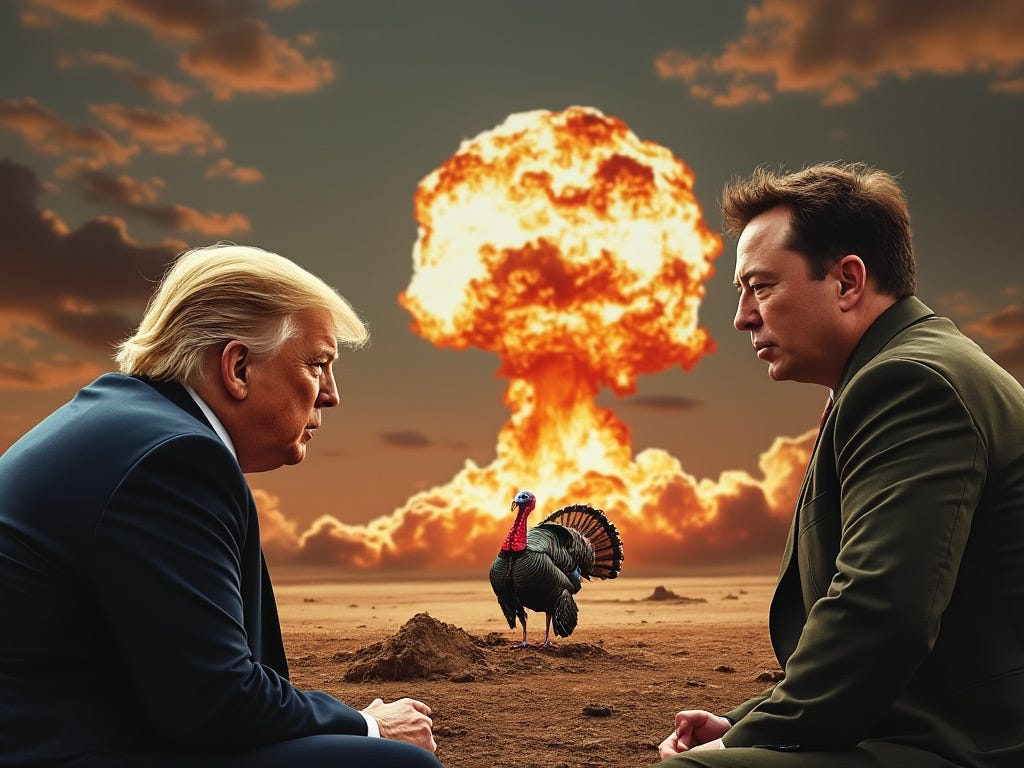
Hopium to Copium
from The Duke Report Podcast Hosted by The Duke Report™️
GPT-Video Summary Introduction 🎯 The Central Theme: Epistemological Warfare “Hopium to Copium” delves into the nuanced and pervasive strategies of epistemological warfare, highlighting how perception and information manipulation are weaponized to maintain control over societies. Through historical and modern examples, it dissects how psychological warfare has evolved from overt tactics to sophisticated, covert methods. Thanks to my readers’ generosity, all my articles are free to access. Independent journalism, however, requires time and investment. If you found value in this article or any others, please consider sharing or even becoming a paid subscriber, who benefits by joining the conversation in the comments. I want you to know that your support is always gratefully received and will never be forgotten. Please buy me a coffee or as many as you wish. Summary 🛠️ Mind War vs. Fifth-Generation Warfare The content juxtaposes “Mind War,” a centralized, overt strategy that dominates perception, with fifth-generation warfare, characterized by decentralization, covert methods, and psychological operations. “Mind War,” rooted in military doctrines like Michael Aquino’s work, relies on total environmental control. Fifth-generation warfare thrives in ambiguity, using misinformation and indirect influence to obscure the source of manipulation. Key overlaps reveal how both strategies are ultimately tools for control but differ in their operational mechanisms. While “Mind War” projects overt power through narrative dominance, fifth-generation warfare employs covert actors to infiltrate public consciousness. 🧠 Role of Neuro-Linguistic Programming (NLP) NLP emerges as a practical countermeasure against manipulative tactics. By reframing language and challenging ambiguous or abstract terms (e.g., nominalizations), NLP equips individuals to engage critically with information. The Thanksgiving setting is used as an example, illustrating how NLP techniques can transform personal interactions into opportunities for fostering understanding and critical thought. 📜 Historical and Modern Contexts Epistemological warfare is traced back to historical examples, such as the Venetian Party’s influence on England, which transitioned into the British Empire and later the Anglo-American regime. The Revolutionary War is discussed as a “bump” in a larger narrative of control. These historical strategies are paralleled with modern tactics like digital botnets, misinformation campaigns, and algorithm-driven manipulation, exemplified by entities like Cambridge Analytica. 🏛️ Key Figures and Organizations The content highlights significant contributors, such as Michael Aquino, General Michael Flynn, Curtis Yarvin, and Anton Chaykin. Aquino’s “Mind War” strategies provide the framework for centralized psychological warfare, while Flynn’s emphasis on fifth-generation warfare underscores the evolution towards decentralized tactics. Yarvin and Chaykin offer contrasting historical and political analyses, with Yarvin focusing on constitutional strategies for change and Chaykin dissecting the Anglo-American regime. Organizations such as the Pentagon, World Economic Forum, Cambridge Analytica, and the Bilderberg Group are positioned as major actors in the realm of epistemological and psychological warfare. Each plays a role in either implementing or challenging these frameworks of control. 🌐 Practical Implications The discussion underscores the erosion of critical thinking in education and media, advocating for individual efforts to rebuild analytical skills. It critiques the oversaturation of manipulated narratives in public discourse, urging individuals to recognize and resist these tactics through critical engagement and informed dialogue. 🗓️ Timeline Highlights The timeline spans from the introduction of “Mind War” in the 1980s to the contemporary application of fifth-generation warfare. Key milestones include Cambridge Analytica’s role in the 2015 elections and the growing influence of digital manipulation technologies. Thanksgiving is framed as a modern context for practicing NLP techniques and applying critical thinking in everyday scenarios. 🤝 Ethical Considerations The ethical implications of these strategies are explored, with concerns about overreach, loss of autonomy, and lack of transparency. “Mind War” raises alarms about neuro-weaponization, while fifth-generation warfare’s covert nature challenges accountability. 🚀 Conclusion “Hopium to Copium” serves as a wake-up call to recognize and counteract the pervasive influence of psychological and informational warfare. By understanding the historical roots and modern applications of these strategies, individuals can develop the critical thinking tools necessary to navigate and resist manipulative narratives in an increasingly complex information landscape. The Duke Report is a reader-supported publication. To receive new posts and support my work, consider becoming a free or paid subscriber. FAQ Q: What is the central focus of the video content?The content focuses on the concept of epistemological warfare, the strategies of “Mind War” versus fifth-generation warfare, and practical applications of critical thinking and Neuro-Linguistic Programming (NLP). These themes are explored through historical and modern lenses to highlight how the manipulation of perception affects societies. Q: How does the content define ‘Mind War’ and ‘Fifth-Generation Warfare’?Mind War is a centralized strategy aimed at dominating perceptions and constructing controlled realities. It relies on overt narratives projecting power and success. Fifth-generation warfare is decentralized and covert, employing psychological operations, misinformation, and indirect influence to obscure the identities of the actors. Q: What role does Neuro-Linguistic Programming (NLP) play in the discussion?NLP is presented as a tool to enhance communication, challenge manipulative language, and foster critical thinking. It is discussed in the context of interpersonal interactions, such as Thanksgiving gatherings, to practice reframing conversations and improving dialogue. Q: What examples of influence operations are provided?The text details examples such as the embedding of journalists during military operations, the use of digital algorithms to shape public opinion, and the deployment of botnets and fake accounts to amplify or diminish narratives. Q: Who are some of the key figures discussed in the content?Key figures include Michael Aquino, associated with the development of Mind War; General Michael Flynn, who discusses fifth-generation warfare; Curtis Yarvin, who contributes to political theory; and Anton Chaykin, who explores historical and political dynamics. Q: What historical contexts are used to explain the evolution of information warfare?The content references the strategies of the Venetians, the transition of England to Great Britain, and the subsequent development of the Anglo-American regime. It also touches on modern military and psychological tactics rooted in these historical developments. Q: How does the content address the current media and educational environment?The content critiques the control of education and media, emphasizing their roles in reducing critical thinking skills and oversaturating the public with controlled narratives. It calls for individual efforts to cultivate critical thought as a countermeasure. Q: What ethical implications are associated with Mind War and fifth-generation warfare?Mind War raises concerns about over-control of populations and the ethical boundaries of using neuro-weapons. Fifth-generation warfare highlights issues of transparency and accountability, exploiting societal vulnerabilities through covert means. Q: What significance does Thanksgiving have in the discussion?Thanksgiving is used as a practical example of how NLP techniques can be applied to real-life situations, transforming potentially mundane or frustrating conversations into opportun… This is a public episode. If you'd like to discuss this with other subscribers or get access to bonus episodes, visit thedukereport.substack.com/subscribe
Embed this episode
No transcript yet.