KPBS On Demand is supported by UC San Diego's Art Power. Presenting Grammy-winning ensemble, the Clasmatics, and their Happy Joyous Hanukkah program featuring lyrics by Woody Guthrie. December 3rd at UC San Diego. Tickets at artpower.ucsd.edu. Welcome back to another edition of the KPBS Cinema Junkie Podcast. I'm Beth Accomando. Horror is something primal, and it goes back to people around a campfire telling a good tale about what lurked in the darkness just beyond the fire's light. John Carpenter reminds us of this with the opening of The Fog, as John Hausman holds his young campers wrapped with a story told in the glow of a fire on the beach. 1155.
Almost midnight. Enough time for one more story. One more story before twelve to keep us warm. In five minutes, it'll be the 21st of April. A hundred years ago, on the 21st of April, in the waters around Spivey Point, a small clipper ship drew toward land. Suddenly, out of the night, the fog rolled in.
Whether it's fog rolling in or a dark and stormy night, horror cinema can trace its roots back to literature. Mary Shelley's Frankenstein and Bram Stoker's Dracula inspired some of the earliest works of the genre. So for this podcast, I'm going to focus on the connection between horror literature and horror cinema. And I'm going to do this with the help of some people from Horrible Imaginings Film Festival, which took place last month. I'll speak with horror author Cody Goodfellow, as well as horror author and filmmaker John Skip. Plus, I have an interview with writer-director Billy Hansen, whose adaptation of Stephen King's Survivor Type won the author's seal of approval.
I'll end the podcast with some campfire readings by horror authors of their works at Horrible Imaginings Film Festival. First, let's hear from festival director Miguel Rodriguez about why he wanted to have a horror literature component at his film festival. I am of the belief that storytelling is connected and horror cinema from its inception had its roots in literature. You know, if you think about some of the first big horror films like Frankenstein and Dracula, definitely had gothic literature roots. It's all just a part of the big umbrella of telling stories to each other. So yes, I wanted to include literature. I've always wanted to, but this is the first year that I've...
been able to do it in a really integral way. David Agronoff, a San Diego-based horror author, programmed the literature components of the festival. He explains what some of his goals were. Well, we're really wanting to show how the roots of horror cinema are in the literature. And also we want to show people that may be horror fans who traditionally just watch the movies, that there is a wide range of horror literature out there to be read that is equally exciting. Somebody who maybe for years has loved The Exorcist might not really be aware that William Peter Blatty wrote it as a novel first. You know, a horror movie lasts two hours, but a horror novel can be a journey or an experience over a couple days where you really get into the psyche of characters and can really explore issues.
We're really hoping to show the wonder and joy that can be found in horror literature. When you read a great horror novel, the author is taking you on a tour of suspenseful moments, and they're really taking your hand and walking you through it. Any piece of horror, whether it's film or book, requires the reader, the viewer, to put themselves into the position of the characters. And a horror novel can really, really put you in the seat right there with the people going through the experience. And what's really great about Horrible Imaginings...
Fest having authors is that this is a chance for the creators of these works of horror literature to be in your space one-on-one. You get a chance to get their books signed and really have a tactile experience with a horror novel, not just the films. Here's a short excerpt from the Horror Literature Panel at Horrible Imaginings Film Festival. Agronoff poses the question, and the authors responding are Brian Evanson, followed by Cody Goodfellow, author-filmmaker John Skip, and ends with Laura Lee Barr. I want to talk about, because this is a film fest, and we've had several adaptations, including with Incessary Stirs, based on Jerry Robert Johnson's awesome short story, Survivor Type, based on Stephen King's classic, and these films provided two of the most horrific moments that I've seen in this festival so far, and they're both stories that I had read before seeing them, and they still affected me, and I want to just maybe dive into the idea of just how can horror literature reach out and provide a scare in a way that cinema may be limited on, and it's great because we have filmmakers.
and writers at the same time here. So just if we could go down the line and talk about the differences. One of the great things about film is it does give you things visually. One of the things that's great about fiction is it puts you in a position where you have to kind of imagine what's going on and you create the visuals yourself. So you can kind of bring the reader in in a very different way in terms of kind of creating the experience. Whereas with film, it's always going to feel at least partly outside of you when you're writing a book. Everyone has a slightly different experience of it and kind of fills the book out in some way. So I guess for me, that's one of the big differences.
Yeah, the biggest difference is that the writer goes in alone, and the reader comes in alone, and they meet in some sort of naturalist middle ground, and the reader will interpret and build out those words into their own satisfaction, using their own aesthetic and their own experience and their own willingness to look. And so if you're going to make something in writing really, really frightening, something like survivor type, you can dwell on making every last little splurt very, very inevitable so that the reader has to crawl over all of the forensic detail and then just lose all the magic. You actually find a way to make that situation boring. You have to make the situation itself really come to life so that the reader's mind goes off doing it themselves. It's not a question of, will I go there and show them the thing, or will I restrain myself? Because Stephen King's survivor type is fantastic in the way it suggests it just finds just the last little bit, because he's telling you his own story. So he's got to be writing this down, and so it's going to have the inevitable, ah!
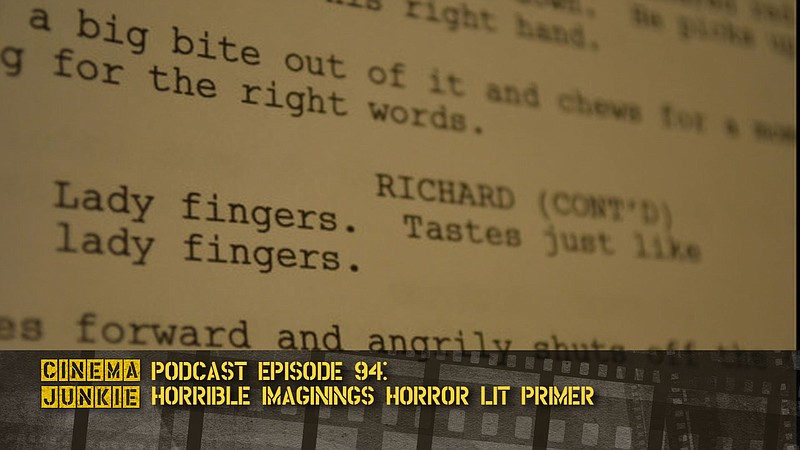
Lady fingers. But you have to make it right in a conceptual way so that the reader internalizes and does it to themselves. And then you can make the thing really work. I remember reading Survivor Type in middle school and thinking it was a really ditch and gnarly rad story. And he'll tell on me if I don't admit it. Shut up. I saw Survivor Type a couple years ago at a moment, and it doesn't even show you everything. But it puts you right there, and it doesn't allow you to flinch away. It makes you hear everything, and thus it makes you, it causes you, it manages to have it both ways. It manages to show it and not show it so that you're doing it.
yourself the way that the book does it, but it's also denying you the ability to look away. When Caesarea Serves forces you to look at every worst last little spurt that Jeremy's story still somehow manages to let you shilly-shally around. And it forces you, yeah, no, you've got to remember, he did take it out. And all of these other things. And it leaves you no way to get by it in words. And so words, you can make it as extravagant and as graphic as you want to with the reader. And so it's more of a collaborative experience. And it also implicates the reader in what they're reading.
I always blame the reader for what they're reading. Wow, okay, so this is tricky. I'm a guy who does both. And I was writing fiction long before I started making films. But I always tried to write fiction that was very immediate, that you were in the middle of. It was kind of a you-are-there experience. And also very visual and very kind of momentum-based. So a lot of people thought that I was a cinematic writer. And then it wasn't that much of a surprise that I wound up actually doing that kind of stuff. The thing about movies, like music, is that they go into your head before you have a chance to grapple with it. You're already feeling it before you've had a chance to think about it.
Whereas books, you go in thinking about it. You're going in eyes first, not the way you appreciate visuals, but you're going in following a text and letting this person guide you through their brainscape. So I think that they're both really, really fascinating ways to work. I think that making movies is harder than writing books, but only if you have to write them first because you still have to make it up. As Ross said, you don't need a budget to write a story. I can blow up the world like 30 times. What was the old line? It cost Stephen King $25 to write The Shining and cost Kubrick $25 million in 1970-something to shoot it. And yeah, I guess the money was mostly typewriter ribbons and paper, maybe whiteout. So I mean, that's huge. But really, what's amazing is taking the things that you imagine and then having to physicalize them and get everybody to agree to show up and do them with you. And that's pretty amazing stuff.
I think they're very, very, very different mediums. Some books that are really great, I don't think necessarily make great movies and vice versa, but one, since you brought up The Shining, I think that that's a really interesting comparison because the movie The Shining is, of course, very, very different from the book, and I think they're both very successful in what they do in their different mediums. The movie The Shining does visually what some of the emotion is behind the book The Shining, but it's a very, The Shining, the book really gets you into the psychology, and it's a very different experience, whereas I feel the movie's more of an operatic. experience and you're looking at something for a movie it's two hours three and a half if you know somebody you can maybe get away with that so you're taking it you're condensing it down you're making it into a certain amount of time so it's very different and i think that thinking about if you're going to do a translation from one to the other how they translate is an important thing i haven't told them how we bonded understand Two of the best films at this year's Horrible Imaginings Film Festival were adaptations of literature. Jeremy Robert Johnson's One Cessarist Stirs and Stephen King's Survivor Type. I spoke with filmmaker Billy Hansen about how one goes about successfully translating a work of literature to the screen. My name's Richard Pine. I was on a cruise ship called the Calus on a trip from Saigon to New York. The ship sank two days ago. There's nobody else here.
Hansen adapted King's Survivor Type, which screened at the festival as part of a special Cannibals panel. If you've read the story, then that's not giving anything away. But here's Hansen with a relatively spoiler-free description of the plot. I would say for anyone who has read the story, it's pretty faithful, so they're going to know what's coming. But for anyone that hasn't read it, I would say it is a psychological thriller. Very suspenseful, very graphic, and a tale of survival. And it's a sort of one-man tour de force the whole time. I guess people will want to hear what happened firsthand. I guess...
Welcome to Pine Island. Kind of the setup for this is there's a guy on a rock of an island, not a big island by any means, and he has a camcorder, so he's kind of doing this video journal. So working with that kind of a limitation, what were you thinking going into it about how you wanted to use that? We have a lot of found footage films, so how did you want to kind of either play into that genre or play away from it? That took me a long time to decide to really nail down what we wanted to do in terms of style and tone, because I think found footage movies, they provide a really great opportunity for some...
immersive storytelling, but what I see in most of the found footage movies I've seen, it's just sort of limiting, and the movies feel kind of constrained by the format. But the reason that I gravitated toward that was because the short story is actually written as a journal. So it made sense to sort of make the movie as a video journal. But that being said, we didn't want to be tied down by that style, so we have a score, you know, we have some jump cuts in there, and so we were a little fast and loose with that format. And I think finding the balance between the found footage feel and a big cinematic experience, I think we landed kind of...
between those two. Well, I think audiences are willing to make a leap also. So I think you're very faithful to what he can do with the camera in the initial goings. And then as the film proceeds, you kind of do some cheats in terms of how you can edit it or how you can use, you know, where the camera is and what he's doing. Yeah, absolutely. And when I didn't really want to be tied to one of the takes, you know, because these scenes were there's some pretty hefty dialogue scenes that, you know, run a minute, two minutes. And if you're not able to sort of chop those up and really make some and really.
control the pacing of it, it can get drab very, very quickly. The actor, Gideon Emery, he'd given such a great performance that it would be sort of a shame if it felt slow and felt like it was dragging because it wasn't moving. So when we got into editing, we said, all right, well, we're just going to have some junk us because we're going to want to go, we're going to want to use pieces from different takes and we really want to build his performance in a traditional way, even though we kind of shot the movie in a non-traditional way. This is adapted from a Stephen King story. So talk about the difference of what...
like what the written word can create in terms of horror and what the visual image can, and then how you worked creating that adaptation. Sure. Actually, this is kind of a different case, too, because it's written as a journal. It's all sort of his dialogue. And because we shot it in the same way as a video journal, a lot of that text actually came through. So we were able to capture Stephen King's written word pretty directly for a lot of it. That being said, the story as it's written ends in a way that sort of leaves you hanging. And so you're left with a lot of questions. And that didn't really work for me when we were doing the adaptation. So I...
The only real thing that I changed is that I reworked the ending a little bit. And that specifically is because in the context of a film, if you're watching a film, you're just getting the information differently. And rather than not answering those questions and leaving that to an audience to decide, it sort of felt like we were cheating them a little bit. So I reworked the ending to a way that felt satisfying to a movie-going audience. But the story itself, the Stephen King short story, is satisfying in a very different way. So I think that's the biggest difference between when you read it and when you watch it.
I guess that was one of the things to consider. Well, the other thing is when you're reading something, everything's really left to your imagination in terms of creating the details. With film, you have a choice of showing something that's graphic or kind of leaving it off screen. So when you were faced with some of these challenges, because there is some graphic elements, when you were faced with this, what was feeding into your decision in terms of when you wanted to show something, when you wanted something to be off screen, and how that affects the audience? That was one of the first conversations that we had, too, with the producers. We said, if we're going to do this story, we need to...
We need to do it. I mean, if we're promising a found footage, without giving too much away, there's a very, very big scene, an amputation scene, and that is sort of a highlight in the story, and that's where the story really goes over the edge, and it's all downhill from there pretty much. But we were talking, and we said, if we're going to do this movie, we need to show the amputation scene from beginning to end. We need to really put people there and make people feel like it's happening because the second that the camera gets bumped and we don't see it or the video distorts or something like that to cover it, people are out, and that's really going to take it away. So we really just went for it and we said, okay, we proceeded knowing that we were going to do this super ambitious, you know, beginning to end amputation scene. Yeah, that was intense. But after that, it's sort of, and that's right about the middle of the movie. So after that, it was, we could show a little bit less because we had already sort of put people in there and made them realize that it's happening, you know. And I think that is, once you're that immersed in it, then you can show a little bit less. So I think usually people would build a movie like this where you show a little bit, you show a little bit more, you show a little bit more, and then your last.
gag is sort of the big, nasty, gross one, but we went the opposite way. And the last thing you see, which is still horrifying, it's off camera. And it's all sound and sort of hinted at, but it's still really effective because you've already seen some really gnarly stuff before that. When you were at the screening doing the Q&A, you talked about finding the right person to do the special effects. Yeah, we met with a few people. I reached out to pretty much all my friends because the same way that we took our time in casting, we said, all right, the next big thing is we need a makeup person because we have so many effects, and we knew it was a big job. So we met this guy named Doug Murphy, and he was so excited about it. And he was the first person to be really excited about the amount of work and the challenges rather than overwhelmed by it. So we said, okay, well, you're on board. And then we immediately started talking. I think...
The day after we cast Gideon Emery, he was in the studio with Doug Murphy, and they were doing the molds of his leg and his head and all this stuff. Yeah, Doug brought this great team of people, and they had a huge document that just laid out every step of his descent. And they had stages of sunburns on his skin and stages of teeth rotting. And so as we were going through, they just did an amazing job of tracking all that, and it really comes through in the movie. Here at Miguel's Festival, there has been a focus on horror writing. There was a horror literature panel. So there's...
A lot of writers here. You have a film that was adapted from a story. And a number of the authors I heard talking about your film were really impressed by how you had brought it to the screen. So how does that feel to have authors kind of feel like you've done justice to the written word? And you actually even showed it to Stephen King. I did, yeah. I mean, it's so rewarding to hear people who have read the story and like the movie. And it's rewarding to know that writers are recognizing it as good, I guess. You know, the writers are really liking it because more than a filmmaker, more than even a screenwriter or anything, I consider myself a storyteller and a big part of...
anything I do, I will spend a lot of time writing it to make sure that it's crafted well, to make sure the character arcs and all the dynamics and all of that is there before going into production with something. So to hear writers appreciating it really makes me feel a little warm and fuzzy inside because I spent a lot of time, especially with this one, on the adaptation and working in theme and all that stuff. So hearing writers talk about it is fantastic. Although I missed the literary panel when they were talking about it, I was so bummed. But everyone told me about it afterwards. And as for Stephen King seeing it, that maybe was one of the most rewarding things of my life because I've been a Stephen King fan forever.
short version of the story is there was a situation that arose where he needed to approve the movie for a screening. So I sent it to him and I didn't hear back for a couple of weeks and I was panicking and I was sweating all the time and he came back and said he loved it and approved it for the screening and that was a nice feeling to get that just hard and fast approval, you know what I mean? What is it about the horror genre that you like in terms of working in it? I think it's so affecting on an audience and I think that's why a lot of storytellers really gravitate toward it because an audience is engaged with horror in a very different way than a lot of stuff. In the case of Survivor Type, it's so dark and so graphic and sort of twisted and disturbing that we had to make sure that if people were engaged, they were going to have to have release valves throughout. So we have little jokes throughout, and King has it in the story too. What I noticed the first time we screened it is that those jokes kill. I did not expect like uproarious laughter, but I think that people are so involved and engrossed in the story that when there's anything funny, they're just so uncomfortable that they laugh so much.
I've never really seen that in any other genre I've done. You know, comedy, if it's funny, people will laugh and it's great. And drama, if you're involved, you'll be sad and you'll cry. But horror, what I love about it is that it can ask some very big questions and it can really get under your skin and keep you thinking about it in a very different way than a lot of other genres. There was a horror comedy panel here and Miguel asked some questions about, you know, what is this intersection of horror and comedy? And it seems like that point where people are so tense that they kind of don't know what to do with all that expectation and all that kind of anxiety that you build.
It seems like that's a point where comedy can come in as that release. Because it seems like there's a place where horror and comedy intersect. In terms of horror and comedy, do you see, I mean, what do you feel about kind of that point? Are they two sides of the same coin or what? I think in a way, yes. I think they serve each other well. But, you know, I've seen a lot of people sort of attempt horror comedy that is, if it's inorganic. I mean, I guess it's really the same for anything. You know, if it's not organic and it doesn't work, it's not going to work. But horror comedy, I think if it's done right, is sort of the same thing. It's a give and take. And the good ones are.
supremely difficult to master because if you are going to be horror you have to be scary and if you're comedy you have to be funny and those you know those are conflicting ideas but if you get the it's gonna I don't know what I'm saying I guess I'm saying they're much more difficult to nail down but I do think they can go hand in hand big time because if you've got something that's just suspenseful and you have that audience captured if you throw a joke in there I mean I feel like it's gonna it's gonna land so much harder than just if it's a regular comedy people are just kind of expecting jokes all the time what was the biggest challenge of making this film I would say conceptualizing how we were gonna do it in the beginning so with the writing and everything Because when we decided we were going to do found footage, the first thought is, well, we're going to set a camera on a tripod or we're going to set it on a rock and he's just going to talk to the camera the whole time. And so we really had to, I worked with Gideon and we really had to craft sort of how the camera was going to move and how we were going to keep everything visually interesting.
Because it's one location, it's a tiny little rock in the middle of the ocean, so it's not like there's any interesting backgrounds. So we really had to work together to figure that out, and I think that might have been the most challenging part, because every time we'd run through the scene, it would be great, and then it would fall to me, because I also shot it, it would fall to me to sort of figure out how to make it look different than anything else that we'd shot before. So that became surprisingly hard on a tiny rock in the middle of the ocean. So we put a lot of time and effort into that. But it was strange on set. I mean, I'm so used to...
the production workflow and the pace of everything moving really fast. But what ended up happening with this one was that we would spend a solid hour and a half to two hours figuring out the blocking of a scene, which is way more than you really should. But then we would do three takes and we'd have four pages of the script done. So it was a very strange back and forth like that where it took a lot longer for things and then all of a sudden we were ahead in time. So it was a very strange pace of production.
You're a young filmmaker, so what would you say to other filmmakers who are kind of tackling something and want to make a short film that will have an impact? Because it seems like, from what you're saying, you put a lot of effort into planning it in terms of picking the right actor, picking the right people for a crew, picking the right location. It seems like you made a lot of smart decisions. So what would you kind of give as advice to other filmmakers? I would say never go into production without a script that...
everyone is 100% with, you're just going to save yourself a lot of trouble. And, you know, like I said, I focus on writing before anything else. And I think there is always a way to do something. Like, if there's something that you want to achieve, there's always a way to do it. It's just a matter of finding out the best route to take. And I know that sounds really generic and vague, but, I mean, if you can kind of resist that temptation to just jump into production and just go shoot it, like, oh, I just want to get something on camera and we'll figure it out after.
or, you know, these problems will work themselves out. If you can resist that urge, and believe me, I feel that urge all the time. Every time I come to film festivals and I see all these great movies that are up on the screen, I'm like, oh, I can absolutely do this. I'm just going to go shoot something this weekend, which is not a horrible thing, but at the same time, it's going to be a lot better if you take the time to think about it, really digest an idea, and then... most of your questions are going to be answered for you if you take the time in the beginning. And problem-solving becomes a lot easier on set when you've got a plan and when you have an idea of where everything's going. Are there any filmmakers or films that you feel influenced you or got you started on this path of wanting to be a filmmaker? I've been pretty lucky, and I've known that I wanted to be a filmmaker for, I think, since I was maybe five years old. So it's always kind of been the path that I was on. But in terms of inspiration, I would say The Wizard of Oz when I was a little kid. I remember watching that, and that scene where the house is in the tornado, and then it lands, and Dorothy goes, oh!
There's just a little moment like that. There's a video of me when I was like two or three, and I just do that every time. I just nailed a little, oh. And so I was just completely absorbed with that. And yeah, so I've been kind of lucky in knowing my direction for a very long time. And then when it came time for college, I went to film school. And after film school, I moved to LA. So it's just been sort of an upward climb the whole time. All right. Well, thank you very much. Yeah, thank you so much.
Next, I spoke with John Skip, a splatterpunk horror and fantasy author whose latest book is The Art of Horrible People. He's also a filmmaker and recently contributed to the anthology film Tales of Halloween. I began the interview by asking him how he felt about having a literature panel as part of a film festival. I've been pushing for this sort of thing for years, so I'm really, really delighted to see somebody else doing it. The reason I think it's important is I feel like...
Film often is stuck telling the same kinds of narratives over and over and over literature has a lot more freedom I desperately want to introduce filmmakers to writers for precisely that reason because I feel like there's a cross-pollination that could really happen at the same time Most fiction writers, or at least a huge percentage of fiction writers, dream about working in film but have no idea how it actually works and what's involved in filmmaking pulling off. The difference between a page of action and a minute of film is a universe of incredible collaboration building up the visual, the sound, the performances, everything. And so I feel like fiction writers could really stand to meet.
filmmakers and learn what's actually involved if they want to go there so that it stops being a dreamy dream and starts turning into a real one. And again, I think filmmakers can't help but benefit from fresh stories from fresh minds. Plus, the fact, you know, I feel like both sides feel like the grass is greener on the other side. Like, if only I could tell stories by myself, says the filmmaker. If I could do everything by myself, you know, just sitting in a room, that would be the greatest thing in the world. Yeah, I'm a guy who writes fiction and makes films. So I've kind of crossed that line myself, and I just want to introduce the cool people on either side of the line to each other. So I think this is fantastic.
One of the things that came up is the idea of what can horror fiction do, or the written word do, that's different from horror in a visual medium. Well, I think the main thing that it can do is speak directly, the writer can speak directly to the reader on a word-by-word basis and unleash something in your head that doesn't already have somebody else's pictures or sounds all over it. And so you get to sort of, as the reader, create your own. As a writer, I really like writing in first person. The only way you can get that across in film is to have a narration, you know, a voiceover or something like that. And while that can be really effective, there's nothing like the way it works in books. And so that's one thing. You can pull literary tricks that you could never afford with film. You know, I don't care how much money you have. There are certain things you're never going to be able to pull off. I think about a book by William Goldman, who is one of the great masters who's moved on both sides, who's a real genuine novelist, who's also a genuine screenwriter. If you've ever seen Magic and read the book Magic, big chunks of that dialogue are verbatim. That's really rare.
that you can take chunks of a novel, have actors speak it, and have it work perfectly. There's a guy who totally knows how to dial that. But he wrote this one book called Control. And Control has never been made into film. The reason being that there are some tricks in it that if you could see what's going on, if you weren't being guided word by word and strung along with his magic tricks, it would give the whole game away. But reading it, you're going along, you think you know what's going on, you hit a certain page and you go, my God, this person has been tricking me the whole time so hard.
And I'm not going to tell you what the trick is because it's such a cool book. Control by William Goldman. I used to read this back in the Skip Inspector Splatterpunk days. I used to read this book just before I would start a new novel every time just to remember how the really good guys did it, how people who were incredibly skilled did it. I learned so many tricks from him. But did I answer your question or have I just meandered off? You've answered and meandered both. Wow, not bad. I don't know if I have anything to add to that unless you add a layer of question. At this particular festival, there have been a couple of films based on stories. The most notable one was...
survivor type, which was based on a Stephen King short story or novella. And I understand that you and some of the other writers appreciated what that filmmaker did. What did he do, do you think, that made that a good literary adaptation? I can tell you exactly what happened. Number one, it's a stupendous short story, told in first person, written in his diary, or the main character's notes. Basically, it's a doctor crash lands on an island, is the only survivor crash lands on this tiny little island, like a chunk of rock, with nothing but his surgical equipment, a bunch of money, like...
a million dollars or something, and an insane amount of heroin. He lands there and is waiting for somebody to save him, but he's got no food and he's got no water and he can't drink the water surrounding him. And so he winds up eating himself in order to stay alive. What the film does, I mean, like I said, the story is extraordinary. It's, I think, one of King's most powerful short stories ever.
And what the filmmaker did, Billy Hansen, was he changed it from being a written narrative to being a camcorder, almost selfie, what do you call it, a video diary? Video diary. Yeah, sort of affair. Cast an incredible actor. I mean, just a phenomenal performance by this guy. Found the perfect little island. I think it's right off the coast of, I think it's like Leo Carrillo Beach, right off Malibu or something, but it looks like God Forsaken Nowhere. And then he impeccably followed the story's arc. And you watch this guy, who's a very smart guy, in a hopeless situation.
forced desperately to do this thing. Again, what can he do? He's got surgical equipment, he's got heroin to kill the pain, and the money's useless. So is everything else. So you watch his personality kind of like fry under the combined drugs, tension, and incredible pain, and just the insanity of the situation. It's so well done. I mean, it couldn't be better done. I think it's one of the best King adaptations by anyone at any budget ever. I would put it, I would say on a getting Stephen King right standpoint, it's way better than The Shining. It's way better than just about anything but like, you know,
Stand By Me, The Dead Zone, and Cujo or something, you know, that really kind of got the King feel, right? So that's an extraordinary example. The other one was When Sussur is Stirs by Jeremy Robert Johnson. I can't remember the names of the filmmakers. He's a phenomenal writer. I actually published that story years ago in one of my anthologies on werewolves and shapeshifters because it was such an unusual take. And the filmmakers really got it. I mean, they really put you there. And so...
I could elaborate, but I think the King example kind of sells it. As someone who does work both in film and in writing for print, what do you think the biggest mistake filmmakers make when they try to adapt a horror novel to the screen? I think starting with a novel is almost always the first mistake because there's so much material that isn't going to fit into a film. They wind up wildly truncating it. It's like the old story with the guy with the rack. If you're not tall enough to fit it, he stretches you, and if you're too long, he cuts parts off. I think you're much better off starting with a short story or...
best is a novella. A novella, which is about a 100-page long story, is just about the perfect length for a film, and so you don't have to be wildly inventing new stuff to try and pad it out, and you don't have to be lobbing off huge chunks of important information to small it down. So that's the first mistake. Other than that... I mean, I don't think that filmmakers necessarily need to slavishly obey a novel, and sometimes the impulse to do that impairs the film, but way more often is the experience of filmmakers taking a novel, going, okay, I like those three ideas, and throwing the rest of it out, and then just making up whatever they feel like, and slapping the name on it because there was some money in it, with no respect for the material at all, in a way that the written word is not respected in Hollywood. Everybody may say, it all starts with the script, and they're right, but past that they don't care. The indignity slapped on every script ever written in Hollywood is something that no playwright would ever stand for.
minute. It's a completely different medium. Film is in awe of books. I think Hollywood is in awe of books because they have this mystique of intelligence or something, whether it's accurate or not on a case-by-case basis. Once the allure runs out, then the book is just another easily disposable element in the food chain. A lot of people who like horror films don't necessarily read horror literature. So if you could pick a couple writers or a couple books to recommend to people who think they're only horror film fans to kind of open their perspective to something else, who might you recommend?
Well, you know, they could start by remembering that Stephen King isn't the only horror writer in the history of the human race. A recent book, which I know is in development for film, and if they do it right, will be extraordinary, but that I recommend for anybody, is called Bird Box by an author named Josh Mallerman. He's a musician. He's been a performing musician for like, you know, a dozen years or so. Kind of a versatile fellow. But over the course of the years, he wrote...
like a dozen novels and had them in a box and just carried them around. And one day he was persuaded to pull one out. It has been an international bestseller. It's a phenomenal story. And it starts...
Let me just say, it starts with a young woman in a house where all the doors and windows are completely sealed up so no one can see and nobody can see out. She appears to be alone in a house with bloodstains that look like maybe they're 10 years old on the carpets and so forth on the walls that have not been cleaned. She goes upstairs. There's two 10-year-old kids sleeping in barbed wire cribs with blindfolds on. And the reason is because there's something outside that if you see it, you will go crazy, you will kill anybody near you, and then you'll kill yourself. And so for their defense, they are not allowed to see, and they walk around sharpening their hearing very, very much, these kids.
They've never seen the outside. Today, she's going to try and get to the last place where there might still be living people. So she and two blindfolded kids, she blindfolded herself, are going to get on a boat and try and row upriver with God knows what is surrounding them trying to get to this place. And it cuts back and forth between the adventure up the river between these three and the flashing back to see how we got to this moment. It's so brilliantly done. So creepy. So engaging. So not...
a book I've ever read before by anyone else, that it just absolutely floored me, and I recommend it very highly. Another one would be Jeremy Robert Johnson, the guy who did Cesaris. He put on a novel last year called Skullcrack City. The best thing I can compare it to would be the last... couple Don Coscarelli movies, Baba Hotep and particularly John Dies at the end. It has a insanely intelligent science fiction narrative with extremely grody horror elements popping up. Skullcrack is not a metaphor. It happens more often than you might hope. But it's so smart and it's so funny and so daring. It has the most insanely doom-tastic ending that still leaves you with hope and actually ties up every single loose end that...
I can't recommend it highly enough. I think it's genius. Other than that, I could make you a list of about 300. But, you know, this being an interview. Yeah, you better stop me now before it gets nuts. Well, that's great. And Horrible Imaginings this year, one of the things that was added, which was brilliant, was you and some of the other writers did a campfire read where you read some examples of your horror work to a group of people outdoors at night, which was fabulous because it brings it all back to kind of like where it starts, the sense of one person to another telling these stories verbally. Yeah, yeah, yeah. It was fantastic. It was so much fun. I can't remember the last time I read stories outdoors in that kind of context with a cool crowd. Yeah, I got to close the show, which was very nice. I think this whole thing started with...
people telling each other scary stories in the cave or wherever they were, hopefully having discovered fire and able to use it to illuminate each other's faces, cast insane shadows everywhere they went and hopefully scare the monsters away. So yeah, it was really, really great. And everybody, I thought, read. really well. I'm a particular fan of Laura Lebar and have published her first two novels doing her next short story collection. I think she's brilliant. She's also a filmmaker. She just did her first feature as writer-director last year, which is not something that most of the writers I know can say. Background in theater. And when she reads, and she read a story called The Liar, she read like the first third of the story called The Liar, but took you right up to the place where it's like, oh, I need to know what happened. And she goes, bye. Because it would have been too long to do the whole thing. She captures the innocence of childhood. This story...
takes place exactly on the line at which a six-year-old girl's Mormon girl in Utah's innocence gets emotionally shattered you know intellectually shattered she understands for the first time that the world is worse than she thought and that her parents won't be able to necessarily save her and she's such a fine actress that having her do it I think really put you in that little kid's place and her scary 16 year old sister's place who knows too much and just the sense that yeah monsters are not abstract monsters are something that if you're lucky, you can lock in the basement and decide the fate of, because you managed to be sneakier than they were. So yeah, I loved hers most. Thought Brian Evanson's stuff was wonderful. I'll be thinking about the invisible box for the rest of my life. Yeah, everybody was great. Cody, you know, with Cody, you're always like, okay, where's he going? Where's he going? You've got these complex layers of weirdness. And then all of a sudden one image kicks in and the whole thing makes sense. The minute the freeze-dried ghost voices started crying out through the vents, I'm like, okay, that's actually the best ghost story moment of this entire campfire.
reading. I loved Ross Lockhart doing his carny. I just, you know, the weirdest thing was that we did this right after these amazing contortionists and aerialists were doing these creepy circus-y themed shenanigans, and then three of the five stories somehow had a clown or a mime or some sort of circus-y motif. So yeah, that was just the weirdest thing possible. Of course, I came with my story, Depresso the Clown. So, yeah. Well, and what I thought was really great about that whole experience is it's kind of this crossover between
Film and reading a book because watching a horror film tends to be at its best a communal thing where you're with a group of people. Reading tends to be a solitary thing. But having these authors read their stories, you get the written word, but you're in a group listening. So you get part of that communal experience, but you're still filling in the details with your own imagination. Here, here. I'll tell you, one of the best things about last night is that everybody picked something short because it's really hard to keep somebody sitting in a room listening to the same person tell a story for half an hour. You can do it.
I think that the written word read aloud is best done in these short bursts because nobody gets bored, nobody zones out, and it has all the freshness and punch of a performance. It's a performance at that point. At that point, reading isn't just somebody sitting there and reading their stuff. Everybody kind of put on a performance, except me, because I suck. No, you didn't. What is it that draws you to horror? Why do you enjoy writing in the horror genre?
For starters, I was born a haunted kid. I had a fever when I was like two and a half years old. I don't remember anything else about being two and a half years old, but I sure as hell remember this. Basically, there were like rat things crawling down the walls. The fever was so intense, they had to Jacob slatter me, which was basically fill in a bathtub full of ice cubes and toss me in to dramatically break my temperature because I was about to the brain popping phase. Yeah, when, you know, the rat things hit the water and kind of disappeared, like those MC Escher drawings where the lizard is crawling and it crawls into a piece of paper and just turns into lines and then it's gone. I was left for...
with that experience, just terrified of everything. And I couldn't see a commercial for Frankenstein without, like, freaking out and hiding under a table. I couldn't go in my basement because it was too scary, and there was a box down there that had a tiger's face on it, and I was sure that that would be the end of me. And at a certain point, I just got so tired of being scared that I decided I was going to confront it and start watching the late-night horror movies, Dr. Cadaverino's Nightmare Theater stuff in Milwaukee, Wisconsin, when I was a kid. 1957 was when I was born, so I'm, like, really old. Yeah, and then I realized, A,
I loved these stories. Some of them were really brilliant and moved me deeply, and some of them were just completely stupid and ridiculous. And Dr. Cadaverino really helped me determine which ones were which. So thank you, Dr. Cadaverino. Then the more that I started to explore it personally, creating it, actually before I started writing stories, I drew them. I drew pictures out of Creepy Magazine and stuff like that. I would try to imitate the panels and got pretty good at it. But then I had a teacher in seventh grade, a horrible seventh grade art teacher, who beat all the fun out of it for me. But meanwhile, I...
read voraciously, and I also was playing music. I thought I was going to be a rock star. That's what I thought was going to happen. When I dropped out of art, I went straight into theater and that whole performance aspect, and then everything started coming together. I became the editor of the school creative writing newspaper. I wrote the school play, which was totally insane and was totally horror-based, kind of very influenced by Twilight Zone stuff, actually.
took The Monsters Are Due on Maple Street, which is one of the great Twilight Zone episodes, and adapted it for ninth graders to perform. And yeah, we had a great drama teacher, and it was amazing to actually stage this stuff. And for the grand finale, I played a hunchback dwarf who kills himself because the nice lady loves the big jerk more. Yeah, I think I had like a three-minute slow-motion self-disemboweling scene with strobe lights and insane music that my friend and I played on guitar and piano backwards. Yeah, so I guess that was...
I was confirmed I was going to be doing weird stuff for the rest of my life. So initially you kind of got into it to overcome fear. Yes. Now that you've continued with it, what is the appeal of writing horror? Do you like scaring other people? Do you like going someplace dark? What is it that keeps you in the genre and keeps you satisfied as an artist? I've been very, very drawn to bizarro fiction over the last number of years. And a lot of it had to do with the fact that, no, scaring people isn't really what it's about for me. What it's really about for me is that the ability to discuss taboo.
subjects from unorthodox angles is one of the things that horror most intrigued me with, the fact that I could do social commentary using very, very vivid, palpable, all-meat metaphors through horror. But I was always one of the weird ones. I was never one of the... I'm not a very... I'm not a conservative horror storyteller. For me, it's never been about, okay, there's the nice doctor and his nice wife, and they're nice kids in the suburbs, and everything's cool until a monster shows up, and it's all bad until they all get together and kill the monster, and then normalcy is restored. I always sort of felt like the horror was there well before the monster got there, that in some ways the monster is there to show you the thing that you don't dare admit about the reality of your situation.
And Bizarro is a genre under which all other genres melt, pretty much like under the gaze of Cody Goodfellow, where science fiction, horror, fantasy, crime, pulp, romance, and everything else you could possibly imagine all kind of get, yeah, just kind of melted together into an anything-goes-ness where the central ingredient is weirdness. And that, to me... is where the fun is right now. I will tell a terrible story like Depresso the Clown where, because I'm enraged by the way clowns are treated in our culture. At this point, I feel like we're in this really, really terrible place where ever since Stephen King did it, the whole culture is so traumatized with regards to clowns that we've lost our valiant buffoons who are these important mirrors of our soul. They're kind of like the emperor's new clothes. They're like the little girl in the emperor's new clothes that reminds us that we're ridiculous. And now they're monsters, which means we've lost that mirror of self-reflection. I think it's a terrible thing. So I had to write this story about a circus clown at a crappy little third-rate circus who gets kidnapped by a woman.
who's terrified of clowns so that she and her boyfriend can keep him in their basement and turn him into a tattooed for real clown while cutting out his tongue and removing any chance of him being able to fight back. And in the process, this was just a regular guy. This is a guy who took pies in his face for a living and rode a unicycle. And through their fear and their misguided... misunderstanding of what clowns are. They've created a genuine evil clown in the basement who, if he ever gets loose, will kill the hell out of them. To me, that's a horror story worth telling. But mostly, it's not about scaring people. It's about freaking people out. I think, to me, the real allure of the genre is being able to do stuff and just really freak people out and make them think about stuff. And I also really, really love horror with a sense of humor. I love the laughs, the shocked laughs of people who can't believe you just did that. And yeah, to me, the best thing about horror is the freedom to do things where everybody goes, I can't believe you just did that.
And I just love that. And that's what I love most of the artists that I love. And one last question. If you could pick a film that, a horror film, that could only be a film. I mean, you know, some books you feel like could never be adapted to film. But can you think of a film that's so kind of like visual or so embedded in the cinematic experience that it would only work as a film and that you liked? You know, that's such an interesting question because even the weirdest one.
started with a script, which means that somebody wrote some words in order to make it happen. So I don't know. I mean, like, you know, on the one level, I think as a pure cinematic experience, Jacob's Ladder is extraordinary. And if you read the script, it's this really elaborate book's worth of story packed into a script. But then the filmmaker looked at it, threw out huge chunks of not the story, but of the kind of Judeo-Christian based.
the devil is a guy with horns imagery and substituted the shaky faced, this really intensely vibrant new horror vocabulary that everybody from David Fincher on has stolen from. You know, all the cool jittery images in Seven came straight out of Jacob's Ladder. He changed the vocabulary of the horror film with that one thing. And again, this wasn't a horror director. This was a guy who was known for doing like flash dance, you know, but he'd made the studios enough money that it was like, okay, so what's your dream project? What do you want to do? Jacob's Ladder had been floating around for 10 years as like one of the best unproduced screenplays in Hollywood. Everybody wanted to make it. Nobody knew how and nobody could get it.
off the ground, but this guy had enough clout and said, you know what? This is my artistic statement. I may never get to make another one, but I'm making this one. In terms of something that couldn't be a book, what's the thing that Dali and... Oh, and Shenandoah? Yeah, yeah, yeah, yeah. I mean, you know, I'm not sure where you could have drug a narrative from that, but the fact of the matter is everything that everybody remembers about that film is pure horror. It's, you know, razors to the eyeball and ants crawling out of the wound in your hand and all these, you know, really sick, insane images that resonate really primordially deep. That's the other great thing about horror is the primordial depth of its resonance.
The fact that you yank some of these chains and you get these incredibly deep visceral reactions. I love going there for that stuff. I mean, to me, to yank those deep chains and to do it with purpose, not just for the hell of it, but to try and awaken. To me, art is about awakening people, awakening yourself in the process of doing it and waking people up through the process of enjoying it. And horror is.
just one set of colors on the vast palette of human experience and awakening. But man, those reds are like the reddest reds that you'll ever find in nature. And I think that stuff is amazing. So really, I think I just answered the horror question much better than I did earlier. Sorry about that. Great. Well, thank you very much for taking some time to talk to me. You got it. Thank you. I also tracked down author Cody Goodfellow, who's collaborated with Skip on books such as Spore and Jake's Wake. On his own, Goodfellow has written Radiant Dawn and Ravenous Dusk. He was also a panelist at Horrible Imaginings.
I asked him if he thought a horror literature panel was appropriate for a horror film festival. Oh, absolutely. Absolutely. I mean, horror has its roots because horror is such a hybrid genre. It's not really a genre of things. It's a genre of effect. And it has its roots in literature. Some of the most resonant stories in world literature, going back to mythology, are essentially horror stories. And so to reconnect it with the basic fundamental act of storytelling is wonderful because I think it's easy to let it be a surface phenomenon, something that you just watch, and I think to reaffirm the experience of going into a story or into a book.
as being of a piece with it and make it a communal experience again, having authors talking about it and then having authors read their stuff. It makes it a communal experience again when it's so private. And I think that's the kind of thing that re-energizes people's interest and love for horror literature. And you guys took it to a really kind of primal route by going outside at night and doing this kind of campfire read where it was, again, communal, but that verbal storytelling from the written word was great. Yes, and it's neat because it's something that's so personal. And following on this dance act with acrobats and these very, very powerful performances and stuff with music in that space, I was really thrilled to do it because I...
And as a native San Diegan, I grew up essentially in Balboa Park. So much of my childhood, going back to where my memories are essentially snapshots, are of these places. And so when I dream, you know, when I'm having like a lucid dream where I'm wandering around and mentally I'm trying to work something out, that's the space that I'm in, is walking around in the Prado and stuff and around the botanical gardens. And so I felt like I was standing around inside of my own head. It was this weird psychodrama inside a psychodrama. So, yeah, I tried to trot out something that was a real simple, neat, punchy ghost story. And the range of stuff was really neat. At the same time, the fact that so many of the authors ended up doing clown stories.
was really uncanny. I knew, because I worked with Skip all the time, that he was planning on reading Depresso the Clown, but then Brian did that hilarious mime story right before it, and then Ross' story Punch about, you know, just the horror of being a clown and trying to entertain people and sacrifice your dignity as that's your stock in trade. It was really fascinating how those things can become like a harmonic convergence sometimes, and so that was fun to see, and I loved seeing a big receptive crowd. I love whenever a crowd doesn't know what they're going to get, but they show up. That's so hard to drum up in San Diego, and it really reflects Miguel's hard work building it, and David Ivanov and Anthony Trevino came in.
You put that together as a neat component. I love it. And I run the Lovecraft Film Festival in San Pedro for a number of years. And I started out running a literary program, which was always kind of a little fifth wheel on the side. Like we were operating in a storefront across the street and stuff. And this year, we did a thing at a nice theater. And we actually got a Fiji mermaid from a prop company that was suspended in the background stuff. And it was a neat deal. We did an art panel and then a literary panel. And it had readings. That was running alongside the films. And so we were competing with the films. And we were able to fill out the room the entire time. And that's fantastic. One of the things that came up at the panel that I find fascinating is what...
Can the written word, what can horror literature do in the horror realm that's different from what film can do? That's an excellent question. And that's, I think, the thing that I've been pursuing more and more as I get older because I was a frustrated filmmaker. I went to UCLA to study film and it got rid of the undergraduate film major that day. And so I kind of cast about and tried to figure out what I would do. And I got an English lit major and I learned how to write compelling arguments and stuff. And I moved on into writing. And it's always been a frustrating side job up until very, very recently. One of the things that I think since my work has really started to take off that I've tried to do is to reconnect it with primal.
what stories did in the very beginning. If you look at the first novels and the first horror novels, they used a set of techniques to make themselves plausible, to feel like you found this document somewhere, that this packet of letters was actually a real correspondence that leads you into the Dracula story. And they had these techniques for making it feel real. And I've tried to go back to the most simple techniques using a first-person voice, confessing something, writing something down that they daren't share with the world. And it sets up a very intimate correspondence with the voice, which is me wearing a mask, and the reader.
And the reader feels very personally invested in it in a way that at a deeper level, a more personal level than they would with any film, with even a very compellingly composed film, because that's an experience that's flat and it's fed to you passively. And the more that you incorporate the reader's own memories and expectations and fears into it, the more that they feel a personal connection with a book. And that's why a lot of people have a love for a book that really opened them up like that as much or stronger than films if they're reading people. Well, the one thing that literature does completely different from film is it leaves so much to... the person's individual imagination to fill in the details. Absolutely. Absolutely. And if you learn that judo of what kinds of words, you don't have to describe everything in every room. You can just describe a few pinpoint details and it sets the reader's own mind going. The scent is a very powerful one. If you just simply describe how something smells or refer to how something smells, it triggers memory really, really strongly. There was a test that we're experimenting with women's perfumes and what kind of perfume fragrances men responded to most strongly. The one that everybody liked was vanilla.
Because, you know, it smells like she's cooking something good. You know, it sets off these little memory nodules going back to childhood and being in the kitchen when, you know, cooking was some sort of wizardry and good things came out of it. that's the kind of thing that we try and do with language is figure out those memories that everybody has, those things that every, I mean, this is what Stephen King is so fantastic at, is touching on the kinds of experiences that nobody ever puts into writing. Those little small things, those little quibble things where it feels like this guy knows, this guy eats the same kind of cereal as me. Yeah, it is murder to get the damn thing open. And those are the things that make us feel intimately connected with it and cause us to put in our own imagination. And so there's that old saw that, you know, the reader's imagination is going to be a lot more powerful than whatever you could put on paper. Well, otherwise, I mean, if that was really true on its surface.
Nobody would need us. Everybody could just sit at home and just freak themselves out. But if you can figure out how to channel that person's memories, that person's fears down this path to where there's no other way to go than where they're going, and you don't come out and say it. In the story I read last night, batteries, it's about a world where they've run out of all of their sources of energy, and they're charging these batteries that keep all the lights on at hospitals. And I never come out and say what they're doing with them.
plug the batteries in, you start to hear these voices coming out like the steam, and it's the last words of people who died in the hospitals. And you don't come out and say what happened, but you just make it a very, very vivid experience, and you leave those two connections just all but stuck together, and that spark that the reader provides is what makes it feel like a nightmare they had, and it feels like a memory that's theirs, and a shared memory, and like we were inside the same place, inside the same dream. If you can build that with readers, I've got a very small readership, but it surprises me how intense it can be, how much they feel like they have a shared experience. We dream the same dream. Films can be really exciting.
like that but the sense of immersion the sense that you were part of what you were what you were reading that you helped bring it to life with the writer you come in alone and the writer comes in alone and you meet in this in this nether space and that in itself is a fascinating process and a lot of people just take it for granted that if you just tell a story you can just describe what happened and what people thought and what people said and they'll react to it and with just a little bit more of a spin if you're just paying attention to how your own mind comes up with these stories how your own mind reacts to the stories that you love then you can recreate that experience and magnify it and make it something really, really alive for the reader in a way that, well, it's certainly a lot simpler than even the simplest film. The most complicated book is easier. I work on the side and background acting in television and film. And the most simple productions, it can take hours to get a door open. Can we take the door off the hinges and reverse it? Call the carpenters in and stuff like that. And you just imagine, yeah, he opened the door. The door opened on the left. And a dog walked in. You know, call the dog handler. Get the guy from the SPCA over.
These things that make film and television really fascinating because the process itself is you're going to war with reality. And in writing, you're just essentially going to war with your own mind to try and make it contrary to this event. And it's such a private, mysterious process. Even to writers. A lot of writers don't like to delve into their process because if it's still mysterious to them, I just kind of go sit in that cave and close my eyes and recite a mantra and something magical pops up in my head and then I just describe it. A lot of them are afraid if they demystify that process, it'll disappear. They'll suddenly become an adult and they'll go out and start selling car insurance. And that'll make sense and be satisfying to them, which is the biggest horror of all.
But if you understand what that process is, it doesn't lose anything for you. It doesn't lose anything for the medicine man and the shaman to understand what's inside the bag as long as the rest of the tribe doesn't understand where the stuff in the bag is coming from. Then you can develop a level of intimacy and a level of mastery over your audience that you can't really do with anything else. And it's a lifelong process. Thank God it's not like boxing where I'd already be a wreck and I would be coaching at the YMCA. But yeah, it's a lifelong learning process. And I'm thankful there's so much that I still have yet to learn that I can get better at. You talk about this intimacy with the writer.
and reading a book is a very solitary thing. It's you and the book. Film, horror films seem to play much better when you're with a huge audience. Yes, it can feel like work if you're watching it by yourself. And yeah, all of my favorite experiences with watching films, the ones where I remember where I was, it was always in a theater. I used to go see films in this real small multiplex on Elkhorn Boulevard over by San Diego State. And I'll never forget, you know, going to see Halloween or Texas Chainsaw Massacre and Maniac when I was nine years old. And my mom's friends were very gullible. Those were really shocking experiences because remember hearing the whole room gasp at the same time. One of my favorite experiences watching a film was seeing Trick or Treat at Comic-Con.
of like 2,500 people and so when the big reveal happens at the end and all of these seemingly random things coalesce into this big man-eating machine, you hear a few people start to get it and then a few more and it's like watching a movie with the ocean as the bell curve finally fills in and then like everybody in the middle after about 30 seconds goes, oh my god, all at the same time and it stirs your hair and it's not just because the bumps are rising up on the back of your neck, which they may or may not be, but everybody's breathing in at the same time. And that's really fascinating because if you can engineer that fear response, that instinctual fight-or-flight response for just a moment in a whole room full of people sitting in chairs in an air-conditioned room, that's really fantastic because it suddenly feels like a cave and there's saber-toothed tigers outside. Well, I remember there was an interview with Roman Polanski. He was talking about Rosemary's Baby, and he had this scene shot where you don't see Ruth Gordon answering a phone. You just see, like, part of her body cut off in a doorframe. And his cinematographer said, oh, we should see her completely. And he's like, no, no, no, trust me. And when they screened it in the theater,
everybody lean to one side to peer around the doorway. And those are the kind of things that happen in horror films where you're all kind of like leaning one direction or something. Yes, yes. That withholding is great because if you use that whole letting the audience imagine it as a crutch, then it falls short. But if you put them in a place where they need to see what's going on, if you play that run-through of a song and then stop short on that final note and the audience leans forward waiting for it to happen like a dog waiting for you to drop a treat, that's fantastic. And yeah, Hitchcock was a master of that, was almost a sadist in that respect in punishing the audience's need to watch. And that's fascinating.
because we all really need to watch and we can be conditioned to all just become just like a bunch of meerkats. I love making that happen. I love always growing up as a child. was fascinated by when people's, you know, their veneer breaks and you see who they essentially are. And in any respect, whether it's a wonderful, fascinating thing or a crushing, horrible thing or just something completely out of the blue, that fascinates me. It helps me make sense of the things, traumatic, shocking things that happened in my own childhood where I still puzzle over what my reactions were. And it helps us to deal. It helps us to cope with the inevitable things, the inevitable great fears that everything else in society is kind of trying to distract you from. And I think great art reminds you that you are mortal and that you don't have, you know, all the time in the world to binge watch everything and that you have to live your life.
life, you know, like it's like the gift that it is. And ultimately horror, the best horror is trying to remind you of that. A lot of it can be kind of dreary and just makes you wonder, what is the point of this? You're making life seem almost as ugly as death. And there's a lot of great films here and a lot of great stories by a lot of the writers that are here that are wonderful ways of putting us into those experiences, into those moments of fear, into those moments of doubt and moments of questioning and moments of disbelief that I don't know if anything can prepare you, but it helps you put it in context. It helps put your whole life into a larger context.
And I think philosophically, I think it's a wonderful thing, whether or not we're openly discussing it. Here at this festival, there are actually two films that I've heard you talk about that are based on literary sources. There's Survivor Type, which was based on a Stephen King story. And there was also When Cicero Stirs, which was based on a story of someone you know. What did these filmmakers do right in adapting? Because both films work very well as cinematic pieces. So what did they do right in terms of adapting them? Well, Survivor Type was a really singular type of story because it's a journal that this guy's keeping while he's a castaway on this island. And so it immediately seems like it would translate itself into the found foot.
genre, and the guy's using a camcorder to document his, you know, hopefully his rescue, but then really his disintegration. And they managed to create that sense of urgency and wearing the actor down. I mean, you see in so many features, like, it's like a prestige thing. It's almost a rite of passage. Yeah, he lost 50 pounds for a movie. He gained 40 pounds for a movie. This guy looked like he lost 60, 70 pounds for a short film. And that commitment and seeing it happen in the film, it's undeniable, the suffering that you're watching. And so...
It doesn't ever feel like just a guy with a bunch of lamplack under his eyes going, I'm so hungry. It was really, really believable and undeniable in a way that the story itself couldn't be. Because the story, you can kind of mitigate it in your mind. And it leaves his ultimate sacrifice, his ultimate state, kind of open to your imagination. And I was put into a fight or flight response by that film like no other film before. I felt like I had to get up and go get some air. And somehow I got lost between my seat and the aisle and ended up back in my seat again. And it was like...
Okay, how long is this going to happen? And, yeah, and then I waited out outside all afternoon by the food trucks to buy that actor a sandwich, and he never showed up. But, yeah, that one was harrowing to me in a way that I, yeah, I have to put that aside on a shelf from almost every other film I've ever seen because it got to me in a way that I exhaustively examined to figure out, yeah, how can I do that to other people? Because it was fascinating. When Cesar Esters, which was written by my excellent colleague and sometimes publisher, Jeremy Robert Johnson, very, very different kind of story, but also a confessional about this guy going through an unspeakable transformation.
And this one is a lot more extraordinary and sensationalist. But instead of a guy reduced down to a skeleton and then eating his bones, you're seeing this guy flower into this unspeakable new form of life. And you're... You're, you know, suburned into watching this. He's not horrified by it. He's not going to get this thing out of me. He's completely seduced by it. And so it tries to seduce you, too, or at least you're bound as a hostage to watch his transformation. And it goes to places that few short films could and that no Hollywood film ever will. And it was extraordinary. I was thrilled to watch it with an audience. I got to see it online before. And it was very, very penetrating. But I couldn't wait to see it in front of an audience. And I was expecting a lot more, you know, shouts and screams and disbelief. Only one guy got up and walked out. But there was a lot of just...
I think people's brains were scrambled. They didn't know how to respond to what they were seeing. There was just a lot of just, and I turned around. I wanted to take a picture, but I didn't think a flash picture would ruin it, but just a lot of open mouths, just a lot of disbelief and utter cosmic dismay. That's fantastic. Fantastic to watch. I wish it could be compulsory to attend these things. If you could get points off, you know, it'd be better than driving school. But that this kind of stuff is ready for, is there for the taking for San Diegans and for people who love horror but feel like there aren't enough good horror movies. Short films are like analog to short stories. It's a beautiful way to jump in with all of the crap cut out.
and just get this shocking experience, get this transformative idea hatched into your brain like freaking gnat eggs, and get in and get out. And it's so much better than the kind of obligatory 90-minute horror films that they trot out every Halloween with a Roman numeral at the end. I wish every horror fan knew about it, knew how good this stuff is getting, because just in the last 10, 15 years, the technology with red cameras and better editing software and stuff like that, effects and acting. The competition has really created an amazing field, and the short film has moved into a genre of its own that I really wish more people were aware of and partook of with the same zeal that they do feature films. Miguel is doing a great job trying to expand people's definitions of horror in different places where you can find it. For people who may only consider themselves horror movie fans, do you have a couple of books that you would recommend to say, like, okay, if you have not dabbled in literary horror, here's something to change your mind about it. Oh, sure. Right now, probably what everybody would say is the best weird horror guy. I wouldn't say the next Stephen King because he's not trying to do the same thing, but it would be Laird Barron. He's got four really fantastic collections of short stories, three short novels. He has a new collection now called Swift to Chase. And Laird is fantastic.
and utterly unique in that his background, he came from Alaska. He did the Iditarod a couple of times. And so he knows whereof he speaks when he creates a sense of utter isolation, a sense of nature as this inimical, inscrutable force that you're wandering around inside an open mouth when you're in a forest just waiting for the teeth to come down. His new collection or his first collection, the Imago Sequence, fantastic stuff. I think it comes the closest to doing the kind of thing that H.P. Lovecraft did in his day. Not to say, yeah, he's like H.P. Lovecraft because he's not at all, but generates that same sort of fear.
I think. Caitlin R. Kiernan is another fantastic author. She wrote a short story called Onion that to me is probably the single best modern cosmic horror story because she balances out that sense that if you see the unspeakable or the impossible, you'll go insane. But it also, in her stories, it induces a sense of longing. The sense that this crack in the wall where you saw a really, really strange alien landscape, it may have ruined you for the rest of your life because you'll know that there's something else out there who will never actually understand it. She sees the beauty in that horror and chaos. She had a book called The Drowning Girl, which won a bunch of awards last year. That's another one I would recommend. And for filmmakers who are
starting out and looking to adapt short stories, are there a couple of feature films that you feel really did a great job of bringing horror literature to the screen? Well, I mean, the classic in that would be The Shining, in interpreting and reinterpreting a text and in not falling for the traps of trying to do the same things that the original text did. I'm not gonna hurt you. You didn't let me finish my sentence. I said I'm not gonna hurt you. I'm just gonna bash your brains in. I'm gonna bash them right the fuck in. Stay away from me. Don't hurt me. I'm not gonna hurt you. Stay away from me!
I would study that first and foremost in looking at how to do an adaptation right because it visually captures a lot of the, in just snapshot moments, captures a lot of the same kind of fear that Stephen King would laboriously lay out 100 pages for. The mystery of the woman in room 217 or 237 in the film. It's a big, long thing. You know all about her way before you even check into the hotel. But in the film, it's this mysterious thing and it leaves you to wonder what's going on there. And seeing it as a child, it was fascinating to me because they show these ghosts and...
The ghosts in that were frightening to me as a child because it seemed to capture everything that adults do that you don't understand and probably aren't supposed to see. And I was growing up in the 70s, so I saw a lot of stuff I probably wasn't supposed to see behind half-closed doors. And then as an adult, to see those films, like the guy in the dog suit kneeling in front of the guy in the tuxedo, it's that fear that maybe there is no heaven or hell, but after you die, maybe you're going to be trapped as a living snapshot in the most humiliating, degrading thing that you ever did. And there will forever be children wandering in going, what the hell? And having their childhood ruined and then running for their lives. That's a...
beautiful way of adapting the text without trying to digest it completely. One of my other favorite ones recently would be High Rise. Ever wanted something more? Ever thought there could be a better way to live free from the shackles of the old, tired world? This development is the culmination of a lifetime's work by esteemed architect, Anthony Boyle. The High Rise has 40 floors of luxury apartments filled with every modern convenience. On site, we have a fully stocked supermarket, gym facilities,
swimming pool spa school there is almost no reason to leave people from all walks of life are here too there are many opportunities to make new friends possibly fall in love because J.G. Ballard has a very singular, distinctive kind of voice and puts himself into his stories. And High Rise did a fantastic job of capturing this whole huge, vertically reintegrated society. It's about a luxury tower apartment in the 70s that becomes this island unto itself, and then it goes all Lord of the Flies. You're able to keep pace with the disintegration of the society with a bunch of people, some whom you follow very intimately and closely, and some you're just seeing as faces in the crowd. But it was fantastic how it juggled all of that and kept all of these very large, weighty, intellectual concepts just coming in like a conveyor belt. It kept pace with the language, and it gave you that same sense of dis...
dislocated savagery that J.G. Ballard labors to do in prose. Amazing job of compacting a very incredible compact book. One of my favorite adaptations of all time, kind of off topic for horror, but yet it is a horror film, is Rollerball. In the not-too-distant future, wars will no longer exist, but there will be Rollerball. Imagine a world without nations. A few of us making decisions on a global basis. Controlled by corporations. Sickness, no needs, and many luxuries. A society that has abolished love.
A lot of it is these enormous combat sequences, but it's adapted from a 12-page story. And the whole movie is in the 12-page story. The whole, you know, the exploration is this gladiator comes to question, you know, what the purpose of this society is and realizes that corporations ate us all long ago and all we are is just consumers. And he's part of this bloody distraction, which they just ratchet up the violence on whenever people's discontent starts to bubble.
But it was fascinating going to the original text. And there's a book that just says, you know, it's called Rollerball. And you think, wow, it's a mighty short novel. And then you realize it's one 12-page story inside a collection. And it's a marvel of compact language because it gets the vividness of the vivid roughneck violence of the sport and that weird apathy of the society that's just forgotten what it's supposed to care about. And that urgency all in a tiny little package. And that's the kind of thing that as a writer you long for, even though it's not really marketable. If you gave that to your agent, that's great. Put 400 more pages on it.
and we'll send it to New York. But if you can do something like that, you can explode somebody's head and have something that turns into a rollerball inside, you know, essentially, you know, five, ten minutes while you're waiting for a bus. That's incredible. That's planning a tiny little bomb on a microdot and getting somebody to eat it. And if you could think of a purely cinematic horror film, something that maybe could not be translated back into the written word that feels very just visual, is there one that you can think of? I mean...
Oh, God. Funny Games by Michael Haneke. That was a beautiful repudiation of all of the tired conventions in horror films. And it's not one of those knowing, winking, yeah, we're in a horror movie type of things. I would hate to spoil it because I love to force people to watch it. And Michael Haneke is this really devious bastard because he made it as a German film and then he came over here and adapted it and it softened not at all. What is it, honey? There's someone here.
Hello. Sorry to disturb you. I'm staying next door. Please, come in. Wow. That's a really great set of clubs. Mr. Farber. What? You want to call someone? An ambulance? Or the police? Why are you doing this? Have a seat. Please. I'm Paul. We're going to make a bet now. You bet that you'll be alive tomorrow at 9 o'clock and we bet that you'll be dead. Eeny, meeny, miny, moe. Catch the tiger by the toe. If he hollers, let him go. Eeny, meeny, miny, moe.
It's just as if to say, what did I stutter? And it reiterates this situation that shows you, because so often so many slasher films, horror films, are really fantasies. Because they're telling you when the chips are down, when the guy with the hockey mask comes after you, you know, you're the final girl. You'll discover your superhuman capability to reaffirm your right to survive. And really, unfortunately, modern life has not prepared us for that at all. They've prepared us to curl up into a fetal position and grab the remote and try and change the channel. To see that is really, really infuriating and frustrating for a lot of people. I ask when I talk to people and they say they're horror fans and I don't know them and they talk about horror films they love, I love to ask them, how do you feel about funny games?
They hate that. I'm going to try and get out of the conversation. If they understand that having your buttons pushed by a knowing, caring professional like that is something that they enjoy and respond to, then you know you're somebody who likes their horror as confrontation and not comfort food. And if you can do it in literature, I haven't seen it yet, at least in such a just stop on a dime and melt it kind of way of conceptually just cracking the whip on the BS. All right. Well, thank you very much for taking some time to talk to me. Thank you, Beth. It's been a real pleasure and a weekend of pleasures.
I want to go out with some campfire readings from Horrible Imaginings. This was a great addition to the festival. And as with the clip I played of John Hausman from The Fog, it reminds you of how horror storytelling began. Festival director Miguel Rodriguez explained why he wanted to have a campfire reading at his festival. I don't know if you remember, but many, many years ago, we had the art gallery. And part of the art gallery reception opening is I would read a gothic literature short story like The Black Cat or The Wardrobe or something like that. And that was a lot of fun and it drew a lot of people.
When I think about a scary story, it's a communal experience. It is that image of people around a campfire late at night with the light of the fire kind of giving this ghastly illumination. And it's the perfect atmosphere for something like that. And so I wanted to replicate that in Balboa Park. So we're going to leave MOPA, our theater, and go out onto the lawn and hopefully build that experience on Saturday night. Although the sound I recorded of the campfire readings is not the best, I want you to hear a few short excerpts.
to get a feel for what it was like sitting on the grass in Balboa Park at night in mere darkness with some masters of horror reading creepy, funny, scary, and just wild examples of their work. So turn the lights down low, make some s'mores, and let these authors transport you to someplace dark. First up is Brian Evanson, whose latest book, The Warren, got an early release at Horrible Imaginings. He read Invisible Box about a one-night stand that goes wrong. In retrospect, it was easy for her to see it had been a mistake to have sex with a mime. At the time, though, she'd been drunk enough that it seemed like a good idea. Sure, she had been a little surprised once she'd coaxed him upstairs when he refused to speak, and even more surprised by his refusal to wipe off his face paint or shuck his beret. But whatever, so what? It would give her a story to tell at parties. But ever since, she'd had trouble sleeping. She could manage a fitful hour, but then woke up, imagining him there again above her, naked safe for his face paint and beret and white gloves. She watched, as straddling her, he carefully felt out an invisible box around them.
He kept making gestures to remind her about the box, feeling it out again, steadying her as she approached one imaginary edge, running his flattened palms along the box's ceiling just before penetrating her. It was a hell of a thing, once funny and deeply disturbing, and distracting as hell. When he was coming, pretending to cry out silently, she suddenly realized this was not a story she could bring herself to tell at parties. Mostly passed out, she lazily watched him lift the imaginary box off of them, get up and get dressed, then lift the box back in place, over her. She drifted off, feeling it there around her, edges softly gleaming, holding her in.
She woke up early the next morning to find herself smeared with white face paint, as well as a few loops of black, like bruises, from his lips. She got up and brewed some coffee, had some toast, vomited. Her head felt wrapped in batting. The mime had not even been good in bed, though he had mined being good in bed when she had picked him up. No, she thought he had been more interested in his imaginary box than in her.
So she had slept with the mime. So what? In any case, it was over now. Over and done. But it wasn't over, nor was it done. True, she didn't think about the mime for the rest of the day, but later that night, just as she was lying down to sleep, she felt something. There was the box, rising up around her. She closed her eyes and tried to sleep, but kept seeing the box, its edges burning and flashes on the insides of her eyelids.
It was hard to sleep, feeling it was there. And when she finally did sleep, it was fitfully, dreaming of the mind moving inside of her, shoulders hunching to avoid the ceiling of the imaginary box, white face floating like a buoy in the darkness. She brushed her hand through the box, but it remained undisturbed. She threw back the covers and got a drink and climbed back into bed beside the box this time, but no, somehow the box was still over her, holding her in. No matter where she went on the bed, it was there. This is ridiculous, she thought, and tried to sleep, but instead sat there, staring at the inside of the non-existent box, wondering how to get rid of it.
Hopefully, this whets your appetite for more of his work. Then, John Skip read his short story, Depresso the Clown, adding to the circus flavor of the evening since the campfire readings followed an outdoor display of aerial and circus arts. Here's a sample of Skip's reading of Depresso the Clown.
You get high? He said. And that got my attention. I've been nursing my last gram of sour cheese beazel for over a week. Rob kept saying he'd score for sure in the next town, but it just kept not happening. We were days out from medical-legal Michigan. You're talking weed, right? He said, I'm talking whatever you want. He grinned, showing God off the teeth. He had the scrawny, scarecrow look of a third-string high school basketball player who found crack and then woke up ten years later still wearing the same t-shirt. And he feared that he might be an undercover cop vanished right there. Just another local loser working us like we worked then. Well, hell, I said. You could use a quick toe. He proffered a skinny-ass joint from his pocket. Van's right over there, if that's cool.
I looked, saw several parked within a hundred yards. That's cool. Appreciate it. Off we went. It's weird how clearly I remember that final track across the dirt and gravel, how loud everything sounded, how alert my senses felt. It was like I was stoned already. Walking beside him, the sun angled just such a way that his tall man's shadow draped over me. Like his smile was suddenly my umbrella. I remember thinking that and being mildly amused, but was I scary? Not even a little. I just wished I was wearing different shoes, different clothes, wasn't dressed for work. Been running grief when I got back. Didn't mean any busybody shed. When I looked around and saw nobody, my only thought was, oh, thank God.
We passed a van, came up on another, it was a bashed up front grill pointing towards us. This got my hopes up, but we walked alongside it without stopping or slowing. The next one was a good 50 yards away. I started to get concerned. Uh, I'm back on in 15 minutes, just to be clear, I said. Uh-huh, he said, just to be reached the back of the van. I heard him stop, a split second before I did. And there she was, beside the open back door.
I took in the bleach blonde hair, bolting halter top, cut off jeans at hot pants length, saw the dimpled legs and beard bloat midriff almost rivalling her boobs, saw the garish trailer tramp make up red lips so huge and crudely drawn they look clownish themselves, saw her crappy tattoos, but mostly what I noted was her terror at the sight of me, the high beam crazy of her eyes. Oh my god! Oh my god! Hit him, Jerry! She screamed. This he did. From behind, that was my last glimpse of the sky. I ain't afraid of you.
The world came back to me, black and cold, throbbing with pain of something worse underneath. I felt it before I felt the floor, heard the faint clink of metal so close in my ears. I felt it in my bones, like they'd been first to awaken. You can't scare me no more. That feeling was doomed. It was in me before my eyes flickered open, saw the harsh strobing light and squeeze shut again. It was soaked in my bones before I could smell the darkness, taste the concrete and best of my tongue.
Ever since I was little, I've been petrified of you, like I couldn't even move, I felt so freaking helpless and scared. I groaned and stirred, felt the tug and the weight of clamps tight around my wrist. I would wake up from nightmares and you would be there, still there, like that dream coughed you up, left you hanging up over my bed, looking down, looking down, and me laughing. Oh, no, no, no, I croaked, more reflex than intention. The thin days are over, ain't gonna be like that no more. I opened my eyes, saw the shackles on my polka dot sleeves, saw the shiny red ridge of the squeezable ball on the tip of my nose, and it all came horribly clear.
Oh, no, no, no, no, I said, rising up with a clatter, rising up only as high as my knees before the chains went taut and yanked me back. I looked around, saw the chains, saw the bars on my cage, saw the girl recoil as I faced her at last. I ain't afraid of you! She shrieked and her little girl squeaked, though she had to be 30 at least. No, no, no, I yelled back. Come on, you gotta be kidding me. What the fuck did I do? Oh, you know what you did. I didn't do anything, lady. I ride a fucking unicycle. I get hit in the face with pies. I give out balloons to kids. Not monster balloons, just regular ones. Jerry! She screeched, gaze flailing everywhere but me. Honest to God, I make less than you make if you work at Walmart. I have no power over anyone. My life is total shit. Jerry!
I'm in a panic now. I mean, Christ, I was probably just out of high school when you saw Stephen King's It or whatever the fuck happened. But let me tell you something. Circus clowns are just people. We just want to make you laugh. It's a job, for Christ's sake. I heard footsteps thunder down the stairs like two bowling balls racing each other. For one measly moment, I entertained Hope, maybe cops, a SWAT team, or three. Jerry! I'm coming, baby! Called the voice I feared most.
And that was that. So much for hope. I caught my reflection on the shackle on my wrist, saw the white face and red lips, my own warped and desperate eyes. Dude, I hollered, please, come on. It's just me. We were going to get high. I brought my sleeve up, wiped the makeup from my cheek. It came off in a grease paint smear. See, this is not my face. Jerry, I'm just a guy. We probably like the same movies. Look, I rubbed my other cheek pink, popped the ball off my nose. Jerry hit the cage door running, then he came in and cut out my tongue.
And it gets worse. But you'll have to read the story yourself to get to the well-earned punchline at the end. And finally, here's Cody Goodfellow with batteries. Municipal Grid 17 wasn't the kind of neighborhood where they went berserk and smashed windows when the lights went out. But Morton still bombarded Stu Fiedler with panicked phone calls while he was getting the batteries recharged. Fiedler told Morton that if he had a brainstorm for how to rush the job without going to the gas chamber, he was all ears. The new cold fusion system used the first truly clean-burning, inexhaustible fuel, but there were still major supply issues. The power station itself was lit by a cranky dinosaur of a backup generator that still burned biodiesel.
It was the only light for two miles in any direction. Morton waited at the door for Fiedler's truck. Sweat plastered his sole surviving lock of hair into an inverted question mark on his ruddy forehead. What kept you? Are they rioting? Fiedler pushed the loaded dolly into the control room and over to the primary generator. Even with all the insulation and tanks of liquid nitrogen, the new model took up less than half the space of the turbines from the old system. Relax, Mort, there's not even traffic. I got the runaround, though. I had to try five hospitals. Ridiculous! They've got to clean up these snarls in the distribution, but they're just setting us up to fail. Morton pulled on gloves and donned a welder's mask, then turned to the hatch in the belly of the generator.
Black frost crumbled as he wrenched the hatch open with a pair of long tongs. The cold that laughed it out was like Christmas on Pluto. Fiedler reverted his eyes and pushed the dolly up to the yawning mouth, then backed away to suck on a nicotine pop. Morton slotted the batteries into the generator and slammed the hatch. Where did you get these ones? The batteries had been worn, like loaves of aluminum bread, like newborn babies. Fiedler scrubbed frost from his eyebrows. Does it matter? Morton flipped the mask up. Spiky puffs of crystallized breath floated out of his mouth. Sure it matters. Not the way you're thinking, but... Well, if we have to listen to it all night...
His hand shook as he tugged off the gloves. I just hope it's not in English. Fiedler tossed the spent popstick in the trash and went over to the board. It still bugs you? I won't pretend it doesn't. Fiedler threw the big switch. Nothing gets to you unless you let it. The generator hummed and the batteries squealed as the circuit closed. Both men looked at each other, then at their feet as, like steam pouring off the big frigid machine, the voices began to leak out. Jack, it's so cold. Did you let the pilot light go out? Jesus, when my wife finds out, she's going to kill me. Fiedler reached for the radio, but Morton pinned his hand to the desk hard enough to leave a mark. No, Stu. Listen.
The voices were faint and brittle, but there was no shutting them out. They used the shell of the generator as their larynx, and the crackling of the cold fire that bathed them for their breath. Inez, darling, there's something you have to know. Blessed art thou among women, and blessed is the fruit of thy womb. Mommy, I'm scared. Fiedler bolted for the exit, double-hauled and soundproofed, but the voices still spilled out and followed him into the night. Morton came up behind Fiedler and patted his shoulder. I'm sorry, man. It's just noise, Fiedler grumbled. Energy can't be created or destroyed. They're just a higher kind of energy, breaking down to waste heat.
Sure. Morton peered nearsightedly into the dark, unscrewed the lid on a tarnished silver flask and took a long steering belt from it. You know what I miss, Mort? I miss smog. I miss purple sunsets and harvest moons. Oil slicks. Morton took the flask and scoured the chill out of his bones with three short, sharp shots. Everything that turned to oil was alive once, too, he said. They toasted oil, dinosaurs, and darkness. They killed the flask just as, two by two, all down the avenue. The streetlights came to life.
Thanks for listening to another episode of listener-supported KPBS Cinema Junkie. Special thanks this week to Kurt Conan for audio help with the Campfire Tales, and a shout-out to Phil Nenna, who composed the Cinema Junkie theme music. If this podcast whetted your appetite for horror literature, then check out the Halloween Horror Celebration at Mysterious Galaxy on October 30th from 2 to 4 p.m. with authors such as David Agronoff, who program the Horror Literature Panel at Horrible Imaginings. And on the next Cinema Junkie podcast, It's All About Godzilla, with Professor Rami Tataishi, who'll trace the history of Big G all the way through to the just-released Shin Godzilla.
I'll try to stump the professor by playing sample sound effects and see if he and you can identify which monster they're from. And I'll end my month of horrors with my second annual podcast with the Doctor of the Dead, Arnold T. Blumberg, as we discuss zombies for humanity. And if you're starting to feel a bit addicted to the show, consider paying for your weekly fix by donating to my home station in San Diego. Just go to kpbs.org slash feed the junkie. Or if you're on a tight budget or just a tight one, leave us a review on iTunes, which costs you nothing but your time. And it means so much till our next film fix. I'm Beth Accomando, your resident cinema junkie.
KPBS On Demand is supported by UC San Diego's Art Power. Presenting Grammy-winning ensemble, the Klezmatics, and their Happy Joyous Hanukkah program featuring lyrics by Woody Guthrie. December 3rd at UC San Diego. Tickets at artpower.ucsd.edu.