
Hello, Roy here. I just wanted to let you know that you can listen to The Roy Green Show ad-free on Amazon Music, included with Prime. At this point, most shows are winding down. Roy is just getting started.
The Roy Green Show, on the Chorus Radio Network. Guess who just got back today? Then why not go? That'd be the way.
Boy, you're back in town. Haven't changed, hadn't much to say. Well, then I'm still being them cats a place. Later on this hour, we're going to speak with Derek Barrs.
You remember them? Derek and Francis Barrs made headlines nationally when the former foster parents in Hamilton took the Children's Aid Society to court and alleged their two young foster children were removed from the Barrs' home because the family insisted on the parents, foster parents insisted on telling the kids neither Santa Claus nor the Easter Bunny are real. So that case will go to court in Hamilton next Wednesday, and we're going to talk with Derek Barrs before the end of this half hour. And, of course, it's Beauty and the Beast in the next half hour, and it's somebody's birthday.
Somebody's birthday today. We're going to find out who. We're going to ask about numbers. Here's a number for you.
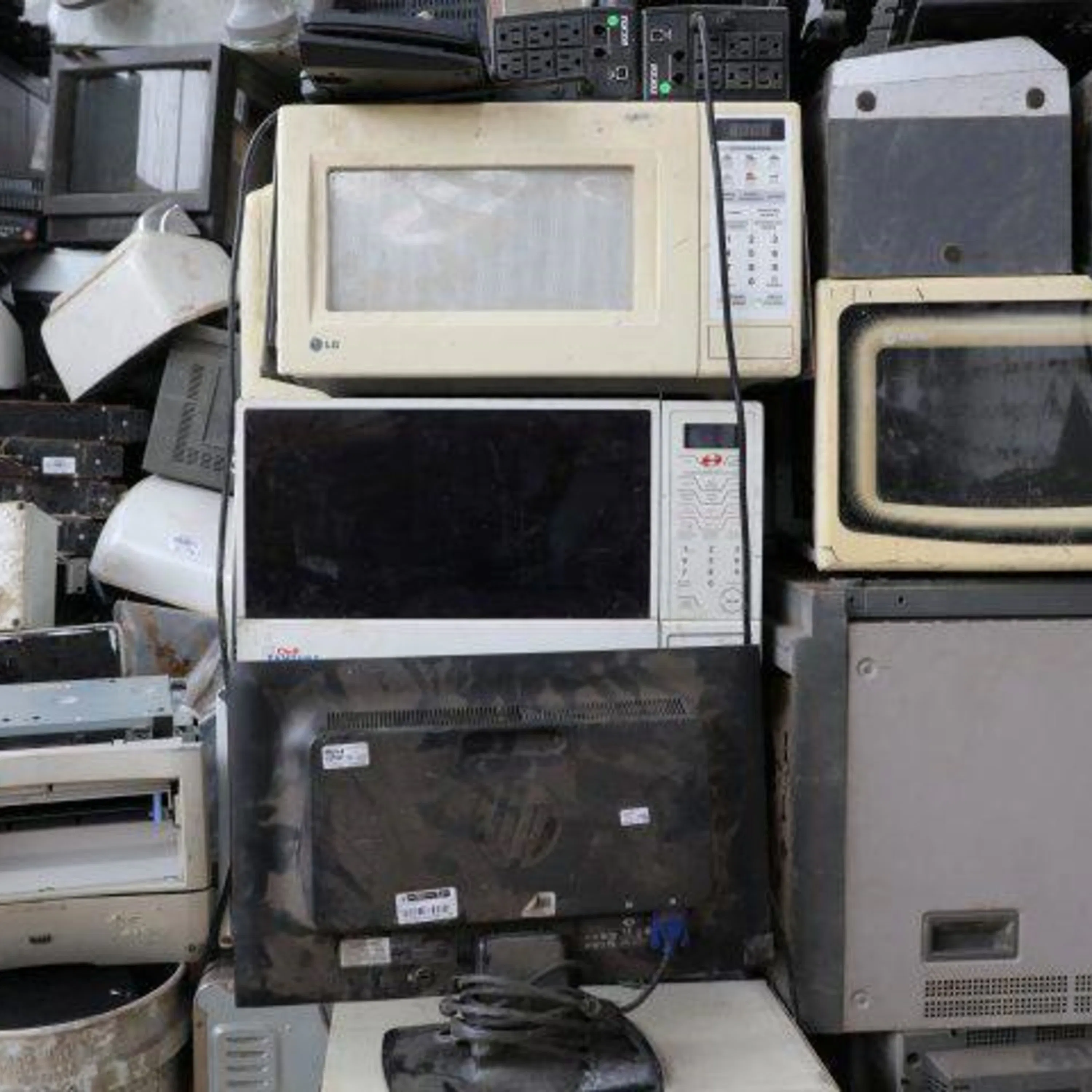
45 million, 45 million tons of worldwide electronic waste last year, establishing a new record. I think that was 2016. The old record in 2014 was 41 million tons. Just think about that.
45 million tons. That, somebody said, is the equivalent to, was it 4,500 Eiffel Towers? Can't be. That's what I read.
And what do you do with the gold and the copper inside the computers, inside the televisions, inside the mobile phones? I bet you most of those mobile phones still work. I bet you a lot of it wasn't. I don't want it.
I'm going to save the planet right after I get my new mobile phone. 4,500 Eiffel Towers. I'm just looking at it. So, the joint weight of 2016 e-waste and raw materials in the electronic scrap was worth approximately $65 billion.
That's more money than Bill Gates has. And yet, 36 billion tons were not recycled. So, what's the answer for this scrap, which often contains extremely confidential corporate and personal information? Stored on computer hard drives.
This is a big issue, getting rid of this stuff. How do you do it? Dave Potter is the vice president of business development for global e-waste solutions. They have offices in this country and internationally.
So, what happens to your corporate, personal, junked, electronic stuff? Dave, 45 million tons. That is a massive... I can't imagine how we accumulate that, but some 36 billion tons don't get recycled.
That's an insane number. Hello, Dave. This is a damn thing not working again. Dave, go ahead.
Hello, David. Hello, David. Let's call David back. So, you know when you feel lousy, you want everything to work.
And I feel lousy. I really, really do. But I'm thinking about the numbers of people who have to get the very latest and the next greatest mobile phone. I'll just pick on that particular device.
Now, I'm still messing about with a 2,000, I think it is, 12 BlackBerry, Q10. And it's not doing very well. But it still works most of the time. How are we doing with Dave?
It still works most of the time. But, hey, can we scrap this stuff? Can we scrap all this stuff along with 45 million tons? I'm still dealing with this old BlackBerry.
And it's just barely hanging on. But I'm going to ride this sucker all the way to the horizon. And then I'll exchange it. Then I'll get rid of it.
These are massive, massive numbers. We got them? Good God. We pay you people too much money.
David, where were you? I was on and all of a sudden I heard a click. And I think you were cutting over. I'm not sure what happened there.
Oh, because I'm losing my voice off how you were playing games with me, man. I promise I wouldn't do that. I'm just joking. 45 million tons.
How do we accumulate that much electronic waste? How do you reach another 36 billion tons or million tons are not to dispose of? This is a huge problem, is it not? It is.
It's absolutely incredible. Some of it is a consumer issue. You know, in the past, the average life cycle of products, people kind of stretch into the four to five to six year realm. We've seen that life cycle for consumer electronics, business electronics, continue to get compressed almost down to the point where there's an 18 to 24 month life cycle on a lot of these products, which is doing exactly what you outlined earlier.
It's generating a tremendous amount of e-waste. And quite frankly, it's overloading a lot of the systems. There's some new concerns that are developing kind of around the data security standpoint. You know, how do businesses, how do consumers properly dispose of these end-of-life electronics and ensure at the same time, you know, there's not some residual data on there.
So it's going to continue to be a challenge for the next few years for local provinces and states to kind of figure out the best solution. Because you can't just put it in landfills. This stuff isn't just a center, right? You really can't.
And a lot of people know that with CRTs and some of the PCs and the laptops, but people don't stop to think of the miscellaneous items, toothbrushes, the alarm clock. You know, Global E-Waste Solutions recently hosted a collection event in Duluth, Minnesota. It was called the Twin Ports Recycle Rendezvous, where we actually advertised on a number of different radio stations. We collected almost 50,000 pounds of e-waste in two days.
And the residents that came out were so happy. There hadn't been one done in a long time. And really what that did for the local community, it just really reminded everyone of the fact that there is a proper manner for disposal on these type of items. You know, everybody kind of knows that provincial programs exist and the governmental programs in the U.S.
exist. But in too many instances, they're just not utilizing those programs, or they don't stop and think of a lot of things about little items that end up in the trash, which are, in many instances, big culprits. Yeah, I'm thinking about old laptops or old computers that are around the house, or old televisions, old TVs, that's fine. Nobody worries about that.
But an old computer may have important personal information, or you consider it important because it's your personal information. And you don't want that to fall into the wrong hands. You don't want people to get all that information. Unless corporately, there are computers with hard drives that have a tremendous non-confidential information on them.
So there's a reluctance to part with those particular units because, again, of security concerns. How do you get around that? Well, you're absolutely right. I mean, brand protection is really what it comes down to on the business front.
The big challenges they face are protecting their brand from an information perspective. And the other component is really the chain of custody. One, you know, I would certainly recommend that businesses today work with a certified recycler. Global E-Waste is actually a e-steward certified, which happens to be the highest level certification there is in recycle today.
Essentially, what that ensures is that we're going to do a three-path, Department of Defense style data erasure on every hard drive that comes in, or it's going to go into a shredder to completely ensure that that data is eliminated and there is no connection back to the business. So that is, again, by far the number one reason individuals don't recycle old devices, and it's the number one concern for businesses. Now, you have a program called Redeploy instead of Recycle. What is that?
We do. So we really strongly believe that the best form of recycle is reuse. Sure, we can grind this stuff up and turn it into ceiling tiles, but the reality is we're going to make as many good, usable units as possible on old consumer electronics. We have to get very creative in our sales ability in many instances.
We bring products in. We completely test them. We do what's called value-appropriate repair, where we'll actually combine parts off different laptops to make as many good, usable units as possible. We really go further than any other recycler because we really want to put the emphasis on reuse, knowing that that's going to have the largest environmental impact.
Sure. You want to get that equipment out to people who can still use it, and then you clean it and make sure that nothing confidential remains on it when it's set out. I just read the story again. The weight of e-waste in 2016 was the equivalent of 4,500 Eiffel Towers.
That is unbelievable. Global E-waste Solutions is a company, and Dave Potter is their vice president of business development, and they have offices right here in Ontario. And it's not a commercial or an infomercial. I just found it fascinating.
Dave, thank you very much for the time. I was only joking before. It was our e-waste that was called causing problems. It is.
Well, and it's been exported for years and years, and now there's been some tracker studies where they're actually placing GPS trackers and devices to determine where they end up. Okay, my friend, I got to go. Thank you so much for the time. Thanks, sir.
Dave Potter. And I just can't get over that number. 4,500 Eiffel Towers. When we come back, we're going to be speaking with Derek Bars and their case against Hamilton's Children's Society goes to Gordon Hamilton next Wednesday.
Don't go away. Puff drops, tip-offs, first pitches, kick-offs. When the game is on, you call the shots. Head to betway.ca and bet your way.
Must be 19-plus. Ontario. Play responsibly. Concerned about your gambling?
Visit connectsontario.ca.