Hello, Roy here. I just wanted to let you know that you can listen to The Roy Green Show ad-free on Amazon Music, included with Prime. At this point, most shows are winding down. Roy is just getting started.
The Roy Green Show on The Chorus Radio Network. Tomorrow at this time, we're going to be speaking with Tom Quiggin, the author of Submission. The Danger of Political Islam to Canada, with a warning to America. Tom Quiggin is an internationally recognized expert on terrorism and on national security, and he's worked with the RCMP, the United Nations, Canadian Armed Forces, and he also was involved with the tribunals following the Yugoslav War.
I have to get the information on that, but certainly he has a stellar international reputation, and we'll talk to him about his book. So that's tomorrow. Later on this hour, it's Beauty and the Beast with Catherine Linda and Michelle, and one of the issues will be President Trump, who has declared himself a very stable genius. Now, what happened with my email at RoyGreenShow.com, as soon as I ended up with the Fire and Fury book, which, the credibility of the thing was destroyed, the minute the author said that, well, I can't be sure that I quoted people correctly, or that I reported correctly, as soon as you do that, you just destroy the whole book.
Except for the people on the left and those who hate Trump, who believe they actually watch the guerrilla channel. That was one of the funniest, one of the absolutely funniest spoofs, where a very clever guy on Twitter told the story that President Trump spends up to 17 hours a day watching the guerrilla channel, and that he sat very close to the television and he talked to the guerrillas, because he thought they could actually hear him. Some moron at MSNBC decided to tweet that this great revelation about Trump, and the funny part of it is that the guy on Twitter who released that spoof made it very clear at the very top of what he wrote that it was a joke. But the guy at MSNBC, oh, we have to inform the world that Donald Trump watches the guerrilla channel, you doofus.
Do a little homework. I haven't talked to my current guest for quite a few years. Ken Timmerman is the President and the CEO of the Foundation for Democracy in Iran. He was a Nobel Peace Prize nominee and ran for Congress in the United States.
And I've spoken with... Ken, I'm sorry, would you please remind me what the title of your book is? The most recent book is Deception, the making of the YouTube video Hillary and Obama blamed for Benghazi. Benghazi has been something I've followed very closely for a number of years, and the story has not yet been fully told.
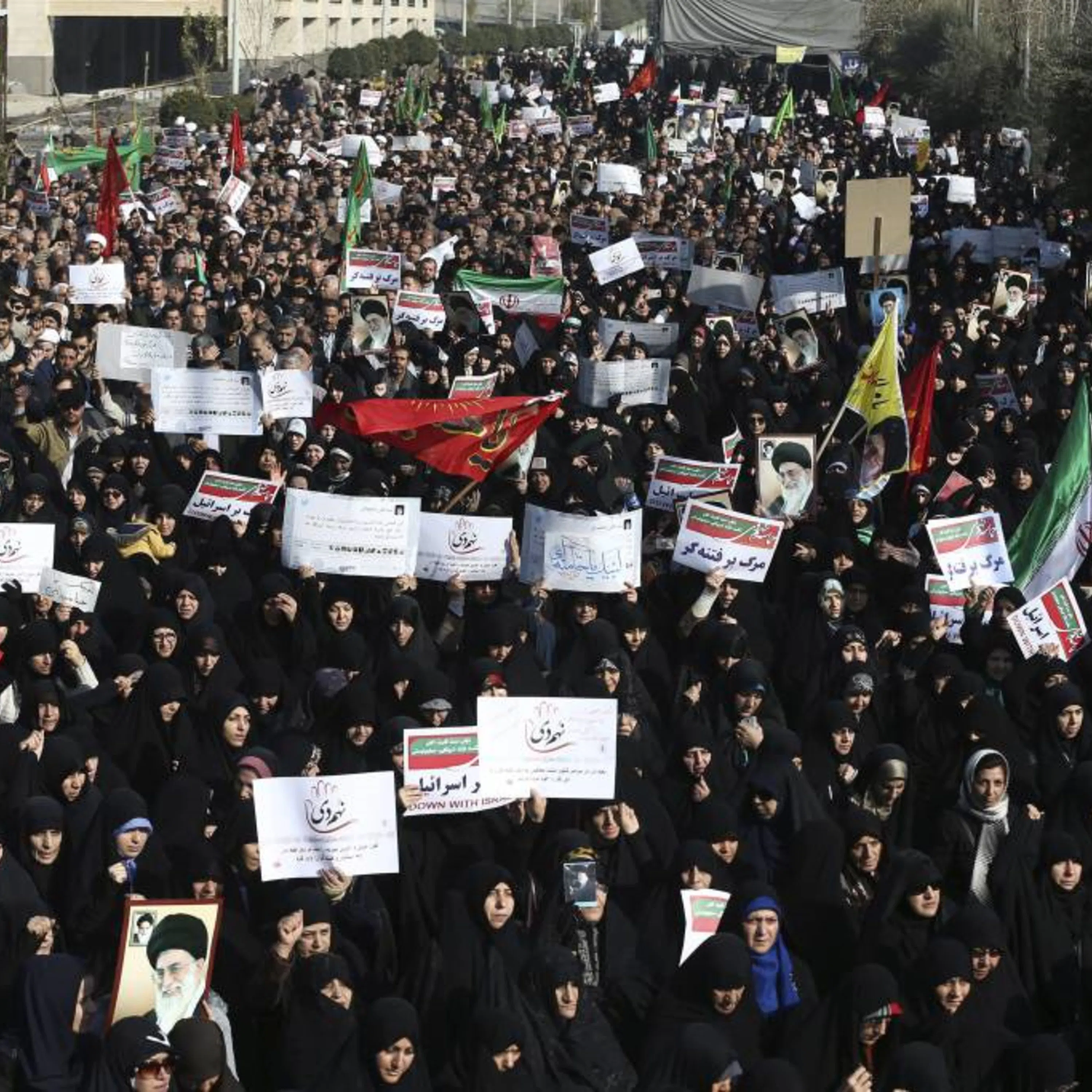
Well, it's good to talk to you again. It's been a long time, and I thought of you immediately when I saw people in the streets of Iranian cities demanding their freedom and calling for the ouster of this oppressive regime, and the progressive Western media were talking about economic concerns. I'm sure there are economic concerns, and the sanctions created economic difficulties, but the regime has only itself to blame for that, whereas the people just want to change. But the progressives in the West, including many federal governments, national governments, had zero to say.
And when the United States called the Security Council of the United Nations together yesterday, there was... France and Russia said, well, it's a domestic issue, so stay out of it. So you've studied and watched and written on Iran for years. What's the current situation about?
What started it again? What do people really want? Well, the protest began in Mashan, which is a pro-regime city. It's considered to be the second holiest city in Shiite Islam in Iran.
And it's surprising to see anti-regime protests start there. It's certainly true that at the very beginning, and this is now 10 days ago, these protests began with a great deal of frustration over regime corruption. They saw all this money coming to Iran, thanks to the Iran deal that Obama and the Europeans negotiated. And they didn't see it coming to the people of Iran.
It was all going into the coffers of the regime and the pockets of regime leaders. So there was certainly a great deal of frustration over the corruption of the regime. But that very, very quickly, I mean, within hours, really, became... It transformed into an anti-regime protest.
And since the very first day, these protests, unlike the ones in 2009, have been squarely aimed at the regime, at the regime leader, Ayatollah Khamenei, and at the clerics. And they were also not very happy with the people who had been on the front and center of the protest in 2009, right? That's right. And those people called the reformists have quite pointedly refused to back these protesters, because it is clear they are for the regime.
They would like to, quote, reform the regime, whatever that means. They want to make the regime more palatable to the West so they can enrich themselves. But they really don't care for the freedom of the people. They don't care for the great unwashed.
What's unusual about these protests is that it's the same class of Iranians who made the 1978-1979 revolution. That's the poor, the urban poor, the rural poor, the unemployed people who have been set aside by Iranian society. And that's a real big problem for this regime, which claims to represent those people. What's amazing, Ken, is that people will really risk their lives to go and demonstrate against a regime that has already threatened them with execution.
If they're found to be particularly troublesome, demonstrators, a judge, I believe, in Tehran, said words to the effect that some people could be executed. But they're going out and they're protesting in huge numbers. Do they have any real expectation of success? Do you think that this is possible?
Because I've heard that some cases of revolutionary guards have burned their IDs and have joined with the protesters. Do you think there's any real chance that this could continue? It's 10 days now, and it's still going on. They could morph it into something that would, in fact, bring the current regime down.
You know, we don't know. But what I can tell you is that the pro-regime media in the West, and I would include the Voice of America, unfortunately, with that, already proclaimed the protests were dying out three days ago when their friends in Tehran told them that the protests were dying out. And that was because the regime called their people into the streets. We're requiring regime employees to take part in counter-demonstrations.
These protests are not over. Today is the 10th day. They have spread to more cities. We have seen them, and this is quite unusual and extremely important.
They are in all of the minority areas of Iran, all the areas on Iran's periphery. The Baluchyche areas close to Pakistan and Afghanistan. The Azeri areas close to Azerbaijan. The Kurdish areas on the border with Turkey and Iraq, and even with Syria.
The Arab areas on the border with Iraq. And all of these areas on Iran's periphery, which the regime has never really been able to control very well, and they know are hotbeds of protests. Those areas did not join the 2009 protests. So this is new, and it's extremely important.
And I think they're staying power. Stay with us, please. Ken Timmerman is my guest on The Roy Green Show on Global News Radio. And he is the president and CEO of the Foundation for Democracy in Iran.
He's a Nobel Prize nominee, and he did that in 2006. And he's the author of Deception, the making of the YouTube video, Hillary and Obama Blame for Benghazi. We'll come back with more with Ken Timmerman about what's going on in Iran right after this. Passionate, patriotic, a little bit futuristic, and always professional.
Hear what Roy Green has to say on The Chorus Radio Network. We're talking about Iran, what's going on in Iran, the 10 days of public protests, and calls for the regime change by the people who are on the streets protesting, and more than 20 people have been killed. And the United States called for an emergency meeting of the Security Council. That happened yesterday.
Here's a little bit of what the U.S. U.N. ambassador, Nikki Haley, had to say. In the past week, what has happened on the ground throughout the mission of Iran is something the world must take note of.
It is a spontaneous expression of fundamental human rights. The Iranian people are rising up in over 79 locations throughout the country. It is a powerful exhibition of brave people who have become so fed up with their oppressive government that they're willing to risk their lives in protest. I like her.
I really like her. Nikki Haley seems to me to be very much like a young Margaret Thatcher. Get off that island. Get off those islands.
Or else. Ken Timmerman, President and CEO of the Foundation for Democracy in Iran, joins me on the Roy Green Show on Global News Radio. So Ken, how important is, because you wrote a piece that's going to take more than talking, how important is it that President Trump has publicly spoken in support of those who are massing in the streets? And what is it going to take, beyond talking, beyond President Trump, and whatever else support there might be, and it's been pretty sparse as far as international governments are concerned, what's it going to take to make a real change in Iran?
Well, first of all, it's tremendously significant that the President of the United States is speaking out publicly on behalf of the protesters. This is in pretty dramatic opposition to what happened in 2009 when Obama stayed silent for the first couple of days. And when he finally spoke out, he said, well, we're not going to get involved because it's a domestic Iranian affair. Obama essentially said what the Europeans in Russia are saying today, don't get involved because we've got business interests in Iran.
President Trump has taken a very different position, and I can tell you from my interaction with the people in the pro-freedom movement in Iran, they are thrilled. They're really ecstatic that the President of the United States has been supporting them. They are ecstatic when they listen to Nikki Haley. That clip that you played is just one of many where she has come out and really become a voice for the Iranian people.
It's amazing to see this and to hear this, where a senior U.S. official, she's a member of the Cabinet, Rex Tillerson, the Secretary of State, has as well, but Nikki Haley, I think, has been the papsy omara of the Iran protests here. It's amazing to listen to this. We've never had this from a U.S.
government, not even under George W. Bush in the 2003 protest. So starting with right there, it makes a big difference. It has really encouraged the people of Iran.
But it's not all. There is a leadership to this movement. It's not very well known. It's not very public.
But there is a leadership. They have organized cells in at least 50 Iranian cities coordinating their operations. You can see this by the way the protests are moving. They're very careful to have these protests pop up in all kinds of different areas where the regime has really not been able to camp them down all at the same time.
It's like whack-a-mole. They camp them down one place, and then there's a protest someplace else they hadn't been expecting it. And it's throwing them off balance. It's throwing the regime off balance.
But I think there's more that can be done. I think certainly the United States can do more, and I think we are going to be doing more if we're not already doing it behind the scenes, for example, in providing free Internet access to the people who are protesting. The Pentagon has ways of doing that. And I think it would be wonderful if the international community would at least recognize the rights of the Iranian people.
I'm going to be in Brussels next week giving a speech to the European Parliament encouraging them to do just that. This is as important as any revolution that we've seen in history, and they need support from the outside. Because a lot of the mainstream media are really playing it down. They continue to refer to the regime as the Iran or Iranian government, and then they talk about the rallies that supposedly supports the clergy, the mullahs that are running Iran.
And you look at the supposed government-supporting rallies, they look more like marches. The people are lined up about 10 across, and there's no emotion. It's just like, you're going to be here at such a bit of time, and you're going to hold this sign, which really defends and supports the regime. Vis-a-vis the protesters who are out on the streets, milling around, doing what they need to do, creating an atmosphere.
But they're also, again, many of them are calling, as I understand it, calling for a return to Iran of the crown prince, the son of the Shah. Is that for real? Do they want a return to the royal family? It is for real.
I can't tell you how widespread it is, but absolutely. There have been protesters who have been champing for Reza Pahlavi to come back to Iran. He's a figurehead of what was once a successful country, a prosperous country, a country that was accepted by the world community, a country whose citizens were not pariahs, as the Iranians feel that they have become today, because of the terrorist activities of the clerical regime. So Reza Pahlavi really does represent something real and positive to the Iranian people.
Again, how widespread is that pro-Shah sentiment? I don't know, but it's very real, and I think it's pretty deep. If they were to be successful, if the people were to be successful, the protesters were to be successful, to remove the regime, if the military, certain parts of the military, were to say, we're not going to fight our own people, which effort has already happened, we won't do this, this is not why we're in uniform. So if they were to be removed, what's the objective then, as far as the future of Iran, without the clergy running the show, would it be to return to almost a westernized country, which is what they were, prior to the removal of the Shah?
I think that is ultimately in the cards, because Iranians see themselves as a sophisticated people, as a well-educated people, as a people connected through the internet to the world community, to the rest of the world. You know, Persia is one of the top languages on Twitter and on Facebook, after English. So Iranians really are connected to the outside world, and they suffer when the regime does, as it has in the past few days, when they shut down social media. They suffer from that, and they're sophisticated enough that they're able to get around that crackdown on social media.
Yeah, I think you would see a pro-Western government in Iran, a representative government of Iran, one that accepts the rights of women, promotes women. There used to be women judges in Iran up until the revolution in 1979, which was obviously a regressive revolution for Iran, around 700 years backwards, not forwards. Yeah, Ken, I have to stop. I have to stop there, but I thank you so much for joining us today, and I hope you'll come back, because I have a feeling this is going to continue for some time.
You bet, where is Iran.org? Exactly, yeah, that's it. Thank you so much. Ken Timmerman is the, he's the president of, I got it here, hold on, he's the president and CEO of the Foundation for Democracy in Iran, and he's the author of Deception, the making of the YouTube video, Hillary and Obama Blamed for Benghazi.
When we come back, it's Catherine and Michelle, it's the police, and me, and Donald Trump. Puck drops, tip-offs, first pitches, kick-offs. When the game is on, you call the shots. Head to betway.ca and bet your way.
Must be nice and close. Ontario won't be. Play responsibly. Concerned about your gambling?
Visit connectontario.ca.