How a Dragon Flies
from Story Time at Clatter Ridge Farm Hosted by Bobbie Emery
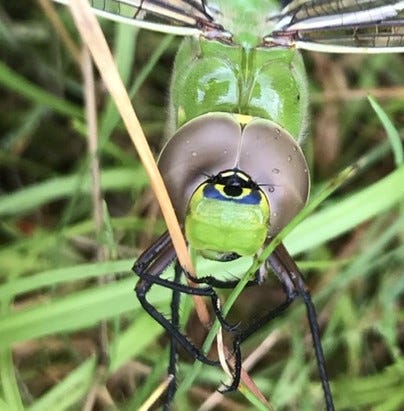
Early one morning, I found a Green Darner Dragonfly in our pasture. She had beads of dew still visible on her enormous gray eyes. I was completely mesmerized. We stared at each other, and I imagined that each of her 28,000 individual lenses were focused on me. I wondered what she was thinking. Was she as smitten with me as I was with her? Was she contemplating if I was a threat, or just considering if I would be better paired with red wine or would a dry white work just as well? Though completely harmless to a human being today, 300 million years ago running into this lady’s ancestor really would have been a frightening encounter. Pre-dinosaur dragonflies sported two-and-a-half-foot wingspans and with the same voracious appetite they have today, I’m sure she wouldn’t have limited herself to just devouring other insects. Today, the dragonfly’s insatiable appetite for gnats and mosquitoes has earned it the nick name “the mosquito hawk”. They can fly up to 18mph and can operate each of their four wings separately. Such nuanced control enables them to levitate like a helicopter, fly forwards, backwards or sideways on demand, and explains, in large part, their 95 percent success rate while hunting. Like the Monarch Butterfly, Green Darners have a multigenerational migration pattern. My new friend will head south once the temperatures here start to dip into the 50s. She’ll travel up to 87 miles a day to get somewhere warm and complete her journey (and her life) after mating and laying eggs in a pond or lake. Her offspring will hatch quickly but unlike their mother, they won’t migrate. The non-migratory generation will spend its’ entire life in the south, laying eggs and completing its life cycle over the course of a southern winter. The following generation (my friend’s grandchildren) will hatch and travel north again next spring to spend the summer in New England. Because they require clean water with a stable oxygen level to reproduce and survive, the presence of dragonflies is a sign of a healthy ecosystem. For this reason alone, I am proud to host them in our pasture, but even if they weren’t such a positive biomarker, I’d welcome them anyway. We have plenty of mosquitoes and it would just seem rude not to share! Thanks for reading Clatter Ridge Farm! Subscribe for free to receive new posts and support my work. This is a public episode. If you would like to discuss this with other subscribers or get access to bonus episodes, visit clatterridgefarm.substack.com
Embed this episode
No transcript yet.