How AI Aggregation Affects Knowledge episode artwork

EPISODE · Apr 11, 2026 · 22 MIN

How AI Aggregation Affects Knowledge

from Best AI papers explained · host Enoch H. Kang

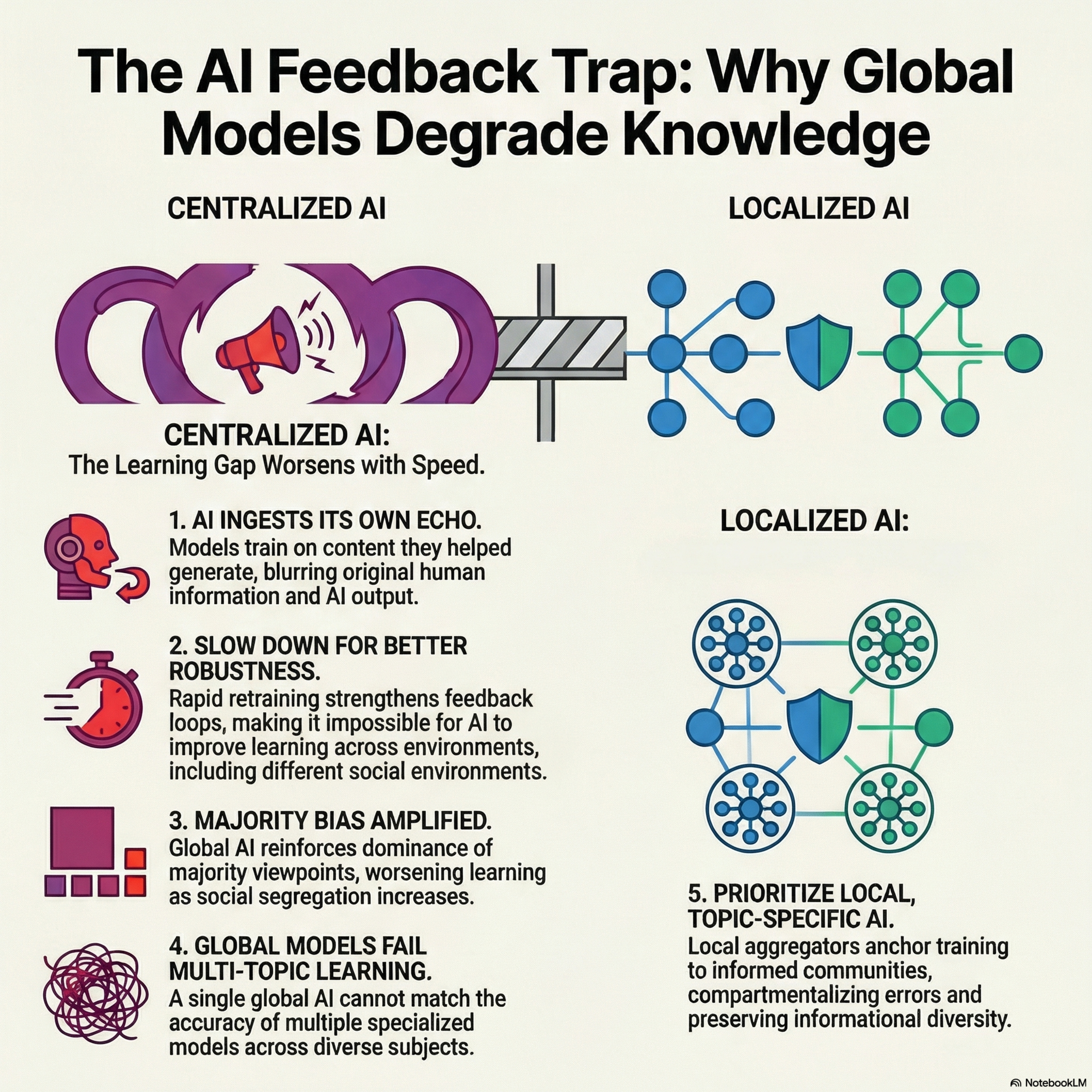
This research examines how generative AI systems impact collective knowledge by creating feedback loops where AI outputs become future training data. Utilizing an expanded DeGroot model of social learning, the study demonstrates that when AI aggregators update too rapidly, they amplify existing social biases and segregation rather than correcting them. This phenomenon leads to a "learning gap," where long-run public beliefs deviate significantly from the truth, particularly when majority viewpoints are overrepresented in training data. The authors highlight a critical robustness tradeoff, showing that fast-learning global models often produce fragile and inaccurate social consensuses across diverse environments. Conversely, the text suggests that local, topic-specific aggregators are more effective at preserving informational diversity and improving long-term accuracy. Ultimately, the paper argues that centralized AI architectures inherently struggle with distributional tradeoffs, whereas modular systems can better compartmentalize feedback to protect the integrity of human knowledge.

Episode metadata supplied by the publisher feed · Published Apr 11, 2026

This research examines how generative AI systems impact collective knowledge by creating feedback loops where AI outputs become future training data. Utilizing an expanded DeGroot model of social learning, the study demonstrates that when AI aggregators update too rapidly, they amplify existing social biases and segregation rather than correcting them. This phenomenon leads to a "learning gap," where long-run public beliefs deviate significantly from the truth, particularly when majority viewpoints are overrepresented in training data. The authors highlight a critical robustness tradeoff, showing that fast-learning global models often produce fragile and inaccurate social consensuses across diverse environments. Conversely, the text suggests that local, topic-specific aggregators are more effective at preserving informational diversity and improving long-term accuracy. Ultimately, the paper argues that centralized AI architectures inherently struggle with distributional tradeoffs, whereas modular systems can better compartmentalize feedback to protect the integrity of human knowledge.

PodParley-generated summary based on available episode metadata and transcript content.

NOW PLAYING

How AI Aggregation Affects Knowledge

0:00 22:53

No transcript for this episode yet

We transcribe on demand. Request one and we'll notify you when it's ready — usually under 10 minutes.

The Course Mentors Podcast The Course Mentors Hey there, future course creator!Ever feel like turning your know-how into an online course is like trying to solve a Rubik's cube blindfolded? Well, grab your headphones because "The Course Mentors Podcast" is here to be your secret weapon!Meet Aimee and Odette (that's us!), your new best friends in the course creation world. We've been in the trenches for over a decade, and for the last five years, we've been rocking the online course space. Now we're here to spill all our secrets in bite-sized, 15-20 minute episodes that'll fit perfectly in your coffee breaks.No fluff, no filler - just real, actionable advice that'll take you from "um, what's a landing page?" to "holy moly, I just hit six figures!". We're talking everything from crafting your course to marketing it like a pro and building a business that'll have you pinching yourself.Whether you're dreaming of ditching the 9-to-5 grind, adding a sweet extra income str AI Erik's Podcast Audio Erik Conn The AI News Podcast where we talk AI. CISO Perspectives (public) N2K Networks This season on CISO Perspectives, host Kim Jones explores some of the challenges of leading through uncertainty. We explore the complexity of the changing nature of regulation and working with the federal government, the evolution of privacy and fraud, and how emerging technologies like AI and quantum computing are changing cyber. When you don’t know what questions to ask, you’re afraid to ask, or don’t know who to ask, CISO Perspectives provides the foundation for learning in this brave new world. Tweens and Dreams Anna B 💕 Hi! I’m Anna, a 12 year old in seventh grade! I’m a theater kid! (HAMILTON IS GOD!!) I post about a variety of things; some of these things include journaling, TV shows/movies, music, shopping, theater, books, etc. If you have any episode requests please comment and I will do my best to do them! If you have any movie, TV show, book, or music recommendations I would love to hear them so please comment!! I’m always looking for more TV shows, movies, books, and music artists to watch/read/listen to! But anyways, I hope you enjoy listening 💕💕

Frequently Asked Questions

How long is this episode of Best AI papers explained?

This episode is 22 minutes long.

When was this Best AI papers explained episode published?

This episode was published on April 11, 2026.

What is this episode about?

This research examines how generative AI systems impact collective knowledge by creating feedback loops where AI outputs become future training data. Utilizing an expanded DeGroot model of social learning, the study demonstrates that when AI...

Can I download this Best AI papers explained episode?

Yes, you can download this episode by clicking the download button on the episode player, or subscribe to the podcast in your preferred podcast app for automatic downloads.
URL copied to clipboard!