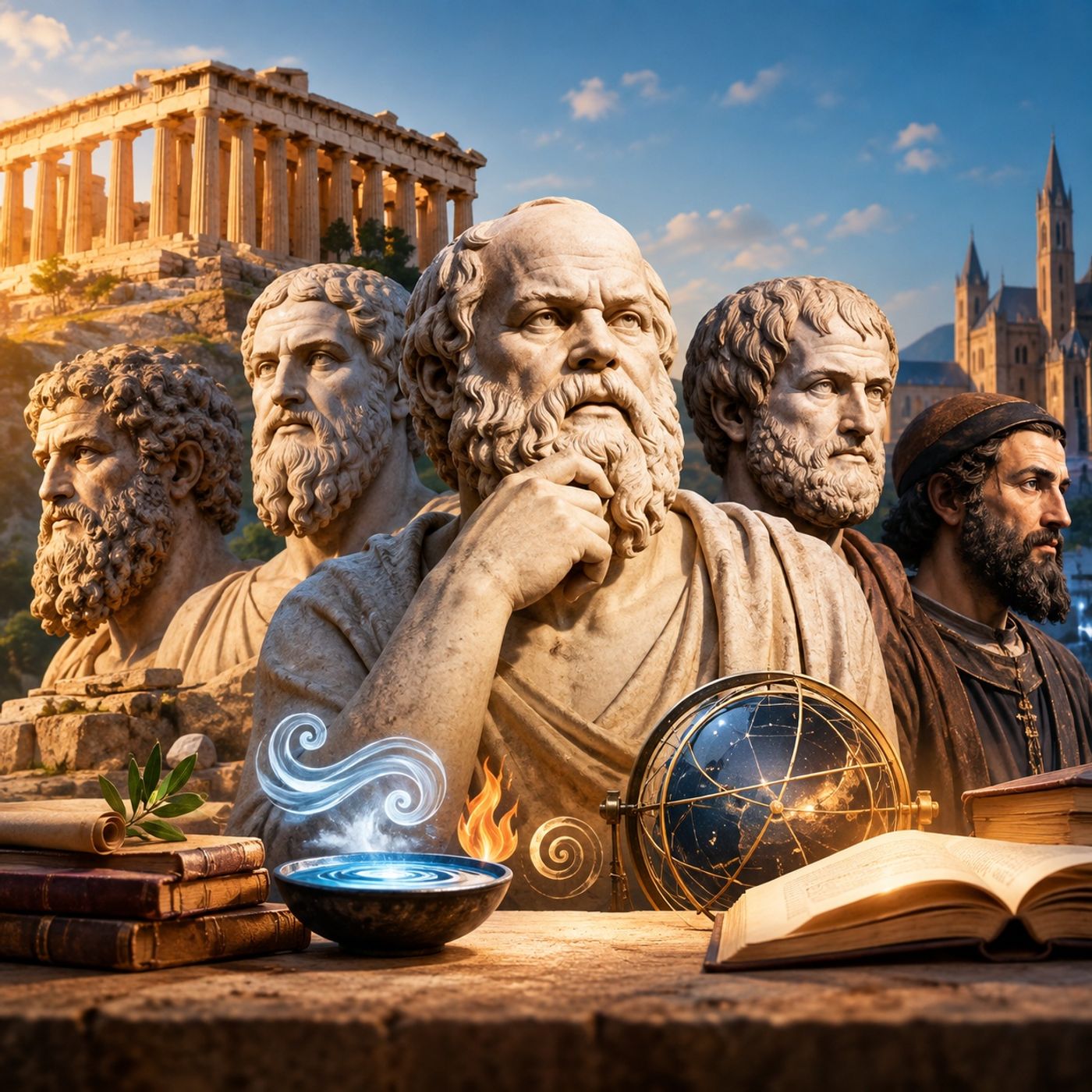
How Ancient Greek Rebels Decoded the Universe
from Hidden History Hosted by Hidden History
Western philosophy began in ancient Greece with a profound curiosity about existence, nature, and the fundamental principles governing the universe. The earliest thinkers, known as the Presocratics, searched for the underlying substance of reality, proposing ideas centered on water, air, mathematics, and the nature of the soul. The debate became increasingly abstract with philosophers such as Heraclitus and Parmenides, who offered opposing views on change and permanence. Socrates then transformed philosophy by placing ethics and the pursuit of a virtuous life at its center, while Plato developed his theory of eternal Forms and explored questions surrounding knowledge, reality, and morality. Aristotle expanded philosophical inquiry into an enormous framework covering logic, nature, ethics, politics, and countless other fields. His approach profoundly influenced later intellectual traditions, particularly medieval Christian theology and thinkers such as Thomas Aquinas, who sought to reconcile philosophical reason with religious belief. Across centuries, Western philosophy gradually moved from explanations based primarily on the physical world toward increasingly sophisticated arguments about reality, knowledge, God, morality, and the human soul. This enduring journey between observation, reason, and abstract thought laid many of the foundations of Western intellectual history. You can listen and download our episodes for free on more than 10 different platforms: https://linktr.ee/Hidden_History Get the books of the Hidden History podcast: 📚 The book series: 166 true stories, 15 books, hundreds of original painted illustrations: https://hiddenhistory10.gumroad.com/
Embed this episode
No transcript yet.