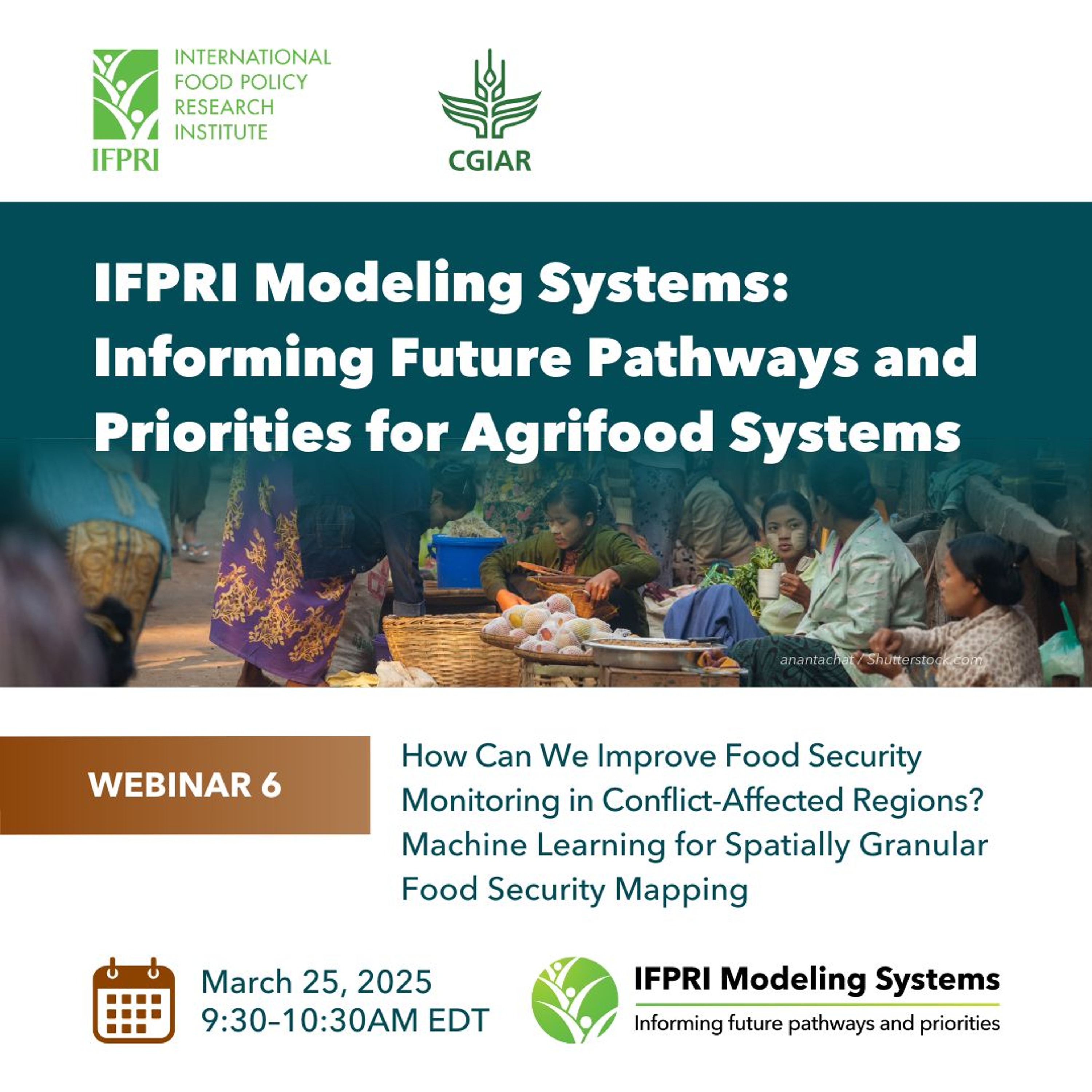
How Can We Improve Food Security Monitoring in Conflict-Affected Regions? episode artwork

EPISODE · Mar 24, 2025 · 53 MIN

How Can We Improve Food Security Monitoring in Conflict-Affected Regions?

from IFPRI Podcast · host International Food Policy Research Institute

IFPRI Webinar How Can We Improve Food Security Monitoring in Conflict-Affected Regions? Machine Learning for Spatially Granular Food Security Mapping Co-organized by IFPRI and the CGIAR Initiative on Foresight March 25, 2025 Machine learning is transforming agricultural and food security research, enabling more accurate and timely insights. The International Food Policy Research Institute (IFPRI) is advancing data-driven approaches in various domains, including crop-type mapping, maize yield estimation, and boat detection. These innovations demonstrate the potential of machine learning in addressing complex challenges and informing policy decisions. A key challenge in this space is food security monitoring in fragile and conflict-affected settings, where timely, granular data is often lacking but essential for policymakers, humanitarians, and researchers. Traditional methods, such as in-person household surveys, are often expensive, infrequent, and spatially coarse, limiting their ability to provide timely insights at local scales. To address these challenges, IFPRI has developed a machine learning-based approach to estimate Food Consumption Scores—which is the most commonly used food security indicator by WFP and partners— at a granular village-tract level in Myanmar. This model leverages multiple data sources—including phone survey data, earth observation, crowd-sourced data, and GIS (Geographic Information System) datasets—to generate spatially explicit and near real-time food security assessments. During this seminar, we will discuss the development and application of this approach, the key data and modeling techniques used, and how this method can be scaled for other conflict-affected regions. We will highlight challenges such as data representativeness, feature selection, and model validation, and share insights into improving food security predictions. Finally, we will outline the broader implications of integrating machine learning with earth observation and survey data to support humanitarian efforts and policy decisions. Moderator and Opening Remarks Jawoo Koo, Senior Research Fellow, Natural Resource and Resilience Unit, IFPRI Presentations Joanna van Asselt, Associate Research Fellow, Development Strategies and Governance Unit, IFPRI Zhe Guo, Senior GIS Coordinator, Foresight and Policy Modeling Unit, IFPRI Links: More about this Event: https://www.ifpri.org/event/how-can-we-improve-food-security-monitoring-in-conflict-affected-regions-machine-learning-for-spatially-granular-food-security-mapping/ Subscribe IFPRI Insights newsletter and event announcements at www.ifpri.org/content/newsletter-subscription

IFPRI Webinar How Can We Improve Food Security Monitoring in Conflict-Affected Regions? Machine Learning for Spatially Granular Food Security Mapping Co-organized by IFPRI and the CGIAR Initiative on Foresight March 25, 2025 Machine learning is transforming agricultural and food security research, enabling more accurate and timely insights. The International Food Policy Research Institute (IFPRI) is advancing data-driven approaches in various domains, including crop-type mapping, maize yield estimation, and boat detection. These innovations demonstrate the potential of machine learning in addressing complex challenges and informing policy decisions. A key challenge in this space is food security monitoring in fragile and conflict-affected settings, where timely, granular data is often lacking but essential for policymakers, humanitarians, and researchers. Traditional methods, such as in-person household surveys, are often expensive, infrequent, and spatially coarse, limiting their ability to provide timely insights at local scales. To address these challenges, IFPRI has developed a machine learning-based approach to estimate Food Consumption Scores—which is the most commonly used food security indicator by WFP and partners— at a granular village-tract level in Myanmar. This model leverages multiple data sources—including phone survey data, earth observation, crowd-sourced data, and GIS (Geographic Information System) datasets—to generate spatially explicit and near real-time food security assessments. During this seminar, we will discuss the development and application of this approach, the key data and modeling techniques used, and how this method can be scaled for other conflict-affected regions. We will highlight challenges such as data representativeness, feature selection, and model validation, and share insights into improving food security predictions. Finally, we will outline the broader implications of integrating machine learning with earth observation and survey data to support humanitarian efforts and policy decisions. Moderator and Opening Remarks Jawoo Koo, Senior Research Fellow, Natural Resource and Resilience Unit, IFPRI Presentations Joanna van Asselt, Associate Research Fellow, Development Strategies and Governance Unit, IFPRI Zhe Guo, Senior GIS Coordinator, Foresight and Policy Modeling Unit, IFPRI Links: More about this Event: https://www.ifpri.org/event/how-can-we-improve-food-security-monitoring-in-conflict-affected-regions-machine-learning-for-spatially-granular-food-security-mapping/ Subscribe IFPRI Insights newsletter and event announcements at www.ifpri.org/content/newsletter-subscription

NOW PLAYING

How Can We Improve Food Security Monitoring in Conflict-Affected Regions?

0:00 53:38

No transcript for this episode yet

We transcribe on demand. Request one and we'll notify you when it's ready — usually under 10 minutes.

That Hoarder: Overcome Compulsive Hoarding That Hoarder Hoarding disorder is stigmatised and people who hoard feel vast amounts of shame. This podcast began life as an audio diary, an anonymous outlet for somebody with this weird condition. That Hoarder speaks about her experiences living with compulsive hoarding, she interviews therapists, academics, researchers, children of hoarders, professional organisers and influencers, and she shares insight and tips for others with the problem. Listened to by people who hoard as well as those who love them and those who work with them, Overcome Compulsive Hoarding with That Hoarder aims to shatter the stigma, share the truth and speak openly and honestly to improve lives. The Small Business Startup School – Business Notes | Financial Literacy | Retail Psychology – For Professionals & Entrepreneurs The Small Business Startup School Inc. Starting or buying a small business? While personal circumstances may vary, business patterns remain timeless. On The Small Business Startup School, we explore strategies, insights, and practical solutions to help entrepreneurs confidently navigate their journey.Hosted by Ola Williams—a retail entrepreneur, fintech founder, and financial coach with over two decades of experience—this podcast marries financial awareness and retail psychology with optimism to deliver actionable takeaways.Join us to learn, grow, and connect as we uncover the keys to business success.Let’s continue to learn together and be encouraged to keep on connecting! DIOSA. Carolina Sanper This podcast is a sacred space created by Carolina Sanper where you connect with your inner wisdom and embody your magnetic feminine power.It is the realization that the mystical realm is where you plant the seeds of your desired reality.It is a portal to your true essence: awareness, presence, and receiving with ease. Welcome home, DIOSA. 🖤 XXX Tech by SOVRYN Dr. Brian Sovryn The crossroads between technology, sensuality, and metaphysics - and the longest running anarchist podcast in the world! Brought to you by Dr. Brian Sovryn.

Frequently Asked Questions

How long is this episode of IFPRI Podcast?

This episode is 53 minutes long.

When was this IFPRI Podcast episode published?

This episode was published on March 24, 2025.

What is this episode about?

IFPRI Webinar How Can We Improve Food Security Monitoring in Conflict-Affected Regions? Machine Learning for Spatially Granular Food Security Mapping Co-organized by IFPRI and the CGIAR Initiative on Foresight March 25, 2025 Machine learning is...

Can I download this IFPRI Podcast episode?

Yes, you can download this episode by clicking the download button on the episode player, or subscribe to the podcast in your preferred podcast app for automatic downloads.
URL copied to clipboard!