
EPISODE · Jan 29, 2026 · 19 MIN
How Can You Beat Walmart?
from Strategy Literacy Podcast · host Mehmet Ali Koseoglu
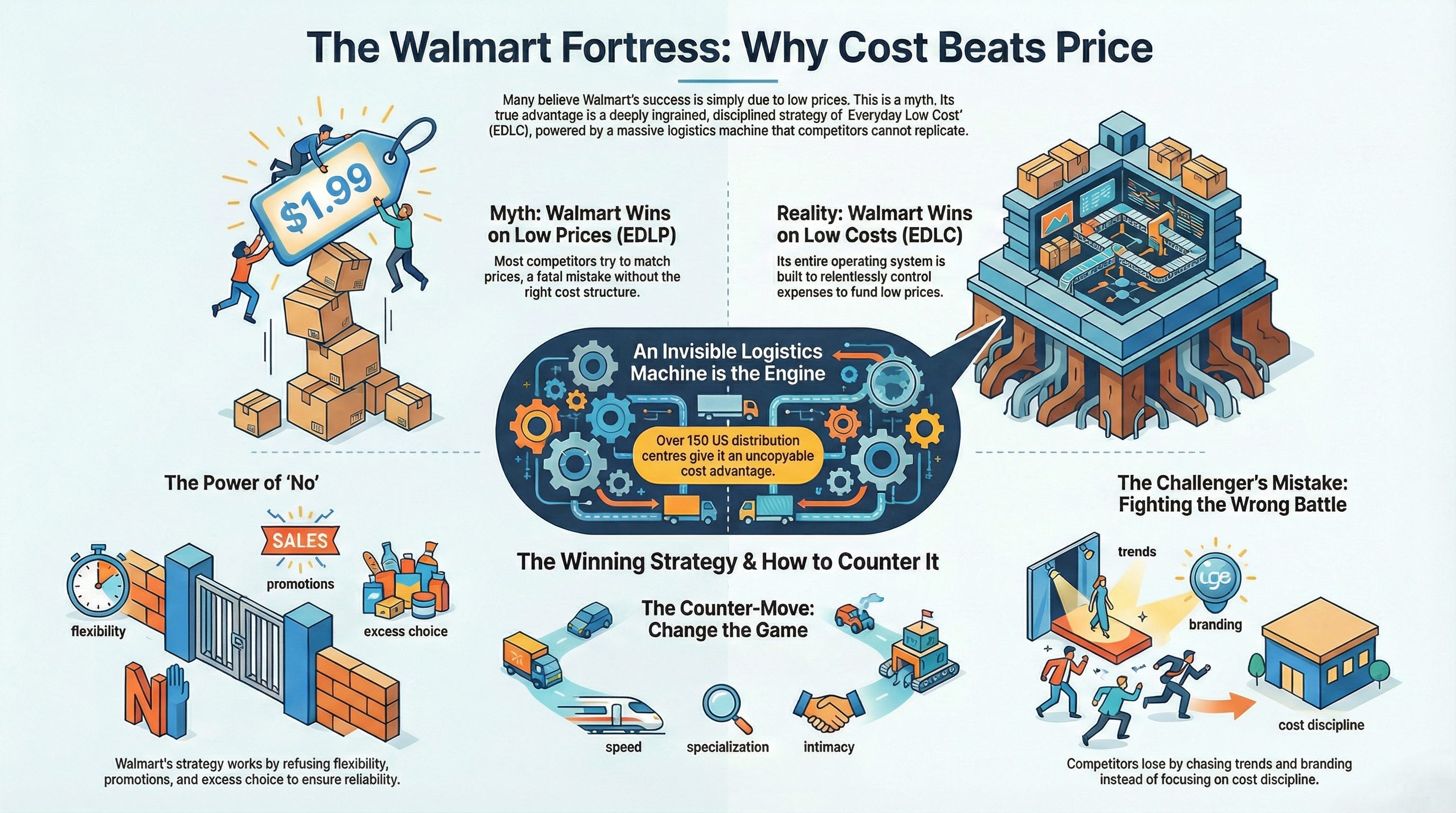
Most people believe Walmart wins because it’s cheap.That’s wrong.Low prices are not Walmart’s strategy. They are the visible outcome of something much deeper—and much harder to copy.If beating Walmart were simply about lowering prices, someone would have done it by now.They haven’t.And Walmart’s own 10-Ks quietly explain why.Walmart Doesn’t Compete on Price. It Competes on Cost.Walmart repeats two phrases obsessively in its annual reports: Everyday Low Price (EDLP) and Everyday Low Cost (EDLC). On the surface, they sound similar. Strategically, they are worlds apart.EDLP is what customers see.EDLC is what competitors can’t replicate.Walmart explicitly frames EDLC as a structural commitment: controlling expenses so relentlessly that savings can be passed on continuously, not episodically. This is not promotional pricing. It is not margin sacrifice. It is an operating system.Most retailers try to compete on EDLP without possessing EDLC. That gap is fatal.The Invisible Asset: A Logistics Machine Disguised as RetailWalmart does not describe itself as a retailer first. Across its filings, it increasingly positions itself as a people-led, technology-powered omni-channel operator whose advantage depends on logistics discipline and scale, not merchandising flair.The scale is staggering:* Over 150 strategically located distribution centers in the U.S. alone* A private truck fleet integrated with supplier shipments* The majority of store merchandise flowing through Walmart-controlled infrastructure, not third-party systemsThis matters because logistics is where cost leadership becomes real. Walmart’s size does not just lower prices—it compresses uncertainty. Inventory turns faster. Transportation costs are amortized. Suppliers adapt their processes around Walmart’s requirements, not the other way around.That is not something a competitor can copy by “investing more.”Why Copying Walmart Fails (Even for Giants)Here’s the uncomfortable truth hidden in plain sight:Walmart’s strategy works because it refuses flexibility.EDLP only works if you eliminate promotions.EDLC only works if you eliminate excess choice.Scale only works if you standardize relentlessly.Most firms—especially digital-native or premium-positioned ones—cannot tolerate that level of discipline. They want optionality. Walmart wants reliability.Even Amazon, with all its technological power, faces a different constraint: its economics are optimized for speed and breadth, not for uniform cost compression at physical scale. Walmart’s filings openly emphasize how physical stores double as fulfillment assets, reducing last-mile costs and reinforcing the cost flywheel.This is why beating Walmart is not about innovation.It’s about strategic refusal.The Strategic Mistake Most Challengers MakeChallengers don’t lose to Walmart because they lack ideas.They lose because they fight the wrong battle.They chase:* Better branding* Smarter pricing algorithms* Trendier formatsMeanwhile, Walmart keeps doing something profoundly unsexy: executing the same cost discipline, year after year, across hundreds of billions in revenue.Its strategy statements barely change across filings from 2017 to 2025. That stability is not stagnation. It’s intent.Strategy, in Walmart’s case, is not creativity.It is consistency under scale.So… How Can You Beat Walmart?Not by copying it.You beat Walmart by changing the game it refuses to play.By competing where:* Cost leadership is irrelevant* Scale becomes a disadvantage* Speed, specialization, or intimacy matter more than efficiencyBut that requires clarity most firms never reach.Which is exactly why Walmart keeps winning. This is a public episode. If you'd like to discuss this with other subscribers or get access to bonus episodes, visit strategyliteracy.substack.com/subscribe
Embed this episode
Ready to play
How Can You Beat Walmart?
No transcript for this episode yet
Similar Episodes
No similar episodes found.