How Cell Phones Communicate with Satellites
from The Innovation Attorney Podcast Hosted by The Innovation Attorney
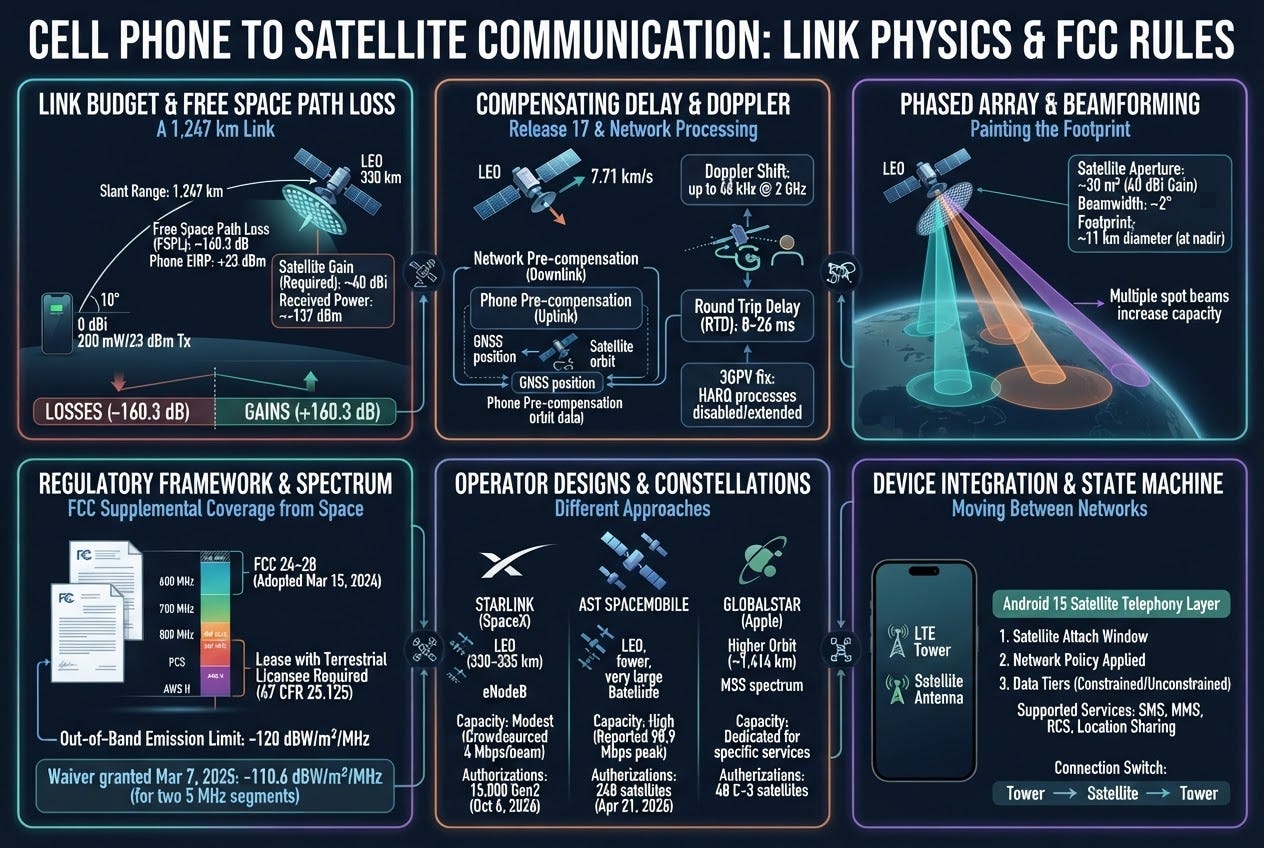
Cell phones communicate with satellites by sending ordinary LTE or 5G radio signals to a low Earth orbit base station licensed under FCC rules adopted March 15, 2024. The satellite carries a cellular base station and a phased array antenna that forms narrow beams on the ground. The network removes most of the delay and Doppler shift, and phones built to 3GPP Release 17 remove the rest by computing their own position from GNSS and reading satellite orbit data from the broadcast. A handset transmitting 200 milliwatts across a slant range of 1,247 kilometers faces about 160 decibels of free space path loss, so the satellite array must supply the gain that closes the link. On October 6, 2026, the FCC released order DA 26 1078, which authorizes 15,000 SpaceX satellites between 326 and 335 kilometers. Measured performance is modest. Crowdsourced readings of the first Starlink service in the PCS G block showed a median received power of negative 121 decibel milliwatts, 24 decibels below the terrestrial network of the same carrier, and an estimated 4 megabits per second per beam. AST SpaceMobile reported a 98.9 megabit per second peak to an unmodified smartphone in its first quarter 2026 results, using a far larger array. Capacity depends on spectrum, and spectrum depends on FCC licensing. The supplemental coverage from space rule at 47 CFR 25.125 requires a lease with terrestrial licensees and limits out of band emissions to negative 120 decibel watts per square meter per megahertz. The agency relaxed that limit by 9.4 decibels for two 5 megahertz segments in March 2025. Detailed Findings How Does a Handset Close a Link to a Satellite Hundreds of Kilometers Overhead? A handset closes the link to a satellite because the satellite supplies tens of decibels of antenna gain that the phone cannot. The reference handset in the 3GPP study is an omnidirectional device with 0 dBi antenna gain, power class 3 output of up to 200 milliwatts, which is 23 decibel milliwatts, and a receiver noise figure of 7 decibels. The arithmetic fits on one line. At 1.99 gigahertz, a satellite at 330 kilometers altitude seen at a 10 degree elevation angle sits 1,247 kilometers away, and free space path loss over that distance is 160.3 decibels. A 23 decibel milliwatt uplink therefore arrives at the satellite aperture at about negative 137 decibel milliwatts. Thermal noise across a 5 megahertz LTE channel is negative 107 decibel milliwatts, or about negative 104 with a 3 decibel receiver noise figure. The signal to noise ratio equals the satellite antenna gain minus 33 decibels. A satellite array with 40 dBi of gain therefore delivers about 6.7 decibels of signal to noise ratio before implementation losses, which supports the lowest LTE modulation and coding schemes. Forty dBi at this frequency requires an aperture near 30 square meters at 60 percent efficiency, and the resulting beam is about 2 degrees wide, which paints a footprint near 11 kilometers across at nadir. These figures are my own calculation from the stated assumptions. As a nuclear trained submarine officer I learned to treat a link budget as a ledger in decibels. Every loss on one side of the ledger must be matched by a gain on the other, and every gain is bought with power, aperture, or time. Orbit does not change the ledger. The phone brings 23 decibel milliwatts and no aperture, so the satellite pays the entire balance with a large array and a low noise receiver. What Do 3GPP Releases 17 and 18 Change in the Phone and the Network? Release 17, completed in 2022, added the first normative support for 5G New Radio over non terrestrial networks, and the work in Releases 18 and 19 extends coverage and moves toward regenerative payloads that place the base station on the satellite. The earlier technical reports set the ground rules: TR 38.811 defined the deployment scenarios and channel models, TR 38.821 evaluated approaches for timing, frequency, and random access, and TR 36.763 did the same for narrowband IoT and eMTC devices. Three changes matter most in the handset. The phone reads satellite ephemeris, an epoch time, a common timing advance, and a timing drift rate from system information, specified in TS 38.331. The phone uses its own GNSS position with that data to compute its round trip delay and its Doppler shift, then applies a UE specific timing advance and pre compensates its uplink frequency, using the uplink timing procedures in TS 38.213. A scheduling offset called K offset lengthens the gap between a downlink grant and the uplink transmission it triggers, so the uplink timing still follows the grant once the round trip delay is included. Hybrid automatic repeat request needed the most surgery. NR in Release 16 uses up to 16 stop and wait processes, and Release 17 extends that to 32. Thirty two processes still cannot cover the round trip of a low Earth orbit or geostationary link, so the standard allows a network to disable HARQ feedback for the downlink and reuse processes before a full round trip passes. The NTN bands in Release 17 include n255 in the L band and n256 in the S band, and Qualcomm announced a modem on February 26, 2024, with integrated narrowband NTN support and Release 17 compliance. Direct to cell service on unmodified handsets sits outside those specifications. The satellite pre compensates the downlink carrier and sampling frequency and post compensates the uplink, because the delay of a satellite link exceeds what the LTE timing advance range handles alone. The LTE timing advance spans about 0.67 milliseconds of round trip, which corresponds to a cell radius near 100 kilometers. A beam only 11 kilometers across leaves a delay spread of tens of microseconds, so the satellite can remove the bulk delay at the beam center and keep every phone inside the LTE range. How Much Delay and Doppler Shift Does a Low Earth Orbit Satellite Add? A low Earth orbit satellite adds between 8 and 26 milliseconds of round trip delay and up to about 48 kilohertz of Doppler shift at 2 gigahertz. The 3GPP study tabulates a round trip delay for a transparent payload at 600 kilometers of 25.77 milliseconds at the worst case 10 degree elevation and 8 milliseconds at the minimum, with a regenerative payload halving the figures to 12.89 and 4 milliseconds. A geostationary transparent payload runs from 477.48 to 541.46 milliseconds. The Doppler figure follows from orbital speed. A satellite at 330 kilometers moves at 7.71 kilometers per second, and its component along the line of sight reaches about 7.2 kilometers per second at 10 degrees elevation. That speed produces a shift of 24 parts per million, which is 48 kilohertz at 1.99 gigahertz and equals roughly three LTE subcarriers of 15 kilohertz each. A phone receiving that offset uncorrected could not decode the downlink, which is why the network removes it and why Release 17 phones correct their own uplink. Altitude moves every term in the ledger. At 1,414 kilometers, the altitude planned for the Globalstar C 3 satellites, the same 10 degree geometry stretches the slant range to 3,502 kilometers, raises path loss to 169.3 decibels, which is 9 decibels worse than at 330 kilometers, and lifts the bent pipe round trip to about 47 milliseconds. A very low orbit at 326 to 335 kilometers buys that 9 decibels back, and the FCC authorized those shells on October 6, 2026, an altitude described as a record low. What Do Measurements of a Live Direct to Cell Network Show? Crowdsourced measurements from October 2024 through April 2025 show a satellite link that delivers about 24 decibels less received power than a terrestrial tower and a throughput near 4 megabits per second per beam. Starlink used the PCS G block with a 5 megahertz channel, 1910 to 1915 megahertz on the uplink and 1990 to 1995 megahertz on the downlink, and the service carried text messages during the measurement period. The median reference signal received power was about negative 121 decibel milliwatts on the satellite cell an… This is a public episode. If you'd like to discuss this with other subscribers or get access to bonus episodes, visit theinnovationattorney.substack.com/subscribe
Embed this episode
No transcript yet.