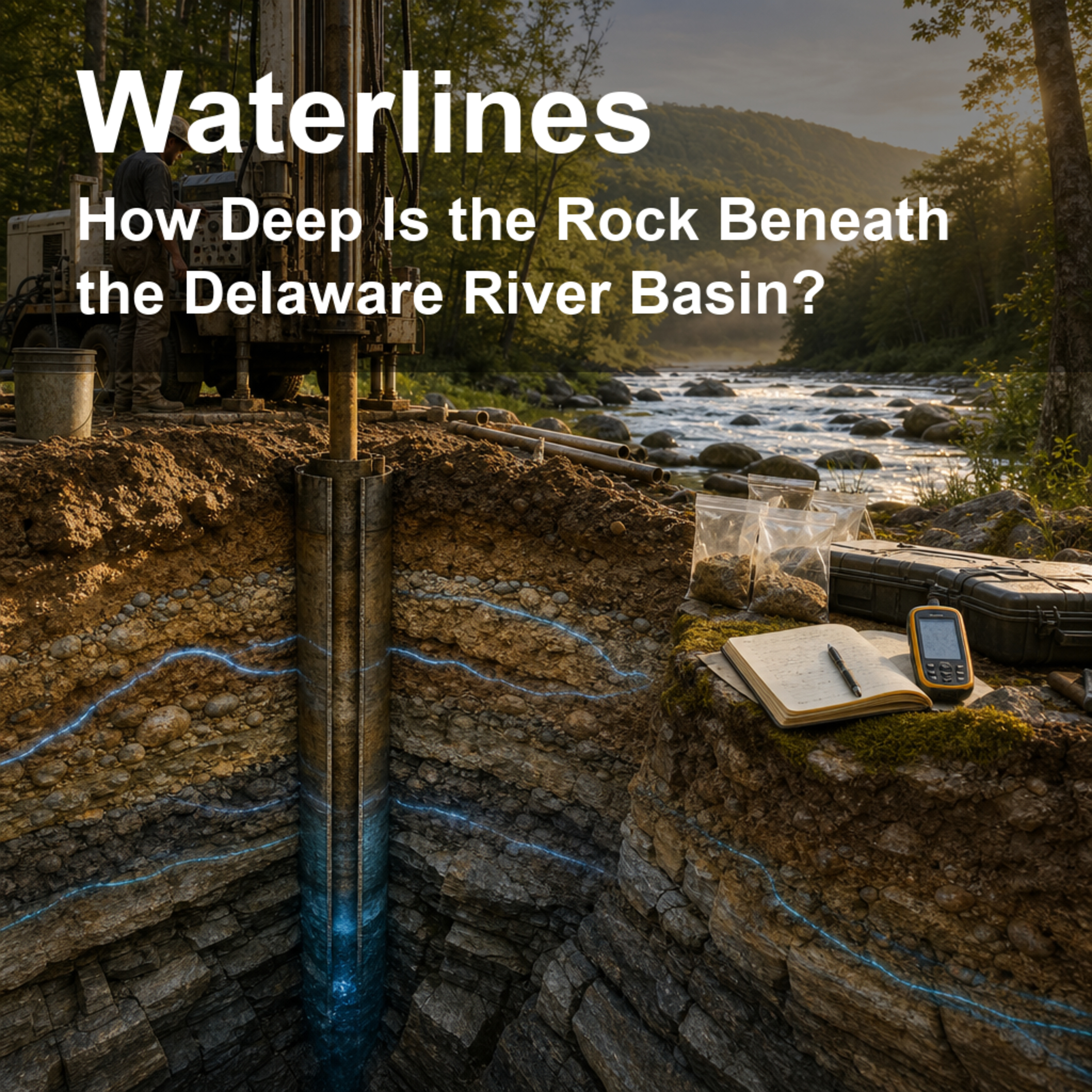
How Deep Is the Rock Beneath the Delaware River Basin? episode artwork

EPISODE · Jun 15, 2026 · 10 MIN

How Deep Is the Rock Beneath the Delaware River Basin?

from Waterlines: How Water Shapes Our World · host jaywen

Takeaway: A noisy bedrock map can still be useful if it gets the basin-scale pattern right, not every exact backyard.Knowing where solid bedrock begins is not just a geology puzzle. It shapes where groundwater can move, how wells behave, how roads and bridges are planned, and how regional water models estimate what a basin can store and supply. In this episode, we visit the Delaware River Basin through a deceptively simple question: how deep do you have to go before loose earth becomes rock?The paper follows U.S. Geological Survey researchers using machine learning to map depth to bedrock from more than 72,000 observations. But the real story is about uncertainty. Well logs are rounded, locations can be approximate, drillers may describe materials differently, and the underground surface itself can change sharply over short distances. Instead of pretending the data are perfectly clean, the researchers ask a practical question: at what scale is the model actually useful?We unpack their three-part model check: exact point-by-point accuracy, whether the predicted spread of values looks like the real spread, and whether the map captures realistic spatial patterns across the basin. The result is a useful lesson for environmental science in the age of AI: a model that looks weak at a single address may still be strong enough for basin-scale planning, if it is tested at the scale of the decision.Citation: Goodling, P., Belitz, K., Stackelberg, P., & Fleming, B. (2024). A spatial machine learning model developed from noisy data requires multiscale performance evaluation: Predicting depth to bedrock in the Delaware river basin, USA. Environmental Modelling & Software, 179, 106124. https://doi.org/10.1016/j.envsoft.2024.106124Disclosure: This Waterlines episode uses AI-generated voices for the host conversation.

Takeaway: A noisy bedrock map can still be useful if it gets the basin-scale pattern right, not every exact backyard.Knowing where solid bedrock begins is not just a geology puzzle. It shapes where groundwater can move, how wells behave, how roads and bridges are planned, and how regional water models estimate what a basin can store and supply. In this episode, we visit the Delaware River Basin through a deceptively simple question: how deep do you have to go before loose earth becomes rock?The paper follows U.S. Geological Survey researchers using machine learning to map depth to bedrock from more than 72,000 observations. But the real story is about uncertainty. Well logs are rounded, locations can be approximate, drillers may describe materials differently, and the underground surface itself can change sharply over short distances. Instead of pretending the data are perfectly clean, the researchers ask a practical question: at what scale is the model actually useful?We unpack their three-part model check: exact point-by-point accuracy, whether the predicted spread of values looks like the real spread, and whether the map captures realistic spatial patterns across the basin. The result is a useful lesson for environmental science in the age of AI: a model that looks weak at a single address may still be strong enough for basin-scale planning, if it is tested at the scale of the decision.Citation: Goodling, P., Belitz, K., Stackelberg, P., & Fleming, B. (2024). A spatial machine learning model developed from noisy data requires multiscale performance evaluation: Predicting depth to bedrock in the Delaware river basin, USA. Environmental Modelling & Software, 179, 106124. https://doi.org/10.1016/j.envsoft.2024.106124Disclosure: This Waterlines episode uses AI-generated voices for the host conversation.

NOW PLAYING

How Deep Is the Rock Beneath the Delaware River Basin?

0:00 10:56

No transcript for this episode yet

We transcribe on demand. Request one and we'll notify you when it's ready — usually under 10 minutes.

Eat to Live Jenna Fuhrman, Dr. Fuhrman Our health is our most precious gift and smart nutrition can change your life. Each month, join Dr. Fuhrman and his daughter, Jenna Fuhrman as they discuss important topics in the world of nutrition. Eat to Live will change the way you eat and think about food. French Your Way Jessica: Native French teacher founder of French Your Way Boost your French listening skills and test your comprehension with this one of a kind series of podcasts. Get the chance to listen to a real conversation between native speakers talking at normal speed AND customise your learning experience through carefully designed sets of questions (2 levels of difficulty) available for download at www.frenchvoicespodcast.com. All interviews also come with the transcript. French teacher Jessica interviews native speakers of French from around the world who share a bit of their life and passion. Where else would you meet in one same place a French yoga teacher based in Melbourne, a soap manufacturer from Provence, or a couple cycling around the world? HOMELAND HOMELAND The Church is a body not a building. It's the bride of Jesus Christ! Jesus is coming back for a mature bride. That means it's time for the church of Jesus Christ to move from milk to meat. This is the hour of maturity!HOMELAND is an announcement that the church is being set free. Only the church has the ability to transform the world. The kingdom's of this world will become the kingdoms of our Lord and Savior!All of creation has been waiting for this moment! Sons and daughters of God are rising up and taking their seat! XXX Tech by SOVRYN Dr. Brian Sovryn The crossroads between technology, sensuality, and metaphysics - and the longest running anarchist podcast in the world! Brought to you by Dr. Brian Sovryn.

Frequently Asked Questions

How long is this episode of Waterlines: How Water Shapes Our World?

This episode is 10 minutes long.

When was this Waterlines: How Water Shapes Our World episode published?

This episode was published on June 15, 2026.

What is this episode about?

Takeaway: A noisy bedrock map can still be useful if it gets the basin-scale pattern right, not every exact backyard.Knowing where solid bedrock begins is not just a geology puzzle. It shapes where groundwater can move, how wells behave, how roads...

Can I download this Waterlines: How Water Shapes Our World episode?

Yes, you can download this episode by clicking the download button on the episode player, or subscribe to the podcast in your preferred podcast app for automatic downloads.
URL copied to clipboard!