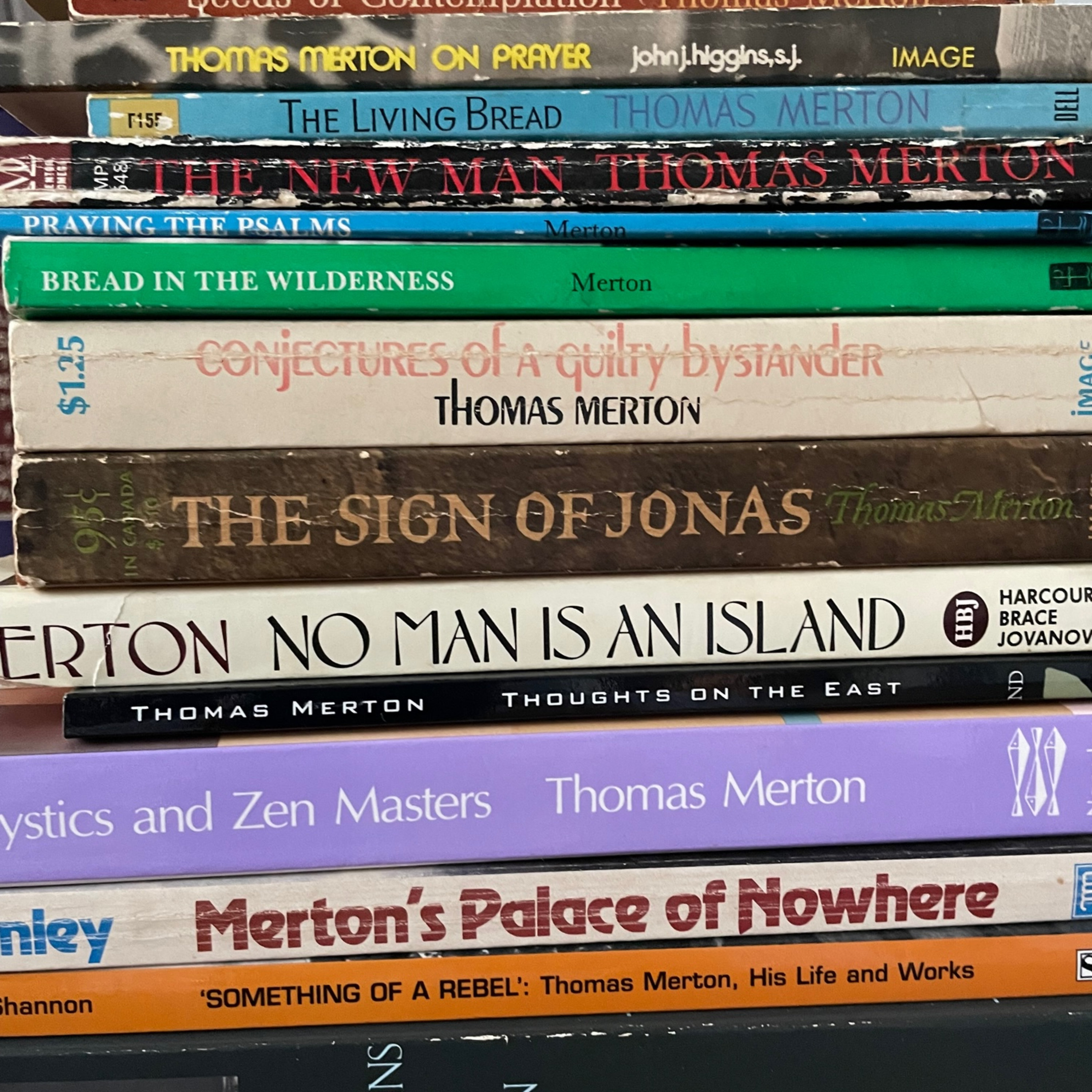
So, how do we account for Thomas Merton? Thomas Merton started as a writer, became a trapez monk with genuine insight into his spiritual life, and then wrapped himself in worldly activism. What happened? If you go to the show notes page, by the way, or to the article here, you'll see the sweet picture I took.
We were like, all my Thomas Merton books piled up. Anyway. On December 10, 1941, a young, Ivy League graduate arrived at the Abbey of Gethsemane, a trapez monastery in the heart of Kentucky's Bourbon Country, where monks take it off of silence. In 1948, that monk Thomas Merton published the seven-story mountain, it was hugely successful.
At times during 1948, an unprecedented 10,000 orders came in every day, millions of copies were sold. Merton was a pop culture celebrity, but he remained a monk in Kentucky. But not an obedient one. He became critical, finding faults with everything at the monastery, from its numbers, to its methods of sustaining itself financially, to its abbot.
He increasingly agitated for a hermitage, a space where he could live and write separated for the rest of the monastic community. He thought about moving out of Gethsemane altogether, possibly moving out west, which by the way, was what Holden Caulfield dreamed of doing and catching the ride. There are definitely parallels there, but that's not the point of today's podcast. Merton also got caught up in the counterculture of the 1960s, seeing himself tied to the hippie movement, by a finest sympathy and understanding.
A young correspondent aptly referred to Merton as the, quote, hippie hermit, unquote. Merton was such a big fan of Bob Dylan's that, when the elderly philosopher Jacques Moratane visited him in his hermitage. Merton, to Moratane's exasperation, wasted precious time, planned a Bob Dylan record, and hoped that Moratane would agree that Dylan was a great artist. Merton also acquired a girlfriend.
He overdulged an alcohol. He became a political activist, a social advocate of various 1960s activist movements, such as, excuse me here, such as the Vietnam War protests, the nuclear disarmament movement, the civil rights movement. Heck, he even toyed with the idea of taking pills to make himself look black, like the author John Howard Griffin had done. The book that Griffin was a black like me, he became caught up in the early environmental movement triggered by Rachel Carson's Sound Spring, the war on poverty, the Catholic Church reform movements leading to the Vatican II, and even efforts to unionize the Catholic Church's priests.
He at one time wrote that America is a totalitarian society in which freedom is pure illusion, teaching that white America was engaged in an oppressive war against all non-whites and regretting that he had become a naturalized citizen. What a free cabin. No one really knows. The bagger for Michael Mott, the seven mountains of Thomas Merton, seems attributed to Merton's rebellious nature.
Others say he simply marched to the tune of a different drummer. I have a different theory. Merton was, I believe, agnostic, in his early adult years he partially embraced ancient narcissism. In his later years, he became a modernistic.
Existence is tension. One of the greatest philosophers of the 20th century, Eric Boaglin, emphasized that we exist in a thing called the Metaxi. It's an in-between area between transcendence, like the heavens or spiritual realm. You might think of it, and imminence, that's I, M, M, A, N, E, N, C, E, or the Earthy or bodily.
So transcendent and Earth. We exist between those two. This reality results in tension, where it pulled up and where it pulled down. The tension isn't pleasant, especially for those who really feel the transcendent pull.
Everyone after all feels the imminent pull. It's earthly life. It's the freaks among us who intensely feel the transcendent pull. They had the most trouble dealing with the tension of the Metaxi.
They're the troubled souls. The freaks who deal with the well are the sages and saints. They live in harmony within both realities. The freaks who deal with the poorly are the drunks and outcasts.
They deal with the tension by trying to drop off one side of reality. Picture a person being tortured by being stretched between two poles. His wrist tied to ropes and pulled in opposite directions. The torture abruptly ends if you cut the rope to one of the poles.
The freaks who deal with their acutely felt tension poorly try to cut the rope to one of the poles. Ancient Gnostics cut off the imminent pull. So around the time of Christianity, when revelation and philosophy were making it clear that there was a transcendent reality, I think God the Father, that wasn't tied to earthly affairs, I think Zeus the Father. The tension got really bad for the first time.
A lot of people simply couldn't deal with the tension. They responded by denying the imminent pull of existence. They understood that the transcendent was truly transcendent and decided that was all that mattered. They became wholly spiritual and heavenly, denying the legitimacy, relevance, and or actual existence of the bodily and the earthly.
And then acted on it to start religious movements that conformed to their stilted consciousness. That's kind of a mouthful, that's a voglin though. Those were the ancient Gnostics. In the modern world, the Gnostic phenomenon got flipped upside down.
Started with the modern world, a lot of people who couldn't deal with the tension responded by denying the transcendent pull of existence. They became wholly bodily and earthly, and then acted on it to start, in voglin's phrase, or sats of religions, like fake religions. This is like Marxism and fascism. Those are the modern Gnostics.
I came back to Merton, I call him the artist, turned Gnostic. Merton's father was a professional painter, and member of the Royal Society of British Artists. He read poetry to the young Thomas, and laid down firm roots for the love of William Blake, who was arguably the most transcendent poet of all time. As a young adult, Merton channeled, with artistic blood and literature, studying the craft of writing and trying to come up with his own style, he wrote a novel.
He was the classic, frustrated novelist. He published poetry. He won a prestigious writing award from Columbia University. He liked to draw.
Merton was to put a simply in artist. The artist intensely feels the tug of the transcendent. He's pulled towards the beautiful, one of the three transcendentals in the Platonic tradition. And responds with works of art.
Art observed the great theologian Hans, Erasm von Balthasar, is an expression of grace. If the artist also obviously exists in the world, the result, the artist intensely, feels the tension of living in the metaxi. It's not comfortable, such a person wants to end the tension, which you can do in all sorts of ways. All callism, don-wan-ism, you know, bang-a-lotta-shicks, career-ism, anything to deal with the tension.
Or he can simply lop off one of the poles that are stretching them. I suspect that's what Merton tried to do by joining the trapez, he was trying to lop off the imminent, as a pole of existence. That being said, I don't think it's accurate to describe the young Merton as an ancient Gnostic. A Gnostic must act on his deformed view of existence.
He must have the deformed view of existence and claim a special knowledge that's the gnosis part of Gnocism. But claim a special knowledge emanating from that deformed view, which you can then use to change the rest of the world to align it with his deformed view. So the formula is deformed view of reality, plus claimed special knowledge, plus activism equals Gnocism. At the early Monastic stage of Merton's life, I think that third ingredient, activism was lacking.
Life in a monastery is the exact opposite of acting on one's dissatisfaction with the reality of existence. But it is still an act to lop off, or at least greatly quell, the pressure of the imminent pole, or the earthly pole, Merton, I believe, thought his life would be all transcendence all the time. He then got frustrated as a monk when the imminent, in particular his abbot, who he always fought with, still made worldly demands on him. So he was still dissatisfied, plus he started feeling the incredibly strong pole of the earthly or imminent due to his fame.
He had to try something else. So he lapped off the transcendent pole. That's my theory. Basically, he moved from one extreme to the other, but not really.
He really lapped off one extreme, the imminent, and when that didn't end the tension of the metaxi, he lapped off the other extreme. At least partly. He never did leave his order. That is something.
But the bottom line is Merton himself never really moved. That's the problem. On December 10, 1968, Merton gave him morning talk and had been a ditching conference in Thailand about Marxism and monastic perspectives, in which he offered the possibility that Marx of students might be the true monks of 1968. He had lunch, then retired to his room, where he took a shower.
Upon coming out of the shower, he died, probably electrocuted by a fan that was improperly wired. It was too bad. He was only 53 years old. It would have been interesting to see what he would have done if he lived longer and started to realize that modern ascism wasn't working for him either.
Maybe then he would have gone back to pursuing a proper monastic vacation. One that, though immersed in the transcendent, also embraces the imminent. It's clear from his journals that he was working through such matters and still searching. Not then again, he may have just gone further off the rails.
We'll never know.