
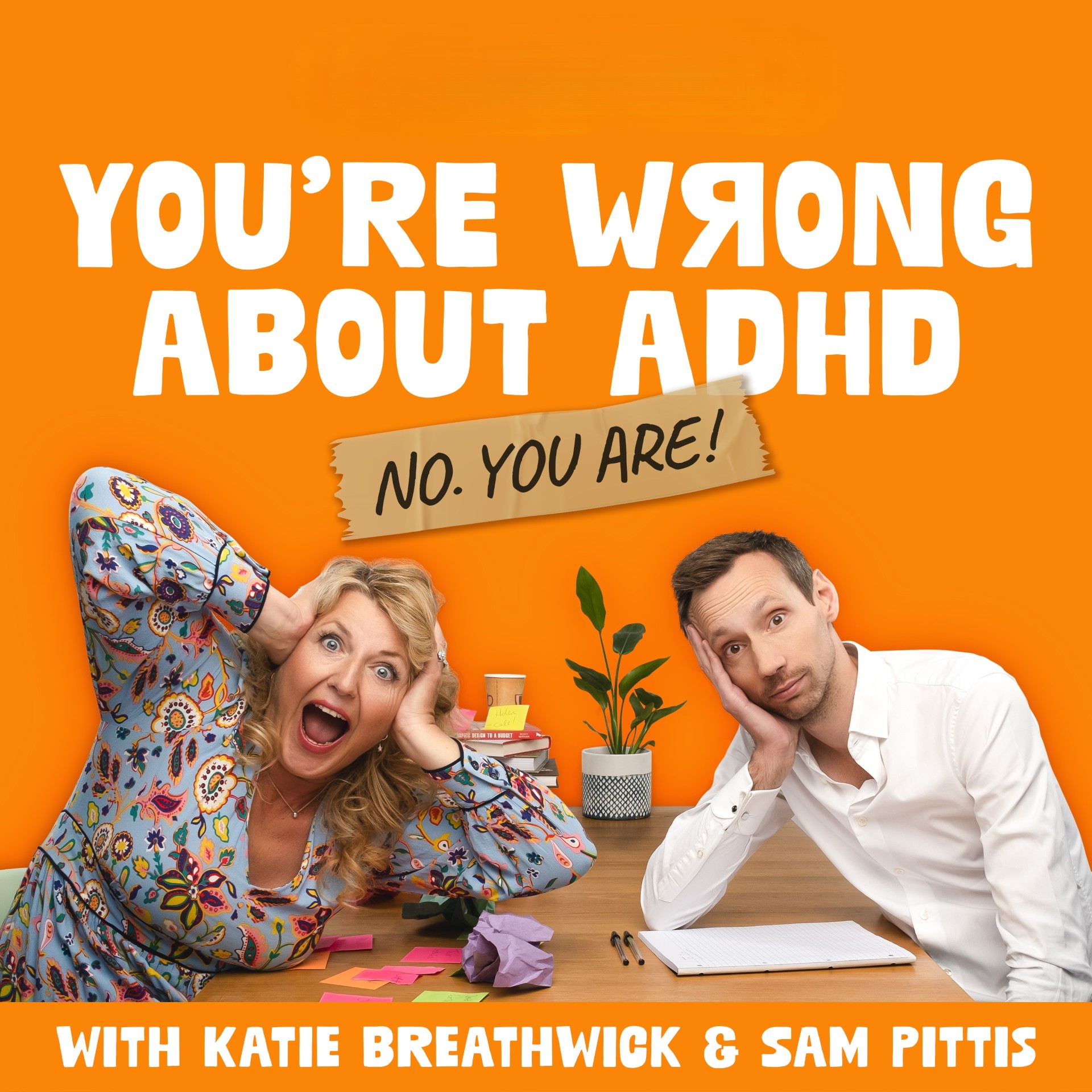
This is a Global Player original podcast. Yeah, I'm quite looking forward to today's episode, but I'm wondering how you are, because I think this is one that affects you more. Yeah, it's really good. For me, actually, this is the central question to ADHD, for me, memory, and how I meet the challenge of not having one.
This is how I found out I had ADHD in the first place. Okay, this was a big part of your journey story. It really was. So, you know, we go back to four or five years ago, when I was really struggling at home with remembering conversations with my children from the day before.
I was experiencing proper emotional dysregulation, and my husband says I was basically a bloody nightmare to live with. And I had all sorts of issues, but the biggest one for me was memory, and I had a father, have a father with dementia. And I genuinely started to question whether or not that was what I was dealing with. It was really scary.
I didn't want to tell my husband I didn't want to frighten him. And so I booked an appointment with a doctor. And I was very, very lucky that day. I got a female GP, and she printed out six pages of information on the menopause.
And for her, she gave me a diagnosis of, you are perimenopausal. And actually, to a certain extent, she was right. Lots of the things that I was dealing with matched up with the symptoms of perimenopause. Great.
But then, cut to three, four years later. And of course, as I said before, my oldest is going through an ADHD diagnosis following a teacher flagging him at school. And sitting in the consultation room with him, and hearing those questions asked about him, about all the things he's lost, all the ways in which he has struggled, and essentially the difficulties with just remembering stuff that had made his childhood a nightmare, and incurred all that criticism that comes with that, of losing those things, and being forgetful, and forgetting homework, and failing to turn up for appointments, all those things. I realized that that was also my story, too.
And it was only once I really started looking at that that I realized the confluence of perimenopause meeting ADHD. And that was why my life fell apart at that moment. And I've now realized, looking into it a bit more, that it's something to do with estrogen and dopamine. They're really connected.
And when you lose your estrogen in perimenopause, during perimenopause, you lose what's left of a brain that's already dysfunctional. And it was a real problem for me. I genuinely thought I had early on to Alzheimer's, and it was very, very, very frightening. And I now realize that I needed to treat it in two ways.
I needed to treat the lack of estrogen and the lack of dopamine, and that's why I now do it. Well, we should definitely do an episode on menopause and ADHD crossover in the future. Yeah, yeah, yeah, that's a good idea. I always think when you tell me that story, to go to the doctor thinking you had Alzheimer's, and eventually to find out you had ADHD.
I mean, a relief in some ways. Yeah, actually, yes. And maybe that's why I am so much more positive about it than you are. Because it was a really first of all to discover, oh, I'm only perimenopausal.
Oh, there's stuff I can find out about that online. So that's good. And also, yeah, the whole ADHD. But again, when that diagnosis eventually came through, there was, once again, that sense of going back and making sense of all of those times in my childhood.
That's what I'm asking, right? Talking about childhood, sorry to interrupt you, but you've gone to the doctor because you're experiencing memory issues. Had you had memory issues as a child? Oh, God, yeah.
So this wasn't new, it just got worse. But you had this as your child, too. Yeah, absolutely. I lost everything.
I lost everything. You know, I went to school in trainers because I lost my school shoes. I left my school bag on the bus. You know, I would turn up at school having forgotten my homework.
Of course, I was always losing or forgetting or feigned to do my homework, so the teachers would be furious with me. But often it was because I'd forgotten it, or I'd forget to revise for a test because I'd, you know. And people say to me now, well, why didn't you have mechanisms in place for remembering that stuff, like a diary or writing down? Did you write a file?
No, I did write those things down, and then I'd lose the thing, but I'd written it down. You know, even later, even later, do you remember, I mean, you're probably too young for this, but do you remember Palm Pilots? Yeah, I was young. I was young.
I was young. 12. I remember. My husband said, I've got a good idea for you.
You just started your big, proper first job. There's this thing called Palm Pilot. Let's get you one of those, and let's see if once again my carer steps in to solve my problems. And I had this flash, fancy thing, this Palm Pilot that came with a special pen that you write stuff in.
I lost the pen first, and then I lost the Palm Pilot. And when you lose that stuff, everything falls apart. I had two file boxes. I wrote everything in them, and then I lost them.
And the thing for me has been, actually, the cloud, that has changed everything for me. Because now I have a phone. Everything goes in that. But actually, if I lose a phone, it doesn't matter.
It's all somewhere. Because somewhere up there in that big magical world of the cloud is my life, and that has been completely life-changing for me. Because it's all very well, writing stuff down. But if you lose it, you're completely stuck.
And I've had a lifetime of it. And along with all of that, along with all of the losing stuff and forgetting stuff, is the criticism that follows. And that's, again, the thing that I know really, really, actually, from talking to you, Sam, is over time I've begun to realise that if you grow up living with ADHD, you grow up living with the criticism that comes with it. And actually, it's a lot for a child to deal with, and it's a lot for an adult to deal with, and you have a lot of cortisol rushing around your system because of that.
That's a really important point to make, and I think we should pause on that, and definitely we should start with what you just said. However... Are you about to... However...
Oh, my God. I have never, ever had a problem with memory. I remember everything, and I'm really organised. Are you sure we've got ADHD?
Well, do you know what? That cannot be true. No, no, no, no. We have to interrogate that just a little.
There's got to be... Seriously? I don't remember ever. Do you remember anything?
Maybe because I've made up and forgotten and forgotten. But I don't think as a child I've ever had a problem with memory. I've always been hyper-organised. It's a family trait, and I still am.
I have a sort of running log in my head. I do keep lists. And even as a child, I would just be on top of things. Now, I have a theory.
Now that I know I've got ADHD, I do have a theory that I've ever compensated. I think at some point, I became hyper-organised. And I think that's why I would say I don't have a problem with memory, because I think I've done things to compensate for my ADHD. And what you said was really interesting.
I know you were joking. How I got ADHD. I think it's one of the reasons why I didn't get diagnosed sooner. Because all those things about ADHD that you see, or you read about, never quite seem to fit me.
And the memory issue and being forgetful was never something I struggled with. I think it's one of the reasons why I didn't come to diagnosis sooner. And I think that idea of being hyper-organised explains why perhaps that isn't a trait for me. But I'd be really interested to know why ADHD causes memory issues.
Oh, me too. And I think that's one of the key questions today. Yeah, because it affects absolutely everything I do. Every moment of my life.
It's simple things like, if I am switching between tasks, I can't remember to go back to the task before. There's nothing that sticks in my head. It's gone. And so I have to set alarms for everything.
I have to stick reminders up everywhere. I've had to find strategies that make sure my brain works in a way that I can see everyone else's is working. And meds help to a certain extent. They help a lot.
But they don't fix it completely. And for me, I just want to know what is wrong with my brain, actually. What's going on in my brain that is not going on in other people's or the other way around. Well, we've got the person to answer that question.
Yeah, he's back. We're going to be speaking to Dr. Tony Lloyd from the ADHD Foundation. Tony, great to see you again.
Thanks for joining us again. Thanks very much for asking me, Sam. Good to see you. This particular subject is one particularly close to my heart, I have to say, because I think it's the reason why, ultimately, I found out I had ADHD.
And for me, the digital age could become sooner, because that has been, that's been the biggest help for me in terms of being able to set alarms, write digital lists that never disappear, et cetera. But let's talk about memory and ADHD. Can you tell us what it is? Why does it affect memory so much?
And later we'll talk about what tips you might have to help us fix those problems. But let's begin by exploring the issue of ADHD and memory. Well, there are two neurotransmissors in play with ADHD, noradrenaline and dopamine. And dopamine plays a key role in memory, learning, motivation.
It's a feel-good hormone. We get a rush of dopamine when we do something that is good for us. So when we exercise, you get a rush of dopamine. When you eat food, you get a rush of dopamine.
When you listen to music that you like, you get a rush of dopamine. When you experience something novel that really captures your attention, you get a rush of dopamine. When you're playing a computer game, if that's your thing, you get a rush of dopamine. It is a reward-based hormone.
And often, because the dopaminergic system in ADHD brainwakes differently, you will find that people compensate for the lack of dopamine. So when you see fidgeting and movement, it stimulates dopamine, which improves your concentration, your memory. So does caffeine. So do carbohydrates.
So you can see the link here around sugar rush. It's a reward-based kind of form. And when I go on holiday somewhere I've never been before, or if I've been somewhere and I haven't been there in 20 years, I can remember my way around because I've got a really good visual memory. And we know that people with ADHD have greater synaptic connections in the past of the brain that deal with visual imagery.
Whether that's a compensation is open to debate. But here's the thing. When you have poor memory, and I mentioned before about you can do really well in school, in class, and then the following week, you've completely forgotten what you learned last week. You can have completely forgotten.
And that can cause gaps in learning. You know, our lives, when we make decisions, they're based on hindsight and foresight, aren't they? We look at what we know so far. But if you can't remember half your mind, it's going to be a judgment of what, isn't it?
Yeah, you're starting from scratch every time, aren't you? Well, not quite. But again, it is that thing about, you know, we retain what we think is important, but we can only retain so much. And this is where, you know, medication really does help.
A lot of people, I think, sometimes have unrealistic expectations about medication. Medication doesn't change your personality, it doesn't change your life, and it doesn't undo everything that has ever happened to you. But in the hours that it's active, it really improves your cognitive functioning. So I know that if I can take, when I take meds, I'll remember an awful lot more about what I've done that day.
The days I haven't taken meds, I can work for 12 hours, I know I've been productive, but if you ask me what I did at the end of the day, I'll struggle to remember much of the detail. It's funny, I've never really had big issues with memory, and we've talked before with you, Tony, you're kind enough to come back and talk to us again about how I've managed to almost be hyper-organized. But strangely, I've found, since I've been diagnosed with ADHD, I've found that my memory has been worse. Now, that may sound ludicrous, but I've got a theory.
I think what happens is I need to put so much pressure on myself to remember things, to write things down, to be constantly keeping things in my head. And I've caused myself stress, and I've caused myself emotional dysregulation, and I've crashed. And I think what's happened since I've been diagnosed is I've started to say, okay, one of the ways I need to manage my ADHD is to take some of the pressure off myself. Give yourself a bit of a break.
And maybe I might forget something. Or maybe, do you know what, I might note something down, or forget I'll have a conversation with my wife. Now, that doesn't mean that I've just let everything go, but certainly, if I look at the old way of being, it wasn't working, and I've got a new way of being, and it's interesting that I've, since I've let some of that pressure off, perhaps I'm more forgetful. And that's okay.
Well, I don't know that I'm okay with it yet, but I've certainly noticed it. It is okay. It is okay. I mean, you know, as long as you're not leaving a child behind.
Which I have done. I have done. I once dropped, I dropped my eldest off at nursery when a child was three, and left Jamie in the nursery with him, and got to the traffic lights at the road, walking back to the house, and went, oh, you know that, I had a bag. I had a bag feeling.
And turned around to see my friend wheeling my poor child, my toddler, out in a pushchair, and I thought, how could you forget your own kid? Well, he'll be doing a podcast one, don't you? Telling someone about that story. Yeah, this is a kid who's going to have therapy.
Years and years of therapy because of this. How could you forget your own child? But it is that feeling of, it's not permanent. There's no permanence.
And I have to really, really, really try very, very hard. As you say, it's usually about a visual reminder. It's usually, my desk, as Sam knows, is covered in post-it notes. Yellow post-it notes are my friend.
There we go. There we go. Tony's just held up all the post-it notes on the desk. And my husband comes in and looks in horror at all of the things that I've got to do.
But I don't see it as an overwhelm of jobs. I need to have every single one visually available to me, so I know which one to do first. And I look at all of them and go, oh, okay, start with that one. And then cross that one out and then hope that by the end of the day I get to tear one of those wonderful post-it notes off the table and throw it in the bin, which is the best feeling in the world.
Do you ever write things on the list that you've already done so you can have the pleasure of ticking them off? Every single day, Tony. Every single day. Because that's a good feeling, isn't it, to feel you've achieved.
That not only have you written it down, but you've remembered to do it. And you did it. And I know, I mean, there's an eight-minute video clip of my husband talking about words like to be married to somebody with ADHD, which is available on an NHS website, which is candid.nhs.uk. C-A-N-D-D-I-D.N-H-S.U-K.
And the first time I watched it, I really had a bit of a lump in his throat because, oh, my God, how difficult must it be? Poor man, that's what it would be. But, you know, he gets it. And he also gets how stressful and overwhelming it is for me.
And, you know, I mean, I can laugh at myself here, as you can, Kate, and as you can, Sam. But we all know, don't we, that sometimes having ADHD is just bloody hard. Yeah, it's really stressful. And exhausting at times.
And that, you know, rejection sensitivity, I think just sensitivity often in general can be overwhelming. You feel things with a greater intensity. That may be true of everybody with ADHD, but a lot of people with ADHD say that too. Certainly true for me, yeah.
So let's talk about some of the tips. We've talked about post-it notes. I think they're great. Post-it notes.
Another thing I found really helpful is setting an alarm on my phone for five minutes later. Or, say, I put a wash in. When I put a wash on, I immediately set an alarm on my phone to tell me when to take it out. Because otherwise it could be there three days later and my mother-in-law sees it and is very disproving.
So I have to, if I have a job to do, a task to finish, I have to not only start the task, but then set the reminder for how to finish it. You see, when you're cooking. Oh, yeah. Well, I'm lucky.
My husband does the cooking in my house. Thank God, otherwise I think I would have burnt the house down years ago. I spoiled my Christmas day once by putting the turkey in and actually forgetting to turn the oven on when we all got home. None of it was cooked.
So, yeah, so timers are really, really helpful, aren't they? Yeah, I mean, you know, we can laugh at it now, but it can be quite depressing. I certainly hope people say, oh, you know, ADHD, what, impulsivity, forgetfulness, hyperactivity, what's the big deal? And I just think you can't trivialise it like that because actually sometimes those things can have such a profound impact on your life, can't they?
That, you know, it can make ADHD incredibly empowering. And that's why understanding what ADHD is and what it isn't and learning how to manage it and taking responsibility for it because actually, you know, I might not bat 100 every day, but like you, Katie, you know, I have my to-do list, my reminders on my phone, my whiteboard, my flip chart, you know, the calendar on my diary, you know, and our long-suffering husband do kind of reminds me about things. But even then, sometimes just holding all that information in mind in working memory can very easily lead to cognitive overload. So having, you know, what I call external hard drives like your phone or your whiteboard or your to-do list all help to take some of the stress away from trying to remember a lot of information in mind.
But I think it's about understanding how to play to your strengths. I mean, Sam, you've clearly got a handle on this. To some extent, I think what you said. I mean, what you said there about it leading to emotional stress, I know that that sort of piling up the things I need to do in my head just leads to emotional dysregulation and crashing.
And I think I've started to learn to make lists. I've started to learn that this is a symptom of ADHD and it's something that I need to do something about. I think one of the things that's really helped me as well is prioritising. It's actually saying, this list of things that seems overwhelming, not everything is as important as the other.
And I think that's been a change for me. So again, my little to-do list has what I've got to do today, what could wait till tomorrow, which are the priorities, and then five little tips on the top that remind me to stop and breathe, don't forget to laugh at yourself, do some exercise, and remember that happiness is subjective. And remember to feel in that form as well. Yeah, but just the fact that I have to repeat that to myself every day.
Because again, it is that thing, isn't it, about how you feel isn't necessarily the way it is when it comes to ADHD. And people say, well, how can you say that as a psychologist, a psychotherapist, feelings are really important. Of course they are. But I think sometimes when people say to you, well, how was your life?
Would you say you were happy? And if you're having a really tough day over the world, right now I'm feeling really frustrated. This has gone wrong and that's gone wrong and I've got this deadline. And it's okay.
I'm asking you, in terms of your life and who you are, are you happy? Absolutely. I'm very fortunate and healthy, happily married, great friends, enjoy my job, nice home. What have I got to be unhappy about?
Absolutely not. Well, I also, Sam and I talked about this the other day. I also, I do wonder if ADHD can be a huge boost for a lot of people cognitively. Yes, it holds us back in lots of ways in certain situations, but in others, I think we perform better than anybody else.
Oh, yeah. And I think there's so much to celebrate about what ADHD gives us. Yeah, it's not all negatives. I think this is one of the things I often got concerned about when I looked at the information on the NHS website.
And even some of the other websites are called Charities, where it listed all the difficulties that people with ADHD might experience. But it didn't talk about some of the advantages. I mean, you know, there's always states that suggest that because we know ADHD co-occares with dyslexia, so about 40% of people with ADHD also have dyslexia, about 30% of people with ADHD also have autism. And both are very broad spectrums of these different types of ways of thinking that are a naturally occurring part of the diversity of human neurocognitive capability.
ADHD, dyslexia, has been around since the beginning of human beings have been around. And dyslexia, well, dyslexic minds have existed for tens of thousands of years when we only started using the written word 7,000 years ago. So, you know, context matters when we look about, look at what is an asset, what is a disadvantage. But you're absolutely right, Kate, there are.
There's always states that say approximately 30% of leaders, entrepreneurs, self-employed people have ADHD. Wow, that's a good statistic. That's a good statistic. That's a bit of encouragement, isn't it?
University graduates of ADHD twice as likely to start their own business. So, again, reinforcing that link between entrepreneurism. We know that there are a lot of executives in leadership positions. We know that there's a lot of people in media and creative industries that have ADHD.
But you'll find people with ADHD in any industry at all. I know barristers and, you know, building site supervisors. I don't think it helps to make sweeping generalisations. But, you know, I've never been sort of bothered about the fact that I have staff who are hyperactive who are always on the ground really hard.
That's really a good thing. Yeah. And they're often very creative lateral thinkers. They can find solutions to challenges in ways that other colleagues can't.
They can be particularly visionary about, you know what, if we were able to do this and see the end result. And then the other colleagues kind of start with the detail bit at the beginning and then they meet in the middle. So I think any good project team has two leaders. One is the visionary and one is the other who has the attention to detail.
So there are some advantages to it. Which is which in this partnership, Cathy? Well, are you the visionary? Have I got the attention to detail?
I don't know. Which is which? Well, no, because we've both got agency. We need someone else to come along who can do a lot of paperwork.
Otherwise, that won't happen. Well, thank you, Mr. Tony. Tony, thank you again for joining us.
I really appreciate your time. And I just always feel like I'm sitting under the Tony Lloyd learning tree every time I'm daughter. So thank you very much. Well, I'm learning every day, Sam.
Believe me. That has made me really think about my memory. Because I said at the beginning of this episode that I never have problems with memory. But I said I think I've ever compensated for it.
And as I explained when we were talking to Tony Lloyd, I think now that I've taken some pressure off myself, maybe I'm starting to forget more. And I think one of the things about this podcast and one of the things that we are exploring is what is ADHD and what is, in quotes, normal behaviour. Yeah, that's me. But obviously, ADHD is us.
So you can't separate. I can't separate me and ADHD. Because, for example, I think to myself, I'm heading to 40. I've got small children.
That is when your memory starts to change. And I'm certainly starting to experience issues that I never did before. Is that because I've taken the pressure off? Is that just because I'm older?
It doesn't really matter. But it certainly starts to make me ask some more questions about myself. Yeah, it's that horrible phrase, what is normal? I hate the word normal, because what is normal?
But you don't want to be making a mountain out of an old hill about something which is really commonplace. And it's trying to figure out. And I suppose that's the entire journey that we've been on for the last year or so, isn't it? It's realising that we have something about us which is different to everyone else, but trying to identify exactly what that is so we can make allowances for that bit of us and also help other people to make allowances for that.
I don't know. No, I think that's exactly it. But surely, and this is what we said before, the important part is when it starts to actually interfere with your life. That's the difference.
That's why it's not just I'm a bit tired, I'm a bit forgetful, and the kids are there and they're wearing me out and I can't remember all the things I'm supposed to do. The point is what you've described with your memory issues is they have a massive impact on your life. Without your post-it notes, without your aids, in some senses, you can't manage certain things. No, and I do often think, gosh, I'm so lucky that I get to have this now, that I get to be existing in a world where, complete disaster and fear and worry.
And I don't have this moment anymore because it's still on the tube, so on the tube, on the tube, it's still going round and round and round, on the tube, somewhere. But yeah, it's all in the cloud, and so that really, really helps. I really liked Tony's identification of, what do you call it, the external hard drive, the use of the external hard drives that he described, post-it notes, obviously, they're great, but whiteboards or lists of getting things out of your head and onto paper or written down so you can see them. That's really helped me visualising stuff, seeing it, and it's almost like it takes it out of the loop in my head and removes it, because there it is.
So that's a really good tip. You and I should definitely do a tips episode at some point. Definitely we should, because I think we do things in different ways, and it'll be interesting to see if there's some other tips that maybe we haven't used. We should definitely do an episode talking about coping strategies, essentially.
Yeah, yeah, definitely. But next time, we're going to talk about schools. And I'll be honest, there's a slight shudder, even as I say that, and I've been told that you found some of my old school reports as well. So we'll look at school and what it's like having ADHD.
Yeah, and they make extraordinary readings, Sam. And I, you know, I kind of, it's funny, isn't it? I read them as a parent, and I found them extraordinarily moving, so I'm looking forward to talking to you about them. I hope my parents felt the same way.
Also, we want to hear from you, and we have an email address you can get in touch with us on. It is ADHDpodcast at global.com. I will repeat that again in a minute. We want to hear from you specifically about Christmas.
I find it a flipping nightmare. I find September to December is gone in a flash, and I would like to hear your story. Sam and I would like to hear from you if you've had any of those moments like Tony did when he talked about forgetting to turn the oven on when he put the turkey in, all those little things that we've done if you've forgotten to buy Christmas presents for anyone in particular. We want to hear your stories.
ADHDpodcast at global.com. That's everything from us for today. You can listen to You're Wrong About ADHD for free on Global Player. Download it from the app store or go to globalplayer.com.
See you next time.