I'm Redrong, I cover climate and the environment for The New York Times. I recently spent eight weeks on a research ship going to Antarctica, the planet's getting warmer, ice is melting away. Sea level rise is going to change our coastal cities. It's one thing to read about what scientists have discovered when they write papers, but it's another thing entirely to be there with them. This is what we do at The New York Times.
We want to bring you closer to the biggest stories that matter for how we all live in the world. If you'd like to support this work, you can become a subscriber at nytimes.com. Subscribe. Let's get this section out of the way. Above the furthest most.
See it up there? Yeah. That's one of them. Interesting. And so...
I'm Rachel Abrams, and this is the daily. And it's one over there too. Yeah. I guess once you start to see them, you start to see them. I guess I've never paid that much attention to it.
You will be aware of them after today. Earlier this summer, my time's colleague Fernando Alfonso got in a car with a man named Philip. He didn't want us to use his last name. They drove around the suburban streets of Dallas, searching for traffic cameras. You see the white pole up there?
There's a camera kind of sticking down flat. That's one. That's one. They want to look out not for a red light camera or a speed-trail camera, but something totally different. An automatic license plate reader made by a company called Flock.
And that's a Flock? That is a Flock. Yeah. Law enforcement agencies say that these cameras are essential in fighting crime. But Philip and people like him, who've identified the locations of 100,000 Flock cameras all over the country, see them as something else.
The beginnings of a surveillance state. Today, I speak to my colleague, Cashmere Hill, about the company behind the cameras and the mounting backlash against them. It's Monday, August 31st. Cashmere Hill, welcome back to the daily. Good to be here.
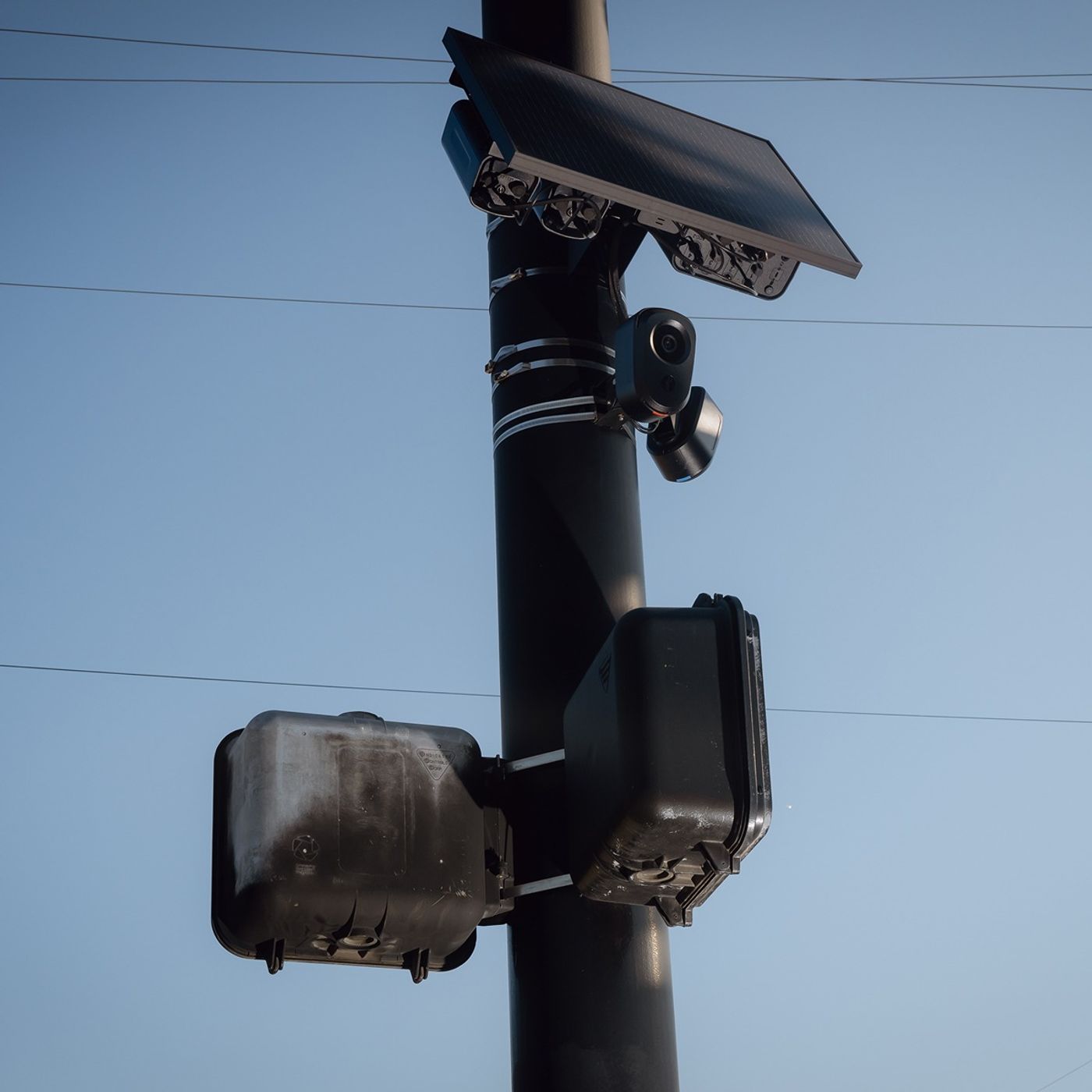
So, Cash, you've covered so many different types of surveillance. At this point, I know a lot of Americans are aware that they are being watched in one form or another, whether it's online or public spaces. So, can you just start off by explaining what is so different about this particular kind of surveillance and why it's prompted people to finally say, like, enough is enough? So, these are cameras that take photos of cars and read their license plates. If you start looking around as you're driving, you might see them on a pole by the road, solar panel, camera looking down your way.
And there are places where people maybe aren't used to being surveilled. They're in rural roads, just in communities that don't necessarily have a lot of other cameras around. Also, people do have this kind of privacy attachment to their cars. And so, I think Americans think of your car as this kind of simple freedom, this thing you can get away from everyone, but now you can't because they're going to be cameras tracking it. And so, my colleague Fernando and I found that people were just getting really upset about these cameras.
And it was a level of uproar over privacy that I haven't seen before or at least haven't seen in a very long time. So, what is the camera capturing exactly just a license plate or is it something more complicated than that? Because on its base, a license plate reader that sort of sounds a bit benign. Yeah, so the cameras take photos of cars as they pass. They get the license plate, but you can also use a system to search other things like the color of the car, the make of the car, whether it has a bumper sticker or visible damage or a toolbox on the back.
And this gives police more visibility into our movements than they've ever had before. This company called Flock is the industry leader. They're kind of the name that everybody knows because they're the biggest. Flock alone has 120,000 of these cameras across the country in every state but Alaska. 7,000 law enforcement agencies have contracts with Flock, which is about 40% of all law enforcement in the country.
Okay, so a lot, very ubiquitous. A lot. They have really achieved market penetration quickly. They only started working with police in 2020. And the company is now valued at over $8 billion.
Wow. Okay, so $8 billion, 40% of police departments. Let's talk about the company for a minute. How did its cameras get everywhere so quickly? So Flock was founded by a serial entrepreneur named Garrett Langley.
Hi, Garrett. Nice to meet you. I'm a cashmere. I actually met with him a few weeks ago. I was an into cashmere if you're in New York, right?
I am. He said he got the idea because he lived at Atlanta, Georgia. That's where the company is headquartered. I started the company nine years ago and I was not thinking about law enforcement. I was saying to you, this is a confusion as an engineer of why it was so easy to get away with crime in America.
And in his neighborhood, people kept breaking into cars on the weekends. And we kept having the same group, seemingly the same group coming in on Friday night. And he said, taking guns out of the glove boxes. Oh my God, it was happening every weekend. He was really frustrated.
And so when I was talking to our own commander, I was like, major, why can't you catch these people? Like, do something about this? And so we called the police department. And he was like, what do you expect me to do? We're not the CSI on TV.
I'm not going to like, I'm one guy. I was like, well, so they're stealing guns. Like, this is crazy. And he said that the person he talked to said that they needed their license plate numbers. I was like, what are you talking about?
What are license plate dunes? I'm like, how would it help? Because like, trust me, a license plate is the most national piece of evidence we can get. I said, fine. And I called a page of man.
I was like, we're going to go license plate making cameras for neighborhoods. So he decided to create this product along with two of his classmates from Georgia Tech. This is literally like, we were just messing around, especially like what they wanted to make cheap license plate readers that basically put a phone together with a solar panel. I looked up to an oil Android with solar power that you could put on three poles and it would just get photos of cars that were driving past. And so we built up on, we put them up in a couple neighborhoods.
And for the first, probably three or three years, we were only selling neighborhoods. Flock first started selling these to homeowners associations, kind of like an automated neighborhood watch. So you could see he was coming and going, if there was a package theft, you could see what car was there and drove away. And like two months into the business, we made our first arrest. And just a few months after they start installing these devices, Langley said that he got a call from the police telling him that it was helping to solve crime.
And I was like, oh my gosh, like it works. It's major was applying to me. They actually just need evidence. And they have evidence. They will prosecute tapes.
Well, OK, so in this moment, this is like basically a proof of concept. Right. How do things go from there? How does the company grow from there? So in 2020, the company starts working for the first time with the police department in Jersey Village, Texas.
And this kind of changes the business model instead of putting it on private streets, you're starting to put it on public roads and the business really exploded from there. And they see a ton of success. And so that police chief is telling his friends that mayor is telling her friends. They start working with police departments around the country. You can get this in your town.
Like we're safer now. And that word of mouth, you know, it's right. Quickly. And with that expansion has come a kind of growing backlash as communities are discovering that these cameras are there and how they're being used. I want to talk about the backlash.
But before we do, I just want to understand what the police departments are actually using these cameras for and how they are being used. So can you just describe a little bit the mechanics of this? So what these cameras allow police firms to do is essentially to track cars. Most of the departments keep the photos of the cars for 30 days. That's the default that flock has in place.
And so if somebody goes missing or if there is some kind of crime that is committed and you know the car associated with the crime, you can go looking for it. You can see where it's been. You can see where it's gone. You can also set up alerts. So if there is a car you're looking for, it'll shoot up an alert to any police that are using this network, whether it's in your community or in a different community.
Basically any crime that's committed using a car, this system might be helpful with it, which is a lot of crimes. A lot of crimes use cars. Yeah, I mean, it's helpful for tracking down stolen cars, finding a missing person. I mean, we've all gotten those amber alerts on our text messages where it says, you know, yeah, like look around for this random Nissan Altima with this license plate. It's a lot more effective just to send that message out through a bunch of cameras that have their eyes on the road to find that car.
OK, so by this point in the story, these cameras are everywhere. The company's grown super fast. I just want to make sure I understand the legality of this. Does flock need anybody's permission to put these cameras up on streets or do there's these things up and then sell the data? This is actually an issue for the company.
And I talked about that with the CEO, you know, in the early days when they were working with neighborhood associations, it was private streets. They could just put them up as they started working with police. They still have this kind of move fast and break things, Silicon Valley approach, where they would just go out and throw these cheap cameras up and not got them in trouble with departments of transportation, where you were supposed to get a permit to be, you know, putting cameras and pulls up on public roads. And so Langley told me, yes, they made some mistakes, but now they have figured out the right way to do this. It's so interesting to think about how fast this company's grown when this is effectively just like a camera on a stick.
Yes, it is just a camera on a stick, but now it's 120,000 cameras on sticks and they're all connected. And that is really what makes flocks so valuable. It's that they're building this network. It's eyes on the road across the whole country. And that's something we really haven't had before at this scale.
And that's why police want to work with this company. OK, so this isn't just about necessarily your local police department being able to track your car. This is about one camera. I don't know what talking to another camera, like just talk about that network for a second so we can understand why that makes this different than just something that might only affect an isolated area. So local police departments, when they sign up for flock, essentially set their privacy settings, they can decide if they want their network of cameras to only be available to their department or if they want to be able to make it available to the whole state or the whole nation.
And it's reciprocal if you want to be able to search all the cameras in your state or all the cameras in the whole country, you have to grant access to your cameras. I asked Lainley about this and he said the vast majority of their customers opt in for the national network. Like that is what's appealing that you have eyes on the road everywhere, not just in your community, but in your whole state, in your whole country. Because as they put it, you know, crime doesn't respect borders. And why gave me an example of why this is useful.
In one case, there was somebody who had made a threat against an event in New Orleans and for some reason, police had a car associated with this threat. And the person was based in North Carolina. But when they picked him up, he was in Florida. And so this involves, you know, three different communities, three different states. And the only way they said, you know, can really solve this crime is with these cameras that are everywhere.
So basically the difference, it sounds like what you're saying is that pre-flock or without flock, some police chief in one district might have to figure out who to call in another district, ask them to run a report and presumably that takes longer than going to a database on your computer and typing in a license plate, in this case, right? Exactly. And this is really fast. I said, you know, it basically comes off their cameras and within seconds, it's in the database. And it really is a pretty simple tool.
You know, there is a search page where you are supposed to enter the case number, the crime that you're looking into. And then you can either put in the license plate number or you can put in a description of the car, you know, the color or the has damage or bumper sticker. And you hit search and it will pop up a grid of photos of the backs of people's cars. It will say where the photo was taken, when and which agencies cameras took it. It's pretty simple, but police say it makes their jobs much easier.
The CEO of Flocks says that the company helps solve more than a million crimes last year. I don't have the reporting to back that up, but police chiefs did tell us that it is really a useful tool for solving crimes. But this makes it really easy to track Americans. And, you know, we're all in the database. If you're driving cars in the 49 states where they have their cameras and it's not just people who have committed crimes.
And that is just making people very, very uncomfortable that this is too powerful a tool that is surveilling too many of us. We'll be right back. Law transforms agreement into reality. A word becomes an agreement. An agreement becomes a contract.
A contract becomes law. Today, Harvey, the AI platform for legal work, is writing the next chapter. More than 200,000 lawyers are building with Harvey, accelerating review, sharpening negotiations and more. This is how the future of agreements is being crafted now. Harvey, learn more at Harvey.ai.
Harvey does not provide legal advice. Users should always independently review and verify any output from Harvey. I'm Gilbert Cruz. This week on the Book Review Podcast, we have a special Halloween treat or treat or treat. Two hard riders recommend some titles that are sure to keep you up at night.
I am a big fan of sentient houses in general. I think this is one of the scariest books I've ever read. Listen to the Book Review, wherever you get your podcasts. That door shouldn't be open. Who left it open?
OK, so, Kesha, I understand from what you're saying, the people are upset about these cameras and have a lot of privacy concerns. But I wonder how much of these concerns are theoretical at this point? Or are critics saying that there's already evidence that these cameras have been misused? Yeah, one of the cases that has gotten the most attention and was originally reported by 404 media was a woman who was suspected of self-administering and abortion in Texas and an officer searched floc cameras to see where she had traveled, if she was out of state, to try to track her down. There have been examples of police officers abusing their access to these systems to track exes or love interests or romantic partners.
Oh my God. And one of the big concerns has been how immigration officers are using these cameras for immigration enforcement. You mean, like, I used to like try to track on people. They're trying to deport. Yes, I used to try to track on people that they want to deport.
And it's not just the libertarians that are criticizing this. Cities themselves have been surprised that their cameras have been accessed for immigration enforcement. So some cities have paused or canceled their contracts with floc after discovering that because they basically didn't realize that when they were making it available nationally, that meant they're making available to federal law enforcement like ICE. That feels a little bit surprising though, Kashmir, because you said earlier that they signed something saying like their databases are searchable. So were you surprised that they were surprised?
I don't know. That just feels a little bit strange. Yeah. I mean, floc says that they don't have a contract with ICE for one. And the way that this is happening is actually ICE agents are partnering with local police departments and then searching the networks of cameras that they have access to.
So it's not necessarily the police department that they're partnering with that is upset over this. It's the police department in another city that is learning that ICE is using them. Yes. This is kind of a concept called networked privacy where it's hard to protect your own privacy. Since they're sharing it with others, they have to trust that other agencies are using the cameras appropriately.
And this actually comes up on the sign in page. There's kind of this pop up. There's a click through screen where you have to say, I acknowledge that in these states, I can't do searches related to reproductive care. And in these other states, I can't do searches related to immigration. So it sounds like a little bit of an honor system.
I mean, I'm curious what else the company has told you about the safeguards it has in place to prevent misuse because I don't know, I just can't imagine how effective that actually is if you're a bad actor, you know, operating bad faith. Fox says that they only allow abortion related searches in states where abortion is illegal. They also say that they have an audit system in place that alerts departments if officers are doing unusual searching. That doesn't look like it's related to an official investigation. So they do say they have some safeguards in place.
But at the end of the day, it's up to the police departments to use this tool appropriately. So Locke doesn't consider itself the one that should make the rules for how these cameras should work. It says, you know, it's just technology company offering a service and it's up to the United States to decide how these cameras should be used. Why should we put restraints on our own growth when there's no law preventing us from growing as fast as we can? Right.
They're just a company offering a service and it's not up to them to make the rules. That's up to lawmakers. That's up to regulators. Okay. I'm really starting to get a sense catchment from the picture that you're painting of why people are maybe upset.
I mean, this company really does not seem to be doing a ton to block bad actors from abusing its platforms. I mean, I'm sure that it would say that it is and it has pop ups. But as you described, this is an honor system with no government intervention or regulation. It seems like the government has not caught up to this technology. And that sounds like something that would be concerning for people.
Yes, there is this growing backlash from citizens. One of the first ways this manifested was in the form of a website called DFLOC. DFLOC like DE Floc. It's a crowdsource map of where these cameras, these license plate readers are that anyone can contribute to. And the idea is that you should know how many are in your community and where they are.
And now they've mapped over a hundred thousand cameras made by Floc and other companies. And you started seeing some people cutting down cameras. The vandal cut down a flop bolt, spray painted the lens black and cut the wiring. Like spray painting them, vandalizing them. Several cameras were ripped from their mounts and smashed, allegedly using a shotgun to take out floc cameras.
Both cameras were later found in a nearby canal. There have been videos of people demonstrating how to like get rid of the cameras, how to destroy them. With their saw wrapped in a trash bag, they approached from behind the camera's line of sight and sat right through this black aluminum alloy post. People have showed up at city council hearings in free America, where I'd go during the day is my business. Saying I am not happy about this.
Everything out of our city. Get out of our plastic. We're doing such everywhere we go. Y'all are just saying anyway. There was another super viral video of this one guy in San Diego who went to the city council hearing dressed up as Darth Vader.
The emperor is a fan of Floc. Saying how much he loved Floc cameras. Oh my God. And we must continue utilizing Floc technologies so that we can follow and surveil the rebel scum. Some citizens have sued their cities or their towns saying that these cameras are unconstitutional.
Oh wow. They're unconstitutional because because they are capturing everyone's movements. Even if you've done nothing wrong, for most places, it's capturing the last 30 days of people driving around on the roads and that this is something that the fourth amendment is supposed to protect us against. The fourth amendment that is the amendment that prohibits unlawful searches and seizures. Just explain one beat farther cash.
Why that is relevant to these cameras, this network, this idea of capturing people who haven't done anything wrong. Yeah. I mean, the idea behind the fourth amendment, if we go back to the founding fathers, is that they didn't like that, you know, royal officers would just go through everybody's houses, rifle through their drawers, looking for evidence that they were involved in treason or rebellion. The fourth amendment was created so that police have to have a reason to think that someone has done something wrong before they collect information about them. But that's not what these cameras are.
They're everywhere. They're collecting data on hundreds of millions of people. They get billions of license plate reads. And so some of these lawsuits have said, you can't do this. And so far, those lawsuits have not been successful.
But in some of the rulings, the judges have said, well, if these cameras were more ubiquitous, then yes, there would be fourth amendment concerns. Basically, they're not widespread enough yet. Wait, that's so interesting, though. Like who gets to decide what the threshold is for ubiquity for these cameras? Like who gets to decide, okay, this is the level of penetration that would be violated with the fourth amendment?
Yeah. I mean, judges decide maybe one day the Supreme Court will decide when I talk to attorneys in the civil liberties space, they say we're already there. Judges just don't understand how many of these cameras there are and how network they are. I'm just so curious what evidence the judges are looking at to say. No, this is not actually broad enough.
As you said, 40% of police departments are using this billions of hits a day. What is the standard that they're using? So in Norfolk, Virginia, where one of these lawsuits was filed, the city now has 172 flock cameras installed around the city. And the judge said, that's not enough. But the judge didn't say what is the number where it's too much.
Is it, you know, every block is at every street? What level of coverage hits that threshold? That hasn't been spelled out yet. It sounds a little arbitrary at this point. Welcome to the law, Rachel.
Especially around privacy. I mean, privacy is so hard to define, you know, what is an unreasonable search. That is something that's always getting worked out. But what the court has found in the past is that, you know, police can't just put a tracker on someone's car, for example, even though they're on public roads and a police officer could follow them, that this idea of using automated means to track somebody continually, violates Fourth Amendment. And what lawyers I talk to you argue is, well, we're doing the same thing now.
But instead of putting trackers on people's cars, we're just putting these cameras everywhere on the roads. We have talked a lot in this conversation about people who are worried about privacy. But there are also a lot of people in this country who are really worried about crime. Like, I don't even know to the extent that these two groups of people are distinct, which one of them is bigger. So I wonder how we're supposed to think about flock when we hold up these two kind of competing concerns against one another, right?
People who are really worried, maybe more so about getting their license plate readers read versus people who are like, I don't want crime in my communities. I'm more worried about crime than I am of somebody taking a picture of my car. Midnight is the legal question here. And kind of the societal question, what degree of liberty do we want to give up for security? We'll never have perfect liberty.
We'll never have perfect security. What struck me about the reaction to cameras is just how bipartisan it is. People on the left and the right have objections to these cameras. It's kind of across the board. And so that's been really striking.
One of the experts I talked to said there is a version of this where we could just have the cameras give alerts and not be tracking us for seven days or 30 days or five years in the case of some states that say you have to retain, you know, the photos of these cars for that long. I mean, this is a question of every surveillance technology, right? If you had perfect surveillance, we could live in a country of very little crime, but it would certainly violate some of our constitutional principles. I feel like most of my adult life, which has existed mostly in the post Edwards node and era, people have been talking about privacy and surveillance. And for all of those concerns, though, technology just marches on, like it feels like, even though we might be worried about this kind of stuff, we've given up a lot of privacy in exchange for convenience.
Like that does feel like the world we are living in. But I do feel like this issue with flock, it feels like it is hitting a different kind of nerve. And part of me wonders why that is like, is it because of the physicality of being able to see a camera, knowing that it is tracking my car, my person, I guess, like the fact that you can go and break one. How much of that crash do you think is part of why we're seeing so much anger about this system? I think the physicality does play a role here.
You know, so many of our privacy concerns are around invisible tracking and data collection that happens online. And it's time you can actually see it and how and where it's happening. But I think there are bigger issues at play here. Part of it is that private companies have stepped in to do surveillance that previously the government would have been forbidden from doing. And I saw this before covering Clearview AI, this company that scraped everybody's photos to build a facial recognition app that police could use to identify people.
Sure. It's the same thing with flock. You know, they've created this huge database and then they sell it to law enforcement. So they can just use it without getting a warrant. And it's also just this growing amount of technology.
There's so many new ways to track us, to observe us, to create these running databases that are so huge. And I think this one kind of very slowly crept up on us. It was like people weren't paying enough attention to flock. And then all of a sudden we realized there's 120,000 cameras across the country. And as one source put it to me, we're just sleepwalking into this surveillance state where it's just too easy to know everything about us.
Kashmir Hill, thank you so much. You're welcome. We'll be right back. This week on The WirebetterShow, we're talking about face sunscreen. What do you think so far about the ones that you have shacked at this new ingredient?
I think it's sunscreen. And I'm excited it exists. Find out how the new FDA-approved ingredient is changing for new agents and whether our expert thinks it's worth it. The WirebetterShow is on a near-time dap or wherever you'd like to listen. Here's what else we need to know today.
The US struck Iran on Sunday for the first time in a month. According to US Central Command, American forces attacked two Iranian rocket launchers on an island in the Strait of Hormuz. It appeared to be a limited attack rather than a large-scale bombing, but Iran has stated it will retaliate, raising the risk of continued military strikes. Today's episode was produced by Jackie Zadoro, Shannon Lynn and Eric Grumpy, with help from Adrian Hurst and Alex Stern. It was edited by Chris Haxel, with help from Michael Benoit and Brendan Klykenberg, and contains music by Pat McCusker and Dan Powell.
Our theme music is by Wonderly. This episode was engineered by Lissa Moxley. That's it for the Daily. I'm Rachel Abrams. See you tomorrow.