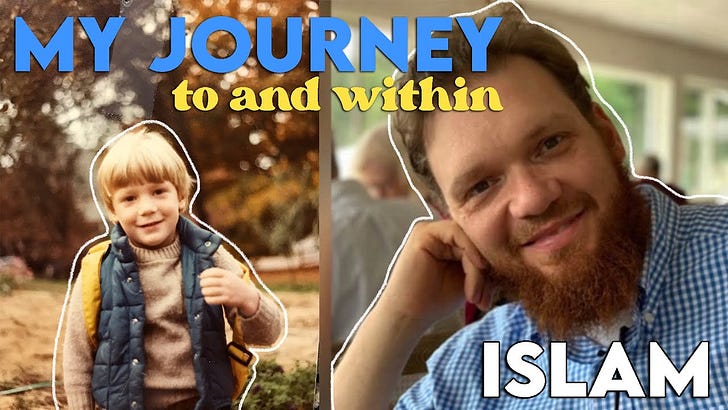
How I Found My Qibla
from Five Before Five Podcast Hosted by Hamzah Henshaw
I want to tell a story I’ve never spoken about publicly before. I have shared different portions of the story of my conversion to Islam in various places. You can see a fairly comprehensive presentation I did about it last Ramadan here: But none of these give the full picture. I became Muslim at 15, alhamdulillah. But I don’t think I became a mu’min (inshAllah) until 5 years later when I was a junior in college. The Journey Begins Let me back up. When I first embraced Islam, there were a grand total of three Muslims in my network—Nabil, the brother who introduced me to the deen, and two other classmates who became Muslim about 6 months before me. We did our best. Some tableeghi brothers used to visit our boarding school once a month and brought us to the masjid in Worcester for taraweeh a few times. During those first couple of years our resolve stayed strong. We propped each other up when our iman began to falter. Facing Doubts and Double Lives By senior year, however, cracks began to appear in everybody’s armor. Although we kept our doubts to ourselves, I believe each of us began to feel increasingly shackled by Islam’s many rules and restrictions. No alcohol. No girls. No inappropriate music. We saw our friends exploring these budding pleasures, and we felt we were missing out on our youth. While my core belief that there was only one God and that Muhammad (SAWS) was his messenger never wavered, my daily prayers become monotonous, burdensome, and eventually ceased altogether. After getting in to Harvard and graduating from high school, I took a gap year and traveled for nine months around the world. I touched down in Hawaii, Thailand, Nepal, India, and Greece; I took trains through nearly all of Western Europe and much of its East; I studied art history in Venice and farming in France. During all this time my horizons were widened to all the possibilities that my narrow Islamic worldview had prevented me from seeing, or so it seemed. By the time I was a freshman at Harvard, Islam had become for me a footnote, something I mentioned in passing. At Harvard, however, I encountered a real Muslim community. For the first time in my life, I could regularly attend Friday prayer. And I began to do just that. I befriended many Muslims, and Islam slowly began to creep back into my life. Before long I had developed two distinct personalities. Around Muslims I was the humble, pious Mahboob; but with my roommates and non-Muslims I was the fun-loving Marshall, whose life resembled that of a typical college student. I was what I now refer to as a “jumma Muslim.” Eventually, this hypocrisy began to eat at me from within. I found myself on the lookout for Muslims when walking towards my final club and ashamed to wear Islamic clothing or make wudhu in front of my roommates. A Turning Point I remember the exact moment when things changed. I attended a Friday khutbah with Sh. Taha Abdul-Baseer, and the topic was nifaq (hypocrisy). He explained that the munafiq—one who professes Islam on his tongue but belies it in his actions—was worse than a disbeliever. Afterwards, I ate lunch at a Chick-fil-a at the Harvard Science Center with a fellow convert. The khutbah had softened my heart, and I was feeling disgusted by the hypocrisy of my lifestyle. My friend was one of the few Muslims who knew about both of my lives. He told me that I was suffering from something called cognitive dissonance, an incongruence between stated beliefs and actual practices. It arises when you simultaneously hold two conflicting beliefs or when your beliefs and actions don’t match up. I knew I had to make a change. But try as I might to shake myself free, I had become too attached to my western freedoms. I realized that I needed a shift in environment to get away from haram influences, and thus I applied to spend my junior spring abroad at the American University in Cairo. The Search for Authenticity In my letter to Harvard requesting to study abroad, I explicitly stated that I wanted to spend time in a Muslim country to ensure that my decision to accept Islam was correct. With this niyya in place, in January 2000, I made hijra to Cairo. During the first few days, I was shocked by the permissiveness of AUC. Buried in the middle of Cairo, I found a little America, whose population was even more westernized than the west. Before long, however, I learned to spend all my free time on the rooftop musalla. I soon built a network of incredible Muslim friends who helped reinvigorate my faith. I made a vow to never intentionally miss a daily prayer, and alhamdulillah, I never have in the nearly 25 years since. While I became Muslim at 15, I found my Qibla at 20. The Challenges of being a Teenage Muslim I have now taught at an Islamic school for more than a decade, and I see my same story play out with so many teenagers. For many students, it’s as if they have an Islam “switch” that they flip on as soon as they enter the school or masjid and then shut off as soon as they exit. I think one of the reasons I’m able to connect with teenagers so well is that I was just like them. They are able to open up to me in a way that many never really can with their parents because they see that I am not going to judge them. What I discover during these heart-to-hearts is that many feel disconnected from the deen. Many are going through the motions, largely to keep their parents off their backs, but only a few have forged an authentic connection with Allah. During Ramadan, some have tasted the sweetness of faith, but then they slip out of harmony with their fitra after the shayateen are released from their shackles. Another issue that nearly all face is a general feeling of rudderlessness. They know they are supposed to be “following their passion,” but they swear they have no idea what it is or where to find it. Their extracurricular choices are guided by questions like “will this look good for college,” and their concern for their GPA far outstrips any authentic curiosity about what they are learning. The boys are often addicted to gaming, while the girls are frequently drowning in toxic social media. I don’t want to paint an overly bleak picture of the Muslim teenager. I am constantly amazed by their generosity, social activism, and ingenuity. I have had countless spectacular students whom I have helped place in many of the country’s best schools. When Muslim students discover something they care about, they go after it with a ferocious tenacity. When they fall in love with the Quran and the deen, they transform their lives. Just like I did in that rooftop musalla in Cairo. Introducing Find Your Qibla Yesterday I launched a premium 1:1 coaching program set to go live at the beginning of Ramadan. It is called “Find Your Qibla.” This is how I described it in an email sent yesterday: “If you’re a student who has high college aspirations but is struggling to figure out what your ‘passion’ is. Or a parent who wants to make sure your child has the best possible chance of succeeding in this world and the next. Then “Find Your Qibla” is for you. FYQ is an in-depth program to help define what success means to you and then make a plan to go and get it. By the end of the program, you will have a comprehensive high school plan to get into the college of your dreams, inshAllah. But more importantly, you will have built a roadmap to janna.” The response has been overwhelming, alhamdulillah. I have gotten close to 25 emails and WhatsApp messages expressing interest. I have already sold some of the 12 available spots with many others saying they are likely to join. I feel that all of my life has been leading up to teaching this course, and I anticipate that it will become the flagship offering of Five Before College, sort of the “front door” to working with me throughout high school. For today’s FBF, I wanted to briefly mention the five goals of the course, which are all aligned with the famous five before five hadith that underpins this newsletter and my company. 1) Getting good g… This is a public episode. If you would like to discuss this with other subscribers or get access to bonus episodes, visit hamzahhenshaw.substack.com
Embed this episode
No transcript yet.