
EPISODE · Jun 6, 2026 · 43 MIN
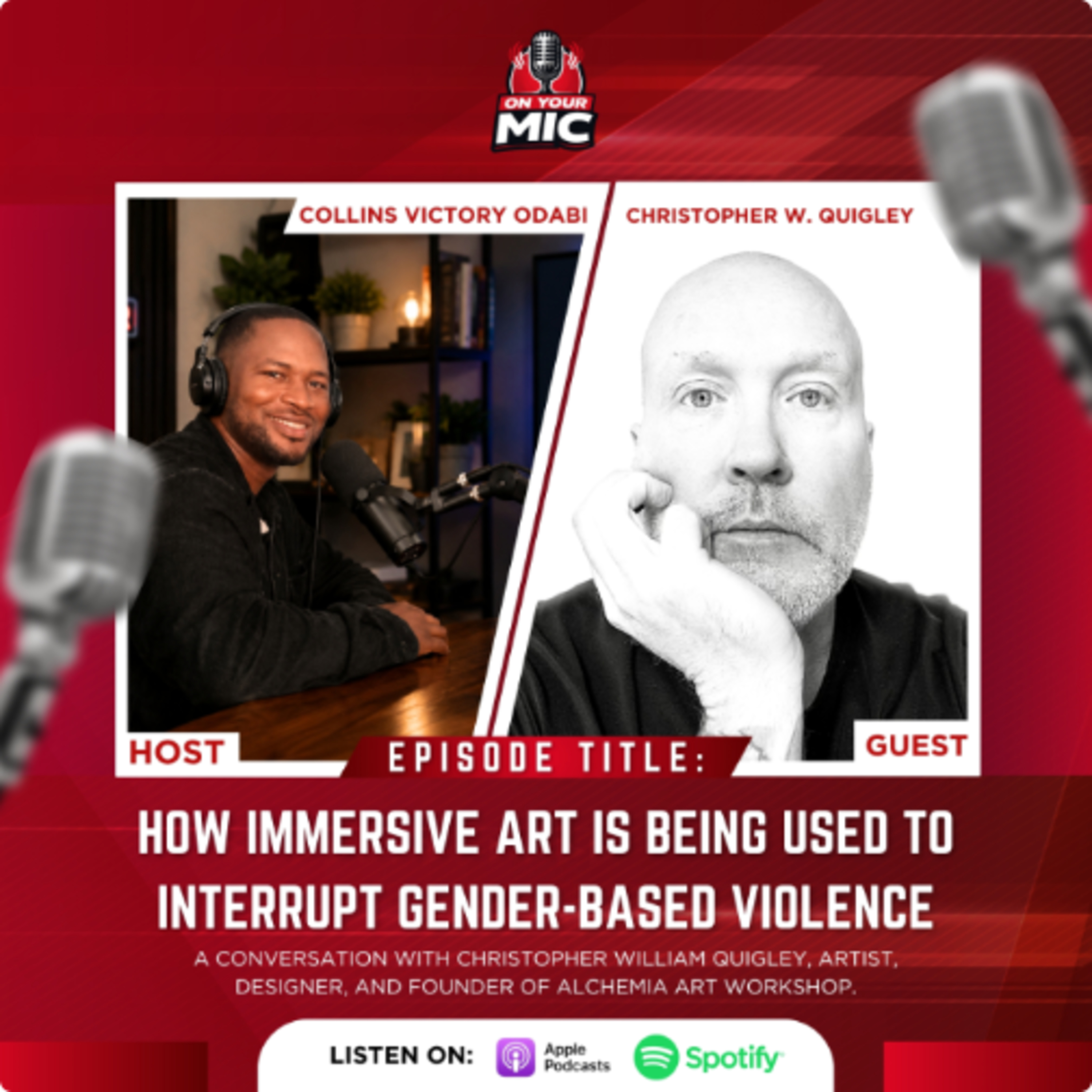
How Immersive Art Is Being Used to Interrupt Gender-Based Violence — Christopher William Quigley
from On Your Mic · host Collins Victory Odabi
Most interventions around gender-based violence focus on behaviour, awareness campaigns, education, and policy. But very few ask the more fundamental question: what is the environment doing? It's not the conversation around the issue, but the actual physical spaces people move through every day and what those spaces quietly permit.In this episode, Collins Victory Odabi sits down with Christopher William Quigley to understand how he built a national arts institution from scratch, why community participation is central to how the work functions, and what it actually takes to keep going when the subject matter is this heavy.What You'll LearnThe institution wasn't planned, it was required. Alchemia Art Workshop exists because the scale of "Transformation of Dangerous Spaces" demanded it. The work needed governance, credibility, a board, and a structure capable of travelling across 90 communities and presenting to the Canadian Senate. The organisation followed the work, not the other way around.The audience is never passive. In The Listening Room — Christopher's spoken word events — there are no phones, no recordings, no photographs. Fifty people, ten storytellers, a shared experience that exists only inside the room. Participants are told explicitly: you are an active witness in this artwork. That framing changes how people show up.The bathroom stall was not a metaphor, it was a lived space. Christopher recounts how he was physically and sexually assaulted in school bathrooms and locker rooms growing up. Those spaces are where boys learn to perform dominance, where language and attitudes toward women are transferred between men away from adult oversight. The installation centres those specific spaces because that is precisely where the socialisation that enables violence happens.The work is not designed to resolve discomfort, it's designed to live inside it. Christopher describes a 3 to 5 second liminal space between emotional response and logical reasoning. That is where prevention lives, and that is exactly where the installation is aimed. Each of the eight stalls targets a different theme, including one on consent that physically forces participants to experience what it means to say no repeatedly before a single yes grants them exit.Authorship is the most transferable lesson. Christopher spent two decades building other artists' work without owning any of it. Building Alchemia gave him authorship — and his closing message to listeners is that the fear of rejection is real, but it belongs to you. So does the work.About Christopher William QuigleyArtist, designer, and founder of Alchemia Art Workshop, a federally registered Canadian non-profit. His inaugural project, Transformation of Dangerous Spaces, is a national immersive installation touring across Canada addressing men's socialisation and gender-based violence. A four-act stage play, a forthcoming podcast (The Crucible), a book, and additional community artworks are in development. A PhD researcher is currently tracking the project's impact.🌐 alchemiaartworkshop.org🌐 ssvu.ca (The Listening Room)Timestamps[0:04] Introduction and episode framing[3:21] Why Alchemia needed to be a formal institution[8:29] Building infrastructure, not just a single project[14:49] How communities are brought into the work[19:47] Trust, ownership, and the relational work behind the art[21:34] Why the bathroom stall — the specific spaces where violence begins[26:12] How the installation is designed to produce lasting change[29:34] Inside the eight stalls — consent, radicalisation, and lived experience[34:10] How to get involved or bring the work to your community[37:29] Final thoughts on authorship and creating your own workConnect with CollinsX: @0xOVCollins | LinkedIn: Collins OdabiGuest enquiries: [email protected] next time, stay sharp, and keep showing up.
Embed this episode
NOW PLAYING
How Immersive Art Is Being Used to Interrupt Gender-Based Violence — Christopher William Quigley
No transcript for this episode yet
Similar Episodes
No similar episodes found.
Similar Podcasts
No similar podcasts found.